info@biomedres.us
+1 (502) 904-2126
One Westbrook Corporate Center, Suite 300, Westchester, IL 60154, USA
Site Map
 ISSN: 2574 -1241
ISSN: 2574 -1241
ISSN: 2574 -1241
Received: December 12, 2025; Published: December 22, 2025
*Corresponding author: Vikram Chauhan, MD in Ayurveda (Dravyaguna), B.A.M.S, N.D.D.Y, India
DOI: 10.26717/BJSTR.2025.64.010018
Immune Thrombocytopenic Purpura (ITP) is a condition where the platelet count drops, causing easy bleeding and bruising; in Ayurveda it is correlated to Raktapitta and seen as an imbalance of the Tridosha, especially Pitta Dosha and the blood tissue (Rakta Dhatu). Ayurvedic treatment aims to balance Pitta, purification of blood, and support the bone marrow to help produce healthy platelets again, using pitta pacifying, blood purifying-nourishing and immunomodulatory herbs such as Ashwagandha (Withania somnifera), Yashthimadhu (Glycyrrhiza glabra), Giloy (Tinospora cordifolia), Eranda-karkati (Carica papaya) which may reduce inflammation, modulate immunity, and strengthen the bone marrow to develop healthy platelets.
Keywords: Ayurveda; ITP; Raktapitta; Platelet Count; Bone Marrow Support
Abbreviations: BT: Bleeding Time; CBC: Complete Blood Count; CT: Clotting Time; ELISA: Enzyme-Linked Immunosorbent Assay; Hb: Hemoglobin; PLT: Platelet Count; RBC: Red Blood Cells; WBC: White Blood Cells; ITP: Immune Thrombocytopenic Purpura
Immune Thrombocytopenic Purpura (ITP) is a condition where the body’s immune system mistakenly destroys its own platelets. Because of the low platelet count (PLT), patients may develop bruises, bleeding gums, tiny red spots on the skin, and prolonged Bleeding Time (BT). Modern treatments often work but may cause side effects when used for long periods. Ayurveda explains it through the concept of Raktapitta, which happens when Pitta (Thermal Energy) increases in the body and affects the quality of Rakta Dhatu (Blood Tissue). According to Modern Science there is often no identifiable cause of this condition but Ayurveda says Poor diet and lifestyle leading to buildup of toxins (Ama) are causing this condition. Common symptoms include easy bruising, petechiae (tiny red or purple skin spots), nosebleeds, bleeding gums, prolonged bleeding from cuts, and in severe cases, blood in the urine or stool and heavy menstrual bleeding. Some patients may remain asymptomatic and are diagnosed incidentally during routine blood tests [1]. Laboratory investigations are essential for confirmation and monitoring. Complete Blood Count (CBC) typically shows a low Platelet Count (PLT), while Red Blood Cells (RBC), White Blood Cells (WBC), and Hemoglobin (Hb) are usually normal. Bleeding Time (BT) may be prolonged, indicating platelet dysfunction, whereas Clotting Time (CT) generally remains normal, suggesting intact coagulation factors.
Enzyme-Linked Immunosorbent Assay (ELISA) and other tests are performed to rule out secondary causes of thrombocytopenia. Normal platelet count ranges between 150,000–450,000/μL. When platelets fall below 100,000/μL, the risk of bruising and mild bleeding increases. Counts below 30,000/μL significantly raise the risk of spontaneous bleeding. At below 10,000/μL, the condition becomes critical, with a high risk of internal bleeding. In adults, the yearly incidence of ITP is typically estimated to be around 2 to 4 new cases per 100,000 individuals [2]. The prevalence of ITP in adults—reflecting how many individuals have the condition at a given time—is estimated to be around 9.5 per 100,000 people, although some studies report a broader range, up to 23.6 per 100,000, depending on the population studied and the definitions used [3]. According to Modern Medicine ITP is usually treated first with medicines like steroids (Prednisone, Dexamethasone) or injections such as IVIG and Anti-D to raise platelet counts. If these don’t work, other options include drugs that boost platelets (Eltrombopag, Romiplostim), immune-suppressing medicines (Rituximab, Azathioprine), or sometimes surgery (splenectomy) [4]. Whereas in Ayurveda there is a very good management which we have reported a number of times. Here, we present a case study of a 33-year-old female patient to illustrate the Ayurvedic management of ITP (Table 1).
Table 1: Diet Chart for Immune Thrombocytopenic Purpura (ITP).
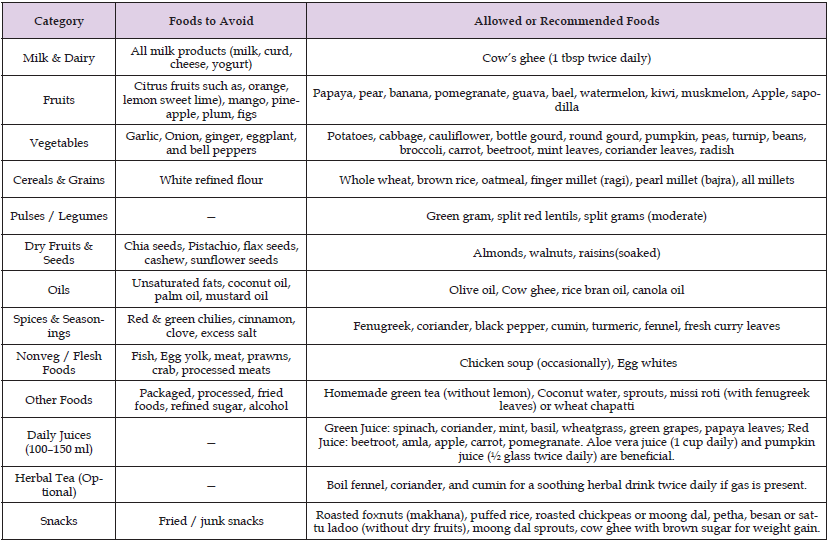
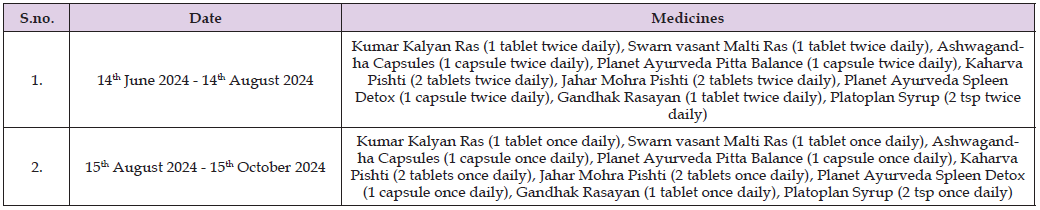
Table 2: Treatment Plan Given to the patient Sneha Soni.
Case Study of an ITP Patient
Patient Profile: Name: Sneha Soni, Age: 33 years, Location: Bastar district, Chhattisgarh, India. Sneha Soni, a 33-year-old female from Bastar, Chhattisgarh, was diagnosed with chronic Immune Thrombocytopenia (ITP) in 2024 on 16th April. Her initial symptoms included unexplained red patches and spots on the body. Due to limited local medical facilities, situated approximately 12 hours away by road, the patient initially took treatment locally. She took multiple allopathic treatments, including steroids, IVIG, Romiplostim, and Rituximab, costing over Rs. 18 lakhs in one month. Despite treatment, her platelet counts fluctuated, reaching a high of 10 lakh temporarily after injections, but then dropping sharply to around 2,000–2,50,000, and she suffered side effects like swelling, constipation, gas, and fatigue. During this difficult time, they watched a YouTube video of Planet Ayurveda, the family first connected with Planet Ayurveda distributor, who guided them to consult Dr. Vikram Chauhan. On 14 June 2024, Sneha consulted with Dr. Vikram Chauhan, and we started an individualized Ayurvedic treatment, including oral herbal formulations, along with clear diet and lifestyle advice.
The dietary guidance included complete avoidance of milk and milk products, daily green and red juices, fresh coconut water each morning, and simple home routines to reduce stress, etc. After 2 months of following the Planet Ayurveda treatment plan, Sneha’s platelet count stabilized at 2.5 lakh, and she experienced no side effects. Her energy returned, she resumed household activities. She even managed a short family trip, showing her improved strength and confidence. Sneha followed the Planet Ayurveda protocol for a total duration of 4 months. She is now pregnant without any complications and continues to maintain excellent health with stable platelet counts to date (Tables 1 & 2).
Kumar Kalyan Ras
Planet Ayurveda Kumar Kalyan Ras is a classical Ayurvedic formulation prepared by Planet Ayurveda according to methods mentioned in classical Ayurvedic texts. This formulation is herbo-mineral including ingredients such as Swarna Bhasma (Calx of Gold), Mukta Bhasma (Calx of Pearl), Kumari (Aloe barbadensis), etc. This formulation acts as Rejuvenator correcting formation of Platelets and preventing its deterioration by modulating immunity.
Swarn Vasant Malti Ras
Planet Ayurveda Swarn vasant Malti Ras is a classical Ayurvedic formulation prepared by Planet Ayurveda under strict supervision of M.D. Ayurveda Experts. It is a combination of ingredients such as Swarna Bhasma (gold calx), Mukta Bhasma (pearl calx), Shuddha Hingula (processed mercury-sulphur ore), Kali Maricha (Piper nigrum), etc. This formulation helps modulate immunity, support bone marrow function to enhance platelet production, and promote overall vitality, providing a holistic therapeutic effect rather than targeting a single system.
Ashwagandha Capsules
Planet Ayurveda Ashwagandha is a single herbal formulation prepared by Planet Ayurveda with the standardized extract of herb Ashwagandha (Withania somnifera). This herb is well known for its adaptogenic, rejuvenative and immunomodulatory properties [5]. Its key bioactive compounds, withaferin A and withanolides, play a central role in these effects. It modulates immunity, supports bone marrow, reduces inflammation, and exerts a natural steroid-like effect, helping restore platelet balance in ITP.
Pitta Balance
Planet Ayurveda Pitta Balance is a herbo-mineral formulation manufactured by Planet Ayurveda in capsule form. This formulation contains Giloy Satva (Tinospora cordifolia), Akik Pishti (calcium compound), Mukta Pishti (calcium compound), Jahar Mohra Pishti (calcium compound), etc which primarily pacify Pitta dosha and provide a cooling effect. It helps control bleeding, promote clotting, reduce inflammation, enhance healthy platelet production, making it effective in managing ITP.
Kaharva Pishti
Planet Ayurveda Kaharva Pishti is a classical Ayurvedic calcium-based preparation renowned for its hemostatic properties. Traditionally used to arrest bleeding, it gently pacifies Pitta, cools inflamed tissues, and promotes coagulation [6]. It is indicated where cooling, strengthening of blood vessels, and natural clot-promoting action are required, thus helpful in the management of ITP.
Jahar Mohra Pishti
Jahar Mohra Pishti, a purified calcium preparation, pacifies Pitta and cools inflamed tissues, controls bleeding, promotes clot formation, reduces inflammation, supports vascular integrity and hemostasis, safely enhances platelet production, and acts as an adjunctive Ayurvedic therapy in managing ITP.
Spleen Detox
Spleen Detox is a polyherbal capsule formulation prepared by Planet Ayurveda for improving Spleen health and its related conditions. This formulation combines Sharpunkha (Tephrosia purpurea), Rohitaka (Tecomella undulata), Jhavuka (Tamarix gallica) and Dudhal (Taraxacum officinale). These herbs cleanse and decongest the spleen, reduce inflammation, improve hepatosplenic filtration, and promote healthier platelet turnover. If taken consistently, it helps restore balanced immune processing and supports platelet preservation.
Gandhak Rasayan
Gandhak Rasayan supports ITP care by purifying the blood, cooling aggravated Pitta, and reducing inflammatory responses that contribute to platelet destruction. Its rejuvenating action strengthens immunity, soothes mucosal tissues, helps control bleeding tendencies, and promotes healthier platelet survival. This formulation acts as an adjunct to balance immune activity and maintain stable platelet counts naturally.
Plato Plan Syrup
Plato Plan Syrup is a herbal syrup formulation manufactured by Planet Ayurveda for supporting healthy Platelet count. Plato Plan Syrup syrup contains Erand Karkati (Carica papaya), Giloy (Tinospora cordifolia), Wheatgrass (Triticum aestivum), and Ashwagandha (Withania somnifera), etc. These herbs work together to support platelet production, enhance bone marrow function, and modulate immunity to prevent platelet destruction. They also detoxify the blood, reduce inflammation and oxidative stress, and strengthen the body, promoting overall vitality and aiding recovery in ITP.
After initiating the individualized Ayurvedic treatment plan from Planet Ayurveda, Sneha Soni showed a gradual and sustained improvement in platelet counts. After 2 months of Ayurvedic therapy, her platelet count stabilized at approximately 2.5 lakh/μL, compared to fluctuating counts of 2,000–2,50,000/μL prior to treatment. Clinically, the patient reported reduced bruising, disappearance of red patches, improved energy levels, and overall well-being. No adverse effects were observed throughout the 4-month treatment period. The patient was able to resume daily household activities and undertake a short family trip, reflecting significant improvement in functional status. Following completion of the 4-month Ayurvedic protocol, she successfully conceived without complications and maintained stable platelet counts during early pregnancy.
This case highlights the promising role of classical Ayurvedic therapy in managing chronic ITP. The patient was treated with a combination of herbo-mineral formulations, including Kumar Kalyan Ras, Swarn vasant Malti Ras, Kaharva Pishti, and Jahar Mohra Pishti, along with herbal supplements such as Ashwagandha Capsules, Pitta Balance, Spleen Detox, Gandhak Rasayan, and Platoplan Syrup. These interventions seem to have worked together to balance Pitta, purify the blood, support the bone marrow, and modulate immunity. Along with these remedies, personalized dietary and lifestyle guidance helped reduce inflammatory triggers, pacify pitta dosha and improve digestion and metabolism, which likely contributed to the overall improvement. The patient showed stabilization of platelet counts, relief from clinical symptoms, and enhanced quality of life, all without experiencing the side effects commonly seen with long-term conventional treatments. This outcome aligns with existing evidence that herbs like Ashwagandha (Withania somnifera) and Giloy (Tinospora cordifolia) possess immunomodulatory and anti-inflammatory properties, potentially aiding platelet preservation and production [5,6].
In this case, Ayurvedic treatment by Planet Ayurveda including classical herbo-mineral formulations, herbal supplements, and lifestyle- dietary modifications proved effective in managing ITP. The patient achieved stable platelet counts, improved symptoms, and better overall well-being, all without adverse effects. This experience supports the potential of Ayurveda as a safe, effective, and complementary or alternative approach in ITP management.
We at Planet Ayurveda sincerely extend our gratitude to the patient and their family for trusting us and actively participating in the Ayurvedic treatment journey. We also acknowledge the efforts of our team, including Mr. Suraj, our Chhattisgarh distributor, for his support in facilitating the consultation and treatment process. Their cooperation and dedication were invaluable in achieving positive outcomes and documenting this case successfully.
The team at Planet Ayurveda declares that there are no conflicts of interest related to this case report.

International Association of Landscape Archaeology, Czech Glass Society, Czech Republic

Department of Chemistry, Semenov Institute of Chemical Physics, USSR Academy of Sciences, Moscow, Russia

Neurology, LA BioMed Research Institute, USA

Associate Professor at Department of Breast and Thyorid Surgey, Chongqing General Hospital, China

Professor of Nuclear Medicine, Faculty of Medicine and Surgery, University of Milan, Milan, Italy





 Abstract
 PDF
PDF



























