info@biomedres.us
+1 (502) 904-2126
One Westbrook Corporate Center, Suite 300, Westchester, IL 60154, USA
Site Map
 ISSN: 2574 -1241
ISSN: 2574 -1241
ISSN: 2574 -1241
Received: November 27, 2025; Published: December 08, 2025
*Corresponding author: Palcová Lenka, Department of Science, Research and Education, Central Military Hospital of the SNP Ružomberok – Faculty Hospital, Slovakia
DOI: 10.26717/BJSTR.2025.64.010000
Acute streptococcal infection, referred to as rosea, from the Latin name Erysipel/Erysipelas, is still a current problem. In recent times, we have recorded an increase in the incidence of this disease. It affects all age groups, regardless of the patient’s age. In many clinical conditions, the diagnosis is often underestimated, especially in the early stages, leading to complications and possibly secondary infections. The case report, which we interpret in our publication, points to complications associated with this diagnosis, but with a happy ending - despite long-term therapy. In laboratory diagnostics, we used an innovative method of laboratory evidence of the infectious agent using sonication of bioceramic covering.
Erysipelas can affect people of all ages, races, and genders. Some studies have shown that the disease is more common in women. It is most common in older people (Klotz C, et al. [1]). The skin and soft tissues are the most common sites of infection, with 32% of patients having cellulitis and 8% having necrotizing fasciitis. Cellulitis and erysipelas are caused by Streptococcus pyogenes in more than 10% of cases, compared to other microorganisms. Data from Europe indicate an incidence rate of approximately 3 cases per 100,000 persons per year, with no specific age or demographic group for infection (Newberger R, et al. [2]). Erysipelas is more common in Europe than in other regions, with an estimated incidence of 70–200 cases per 100,000 population per year (often reported together with cellulitis). In the UK (2004–2005) 516 cases of erysipelas (out of 69,576 cases of cellulitis) were reported. In Poland (2023) 5,350 cases (14.24 per 100,000). In Denmark (2016–2018) incidence 72.1 per 100,000 person-years, with a prevalence of 1% among acute emergency room visits. In Slovenia, an increasing trend has been confirmed, especially in the elderly.
Patients often experience systemic symptoms such as malaise, fever and chills 48 hours before the onset of the skin lesion. Subsequently, the infection manifests itself on the skin - erythema of the skin, which is sharply demarcated, with raised edges. Patients complain of burning, tenderness and itching at the site of the disease. More severe disease may manifest as vesicles, bullae and even open necrosis. The site is painful to the touch. The redness spreads to the surrounding area. Regional lymph nodes are often described and palpable, in the sense of swelling. The typical location of the disease is the lower extremities, mainly the lower leg. There are diseases that can mimic erysipelas, all of which are manifested by erythema, warmth, oedema and pain. More serious diagnoses include septic bursitis, septic arthritis, necrotizing fasciitis, orbital cellulitis, deep vein thrombosis, phlegmasia cerulea dolens, flexor tenosynovitis, and toxic shock syndrome. Less serious diagnoses include cellulitis or abscess. Complications of erysipelas can be serious but are rarely fatal. Local complications include abscess formation, scarlet fever, pneumonia, meningitis, skin necrosis, hemorrhagic purpura, thrombophlebitis, and bullous formation. A case report of erysipelas leading to bilateral elephantiasis of the lower extremities and abdomen has been reported in the literature (Yang YP, et al. [3]). A retrospective study evaluating risk factors associated with local complications reported that prior empirical antibiotic administration and elevated sedimentation rate at the time of admission were independent risk factors for the development of local complications of erysipelas (Titou H, et al. [4]). Local recurrence, with an incidence of 5–20%, can lead to tissue scarring in patients.
The diagnosis is made based on the typical clinical picture after taking the history. The presence of redness at the site of infection and general clinical manifestations manifesting influenza are typical. After blood sampling, there is an increased level of inflammatory markers: increased values of C-reactive protein, accelerated erythrocyte sedimentation rate, increased level of procalcitonin, leukocytosis. Based on microbiological culture examination of wound swabs, we assume the presence of beta-hemolytic streptococci. However, in more than half of the cases, the culture finding is evaluated as negative.
The antibiotic penicillin G, as monotherapy, remains the antibiotic of first choice. Most patients with this diagnosis can be discharged home with oral antibiotics. The recommended duration of antibiotic treatment is 5 days, but if the infection does not improve, it can be extended to 10 days. Hospitalization is recommended due to concerns about necrotizing infection, in immunocompromised patients, patients with a tendency to treatment failure and subsequent monitoring, and in those in whom outpatient treatment fails. Since we also register patients in the population for whom penicillin is contraindicated due to allergy, we then include macrolides in the therapy, i.e. azithromycin, roxithromycin or erythromycin. The use of quinolones, i.e. ciprofloxacin or levofloxacin, or lincosamides, i.e. clindamycin, is also possible. The administration of cephalosporins, i.e. cephalexin, cefadroxil or cefuroxime, can also be considered. In order to prevent secondary infection, local administration of antiseptics is appropriate, especially in the bullous form of infection. Supportive treatment for the patient includes medications to reduce fever and reduce pain, especially in the first days of infection. Bed rest is important. Consideration of anticoagulant therapy with low molecular weight heparins leads to the prevention of venous thrombosis or pulmonary embolism. The prognosis of the disease is generally good and can be treated on an outpatient basis. It responds well to oral antibiotics.
However, increased caution is required in immunocompromised patients and patients who do not comply with the treatment regimen. In severe cases affecting immunocompromised patients, infants, and elderly patients, hospitalization with intravenous antibiotics is recommended. Close monitoring and observation are also recommended for patients who are most likely to fail to comply with instructions or not complete antibiotic treatment for psychological or social reasons (Newberger R, et al. [2]).
In September 2024, a 67-year-old patient was on vacation in Egypt, stating that a “lounger” fell on his right big toe. Immediately after the injury, the patient was practically without difficulty, without pain, and mobile. On October 6, 2024, he had a chill with a subsequent increase in temperature to 39.5°C, with admission to the internal department of another medical facility. An increase in inflammatory parameters was noted, highly elevated inflammatory parameters, and a slight elevation of hepatic, renal, and cardiac parameters. A finding of redness and swelling was described on the lower leg, and due to the increase in glycemia, the differential diagnosis also included the diagnosis of diabetic foot syndrome, possibly gangrene. When taking a personal history, there are no signs of serious illness, hypertension, suspected ischemic heart disease and obesity (BMI more than 40) are noted. In the wound of the right lower leg, a bacterial finding of Streptococcus pyogenes was found, the diagnosis of A46 Erysipelas was established. Due to the presence of a large bulla with hemorrhagic content near the right heel, an incision of the bulla was performed on the lateral side, evacuation of the sanguinolent content, removal of the bulla and application of a fatty truncal. During hospitalization, the patient reported dyspnea, an echocardiological examination was performed, which described a disorder of relaxation of the left ventricle, borderline left atrium and ascending aorta, small mitral and tricuspid regurgitation, trace fluidopericard-monometric and functional findings were identical, compared to the previous ones.
Due to the exhausted peripheral access, a central venous catheter was inserted into the patient on 11.10.2024. The patient was treated with penicillin and ciprofloxacin with a decrease in laboratory inflammatory parameters. However, the finding localized on the lower leg remains unimproved. On 18.10.2024, a transfer was made to the Clinic of Infectious Diseases at the Central Military Hospital of the Slovak National Uprising Ružomberok-FN, admitted for hospitalization and follow-up treatment of an extensive wound on the lower leg. Due to the severity of the finding on the lower leg, an orthopedist specializing in the treatment of difficult-to-heal wounds was consulted. The patient reports mild pain during a consultation examination. The doctor notes the presence of a wound after erysipelas, a circular finding in the re-epithelialization stage, with the presence of dry crusts with minimal secretion. Pedis I. dx in the lateral area of a wound measuring 20x10 cm with a fix. tissue necrosis, mild wound secretion, wound edges slightly coated, mobility normal without signs of compartment, toes fixed crusts, re-epithelialization present without infiltrations. The following image is from October 16, 2024 (Figure 1). Subsequently, the patient underwent debridement once a day at the location of the lower leg due to the incipient reepithelialization, and then the wound had to be lubricated with hydrogel and oily cream 3 times a day. On the wound in the instep area, debridement was performed, lavage was performed with a special solution with antibacterial effect, and a special bioceramic patch was applied locally. The initiated antibiotic therapy was continued. Elevation of the limb and use of vitamin therapy (vitamin C, curcumin) were recommended.
Figure 1
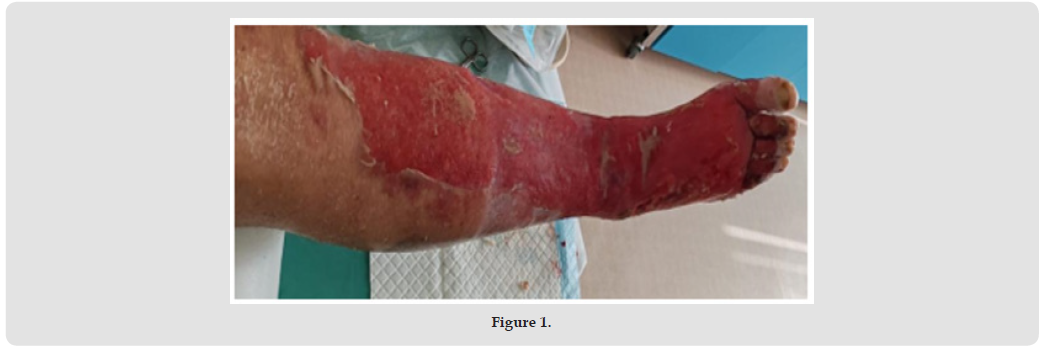
Subsequent consultation with an orthopedist was performed on 29.10.2024, 05.11.2024, 12.11.2024. At the same time, repeated debridement of the wound was performed, and repeated dressing was applied. Due to the continued increased inflammatory parameters, Clindamycin was included in the antibiotic therapy, which was sensitive to Streptococcus pyogenes due to the determination of the minimum inhibitory concentration. Due to the occurrence of yeast in the oral cavity, Medoflucon was also included in the therapy. During the entire hospitalization period, several CRP samples were taken with a gradual decrease (38.30-20.10-19.90-1.90mg/l), as well as procalcitonin (0.108-0.077-0.091-0.086μg/l). On November 14, 2024, the patient was discharged from the Infectious Diseases Clinic to outpatient care with the following recommendations: continue medication treatment with Clindamycin 300 mg 1-1-1, add probiotics, continue treatment with low molecular weight heparin. Based on the recommendation of the orthopedist, lubricate the lower leg and plantar fascia twice a day. Apply dressings (debridement with a special towel, use bioceramic covering) through the home nursing care agency, every two days. Supportive vitamin therapy remains unchanged. Continue outpatient care in the orthopedic clinic. From discharge to outpatient care to the end of treatment by the orthopedic surgeon, the patient visited the clinic 12 times between 15.11.2024 and 17.04.2025. During this care, the following procedures were repeatedly performed: debridement, bioceramic dressing, wound irrigation.
The following photos show the healing of the wound over time. The following photos were taken throughout the entire treatment process (Figure 2).
Figure 2
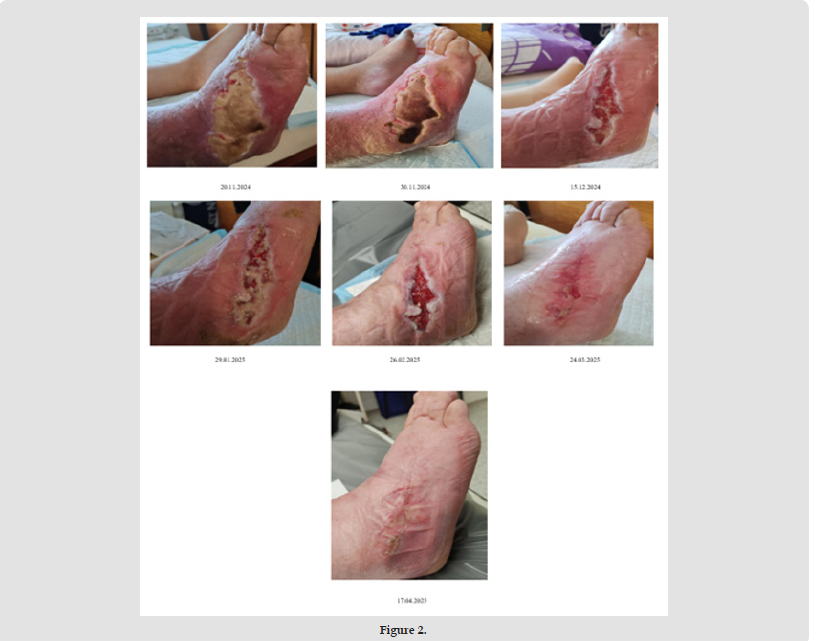
Bioceramic dressing is a medical product designed to treat various types of wounds. It is a patented ceramic structure in the form of granules or pads that supports wound healing through mechanical and chemical properties. Its main effects include:
1. Absorption and destruction of bacteria: The dressing has a suction power up to 20 times higher than the amount of pus or exudate in the wound. Exudate with bacteria is “pulled” into the interior of the granules, where the bacteria are separated from the nutrient medium and die. Microorganisms causing inflammation are permanently removed by absorption and adsorption properties.
2. Wound cleansing and stimulation of healing: The patented structure of ceramics mechanically and chemically irritates the wound, which in the initial phase increases the production of exudate. This allows for rapid cleansing of the wound from bacteria and endotoxins. Later, the production of exudate decreases, which extends the interval between dressing changes (up to several days).
3. Pressure resistance and infection prevention: The dressing is pressure resistant, which prevents secondary infection of the wound with its own exudate. It supports a moist environment in the wound, which is ideal for healing, without the risk of tissue maceration.
An advantage from the point of view of laboratory diagnostics is its ability to be processed by sonication.
Sonization is a low-frequency ultrasound therapy (usually 20–40 kHz), which is used in the modern treatment of chronic and infected wounds. In combination with a bioceramic covering, it significantly increases its effectiveness. Low-frequency ultrasound creates two main effects in tissue and fluids:
1. Cavitation – formation and implosion of microscopic bubbles - mechanical release of biofilm, necrosis and bacteria from the wound surface.
2. Microcurrent flow (acoustic streaming) – a gentle “massage” effect that improves blood circulation, removes dead cells and stimulates cellular activity.
By combining a bioceramic covering and the sonication method, we can also more easily isolate the infectious agent that may be in a potential biofilm. The principle is that the already loaded bioceramic covering, after being removed from the wound (after its action in a chronic wound), is taken in a sterile manner into a sterile collection container, filled with a sufficient amount of physiological solution and then, ideally under laboratory conditions, the container is sonicated in a sonicator device. During the sonication process, microbes that were previously contained in the bioceramic covering are released into the liquid environment. The liquid content is then processed by inoculation onto culture media. Following incubation, the infectious agent is identified using available laboratory tests and an antibiogram is determined. The result is targeted antibiotic therapy also for the infectious agent that could have been in the wound in a potential biofilm.
Non-pharmacological strategies, including weight loss, glycemic control, smoking cessation, compression therapy, and careful skin care, may reduce the need for long-term antibiotic treatment for erysipelas (Jaskóła-Polkowska, et al. [5]). Compression dressing to reduce swelling can be started after pain and infection have resolved. Any prolonged swelling of the leg after the skin infection has resolved is usually treated with compression stockings to reduce the risk of future infections (British Association of Dermatologists [6]). Nursing care for patients with erysipelas includes bed rest, monitoring of general condition, monitoring and treating skin manifestations (swelling, burning, pain), pain management, and prevention of complications. Rest is essential to support the immune system in fighting bacteria that cause infection and the body’s recovery (Rotolo [7]). Regular dressing of the affected limb with the application of antiseptics or compresses according to the doctor’s prescription plays a key role in the patient’s skin care. The affected area should be kept dry and clean to prevent further infection. If blisters develop, the patient should be instructed to handle them gently to prevent them from bursting and causing infection. When dressing, it is advisable to follow strict hygiene rules and use disposable gloves and other protective equipment. In order to assess wound healing and the presence of other lesions, blisters or signs of infection, it is advisable to take photo documentation at regular intervals, recording the size of the wound or skin damage and its description.
If swelling occurs, it is advisable to measure the circumference of the limb. Other supportive treatment activities include hydration, application of cold compresses, fever management, and elevation of the extremities. Surgical treatment of the wound is necessary if abscess or gangrene occurs (Michael, et al. [8]). Elevation of the extremities contributes to the reduction of swelling (Rotolo [7]) and pain. Hydration of the skin by using creams or ointments with a moisturizing effect has a beneficial effect as a prevention of further damage in dry skin with cracks. Disinfection of the skin is also important to prevent infection [9-11].
The occurrence of Erysipelas is still highly topical today. Standard antibiotic therapy is still effective. In clinical practice, we encounter severe forms of this disease, or secondary contamination of the wound. Today, there are several professional studies that describe causal relationships between the intestinal microbiota and the occurrence of erysipelas, which are also a source of innovative, preventive and therapeutic approaches in the treatment of this disease. We have found that bacterial strains of Streptococcus pyogenes have several virulence factors. Several enzymes and toxins that these strains produce diffuse into the tissue, which progresses the process of local inflammatory reaction. This can largely lead to a very variable clinical picture of the disease. With our interpreted case study, we want to point out the effective use of bioceramic covering, also in this disease. Using a special bioceramic wound dressing, choosing the right and innovative approach to treatment, and proper patient management leads to an improvement in the patient’s clinical condition.

International Association of Landscape Archaeology, Czech Glass Society, Czech Republic

Department of Chemistry, Semenov Institute of Chemical Physics, USSR Academy of Sciences, Moscow, Russia

Neurology, LA BioMed Research Institute, USA

Associate Professor at Department of Breast and Thyorid Surgey, Chongqing General Hospital, China

Professor of Nuclear Medicine, Faculty of Medicine and Surgery, University of Milan, Milan, Italy





 Abstract
 PDF
PDF



























