info@biomedres.us
+1 (502) 904-2126
One Westbrook Corporate Center, Suite 300, Westchester, IL 60154, USA
Site Map
 ISSN: 2574 -1241
ISSN: 2574 -1241
ISSN: 2574 -1241
Received: November 26, 2025; Published: December 05, 2025
*Corresponding author: Huihong Dou, Department of Hematology and Oncology, Maternity and Child Health Hospital, Guangxi Zhuang Autonomous Region, Nanning, Guangxi, China
DOI: 10.26717/BJSTR.2025.64.009997
Background: CD36 deficiency is a rare autosomal recessive disorder whose clinical manifestations can easily be confused with immune thrombocytopenia (ITP). Early genetic diagnosis is crucial for the correct management of this condition.
Case Presentation: A male infant experienced severe thrombocytopenia during the neonatal period (24 days old) and during infancy (5 months old). Both episodes responded well to immunotherapy. Considering the early onset and recurrent nature, we performed the whole exome sequencing and confirmed the identified variant by Sanger sequencing in the parents. Genetic analysis revealed that the child carried two pathogenic mutations in the CD36 gene (c.332_333delCA and c.1006+2T>G) in a compound heterozygous state, confirming the diagnosis of platelet glycoprotein IV deficiency. Among these, the splice site mutation c.1006+2T>G is one of the common mutations identified in recent haplotype studies as causing type I CD36 deficiency.
Conclusion: For recurrent thrombocytopenia in infancy, even with a typical response to immunotherapy, monogenic inherited disorders such as CD36 deficiency should be considered in the differential diagnosis. Genetic testing enables precise diagnosis, thereby guiding optimal clinical management, avoiding unnecessary longterm immunosuppression, and providing crucial genetic counseling information for the family.
Keywords: CD36 Gene; Platelet Glycoprotein IV Deficiency; Infant
Diagnosing the etiology of thrombocytopenia in infancy is often challenging, requiring differentiation between immune and hereditary factors. CD36 deficiency, an autosomal recessive disorder, can present similarly to ITP, but the two disorders are different from each other in respect of their long-term treatment principles. The CD36 gene encodes a glycoprotein involved in platelet aggregation, lipid metabolism, and fatty acid transport. Mutations in this gene can lead to loss of CD36 expression on platelets (type II deficiency) or on both platelets and monocytes (type I deficiency). Recent studies have found that in Asian populations, specific haplotypes and recurrent mutations (such as c.1006+2T>G) are closely associated with type I CD36 deficiency [1]. Here we present a case of an infant with recurrent thrombocytopenia caused by compound heterozygous mutations in the CD36 gene to enhance understanding of this disease.
A male infant (G3P1, the other two had abortions for personal reasons), was delivered at full term by cesarean section (Surgical indications: placenta previa with bleeding). He required hospitalization on two occasions during infancy for severe thrombocytopenia and widespread subcutaneous petechiae.
First Hospitalization (24 Days Old)
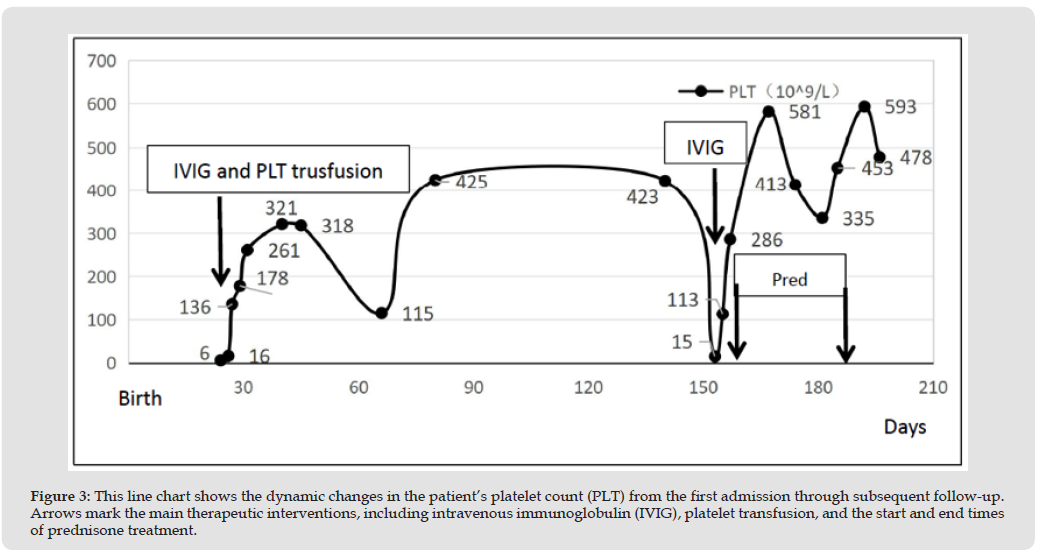
He was admitted following a 2-day history of cutaneous petechiae. Physical examination confirmed petechiae and ecchymoses. Laboratory studies demonstrated severe thrombocytopenia, with a platelet count of 6x10^9/L. Initial laboratory results were negative for platelet-associated antibodies. Bone marrow examination revealed a notable lymphocytosis (75%) and a normal complement of megakaryocytes with morphologically adequate platelet production, respectively. He received a 7-day course of intravenous immunoglobulin (IVIG, 1 g/kg) and platelet transfusions that resulted in a rapid increase in platelet count and clinical improvement, prompting his discharge.
Follow-up
He was subsequently monitored with weekly follow-ups, showing platelet counts fluctuating between 115-423x10^9/L.
Second Hospitalization (5 Months Old)
He represented with petechiae on the trunk, lower limbs, and oral mucosa (Figure 1). His platelet count had fallen to 13x10^9/L. Autoantibody testing was positive for dsDNA. A subsequent bone marrow examination demonstrated markedly hypercellular marrow with decreased platelet production by megakaryocytes (Figure 2). The combination of early onset, recurrence, and these marrow findings raised strong suspicion for an underlying inherited disorder. A second course of IVIG (1.49 g/kg) was administered, and oral prednisone was initiated (1.86 mg/kg/day), again eliciting a positive platelet response (dynamic changes of his platelet counts is shown in Figure 3). Pre
Figure 1
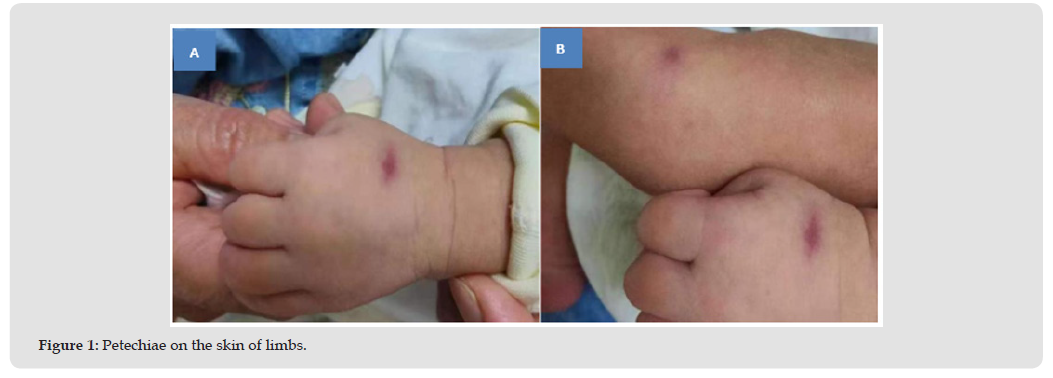
Figure 2
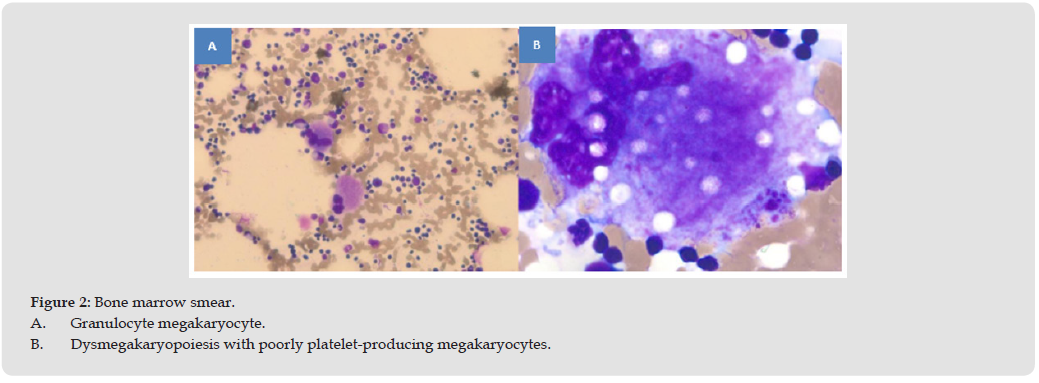
Figure 3
Genetic Diagnosis
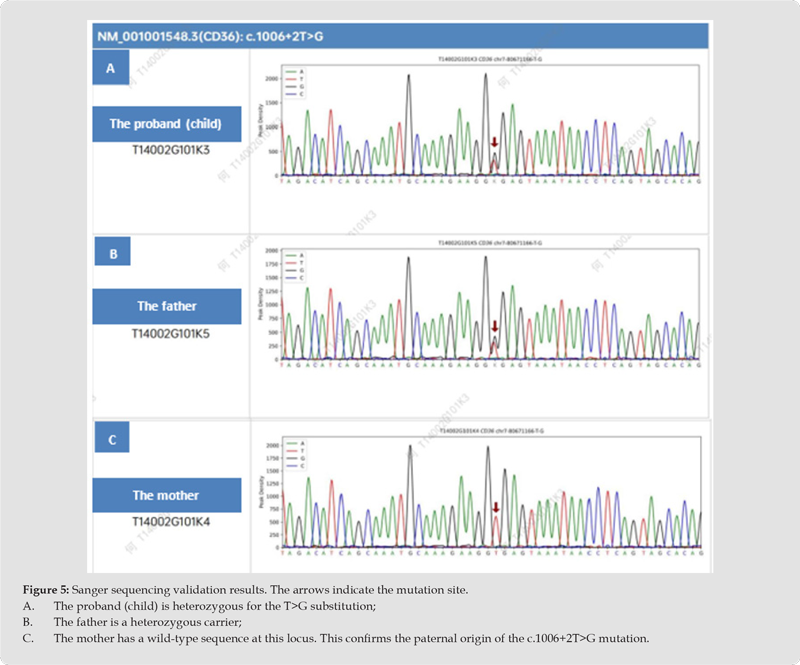
Given the early onset and recurrent clinical course, peripheral blood samples were collected from the child and his parents and sent to Kingsmed Genomics Medical Laboratory in Wuhan, China for genetic analysis. The test performed was “Enhanced Whole Exome Sequencing,” utilizing target region capture and the SURFSeq5000 high-throughput sequencing platform. Genetic analysis identified two pathogenic variants in the CD36 gene in the patient, constituting a compound heterozygous state (Figures 4 & 5): c.332_333delCA (p. Thr1115fs22), a known frameshift mutation inherited from his mother; and c.1006+2T>G, a classic splice site mutation inherited from his father. These pathogenic variants were both verified by Sanger sequencing in the family samples. This result clearly supports the diagnosis of “Platelet Glycoprotein IV Deficiency.” The splice site mutation c.1006+2T>G is particularly noteworthy. Recent haplotype analysis suggests that this mutation often co-occurs with regulatory region variants like c.-132A>C, forming a specific haplotype block strongly associated with type I CD36 deficiency [1]. This case provides another instance of this mutation forming a compound heterozygote with c.332_333delCA, enriching the genotypic spectrum of the disease.
Subsequent Condition and Follow-up
After the genetic diagnosis, we discontinued the unnecessary considering long-term immunosuppressive therapy. We shifted our subsequent management focus to bleeding risk assessment and infection prevention. Half a month ago, during a hospitalization for enteritis, the patient’s platelet count showed a reactive increase, suggesting good bone marrow hematopoietic reserve function.
Figure 4
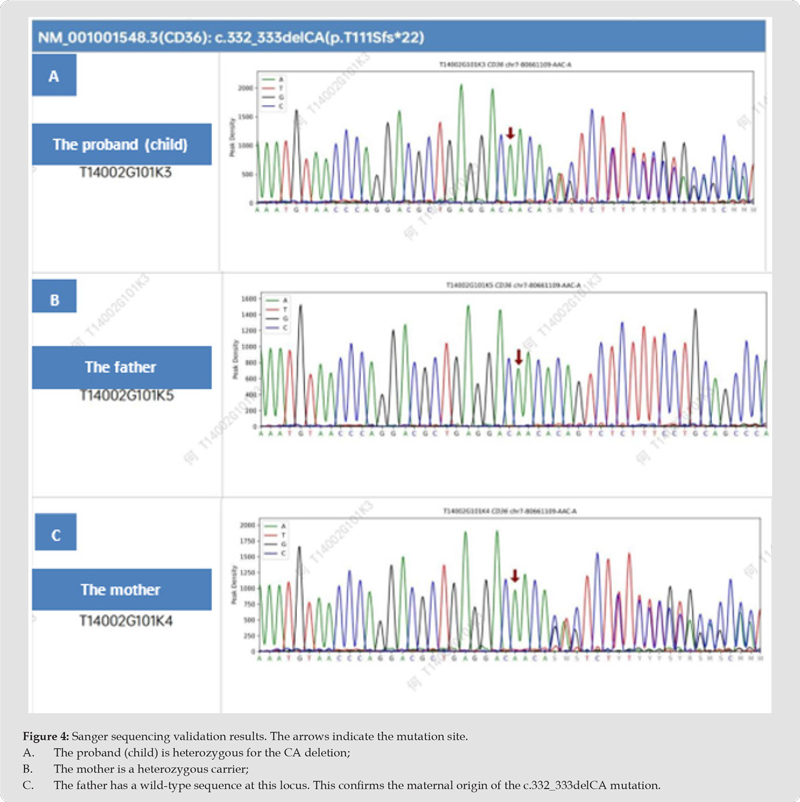
Figure 5
This case clearly demonstrates the difficulty in differentiating hereditary platelet disorders from ITP. The patient’s initial presentation and response to IVIG and steroids were highly suggestive of ITP, aligning with the principles of treatment decision-making based on bleeding severity outlined in the “Adapted Guidelines for the Diagnosis and Treatment of Primary Immune Thrombocytopenia in Chinese Children (2021 Version)” [2]. However, the onset in the neonatal period and early recurrence were key factors prompting genetic testing. The identification of compound heterozygous CD36 mutations was a critical turning point in the diagnosis and management of this case. The splice site mutation c.1006+2T>G is particularly notable. Recent research indicates that this mutation is one of the important genetic bases for type I CD36 deficiency [1]. This case supplements new clinical evidence for the pathogenicity of this mutation in a compound heterozygous state. CD36 deficiency typically follows a benign course but holds significant clinical implications. Individuals with type I deficiency are at risk of developing anti-CD36 alloantibodies following events like transfusion or pregnancy, which can lead to platelet transfusion refractoriness (PTR) or severe fetal/neonatal alloimmune thrombocytopenia (FNAIT) [3,4]. Although such antibodies were not detected in this child, this potential risk indicates the need for long-term vigilance and provision of genetic counseling. From a therapeutic perspective, the management of acute severe bleeding in CD36 deficiency (as in this case) is the same as for ITP, utilizing IVIG and platelet transfusions. However, its long-term management fundamentally differs from that of ITP. A definitive genetic diagnosis allowed the child to avoid unnecessary long-term corticosteroid therapy with its potential side effects. Furthermore, recent studies have revealed that CD36 plays an important role in megakaryopoiesis and platelet production by mediating phospholipid remodeling and polyunsaturated fatty acid uptake [5]. This provides a potential biological explanation for thrombocytopenia in CD36-deficient individuals and points to possible future avenues for exploring new therapies, such as dietary interventions.
This case report confirms that CD36 deficiency is an important differential diagnosis for recurrent thrombocytopenia in infancy. Even if patients show a typical response to immunomodulatory therapy, clinicians must remain vigilant. Early genetic testing is key to achieving a precise diagnosis, helping to formulate optimal treatment measures, avoid inappropriate interventions, and provide crucial genetic counseling for the family. Reporting and analyzing such cases carrying clear pathogenic mutations (like c.1006+2T>G) is significant for deepening the understanding of the genetic background and population specificity of such rare diseases.
This work was supported by the Guangxi Clinical Research Center for Pediatric Diseases (Grant/Award Number: Guike AD22035121).
The authors declare no conflicts of interest.
Informed consent was obtained from the patient’s guardian.

International Association of Landscape Archaeology, Czech Glass Society, Czech Republic

Department of Chemistry, Semenov Institute of Chemical Physics, USSR Academy of Sciences, Moscow, Russia

Neurology, LA BioMed Research Institute, USA

Associate Professor at Department of Breast and Thyorid Surgey, Chongqing General Hospital, China

Professor of Nuclear Medicine, Faculty of Medicine and Surgery, University of Milan, Milan, Italy





 Abstract
 PDF
PDF



























