info@biomedres.us
+1 (502) 904-2126
One Westbrook Corporate Center, Suite 300, Westchester, IL 60154, USA
Site Map
 ISSN: 2574 -1241
ISSN: 2574 -1241
ISSN: 2574 -1241
Received: November 20, 2025; Published: December 05, 2025
*Corresponding author: Marcelo Barros De Vasconcellos, Doctor from the Center for Health Sciences (UFRJ), Master in Public Health (UFF), and Specialist in Aquatic Activities (FAMATH), State University of Rio de Janeiro (UERJ), CAp-UERJ, R. Barão de Itapagipe, 96 - Rio Comprido, Rio de Janeiro - RJ, 20261-005, Brazil
DOI: 10.26717/BJSTR.2025.64.009996
The use of the pedagogical dimension focused on attitudinal content for children and adolescents to learn to “know how to respect and coexist” with norms, postures, values, and attitudes has been widespread in the physical education sector. The objective was to monitor changes in the attitudinal dimension of schoolchildren in Rio de Janeiro, Brazil. The methodology was a longitudinal study conducted from 2022 to 2025 with elementary school students (5th, 6th, 7th, 8th, and 9th grades) and high school students (1st year) at CAp-UERJ. Twelve classes, totaling 334 students in the sample, were monitored throughout the study and assessed four times. Four classes with a total of 116 students in the 8th grade, four classes with a total of 112 students in the 9th grade, and four classes with a total of 106 students in the 1st grade. A structured questionnaire was used, in which students answered yes or no to statements related to correct behavior in the aquatic environment (10 questions). The results showed that, when all classes were analyzed together, six of the ten behaviors investigated achieved 100% accuracy, meaning they maintained the correct attitude from 2022 to 2025, after the interventions. Regarding the correct attitude when entering rough seas, the prevalence of correct answers was 99.1% in 2022, 98.2% in 2023, 99.6% in 2024, and 98.7% in 2025. This fluctuation in the prevalence of correct answers reinforces the need to continue to care for this population. It also aligns with the perception that adolescents overestimate their swimming abilities and require constant attention.
Students at the school are receptive to preventive messages about drowning, which makes the school a suitable and effective place for these actions. The diagnostic use of the attitudinal dimension with school-age students can help identify safety values and concepts in certain regions of the country or specific groups that are unfamiliar with aquatic environments and, thus, help formulate preventive interventions, if necessary.
A longitudinal follow-up study conducted with schoolchildren in Rio de Janeiro has focused on teaching attitudinal content, aiming for children and adolescents to learn to “know how to respect and coexist” with norms, postures, values, and attitudes, such as knowing how to respect the rules for using the aquatic environment and the teacher, adopting drowning prevention habits, and, finally, trying to internalize something that will last a lifetime (VASCONCELLOS, et al. [1]). Researchers from New Zealand, Norway, and the United States state that our attitudes affect our behaviors, and it is our actual behaviors around aquatic environments that will keep us safe or not; they further add that it is important to instill respect for water from an early age (STALLMAN, et al. [2]). This is especially true because the risk of drowning is determined by a complex interaction of individual behaviors, safety knowledge, and awareness of hazards (PRATT, et al. [3]). Physical education classes are excellent for developing these behaviors, rules, and discipline, as they experience, from a young age, the rules of the game, respect for opponents, and, above all, the referee, and acceptance of their decisions (VASCONCELLOS, et al. [4]). This mediation is important, as factors associated with drowning include problems arising from a lack of awareness, a lack of understanding of the dangers of water, and an increase in aquatic risk behaviors (EKANAYAKA, et al. [5]).
Regarding behaviors associated with safer swimming classes, recent research (VASCONCELLOS, et al. [1]) showed that, when analyzing older adolescents as a whole, there was a decrease in the number of correct answers among students who answered, for example, that one should swim across a river and enter rough seas simply because they are taking swimming lessons. This demonstrates that students lack the discernment and humility to recognize that, even though they know how to swim in a pool, they lack the specific skills to swim across a river or enter rough seas, etc. Adolescents overestimate their swimming abilities (DIMMER, et al. [6]) and require constant attention. It was expected that the older they were, the greater their ability to interpret texts and answer questionnaires, the more practical experiences they had, the more education they had, and, consequently, the greater their knowledge of safe behaviors (VASCONCELLOS, et al. [4]). However, this was not universally the case at the school where students have been monitored for four years. Adolescents need emotional control to decide whether to enter the water (GUPTA, et al. [7]), whether they have the necessary skills for that environment, and whether they are in good health to swim (ISIN, et al. [8]). Swimming lessons can contribute to improving aquatic prevention attitudes (VASCONCELLOS, et al. [4]) when they promote teaching about safe behaviors in different aquatic environments (EKANAYAKA, et al. [5]) and when they do not create a false sense of security, which can put them at risk when, for example, swimming in deep water or with currents (WILLIAMS, et al. [9]).
Children and adolescents tend to copy the attitudes of their friends; in this sense, each student plays a fundamental role in multiplying values and preventive attitudes against drowning when they are out of school. In fact, the study by Koon, et al. 2023, mentions that friends are a primary motivator in childhood and can contribute to prevention. Parents, friends, and teachers need to teach children, in addition to correctly identifying signs and flags (GUPTA, et al. [7]), the correct attitudes to be implemented at any given moment in life when visiting a river, pool, beach, dam, waterfall, and/or lake. Having attitudes that value prevention rather than recklessness/irresponsibility are virtues for safely enjoying the aquatic environment.
Instrument for Assessing the Attitudinal Dimension Attitudinal Pedagogical Content Verification Test
Regarding Swimming Lessons. Answer Yes or No.
1. Should I play push other students into the water? () Yes () No
2. Should I put my hand in the hole that sucks water from the pool? () Yes () No
3. Should I wait for the teacher to call me to get in the pool? () Yes () No
4. Should I ask or let the teacher know when I’m leaving the pool? () Yes () No
5. Should I avoid accidents in the pool and prioritize prevention measures? () Yes () No
6. Should I enter the pool with a somersault? () Yes () No
7. Should I play near the bottom drain in the pool? () Yes () No
8. Should I race in the wet area around the pool? () Yes () No
9. Should I try to swim across the river because I take swimming lessons? () Yes () No
10. Should I go into the rough sea because I take swimming lessons? () Yes () No
Below is the answer key for the attitudinal part. Answer Yes (Y) or No (N). The correct answers are: 1 (N); 2 (N); 3 (Y); 4 (Y); 5 (Y); 6 (N); 7 (N); 8 (N); 9 (N); 10 (N).
The attitudinal knowledge result is the sum of each correct answer obtained on the test.
• 0-2 points - very weak attitudinal level
• 3-4 points - weak attitudinal level
• 5-6 points - average attitudinal level
• 7-8 points - good attitudinal level
• 9-10 points - excellent attitudinal level
Below are ten attitudes taught in schools and swimming lessons regarding student awareness in the aquatic environment to prevent accidents (Table 1). Based on the data found in the research, a drowning prevention link was formulated (Figures 1 & 2).
Table 1: Years of monitoring the prevalence of correct attitudes linked to CAP students.
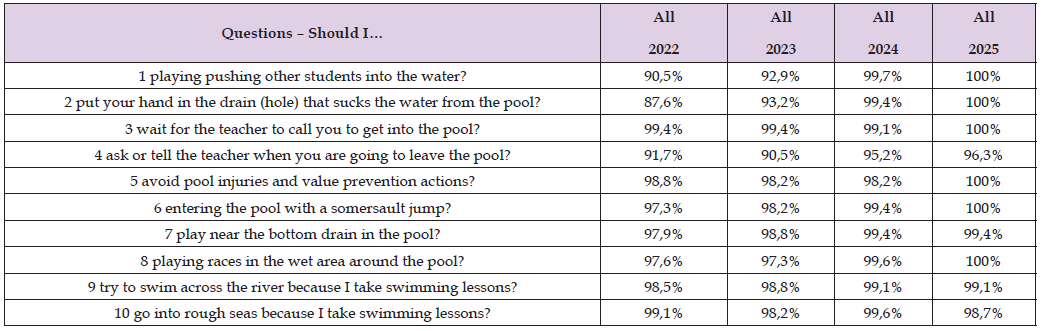
Figure 1
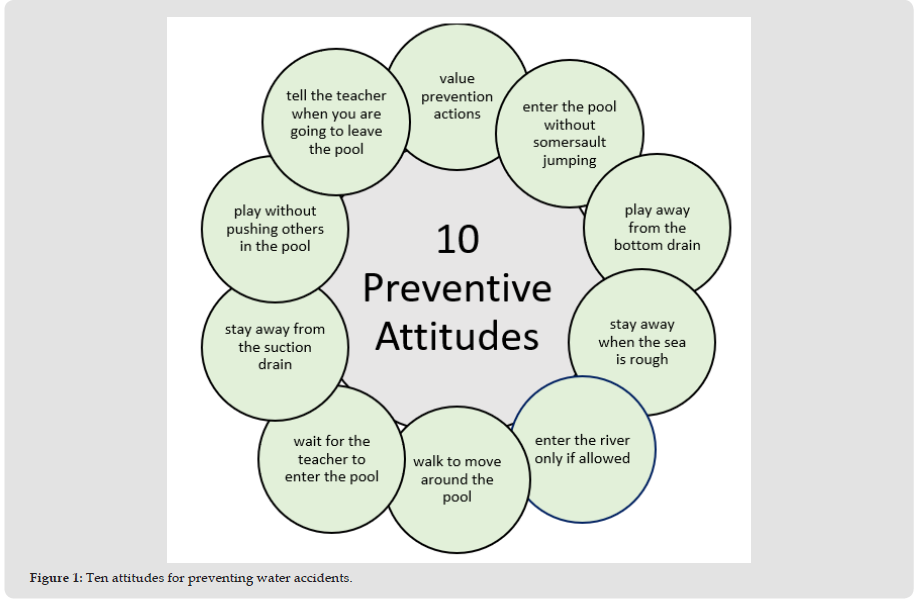
Figure 2
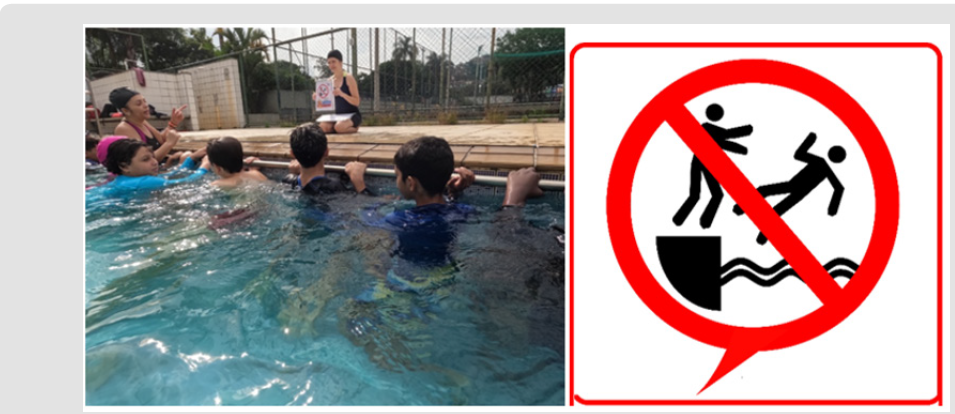
A prevenção é definida como uma abordagem multidisciplinar que reduz o risco de afogamento e It builds resilience through the implementation of evidence-based measures that address hazards, exposures, and vulnerabilities to protect an individual, community, or population from fatal and non-fatal drownings (SCARR, et al. [10]). Swimming lessons need to encourage safe interpersonal behavior. Pushing a classmate is inappropriate behavior that poses a risk to others and should be avoided. Many children are unaware of the dangers of placing their hand or any part of their body in the suction drain. Some are unaware that there is a drain where water is suctioned to filter the pool water and can suck in any body part they touch, potentially causing serious injury or drowning (VASCONCELLOS, et al. [11]). The swimming pool in swimming lessons is like a classroom, where students should not leave without the teacher’s consent. Leaving without warning can result in a student falling into a deep part of the pool or even into another pool that is not being used or supervised. Entry is only permitted under supervision. Even for those who already know how to swim, supervision is always recommended, as if someone becomes ill, has cramps, or experiences any difficulty that could lead to drowning, they can ask for help. Somersault diving can cause cervical injury and, consequently, can lead to severe motor disabilities, such as quadriplegia, depending on the severity of the injury. Diving in shallow waters can cause irreversible consequences and should therefore be avoided (DIMMER, et al. [6]).
It is important to avoid diving in unfamiliar, shallow, murky, or unlit waters, avoid playing games while diving, and look for signs indicating the water’s depth before entering. The message to young people needs to be “Diving in the pool: think first!” The bottom drain is one of the devices responsible for sucking water from the pool by the pump. If a person gets too close, they can be sucked in to the point where their body becomes trapped in the bottom of the pool, even resulting in death by drowning. Therefore, caution is required around drains. There is a risk of falling in the pool area, as it is constantly wet and slippery and is not recommended for running. Many pools have posted a sign around the pool that states: “Walk, don’t run!” Falls in the pool area or in the pool can result in dire health consequences, such as serious injuries, disability, or even death. Therefore, lifeguards and family members should discourage children from engaging in risky behavior in the pool due to the danger it poses to the child. Many students fail to discern and have the humility to recognize that, even though they know how to swim in a pool, they lack the specific skills to swim across a river or enter rough seas, etc. Everyone needs to have emotional control to decide whether to enter the sea and whether they are in good health to swim. People should be taught not to underestimate the risk of drowning and not to overestimate their swimming ability to avoid drowning. Taking swimming lessons can lead to the belief that they already “know how to swim” in any environment and are protected against drowning.
The diagnostic use of the attitudinal dimension of drowning prevention test with school-age students can help identify safety values and concepts in certain regions of the country or specific groups unfamiliar with aquatic environments, thus helping to formulate preventive interventions if necessary. Swimming lessons can help improve aquatic prevention attitudes when they promote instruction on safe behaviors in different aquatic environments and when they do not create a false sense of security, which can put them at risk when, for example, swimming in deep water or with currents.

International Association of Landscape Archaeology, Czech Glass Society, Czech Republic

Department of Chemistry, Semenov Institute of Chemical Physics, USSR Academy of Sciences, Moscow, Russia

Neurology, LA BioMed Research Institute, USA

Associate Professor at Department of Breast and Thyorid Surgey, Chongqing General Hospital, China

Professor of Nuclear Medicine, Faculty of Medicine and Surgery, University of Milan, Milan, Italy





 Abstract
 PDF
PDF



























