info@biomedres.us
+1 (502) 904-2126
One Westbrook Corporate Center, Suite 300, Westchester, IL 60154, USA
Site Map
 ISSN: 2574 -1241
ISSN: 2574 -1241
ISSN: 2574 -1241
Received: November 24, 2025; Published: December 04, 2025
*Corresponding author: D Starokadomsky, MP Semenenko Institute of Geochemistry Mineralogy and Ore Formation, Ukraine
DOI: 10.26717/BJSTR.2025.64.009995
The aim of the work is to establish the possibilities of creating biocompatible bone substitute materials based on epoxy binder and dispersed dry natural bone glue. To achieve this goal, a comprehensive study of epoxy compositions with two types of bone glue (fresher and aged) in a wide concentration range (5–50 mass %). In the course of the work, an assessment was made of the change in viscosity, curing ability and changes in the structure of the epoxy filled composition; practically important mechanical and physicochemical indicators of hardened epoxy-bone composites were recorded. As a result of the research, the following main conclusions were obtained: the distribution of bone glue particles significantly depends on its freshness (aging time); with 5–10 mass % filling, we obtain composites with slightly improved mechanical characteristics (compressive strength, bending strength, abrasion, microhardness); highly filled composites are more resistant than unfilled analogues in aggressive organic solvents; filling at most concentrations significantly worsens the water and acid resistance of composites, has an ambiguous effect on oxidants (for example, 50% hydrogen peroxide); microscopy shows a significant change in the structure of the epoxy polymer with the appearance of filler aggregation zones and surface polymer layers.
Keywords: Composite; Bone Glue; Epoxy Resin; Adhesion; Strength; Resistance
A composite - is a material that consists of two or more components that differ in chemical composition, physical and mechanical properties and are separated in the material with a clearly defined boundary. Components are introduced into the composition of composite materials in order to give them those properties that each of the components does not have separately. By changing the size, location, mass and volume ratio of the components, it is possible to obtain materials with the desired characteristics of physical, mechanical, operational and other properties. Usually, two or more components are combined that are poorly soluble or insoluble in each other and have properties that are very different. One of the components is plastic - a binder, or matrix, and the other is characterized by high strength indicators - a reinforcing (filler, or hardener). Therefore, in a composite, each component plays its own specific role: the matrix gives plasticity, and the filler - strength of the material. Components of certain composite materials that can be used in medicine may include bone glue and epoxy resin. There are adhesives of animal and plant origin. Adhesives of animal origin (glutinous) are made from animal proteins, in particular, bone glue is obtained from bones, horns and hooves of animals, as well as from the bones of birds. And herbal adhesives are made from starch (starch glue) and plant proteins (bean seeds, vetiver, soy yeast, sunflower seeds).
The discovery of industrial epoxy resins was a real breakthrough in the world of materials. This material, born in laboratories, turned out to be extremely versatile, combining strength, durability and an variety of properties [1-2]. Epoxy resin-based adhesives are structural high-strength adhesives. All epoxy adhesives are characterized by high mechanical strength, resistance to atmospheric influences, resistance to fuels and mineral oils, and high dielectric properties. Bone glue is a binding substance of animal origin, a completely natural glue, which consists mainly of a protein substance - gluten. It is obtained by boiling animal bones or skin in water. The main raw material for its production is bone: 48% glue, 1.5% glycerin, 0.5% borax, 50% water [3-4]. The main binder is gelatin. The bones are cleaned, crushed, degreased, mineral salts are removed, treated with a weak solution of sulfuric acid (the acid is needed to remove microscopic residues of unwanted debris), and then boiled in a water bath at a temperature of 60–70°C, stirring constantly, until a homogeneous mass is obtained, which in consistency resembles sour cream. It is not advisable to heat bone glue to a temperature above 80°C - this worsens the viscosity and strength of the bond. Prolonged heating of glue and heating over an open fire reduces its quality. It is advisable to use only copper or enameled dishes to dissolve the glue (iron dishes cause darkening). Due to this treatment, bone collagen turns into gluten, which dissolves in hot water and has adhesive properties. Then additives are added to it: 1.5% glycerin (to improve the elasticity of the adhesive film), 2% borax or 0.5% phenol (to prevent deterioration of the glue).
Obtaining dry glue in the form of hard tiles, granules or flakes from the resulting glue broth, water is evaporated to prepare jelly - jelly, which is dried. The resulting liquid is formed into plates or other forms and dried. Before using the glue plate, it is necessary to crush it and soak it in cold water for a day. The cooked glue should be stored in a cool place for no more than a week. It is undesirable to add fresh glue to previously used glue and to dilute hardened glue again. Sometimes, for the manufacture of valuable specimens, gelatin-based glue is used, which is obtained from selected bones, cartilage, horns, etc. Gelatin is very similar in chemical composition to bone glue, but is of higher quality, cleaner in work, has a lower melting point and greater bonding strength. Bone glue, as a protein substance, is subject to the action of putrefactive bacteria. Adhesive films are poorly water-resistant, a moisture content of more than 15% reduces their strength, but increases elasticity. If the moisture content decreases, the film becomes brittle and brittle. To prevent the fragility of the adhesive film, 3–7% glycerin is added to the bone glue (depending on the purpose) during the manufacturing process. The adhesive film is protected from mold and premature decay by disinfectants, in particular borax (0.5–1%) and salicylic acid, which are added to the working solution. To reduce foam, terpineol (0.3–0.6%) or silicone defoamer PMS-150A is introduced. Sometimes, to increase the stability of the adhesive and the elasticity of the film, an ammonia solution (methanol) in an amount of 0.3–0.5% is added to it.
However, even with the introduction of an antiseptic, bone glue is short-lived [3]. Granulated bone glue has found wide application in the paper, furniture, woodworking, printing, sulfur industries, as well as in everyday life as a carpentry glue. It is used to connect surfaces, give shape to various substances, glue brochures, create hard covers. It is used in the production of matches as one of the most important components in the composition of the ignition mixture, which is applied to the match head and boxes. Bone glue as a subject of study differs favorably from bone meal and other crushed powders in that it has a relatively uniform size of microparticles and mixes well with resins.
Advantages of bone glue:
1. Strength and durability (joints glued with bone glue are distinguished by their extraordinary strength and ability to withstand the effects of time);
2. Elasticity (unlike many synthetic adhesives, bone glue has a certain elasticity, which allows it to compensate for deformations of the material);
3. Eco-friendliness (bone glue is a natural product that does not harm the environment, does not contain toxic substances and is completely biodegradable);
4. Versatility (bone glue can be used to glue various materials, such as wood, paper, leather, bone);
5. Aesthetics (bone glue forms a transparent, strong, almost invisible joint).
Due to the biocompatibility and strength of bone glue, it can be used in medicine to create bone implants, smooth bone defects (filling bone cavities and stimulating bone tissue regeneration), reliable fixation of prostheses and other orthopedic structures So, bone glue is a binding substance of animal origin, a completely natural glue, which consists mainly of a protein substance - gluten. It has a number of advantages: strength and durability, elasticity, versatility, environmental friendliness. Due to the biocompatibility and strength of bone glue, it can be used in medicine.
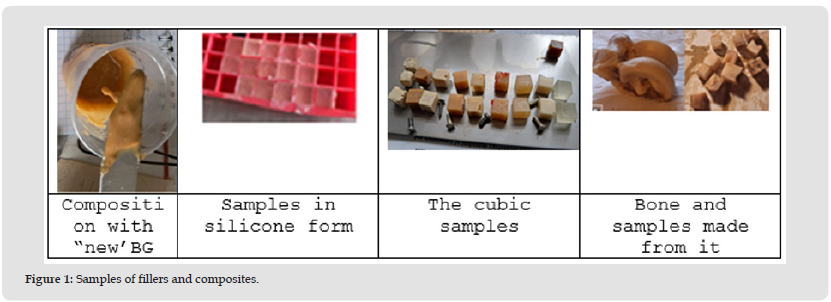
Two types of natural powdered bone glue were used: a relatively new (produced by the Lysychansk Gelatin Plant, 2013) and an older one (produced in 1983). The first glue (“new”) is a cream mono-microdisperse powder (i.e. with a relatively uniform distribution of microparticle size), with a characteristic unpleasant animal odor. The second (“old”) is an ocher-orange powder with lumps and inhomogeneities. Less aged (“new”) and more aged (“old”) bone adhesives were taken in 5, 10, 25, 50 wt% to epoxy resin; they were mixed together and a hardener PEPA was added, the mixtures were poured into molds for further hardening. A sample of unfilled epoxy resin was also made separately. For epoxy composites with each percentage content of bone adhesive were made: cubes 1 cm, cylinders (3.3 cm2 , height of 1.7-2 cm), regular quadrangular pyramids area of 1 cm2, flat hexagons with a side length of 1 mm, plates with a height of 2–3 mm, a width of 1.5 mm, a length of 5–7 cm. Epoxy520 epoxy resin and DETA hardener were used in a ratio of 6:1. Bone glue was used in the following ratios to epoxy resin: 5, 10, 25, 50 wt %. Natural sheep bone (as well as fruit bones) were also tested for comparison with the manufactured artificial material. The main research methods were compression, bending, microhardness and abrasion resistance tests. In addition, the composites were subjected to tests for resistance in aggressive and aqueous solutions and thermal resistanvce (Figure 1).
Figure 1
Optical Microscopy
Visually, compositions with both types of bone glue differ in color and consistency. The “new” glue gives a white composition with a floating filler, and the “old” one - an orange homogeneous composition (Figure 2). With a large filling (50%), the “new” gives a friable composition, which hardens into a porous, low-strength material, and the “old” even at 50% gives a solid composite. From the microscopy data (Figure 3) the dynamics of structural changes during filling is also monitored. The unfilled composition contains disordered zones of heterogeneity and air bubbles. After filling with 5% “new”, single fractal structures and structure-like heterogeneities appear, while the number of bubbles is mixed. Filling with 5% “old” does not change the structure. When the filling is increased to 25%, the composition with “new” becomes even more homogeneous, while “old” does not change the structure, and in both cases bubbles disappear.
Figure 2
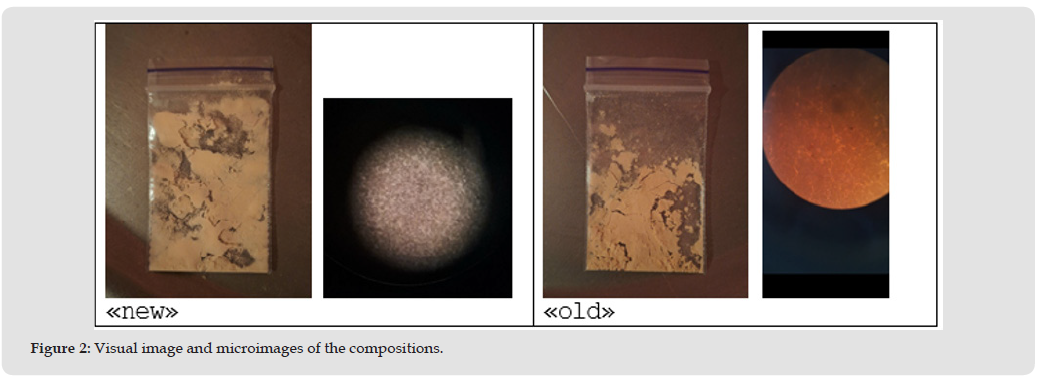
Figure 3

Resistance In Water and Solutions
We tested the obtained samples for stability in various environments. According to the results (Table 1), after 12 days, the weight of the unfilled and filled samples almost did not change at all or did not change. It should be noted that both 5% samples lost a little weight, that is, some water-soluble component was washed out of them. Only the sample with 50% “new” (it is very fragile) it is very prone to water- swelling. However, all filled samples (especially 50%) after water were covered with dark spots. After 12 days of exposure of cylinder samples in 25% nitric acid, the unfilled sample gained up to 10% of its weight, but the weight of most filled samples increased even more noticeably. Especially the samples with “new” and highly filled 25% and 50% “old” are unstable to a strongly acidic environment. In addition, the highly filled samples became covered with mold over time (which confirms their high biocompatibility). At the same time, at 5 and 10 wt% of “old glue” the resistance to swelling in acid increases significantly. That is, optimization of the content of filler allows obtain an acid-resistant material (Figure 4). The samples under study were placed in saline for certain periods of time. The data are given in Table 2. It can be seen that 5% filling in both cases results in a decrease in swelling (i.e., an increase in stability) in saline. At higher concentrations, filling with “new” BG already leads to a noticeable deterioration in stability - the stronger the higher the filling concentration (at 50 wt% “new” swelling exceeds 60%). Filling with “old” BG even as a rule gives a composite that is highly resistant to swelling, and only at 50% filling, 10-15% swelling is possible after 2 weeks of exposure. During 2 months of exposure in saline, the appearance and structure of both unfilled and many filled samples did not change.
Figure 4

Table 1: Results of exposure of the test samples (1 cm3 cubes) in water.

Table 2: Swelling (mg) in saline.

The samples under study were placed in a 1:1 mixture of acetone and ethyl acetate (Table 3). During the 4 days of the experiment, the unfilled sample gained more than 20%, and subsequently destroyed (which is normal for polyepoxide in acetone solutions). The filled ones behave depending on the content and type of glue: in the first hours they either gained or lost weight (Table 3). The instability of 5-10% samples was revealed - they destroyed quickly (after 1-2 days or even earlier), or swelled greatly (for example, with 5% “new” - by 71%). Therefore, 5-10 wt% of the filler does not change the instability of the polyepoxide to the acetone-ether solvent. But among 25wt% filled, there are already those not only destroy, and also not swell - which indicates some structural restructuring when filling increases to 25wt% (Table 3). If the content is increased up to 50 wt%, then the “new” gives very swelling but nevertheless destructive composites. And the “old” BG gives composites with moderate swelling (40-43%), also non-destructive. This is an important result, since acetone-ethyl acetate solutions are known as “nail polish remover”, it is widely used in everyday life, and in particular in contact with skin and nails (and hence not far from the bones). By introducing BG (in the optimal formulation) it is possible to make materials highly resistant to such solutions (Table 4).
Table 3: Swelling (in g) in acetone-ether solvent.
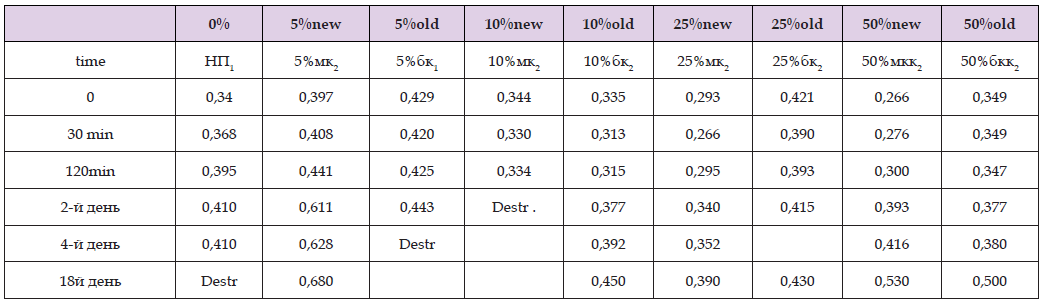
Table 4: Data on heat resistance to extrusion of the studied samples at a temperature of 100°C (qualitative test). “+” - extruded, “-” - not.

The samples were heated and their heat resistance to extrusion was tested. It can be seen that unfilled and low-filled (5 wt%) samples are subjected to extrusion in a heated state. At a filling of 10 wt%, one of them is not extruded, and at 25 and 50 wt% - almost all are resistant to extrusion. Therefore, significant filling with bone glues makes the composite heat-resistant under the action of loads. From the data in Table 5, it can be seen that the introduction of bone adhesives can significantly improve adhesion to various surfaces. Thus, 10% “new” gives an increase in shear adhesion to steel by about 1.5 times. There is a noticeable increase in adhesion to fiberglass, which simulates plant and bone surfaces. The studied samples were tested for hardness. From the data in Table 6, it can be seen that the unfilled sample has a high microhardness index, from the filled ones all gave a good result, especially 25% and 50% “old”. The studied samples were tested for adhesion on bending. According to Table 7, epoxy resin plates with a filling of 10%, 25% are more durable, especially for “old” (an increase of 50-75%). But for higher fillings, the strengthening effect weakens (50 wt% “old”), or the strength essentially drops (for “new”). In this experiment determined height of break the sample by 1 kg thrown. According to Table 8, a tablet of unfilled epoxy resin broke from a lever thrown from a height of 30 cm, so - it is quite strong. Filling with “old” bone glue gives a significant increase in impact strength, especially at 10 wt%. Even at high concentrations, its strength is similar to the unfilled one.
Table 5: Adhesion of glued plastines from steel, aluminum or fiber-glass.

Table 6: Microhardness by (in N) of the studied samples was tested using a hand-held Durometer hardness tester.

Table 7: Testing of test specimens (thickness, 3.6 mm) for bending.

Table 8: Test of the studied samples (with a diameter of 4 mm and a side thickness of 1 mm) for strength. “Height” - The height from which the lever is thrown, cm.

On the contrary, “new” filler limits the strength, especially at high fillings (Table 8). It was determined angle of break the sample under hammer (Table 9). And again, 10 wt% “new” showed its strength well, “overtaking” its natural analogue (lamb bone) by 15°. Analyzing Tables 10 & 11, can see that after 130 C unfilled polyepoxy gives approximately the same indicator – 755+-15 kg/cm2. This is a fairly high indicator, for example, a small car can put on this sample without destruction. With such strength, can also think about creating prostheses or other medical load-bearing products. It is difficult to expect a significant improvement in this indicator from filling with bone glue. The tables show that there are concentrations at which the indicator remained at this (rather high) level. compressive strength does indeed increase (for example, 25% bcc), but in most cases it decreases significantly. But even under such conditions, the compressive strength of filled composites is 2–4 times higher than the compressive strength of natural analogues – bone (lamb) and fruit-stone (up to 100–140 kg/cm2 - the strongest is a peach stones). After 130°С, we have positive changes in the strength of filled composites. This is because the polymer undergoes post-hardening processes (thermally activated post-processes) during additional heating, as a result of which the material becomes even stronger. For example, the compressive strength of an unfilled sample increases from 560 to 660 kg/cm2 (i.e. by 17.9%).
But even more interesting transformations occur with the strength of a number of filled composites. For example, for 10% and 25% “old”, we have an increase in strength up to 710-730 kg/cm2 - that is comparable to unfilled analogue. For 50% “old”, heating at 130°C gives an increase in strength almost twice (from 380 to 680 kg/s, Tables 9 & 10). The same for 25% “new” – it increases from 320 to 520 kg/s, and it can already be compared with the strength of the unheated unfilled one (560 kg/cm2, Table 10). As for the weakest of the obtained composites – 50% “new”, there is also a 2-fold increase (to 150 kg/cm2, Table 10) - that is comparable to natural bone materials) (Tables 12-15).
Table 9: Test of the studied samples for impact strength. Angle° - angle (, °) at which the “bone” hammer was thrown.

Table 10: Compression test of the test samples (Kgf/cm2) after heating (72 hours) to 70°C.

Table 11: Compression test of the test samples (Kgf/cm2) after heating (72 hours) to 130°C.

Table 12: Compression test of the test samples after heating 1 (1 hour) to 200°C±10°.

Table 13: Results of testing the test samples for stability in 25% nitric acid.

Table 14: Microhardness of the studied samples was checked using a benchtop Brinell hardness tester According to the results given in Table 8, unfilled epoxy resin gives the highest index, but small-shaped samples break. Of the filled ones, 10% and 25% “new” are quite strong, 50% “new”and 50% “old” after 30–40 μm deforms without resisuance.

Table 15: Adhesion indices of epoxy-bone composites to steel, aluminum and fiberglass plates (gluing area 3 cm2) under shear – estimated.

1. Filling leads to the formation of compositions colored in ocher (for old bone glue) or cream (for relatively new) colors. The viscosity and distribution of bone glue particles significantly depends on its type (exposure time): for old glue we have less viscous compositions, with a tendency for the filler to settle to the bottom, while for new ones - very viscous with a gradual rise of the filler to the surface.
2. Adhesion testing revealed a number of optimal concentrations for its enhancement. Thus, 10% filling with new bone glue increases shear adhesion to steel by 1.7–1.8 times (the same for 25%) and increases adhesion to fiberglass. Even higher adhesion to fiberglass is provided by filling with 10% of old glue, and 25% of such filling significantly enhances adhesion to aluminum.
3. As a rule, the compressive strength decreases, but in some cases (at low fillings) it remains unchanged or increases. With 5–10% filling, we obtain composites with slightly improved mechanical characteristics (compressive strength, bending strength, abrasion, microhardness). At 25% filling with “old” (aged) bone glue increases compressive strength. After severe heating (up to 200°C), the filled materials lose their strength in 1.2-1.8 times, but at certain concentrations (5% of “old” bone glue) they can even increase it. In any case, it remains 2–3 or more times higher than the strength of natural analogues (animal and plant).
4. The samples are prone to swelling in water, stable in saline and H2O2, filled samples absorb HNO3, in acetone most of them are destroyed (as well as unfilled), and some (25 and 50%) remain stable. Their resistance to aqueous solutions and chemicals was studied. 50% filling with new glue shows resistance to destruction in chlormethylene (in which all epoxy samples are destroyed in a few hours together with the unfilled). In aggressive organic solvents, highly filled composites are more stable than the unfilled analogue. Filling at most concentrations significantly worsens the water and acid resistance of composites, gives an ambiguous effect on oxidants (for example, 50% hydrogen peroxide).
5. Microscopy shows a significant change in the structure of the epoxy polymer with the appearance of filler aggregation zones and surface polymer layers.
6. The work opens up new possibilities for creating eco- and biocompatible epoxy-bone composites with a wide range of medical and household applications.

International Association of Landscape Archaeology, Czech Glass Society, Czech Republic

Department of Chemistry, Semenov Institute of Chemical Physics, USSR Academy of Sciences, Moscow, Russia

Neurology, LA BioMed Research Institute, USA

Associate Professor at Department of Breast and Thyorid Surgey, Chongqing General Hospital, China

Professor of Nuclear Medicine, Faculty of Medicine and Surgery, University of Milan, Milan, Italy





 Abstract
 PDF
PDF



























