info@biomedres.us
+1 (502) 904-2126
One Westbrook Corporate Center, Suite 300, Westchester, IL 60154, USA
Site Map
 ISSN: 2574 -1241
ISSN: 2574 -1241
ISSN: 2574 -1241
Received: November 25, 2025; Published: December 02, 2025
*Corresponding author: Nicoli Flavia, Cardiology Unit, Cardiovascular Department, Humanitas Gavazzeni, Bergamo, Italy
DOI: 10.26717/BJSTR.2025.64.009989
SARS-CoV-2 infection is nowadays one of the most catastrophic disease affecting Italy in the last years. A very heterogenic manifestation range starts from lungs disease with extensive parenchymal involvement, to hepatic involvement with acute hepatitis, acute kidney insufficiency, myocardial involvement, but also coagulopathy (thrombotic or hemorrhagic). We presented a case of a severe peripheral microangiopathy occurring in an old woman during the first Bergamo peak on April 2020. Viral pneumonia with respiratory failure and severe peripheral cyanosis although corrected arterial oxygen content by Ventury Mask were associated with new finding of bladder cancer with acute bleeding during the hospitalization and suspected pancreatic cancer. Cilostazol association to COVID-19 treatment led to partial recovery of fingers ischemia.
In conclusion, antiplatelet and vasodilator effecting Cilostazol was useful in the treatment of a severe peripheral ischemia linked to COVID-19 microangiopathy.
Keywords: COVID-19; SARS-CoV2; Microangiopathy; Ischemia; Multidisciplinary Therapy; Cilostazol
Patient Presentation
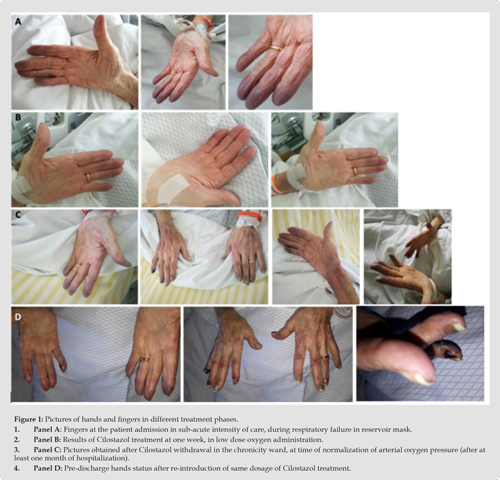
A 87 years old woman was hospitalized for pre-syncope and dyspnoea in a Bergamo full dedicated COVID-19 Hospital, due to severe respiratory failure and high clinical suspicion for COVID-19 infection. Acrocyanosis appeared two days before the hospital admission, as confirmed by the daughter (Figure 1, Panel A). Multiple oral-swab were performed, giving negative results for COVID. Sierology evaluation revealed IgM positivity and IgG negativity, in keeping with an acute COVID-19 infection. Inflammatory biomarkers showed protein C Reactive peak of 13.08 mg/dL and leucocytosis (WBC peak 16410/ uL). D-dimer peak reached 33800ng/mL, with no detection of pulmonary thromboembolism at CT scan or venous thrombosis at echo-evaluation. Only Enoxaparin 4000 UI o.d. was administered although in an anticoagulant indication for atrial fibrillation and elevated D-dimer value, due to an acute bladder bleeding during the hospitalization. A bladder cancer and a suspected pancreatic cancer were diagnosed at imaging abdomen CT scan evaluation. Other comorbidities affected clinical status, as ostomy carrier in hemicolectomy, previous episodes of cerebral ischemia and arterial hypertension, cardiac echocardiography detection of severe aortic valve stenosis with normal left ventricle ejection fraction, moderate-to-severe mitral regurgitation and high right ventricle pressure with severe tricuspid regurgitation, maybe in pulmonary outcomes for COVID-19 infection.
During the acute setting of respiratory failure treated with oxygen in reservoir mask, the great importance of oxygen saturation monitoring lead to introduce acrocyanosis treatment. The radial arteries Doppler exam showed a normal arterial pattern in the absence of stenosis. Cilostazol 50 mg bis in die (b.i.d.) was started for the huge vasodilating and antiplatelet effects. Drug therapy also included steroids, diuretics, hydration and antibiotics, with effective results. Acrocyanosis disappeared in one week and the patient went into recovery with no more advanced oxygen support (Figure 1, Panel B). After 23 days and a normal finger status with normal oxygen arterial pressure in air (paO2 81 mmHg), Cilostazol was withdrawn after patient transfer from the acute ward. The day after fingers cyanosis started again as was happened at the beginning of the disease (Figure 1, Panel C), with stable oxygen arterial pressure at emogas-analysis in ambient air (paO2 91 mmHg). The re-introduction of Cilostazol conducted to ameliorate again acrocyanosis, leaving at the end some residual small necrotic lesions (Figure 1, Panel D). In the chronic phase, at patient stability, a bronchoalveolar lavage confirmed negativity in keeping with no current SARS-COV2 infection: the patient was discharged in a long-term care facility.
Figure 1
The major hypothesis in SARS–CoV2 pathogenesis is directly related to complement pathways activation and its indirect activation by damaged host tissues. In particular, the C5a anaphylatoxin can stimulate platelet-leukocyte aggregation, direct endothelial injury and tissue factor release to trigger the extrinsic coagulation pathway. The final effect can so include a thrombotic microangiopathy and a hypercoagulative state (in the forms of VTEs or disseminated intravascular coagulation or DIC). The consequent capillary and blood vessel occlusion can eventually results in tissue ischemia and oxidant organ injury [1]. Cilostazol is a selective inhibitor of phosphodiesterase type 3 with the result of inhibition in platelet aggregation, by an increase of cAMP leading to rise the active form of protein kinase A (PKA). Its pleiotropic effect comprehends antiapoptotic, anti-inflammatory, antioxidant and cardioprotective activities. The vasodilatory effect is linked to PKA preventing the smooth muscle cells contraction by precluding the myosin light-chain kinase activation. An anti-fibrotic, anti-inflammatory, vasodilator and antiproliferative effects in the lung are linked to elevated cAMP [2]. Interestingly Cilostazol was just demonstrated to be an effective vasodilating and antiplatelet drug against the peripheral microangiopathy [3,4].
As shown in our case, new perspective in usage on COVID-19 lesions for multiple endothelial involvement and micro-clots generation could be reasonable and safe, other than physiological based as just demonstrated in vitro [5]. However new focused in vivo studies are warmly evoked. Cilostazol was also manageable and safe in a critical multiple-pathological old patient with a shown high risk of bleeding. A low dose usage of drug can be used as a precautionary measure.
COVID-19 related peripheral ischemia or microangiopathy could be reasonably and physiopathologically approached with antiplatelet and vasodilating drugs. Cilostazol was shown to be the most effective in a vitro study [5]. As take home message, we firstly present a case in which Cilostazol had shown to be a safe and effective treatment in this setting. However a continued drug usage until stable resolution is suggested and new studies are evoked.
The main reason for the delay of publication is due to author’s post-traumatic stress syndrome after the frightening SARS-COV2 peak in Bergamo. At 5th anniversary she take courage to publish her work related to COVID-19, with the aim to fight the most psychological and healthy-damage virus of the last 50 years. The main acknowledgments are directed to all health workers and their courage and daily sacrifice in dealing with this dreadful disease.
none.

International Association of Landscape Archaeology, Czech Glass Society, Czech Republic

Department of Chemistry, Semenov Institute of Chemical Physics, USSR Academy of Sciences, Moscow, Russia

Neurology, LA BioMed Research Institute, USA

Associate Professor at Department of Breast and Thyorid Surgey, Chongqing General Hospital, China

Professor of Nuclear Medicine, Faculty of Medicine and Surgery, University of Milan, Milan, Italy





 Abstract
 PDF
PDF



























