info@biomedres.us
+1 (502) 904-2126
One Westbrook Corporate Center, Suite 300, Westchester, IL 60154, USA
Site Map
 ISSN: 2574 -1241
ISSN: 2574 -1241
ISSN: 2574 -1241
Received: November 11, 2025; Published: December 01, 2025
*Corresponding author: Anwarul Islam, M.D, Ph.D, FRC Path, FACP, Clinical Associate Professor of Medicine, Division of Hematology/ Oncology, Department of Medicine, Buffalo General Hospital, Room E 318, Buffalo, New York 14203, USA
DOI: 10.26717/BJSTR.2025.64.009985
A bone marrow imprint can be extremely valuable for diagnosing both hematological and non-hematological disorders, especially when a bone marrow aspiration results in either a dry tap or a bloody tap. In these situations, a Romanowski-stained imprint from a bone marrow trephine (core) biopsy specimen, obtained at the same time, can provide immediate and critical information that aids in making an accurate diagnosis. In this report, we present a case where the imprint provided a reliable cell morphologic assessment that the poor-quality aspirate material (due to the bloody tap) could not achieve.
Abbreviations: CDA: Congenital Dyserythropoietic Anemia; HEMPAS: Hereditary Erythroblastic Multinuclearity with A Positive Acidified Serum Test; MAC: Monitored Anesthesia Care; WHO: World Health Organization
Bone marrow aspirations from the sternum or posterior ilium, along with the resulting cytological smears, are commonly used to diagnose and manage various hematological and certain non- hematological disorders [1-3]. However, achieving a definitive cytological diagnosis can be challenging when bone marrow aspirations result in a dry tap or a bloody tap. These situations are not uncommon, particularly when the marrow is densely packed with malignant hematopoietic cells, carcinoma, or in cases associated with myelofibrosis [4-7]. A bloody tap during bone marrow aspiration can also be caused by a faulty technique. In such instances, a bone marrow imprint obtained from a trephine (core) biopsy can be extremely helpful, providing valuable information that may complement or even lead to an accurate diagnosis.
The patient is an 80-year-old white male with congenital dyserythropoietic anemia (CDA) type II, also known as hereditary erythroblastic multinuclearity with a positive acidified serum test (HEMPAS). He was diagnosed in his 50s and has been undergoing therapeutic phlebotomy since that time. The diagnosis was made after he was found to have elevated levels of bilirubin and ferritin. He did not have any major complaints except tiredness and generalized weakness. His physical examination was unremarkable except for anemia and jaundice. His laboratory values were: WBC 5.8 x 10⁹/L, hemoglobin 9.9 g/dl, an elevated MCV at 109.4 fl, a raised MCH at 37.2 pg, high RDW at 18.2% and a normal platelet count of 208 x 109/L. His iron studies were mostly normal including ferritin level which was 133 ng/ml (normal 30-400). His complete metabolic profile was mostly normal except glucose which was slightly raised at 128 mg/dl, and markedly raised bilirubin level at 11.2 mg/dl (normal 0.2-1.2).
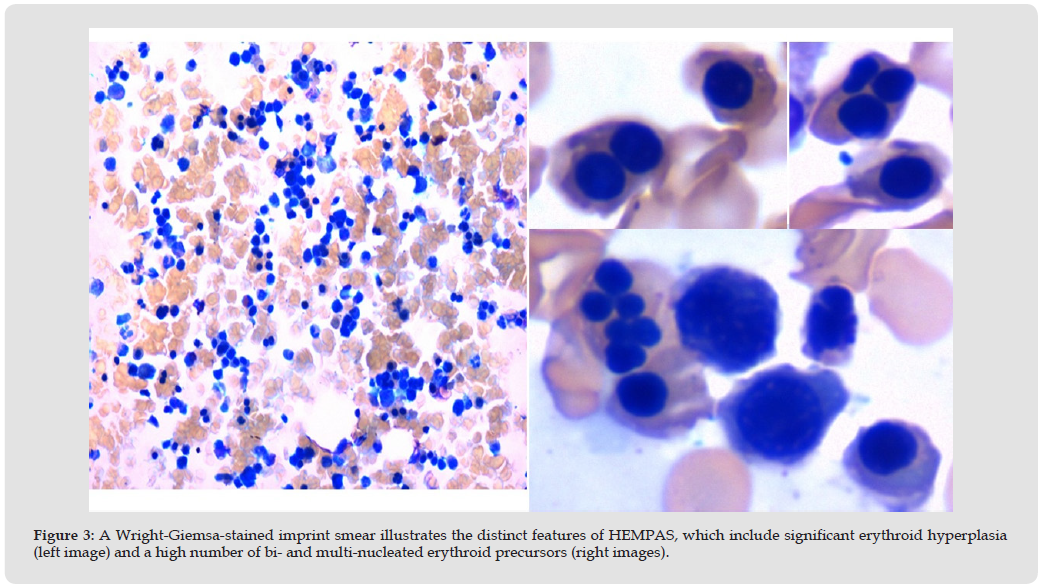
Recently he was having pain in his right knee for which he underwent a right knee MRI which was reported as “marrow proliferative disorder which may be on a benign or potentially malignant basis and clinical correlation is indicated”. Due to concerns regarding a myeloproliferative disorder and potential malignancy, a bone marrow examination was requested. This procedure was performed on the right posterior ilium under monitored anesthesia care (MAC). Unfortunately, the bone marrow aspirate resulted in a bloody tap (Figure 1A). However, the imprint (Figure 1B) obtained from the core biopsy specimen displayed characteristic features of HEMPAS (Figure 2) and did not indicate the presence of any hematological or non-hematological malignancy. Additionally, the bone marrow biopsy findings were negative for any myeloproliferative disorder or malignancy.
Figure 1
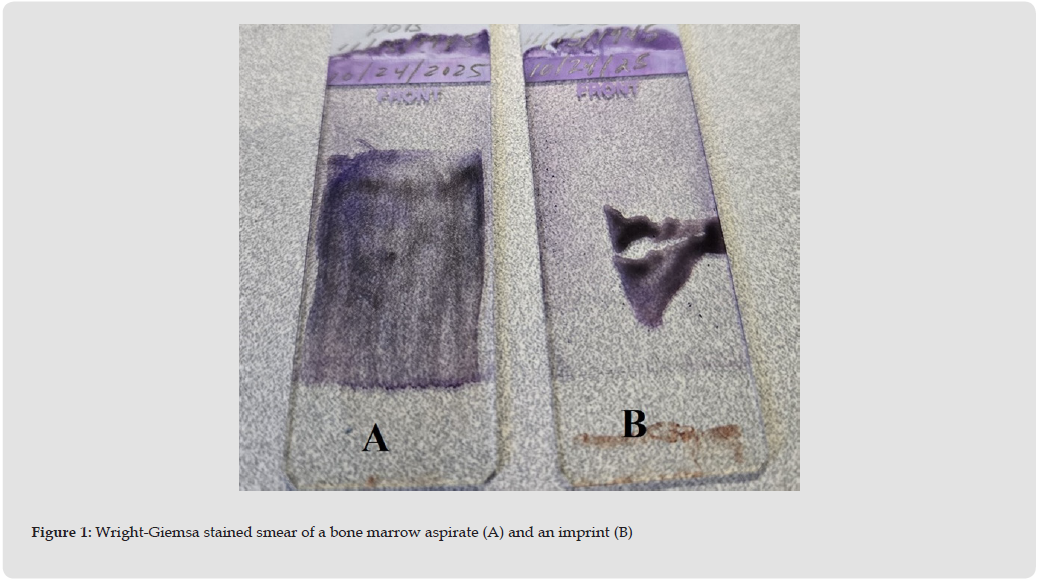
Figure 2
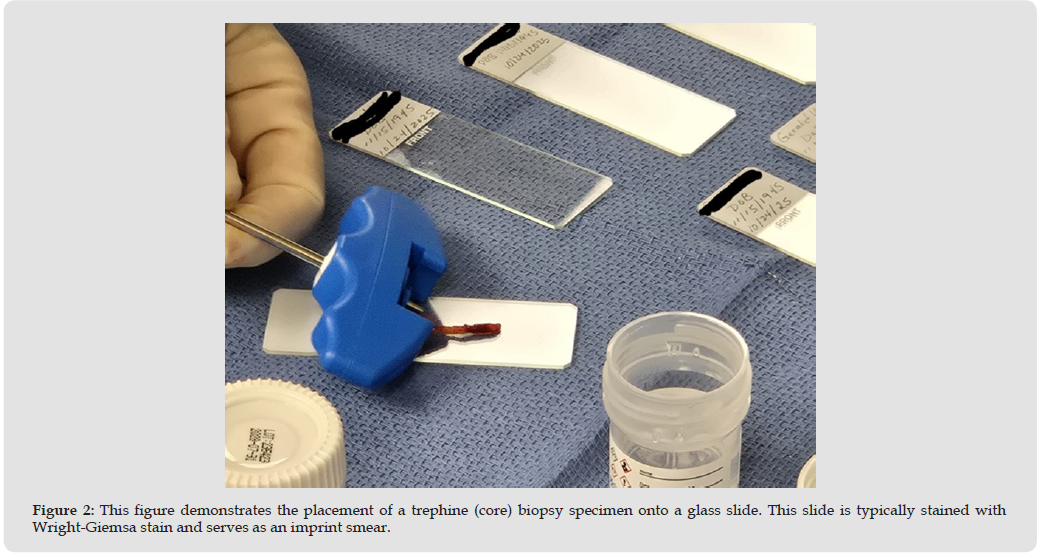
A “dry tap” during a bone marrow aspiration refers to the inability to collect any marrow, while a “bloody tap” occurs when the aspirate consists primarily of blood, with no fragments and very few marrow cells present. In the case of a bloody tap, it indicates that the needle was correctly placed in the marrow cavity, suggesting that the technique itself was not faulty. Both dry and bloody taps can signal potential underlying bone marrow issues rather than merely indicating a failed attempt at aspiration. Conditions associated with a dry or bloody tap may include hypocellular or hypercellular marrow, metastatic cancer infiltration, non-Hodgkin’s lymphoma, acute leukemia, or myelofibrosis. When a bloody tap is observed, it can be helpful to prepare a slide directly from the bone marrow biopsy (Figure 3), known as an imprint, and stain it with Romanowsky stain for further analysis. This can provide valuable information that aids in reaching an accurate diagnosis.
Figure 3
The World Health Organization (WHO) has emphasized the importance of bone marrow aspiration and biopsy as vital tools for diagnosing and prognosing hematological diseases [8]. However, there has been little focus on the value of bone marrow imprints in evaluating these disorders. Limited reports [9-10] suggest that imprints can serve as a reliable diagnostic tool, particularly when bone marrow aspirate smears are non-diagnostic or uninformative. In this report, we present a case in which a bone marrow imprint yielded valuable diagnostic information. We recommend that in instances of a bloody or dry tap, it is advisable to routinely make an imprint from the bone marrow trephine (core) biopsy specimen.

International Association of Landscape Archaeology, Czech Glass Society, Czech Republic

Department of Chemistry, Semenov Institute of Chemical Physics, USSR Academy of Sciences, Moscow, Russia

Neurology, LA BioMed Research Institute, USA

Associate Professor at Department of Breast and Thyorid Surgey, Chongqing General Hospital, China

Professor of Nuclear Medicine, Faculty of Medicine and Surgery, University of Milan, Milan, Italy





 Abstract
 PDF
PDF



























