info@biomedres.us
+1 (502) 904-2126
One Westbrook Corporate Center, Suite 300, Westchester, IL 60154, USA
Site Map
 ISSN: 2574 -1241
ISSN: 2574 -1241
ISSN: 2574 -1241
Received: November 20, 2025; Published: December 02, 2025
*Corresponding author: Takatomo Mine MD, Department of Orthopaedic Surgery, National Hospital Organization Kanmon Medical Center, 1-1Choufusotoura, Simonoseki, Yamaguchi 752-8510, Japan
DOI: 10.26717/BJSTR.2025.64.009982
Introduction: Bone bruises typically result from direct trauma to the bone. In anterior cruciate ligament (ACL)
injuries, bruises are often associated with direct impact. Characteristic patterns of bone bruising in ACL injuries
have been reported.
Case: A 28-year-old female presented with severe right knee pain and gait disturbance. Magnetic resonance
imaging (MRI) revealed a bone bruise in the anterior tibial plateau. A knee brace was applied and conservative
management, including muscle-strengthening exercises, was initiated. After 1 month, follow-up MRI demonstrated
near-complete resolution of the bone bruise. Arthroscopic examination revealed a slightly lax ACL but
no meniscal tear. ACL augmentation was performed using a 7mm single bundle semitendinosus tendon graft. At
6-month follow-up, the patient was almost asymptomatic.
Conclusion: In this case, the bone bruise was not caused by of direct trauma. The stress resulting from anterior
knee instability may have been transmitted to the tibial bone marrow, thereby contributing to the development
of the bone bruise.
Keywords: Bone Bruise; Anterior Cruciate Ligament; Arthroscopy
Abbreviations: MRI: Magnetic Resonance Imaging; ROM: Range of Motion; ACL: Anterior Cruciate Ligament; LTP: Lateral Tibial Plateau; LFC: Lateral Femoral Condyle
Bone bruising, also referred to as subchondral bone marrow edema or edema-like marrow signal intensity, is detected on magnetic resonance imaging (MRI) in more than 80% of acute anterior cruciate ligament (ACL) injuries [1,2]. These bruises are thought to result from inflammation, swelling, and micro fractures of the trabeculare bone caused by compressive forces between the femur and tibia during injury [3]. We report a case of an unusual appearance of a bone bruise associated with ACL injury.
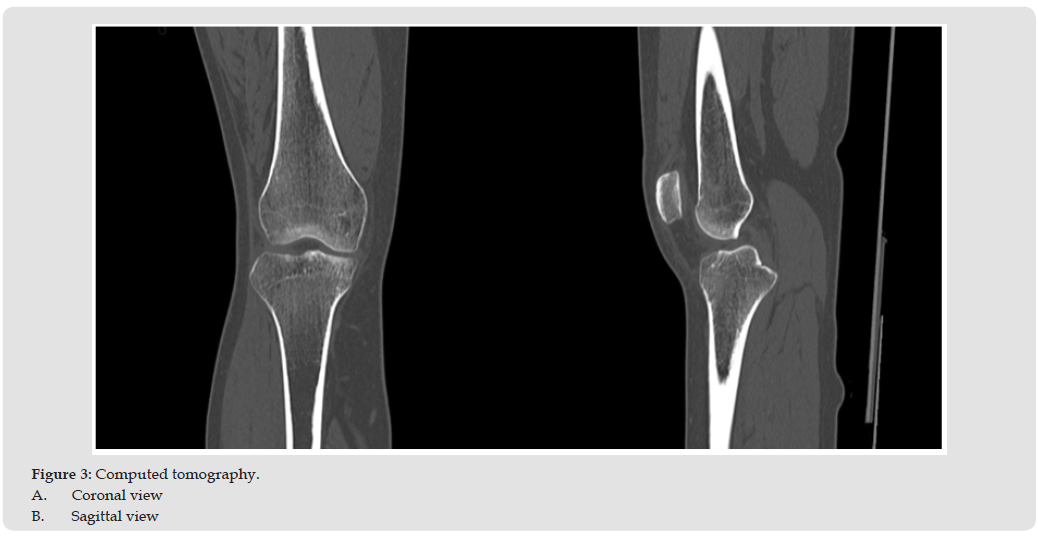
A 28-year-old female presented with severe right knee pain and gait disturbance. The symptoms began after a dog bumped her. She nearly fell, stepped forward with her right foot to brace herself, during which her knee gave way. She was taken to a nearby hospital where MRI revealed no significant findings (Figure 1). She returned to work, but her knee pain gradually worsened. One month later, a repeat MRI showed a bone bruise in the anterior tibial plateau (Figure 2). Her symptoms persisted for approximately 2 months. Therefore, prompting referral to our department. Her past medical and family histories were unremarkable. Physical examination revealed no swelling, or effusion, but tenderness was noted in the right knee. The range of motion was 0°-145°. McMurray test for meniscal injury were negative. The anterior and posterior drawer tests, as well as varus and valgus stress tests, were normal. The Lachman test was positive. The patient had no patellofemoral symptoms. Her Lysholm knee score was 42. Plane radiographs showed no bony or soft tissue abnormalities, including intra-articular loose bodies. Computed tomography revealed no subchondral bone loss (Figure 3). MRI confirmed the presence of a bone bruise in the anterior tibial plateau.
Figure 1
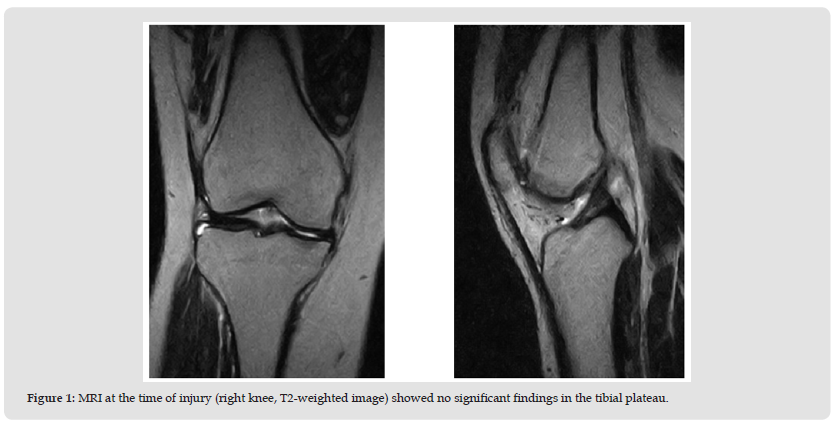
Figure 2
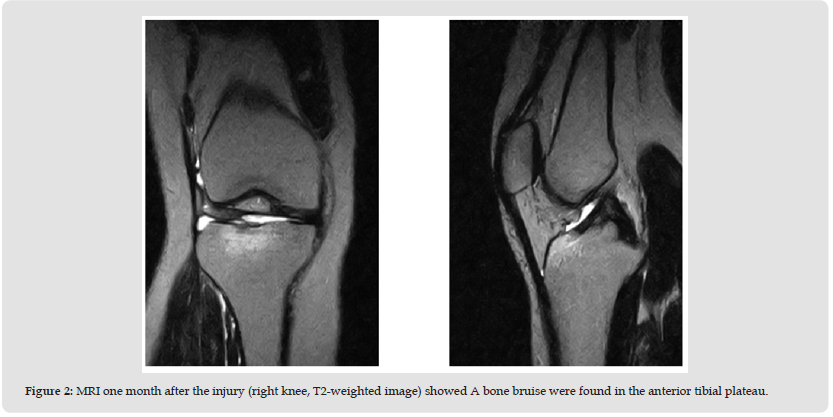
Figure 3
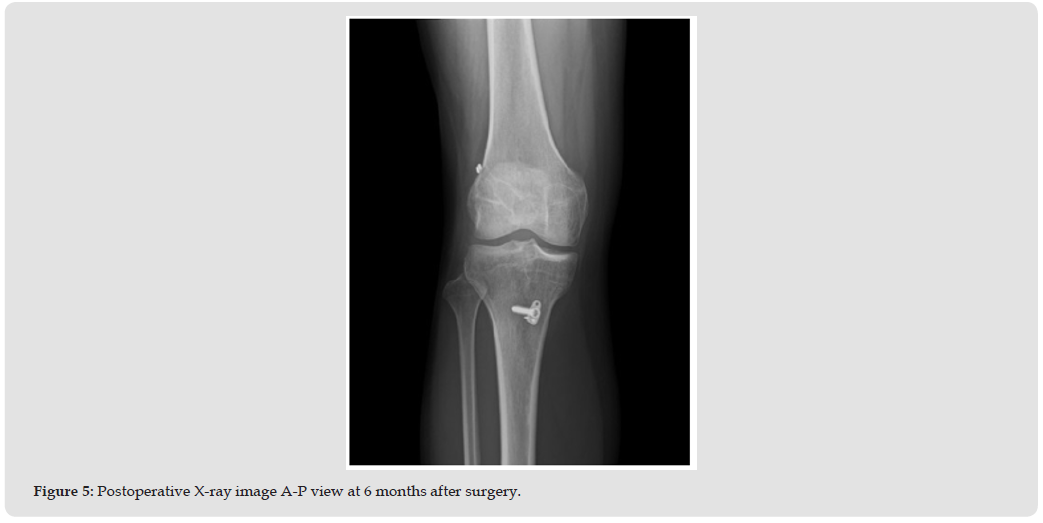
Due to persistent severe right knee pain and gait disturbance, a knee brace was applied, and conservative treatment, including muscle exercises, was initiated. One month later, follow-up MRI showed that the bone bruise had almost completely resolved (Figure 4), and her pain had gradually subsided; however she continued to experience episodes of knee instability. Arthroscopic examination revealed a slightly lax ACL and no meniscal tear. ACL augmentation was performed using a 7 mm single-bundle semitendinosus tendon graft (Figure 5). Postoperatively, a knee brace was worn on the right leg for 2 weeks, and range-motion exercises were allowed. Full weight bearing was allowed at 5 weeks. Six months after the surgery, the patient was largely aymptomatic and had resumed daily activities. Her Lysholm knee score was 82.
Figure 4
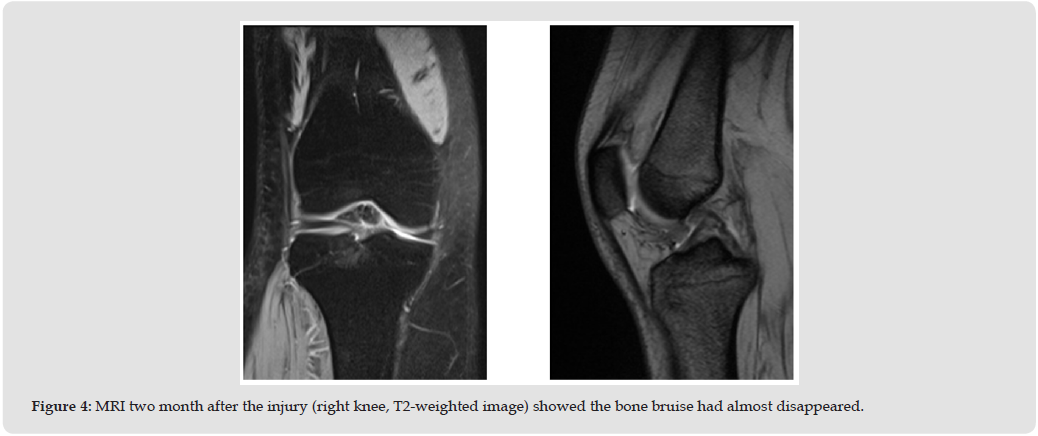
Figure 5
In this case, MRI at the time of injury revealed no bone bruises. However, 1 month later, when the patient’s pain had worsened, bone bruise appeared on MRI. Moreover, as the pain subsided, the bone bruise also resolved. Traumatic bone bruises typically result from direct injury that disrupts the trabeculae of subcortical bone, leading to the accumulation of interstitial fluid and hemorrhage within the extracellular space [4]. On MRI, bone bruises are identified by subcortical hypointense signals on T1-weighted images and hyperintense signals in T2-weighted images, reflecting a localized increase in fluid content [5]. Bone bruises of the tibiofemoral joint serve as a footprint of the dynamic forces within the joint at the moment of ACL rupture, offering insights into the mechanisms of injury [6-8]. Characteristic bone bruise patterns in ACL injuries have been described, with the lateral tibial plateau (LTP) and lateral femoral condyle (LFC) being the most common sites. Notably, the posterior LTP and central LFC are most frequently affected [9-13]. Studies have reported that a higher incidence of bone bruises in the lateral compartment suggests the presence of valgus stress during the ACL injury, which may lead to opening of the medial joint space [6,14].
In this case, the bone bruise was likely due to stress-induced disruption of the subcortical trabeculae rather than a direct traumatic impact. It is therefore considered that a partial ACL injury was sustained, and continued activity under this condition transmitted repetitive stress from anterior knee instability to the tibial bone marrow, potentially leading to the development of the bone bruise. Kroker et al. reported that 19 of 21 bone bruises healed within 2 months and all 21 resolved by 8 months. However, subchondral bone loss persisted up to 10 months [14-16]. In this case, the bone bruise had almost healed by approximately 2 months, likely due to the use of a knee brace and the consequent reduction in stress related to anterior knee instability. Regarding the relationship between pain and bone bruising, Driban, et al. [17] reported that increased bone bruise volume is associated with lower Knee Injury and Osteoarthritis Outcome Scores in the absence of depression fractures [17]. Similarly, in this case, the bone bruise almost disappeared in parallel with the reduction of pain symptom.
We present a case demonstrating an unusual appearance of bone bruising associated with ACL injury. The stress resulting from anterior knee instability may have been transmitted to the tibial bone marrow, thereby contributing to the development of the bone bruise.
Funding
This research was supported by the commissioned research expenses to Kanmon Medical Center (Shimonoseki, Japan) from Kyocera Japan and Japan Medical Dynamic Marketing ING.
Availability of Data and Material
Not applicable.
Consent for Publication
We have obtained consent to publish from the participants.
Competing Interests
The authors declare that they have no competing interests.
Ethics Approval and Consent to Participate
Not applicable.
Human and Animal Rights
No animals/humans were used for studies that are the basis of this research.
Standards of Reporting
CARE guidelines have been used for conducting this research.
Conflict of Interest
Authors declare no conflict of interest, financial or otherwise.
Acknowledgement
Declared none.
Authors’ Information
Not Applicable.

International Association of Landscape Archaeology, Czech Glass Society, Czech Republic

Department of Chemistry, Semenov Institute of Chemical Physics, USSR Academy of Sciences, Moscow, Russia

Neurology, LA BioMed Research Institute, USA

Associate Professor at Department of Breast and Thyorid Surgey, Chongqing General Hospital, China

Professor of Nuclear Medicine, Faculty of Medicine and Surgery, University of Milan, Milan, Italy





 Abstract
 PDF
PDF



























