info@biomedres.us
+1 (502) 904-2126
One Westbrook Corporate Center, Suite 300, Westchester, IL 60154, USA
Site Map
 ISSN: 2574 -1241
ISSN: 2574 -1241
ISSN: 2574 -1241
Received: November 20, 2025; Published: November 26, 2025
*Corresponding author: Zakharyeva NN, Professor of the Department of Physiology, Chief Researcher at the Sports Medicine Laboratory of the Research Institute of Sports and Sports Medicine, Russian State University of Physical Education, Sports, Youth and Tourism, Moscow, University Federal State Budget Educational Institution of Higher Education ‘The Russian University of Sport ’GTSOLIFK’, Russia
DOI: 10.26717/BJSTR.2025.64.009980
This article presents a comparative analysis of the morphofunctional status parameters of highly skilled Sanda
practitioners from Russia and China. Based on their martial arts school affiliation, Sanda practitioners divided
into two comparison groups:
1. Group 1—combatants from Russia and
2. Group 2—combatants from China.
It has been established, that Russian martial artists possess highly developed aerobic endurance, which, coupled
with their high level of psychomotor performance and motor precision in response to biologically significant
and moving stimuli, determines their success in the international arena. The physiological characteristics that
determine the success of Chinese Sanda fighters on the international stage include a highly developed ability to
develop differentiated inhibition when performing tactical tasks, and high precision muscle effort, which, combined
with powerful development of the lower extremity muscles, allows for highly effective strikes to the head,
body, and thigh of an opponent using leg techniques.
Keywords: Sanda; Martial Artists; Highly Skilled Athletes; Physical Performance; Maximum Oxygen Consumption; Kenneth Cooper Test; Psychophysiology; Morphofunctional Status
Martial arts and Sanda are extremely popular among various segments of the population in many countries, but especially in Southeast Asia, Russia, and the United States [1]. In modern sports physiology, the study of the characteristics of the morphofunctional state of martial artists of various ethnic groups is one of the most important areas, which allows us to determine early objective predictors of athletes’ competitive success, identify effective criteria for sports selection, and improve the technical and tactical preparedness and stress resistance of athletes [2,3]. In this regard, of particular importance in the development of the research direction we present is the study of a comparative analysis of a set of physiological parameters of highly qualified martial artists practicing Sanda, belonging to various world schools practicing and developing Sanda, which has not yet received sufficient scientific substantiation [4,5].
Forty-one highly skilled martial artists from Russia and China participated in the physiological experiment. All athletes actively compete in Russian and Chinese, European, and World Championships, where they demonstrate high athletic results. Comparison groups were formed based on ethnicity and geographic location:
Group 1 (gr1) – (n=26) – highly skilled martial artists from the Russian Federation – ethnically Russian; highly skilled athletes: Masters of Sports (MS) – 16% (4 individuals); Candidate Masters of Sports (CMS) – 72% (18 individuals); 12% (3 individuals) – 1 adult sports category. Group 1 – average age: 19.44±2.11; average martial arts training experience: 11.10±0.92; average training volume: 15.75±2.26 (hours per week). Athletes from gr1 belonged to the following types of martial arts:
1. Sambo - 26.92% (9 people);
2. Judo -11.54% (3 people);
3. Freestyle wrestling - 15.38% (4 people);
4. Greco-Roman wrestling -15.38% (4 people);
5. Kyukushinkai - 3.84% (1person);
6. Jiujitsu - kyukushinkai - 3.84% (1 person);
7. MMA - 23.07% (6 people).
The second comparison group (gr2) (n=15) consisted of highclass martial artists from China, who had been practicing Sanda for a long time; ethnically belonging to the Mongoloid race, the average age was: 20.13±1.87 years; training experience: 10.99±1.91 years; volume of the training load (hours per week): 17.53 ± 8.47 hours. All fighters from China were practicing Sanda and noted high competitive results. The assessment of the sports qualifications of Sanda fighters in the China assessed according to the following system:
1. Athletes of the third level;
2. Athletes of the second level;
3. Athletes of the first class;
4. National master;
5. International master.
The study involved second-level athletes - 60% (9 people) and first-class athletes - 40% (6 people).
Inclusion Criteria for the Survey Group
1. High level of athletic skill – martial artist ranks corresponding to adult sports rank 1 or higher;
2. Successful participation in prestigious competitions;
3. No history of acute respiratory viral infections, influenza, or COVID-19 (19, 20, 21) at the time of the survey;
4. Experience: more than 10 years of martial arts training;
5. Low level of motivation for the survey.
Exclusion Criteria for the Survey Group
1. Athletic skill level below adult sports rank 1;
2. No prize money from participation in prestigious competitions;
3. History of acute respiratory viral infections, influenza, or COVID-19 (19, 20, 21) at the time of the survey;
4. Experience: less than 10 years of martial arts training.
Conflict of Interest – Absence of Conflict of Interest
The Following Methods Used in the Study:
1. Sociological methods: questionnaires, interviews;
2. Anthropometric methods: body length and weight, body circumference measurements: chest circumference at rest, during inhalation and exhalation; head, waist, upper arm, forearm, thigh, and lower leg circumferences.
3. Psychophysiological testing conducted using “The Researcher of human spatio-temporal properties” 2.1 computer program (Koryagina Yu.V., Nopin S.V. (2001-2003)). Athletes completed tests assessing reflex responses to biologically significant stimuli: light, sound, moving object, choice reaction time (ms), and individual minute time (s).
4. The psychomotor performance of martial artists assessed using the test “Human mental performance” - “URA” computerized Mental Performance test (V.V. Sonkin, V.D. Sonkin, V.P. Zaitseva (2009)), with increasing cognitive load and varying information delivery speeds. The tests conducted in three difficulty levels.
5. Wrist and deadlift dynamometry (DMER-120 wrist dynamometer and DS-500 RF deadlift dynamometer);
6. Cooper test (12-minute smooth run under standardized track and field arena conditions); VO2 max = (D12 - 504.9)/44.73, where D12 is the distance in meters covered during the 12-minute test. The results of own research According to sociological research (questionnaires, interviews), all athletes from the Russian Federation (gr1) actively participated in competitions and noted high sporting achievements: 1st place at the World Championship - 1 person (3.84%), European Champions - 1 person (3.84%); champions and prize winners of the Russian Sambo Championships - 5 people (19.23%); champions and prize winners of All-Russian competitions - 5 people (19.23%); champions and prize winners of the city of Moscow and the Moscow region - 46.15% winners and prize winners of the championships of Yakutia, the Far East and Dagestan - 7.69% (2 people). Among martial artists from the China (gr2), prize winners and champions of the the China championships - 53.33% (8 people) of athletes took part in physiological testing; Champions of Henan, Hainan, and Jiangxi Provinces in China – 33.33% (5 people); champions of the Sanda Youth Games in China – 13.33% (2 people). Athletes – martial artists from the Russian Federation report a history of musculoskeletal and central nervous system injuries in 76.47% (20 people), sustained as a result of falls on the mat and during attacking and counterattacking techniques. No sports injuries reported in 15.38% (4 people).
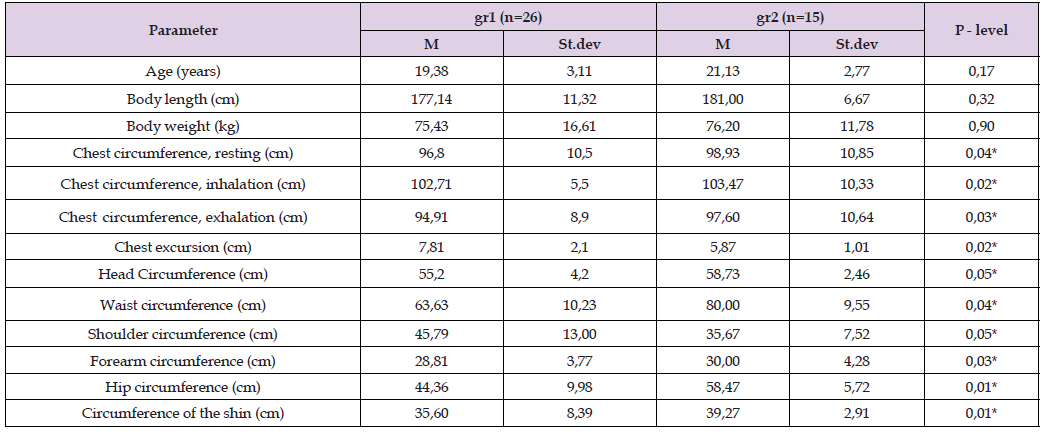
Among martial artists from the Russian Federation, 58.82% (15 people), three (11.53%), reported combined musculoskeletal and central nervous system injuries, including multiple concussions and various limb fractures. It noted that 52.93% of martial artists (13 individuals) with musculoskeletal and central nervous system (CNS) injuries reported concomitant injuries to the oral mucosa, lips, and cheeks at the time of injury in 100% of cases. Chinese martial artists reported only minor injuries in their medical history. Twenty percent of athletes (3 individuals) reported shoulder sprains. No CNS injuries or combined CNS and CNS injuries observed in Chinese athletes. A comparative analysis of the morphofunctional parameters of Russian martial artists and Chinese Sanda wrestlers presented in Table 1. As can be seen from Table 1, no significant differences observed between the comparison groups in the parameters age, body length (cm), and body weight (kg); therefore, the groups can be compared during the comparative analysis. The chest circumference values at rest, during inhalation, and during exhalation are higher in athletes from China (p<0.02). However, it should be noted that the chest excursion (CE) (chest circumference during inhalation (cm) - chest circumference during exhalation (cm)) is higher in Russian martial artists than in Chinese athletes.
Table 1: Anthropometric indicators of martial artists from the Russian Federation and Sanda fighters from the PRC.
Note: *Statistically significant differences.
In gr1, the CE value was 7.81 ±2.10 cm; in Chinese Sanda fighters in gr2, it was 5.87 ± 0.31 cm (p<0.05). In both comparison groups, the EGC indicator is average (standards: <4 cm - low; 5-9 cm - average; 10 and > - high), while in Russian athletes it is closer to high values. Characterizing body circumference measurements, it is worth noting that the shoulder circumference measurements are significantly larger in Russian athletes (p < 0.05), while the forearm, waist, thigh, and shin circumference measurements are larger in athletes the from China. We established a high degree of reliable differences when comparing the values of the thigh and shin circumferences (p < 0.01). Thus, the analysis of the results of comparing the anthropometric indicators of martial artists from the Russian Federation and the from China revealed the prevalence of shoulder muscle development in athletes from the Russian Federation, which enables them to effectively perform grabs, strikes, and throws performed with the participation of the upper limb muscles. Such strikes are especially valuable in Sanda and assessed by the referee as 2 points. Compared to their Russian counterparts, Chinese athletes have stronger thigh and calf muscles, which allows them to more effectively deliver kicks to the head and body, as well as kicks to the opponent’s thigh using kicking techniques. Referee can be assessed this advantage over Russian athletes by the with 1 to 2 points.
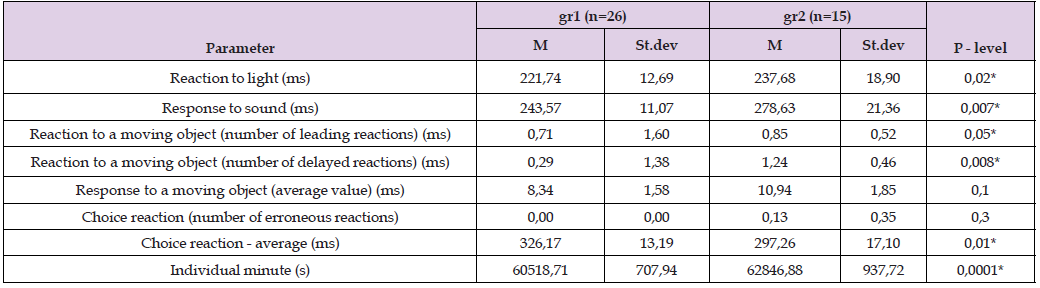
An analysis of the psychomotor performance of Russian martial artists and Chinese Sanda fighters was conducted based on the athletes’ psychophysiological tests performed using a computer program developed by Yu. V. Koryagina and S. V. Nopin (2001-2003). The results of the tests, reflecting the martial artists’ ability to navigate in space and time, presented in Table 2. Russian martial artists exhibit a more responsive response to biologically significant stimuli: light and sound, compared to g2 athletes (Table 2). A high level of reliable differences (p<0.007) was found in the Sound Reaction Test. Chinese Sanda wrestlers exhibit a higher number of leading and lagging errors in the RDO test (ms), which may negatively impact their motor precision when striking an opponent and executing movements during fights. Our data on the performance of martial artists in the RDO test are consistent with the data obtained in a study conducted on Russian martial artists by Professor A.N. Bleer, Doctor of Pedagogical Sciences, and Master of Sports in Freestyle Wrestling, and Professor V.V. Sheyan, Doctor of Pedagogical Sciences (2009). The ability to differentiate inhibition, determined by the results of the Choice Reaction Time test (in ms), is better in Chinese Sanda wrestlers. The “Individual Minute” test is particularly informative in identifying intergroup differences. Athletes from the Russian Federation (gr1) demonstrated near-perfect accuracy in time estimation (g1-g2 at p<0.0001), indicating a high level of fitness.
Table 2: Psychophysiological indicators of martial artists from the Russian Federation and China.
Note: *Statistically significant differences.
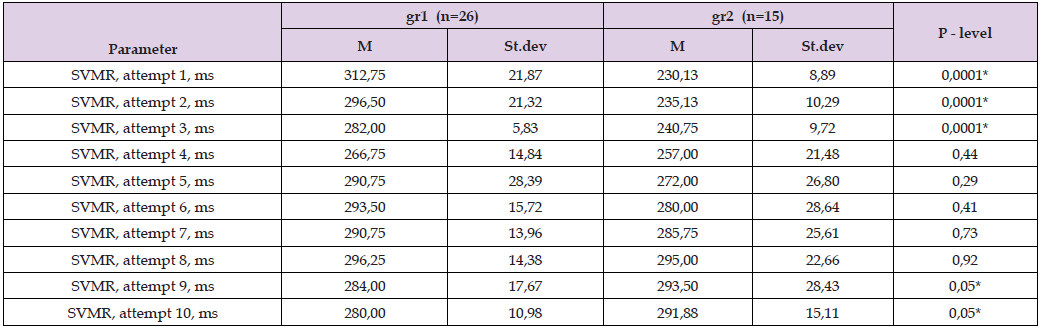
Russian combat athletes report high speed in completing tasks on the Mental Performance Test with the highest cognitive load, noting a high degree of reliability in differences (gr1-gr2 at p<0.01). The average speed for completing the Mental Performance Test in Gr1 was 950.00±191.49 (ms); the average speed for completing the Mental Performance Test in Gr2 was 1125.00±103.51 (ms). The Simple Visual- Motor Response test is the most informative test for identifying differences between comparison groups. The results of the Simple Visual-Motor Response test for combat athletes from Russia and China presented in Table 3. The data presented in Table 4 confirm the rapid fatigue response of martial artists from the People’s Republic of China during psychophysiological testing involving a series of stimuli. Significant differences identified on the 1st, 2nd, and 3rd attempts with the highest reliability (gr1 – gr2, at p < 0.0001). However, martial artists from the Russian Federation were more resistant to fatigue in the SVMR test, as demonstrated by the results of the final attempts. Aerobic endurance indicators for athletes from the Russian Federation and Sanda fighters from the People’s Republic of China obtained using the Kenneth Cooper test. The results of the Kenneth Cooper test performed by martial artists from the Russian Federation and the People’s Republic of China presented in Table 4.
Table 3: Results of the “Simple visual-motor reaction” test of martial artists from the Russian Federation and China.
Note: *Statistically significant differences.
Table 4: Results of the K. Cooper test performed by martial artists from the Russian Federation and China.

Note: *Statistically significant differences.
Modern martial artists, actively competing in the international arena, experience intense and extreme physical exertion on a daily basis. Athletes are forced to compete in highly competitive environments, which stimulates scientific research to identify new, effective criteria for athletic selection based on a set of data characterizing the athlete’s morphofunctional state [6,7]. As leading Russian coaches note: “...when achieving record-breaking athletic results, a tendency toward improving the athlete’s technical and tactical capabilities is noted based on the athlete’s achievement of high functional capabilities.” Therefore, studying the characteristics of the morphofunctional state of martial artists is one of the most important areas in modern sports physiology, as it allows for the identification of early objective predictors of athletes’ competitive success, the identification of effective criteria for athletic selection, and the enhancement of athletes’ technical and tactical preparedness and stress resistance [2,4,5,7]. Our study conducted a comparative analysis of the differences in morphofunctional parameters in elite martial artists practicing Sanda at leading global schools – Russia and China. Compared to their Chinese counterparts, Russian athletes demonstrated superior upper limb muscle development, enabling them to effectively execute grabs, strikes, and throws involving the upper limb muscles. These strikes are particularly valuable in Sanda and awarded 2 points by the referee [8].
Chinese Sanda fighters have well-developed thigh and calf muscles, enabling them to more effectively deliver kicks to the head and torso, as well as kicks to the opponent’s thigh using leg technique, thus demonstrating advantages over their Russian counterparts. When assessing the differences in psychomotor performance between Russian and Chinese combat athletes, it is important to note the advantages of Russian combat athletes in assessing time perception and response to biologically significant stimuli, their ability to resist fatigue when solving increasingly complex cognitive tasks in the third stage of the “URA” test, and their high speed of completion, which is also confirmed by the results of the serial stimulus test. The psychomotor performance advantages of Chinese combat athletes over Russian athletes include their rapid adaptation to psychophysiological tests involving serial stimuli and high precision of differentiated inhibition in the “Choice Reaction” test (ms). Russian combat athletes possess highly developed aerobic endurance, which, combined with their high level of psychomotor performance and motor precision in responses to biologically significant and moving stimuli, largely determines their success on the international stage. Physiological characteristics that determine the success of Chinese Sanda fighters on the international stage include a highly developed ability to develop differentiated inhibition when performing tactical tasks.
This ensures high precision of muscular effort and, combined with powerful lower extremity muscle development, allows them to deliver highly effective strikes to the head, torso, and thigh using leg techniques. Thus, our study demonstrates that success in combat sports at prestigious competitions requires high technical and tactical mastery, which is impossible without athletes achieving a high level of functional capabilities. In this regard, assessing the morphofunctional state of highly skilled combat athletes from various international martial arts schools is one of the most important promising areas for the development of modern sports physiology, as it allows us to identify early predictors of competitive success and the advantages and disadvantages of developing combat athletes’ functional fitness.

International Association of Landscape Archaeology, Czech Glass Society, Czech Republic

Department of Chemistry, Semenov Institute of Chemical Physics, USSR Academy of Sciences, Moscow, Russia

Neurology, LA BioMed Research Institute, USA

Associate Professor at Department of Breast and Thyorid Surgey, Chongqing General Hospital, China
Professor of Nuclear Medicine, Faculty of Medicine and Surgery, University of Milan, Milan, Italy





 Abstract
 PDF
PDF



























