info@biomedres.us
+1 (502) 904-2126
One Westbrook Corporate Center, Suite 300, Westchester, IL 60154, USA
Site Map
 ISSN: 2574 -1241
ISSN: 2574 -1241
ISSN: 2574 -1241
Received: November 06, 2025; Published: November 16, 2025
*Corresponding author: Oluseyi Ogunleye, Department of Maternal Fetal Medicine & Fetal Surgery, Nationwide Children’s Hospital 700 Children’s Drive Columbus, OH, 43205-2664, USA
DOI: 10.26717/BJSTR.2025.63.009961
Study Objective: Ultrasonography (USG) is vital in prenatal care. The American College of Obstetricians and Gynecologists
(ACOG) guidelines aim to ensure judicious use of ultrasound in pregnancy to optimize perinatal outcomes.
Previously, patients seen at the Teen and Adolescent Pregnancy (TAP) clinic at a free-standing children’s
hospital were referred to nearby maternal-fetal units for pregnancy dating and Level II ultrasounds. In spring
2021, an institutional Fetal Center (FC) was established, offering in-house maternal fetal medicine services. This
study evaluates how this practice change affected referral patterns and ultrasound utilization.
Methods: A before-after observational study analyzed all patients referred to the TAP clinic between March 31,
2020, to March 31, 2022. Two groups were compared: Group 1 (pre-FC) from April 1, 2020, to March 31, 2021,
and Group 2 (post-FC) from April 1, 2021, to March 31, 2022. Variables assessed included gestational age at
first ultrasound, time from referral to ultrasound, exam reporting time, number of visits to complete anatomy
surveys, gestational age at survey completion, and missed appointments.
Results: Overall, 612 patients were included (447 pre-FC, 165 post-FC). Post-FC patients required significantly
fewer visits to complete anatomy surveys (6.5% vs. 34%, p < 0.001) and completed surveys earlier (20.8 weeks
vs. 22.3 weeks, p < 0.001).
Conclusion: Centralizing ultrasound services via an institutional Fetal Center improved efficiency in providing
prenatal care for adolescent patients, resulting in fewer visits, and earlier completion of anatomy surveys. These
findings highlight the importance of periodically reviewing referral practices to optimize resource utilization
and enhance perinatal outcomes.
Keywords: Pregnancy in Adolescence; Ultrasonography; Prenatal; Health Care Quality; Access; and Evaluation
Abbreviations: USG: Ultrasonography; ACOG: American College of Obstetricians and Gynecologists; TAP: Teen and Adolescent Pregnancy; FC: Fetal Center; preFC: Pre-Fetal Center; GA: Gestational Age; IQR: Range, and Interquartile
The definition of “adequate prenatal care” varies based on national and international guidelines, encompassing factors such as the timing and frequency of visits, fetal ultrasound examinations, maternal outcomes, and neonatal health indicators [1]. Ultrasound is an important tool in prenatal care as it provides information designed to assist in providing optimal care and improved outcomes for both mother and fetus. There are guidelines for the timing of ultrasounds in pregnancy as to provide accurate diagnostic information of fetal growth and anatomy and create the best managements options for “monitoring, treatment and, for those who desire it, pregnancy termination” [2]. Frequency and indications of ultrasound in pregnancy is determined by maternal and fetal risk factors but the standard clinical recommendation for a single ultrasound examination is between 18- 22 weeks gestations. A first trimester ultrasound, defined as before 14 weeks gestation, is performed with the indication of unknown/unreliable LMP or aneuploidy screening [2,3]. These and other established standards for accurate pregnancy dating are important as timely ultrasounds can be linked to reduction in misdiagnosis such as size/ dates discrepancy, and unwarranted interventions in pregnancy. With these recommendations in mind, every medical practice providing obstetric care should have a process in place for obtaining prenatal ultrasounds for their patients. Beyond clinical guidelines, the delivery of prenatal care should consider systemic factors that affect access, especially among vulnerable populations. Socioeconomic disparities can lead to gaps in healthcare utilization [3-7], with adolescents identified as particularly at risk for adverse pregnancy outcomes due to inadequate prenatal care [4,7]. Factors such as pregnancy-induced hypertension, fetal growth restriction, and low birth weight underscore the importance of targeted interventions.
The main goal of this study was to evaluate the effectiveness of a paradigm shift in delivery of ultrasound services, as well as identify potential opportunities for improvement in ultrasound utilization among the select group of patients. The data from this study was collected from the Teenage and Adolescent pregnancy (TAP) clinic at a free-standing children’s hospital. Previously, TAP clinic patients were referred to external facilities for ultrasound examinations in early pregnancy for pregnancy dating as well as anatomy surveys. Compliance with keeping these appointments was a challenge for teen patients. To minimize logistics involved in this phase of care, this practice was changed with the establishment of an institutional Fetal Center (FC) in the spring of 2021.We hypothesized that with the new paradigm, there would be less delays in scheduling and, completion of anatomy survey [8,9].
Study Design
As part of a quality initiative study, a pre/post observational study was conducted on all patients referred to the TAP clinic over a twoyear period. (04/01/2020-03/31/2022) (IRB: STUDY00004709).
Study Groups
The sample was categorized into two groups: The Pre-fetal center (preFC), group comprised of patients seen in the clinic from (04/01/2020-03/31/2021), prior to the establishment of in-house ultrasound referrals. The post-fetal center (postFC)group consisted of patients seen in the clinic from (04/01/2021-03/31/2022), after the practice change of in-house prenatal ultrasounds was established.
Data Collection
The following data categories were evaluated for each patient: gestational age (GA) at first ultrasound appointment, time interval from ultrasound referral to scheduling of ultrasound appointment, time interval from ultrasound referral to first ultrasound examination, time interval between ultrasound examination and the receipt of ultrasound report by the TAP clinic, number of visits to complete anatomy survey, GA at completion of anatomy survey, and number of missed appointments.
Data Analysis
Descriptive statistics were used to summarize the data. Mean, median, range, and interquartile (IQR) were calculated for continuous variables such as patient age, GA, and time intervals. Categorical variables such as gravidity/parity, race, ethnicity, number of visits, number of missed appointments, and follow-up location (in-house vs. external facility) were presented as frequencies and percentages. To examine the association between groups (“preFC vs. postFC”) and other data points, Chi-squared tests were employed for categorical variables and t-tests were used for continuous variables. To control for potential confounding factors, multiple linear regression models were fitted for each continuous outcome of interest and multiple logistic regression models were utilized for binary response variables. These regression models allowed for the assessment of the independent effects of follow up location (“preFC” v. “postFC”) on the various outcomes while considering the influence of covariates.
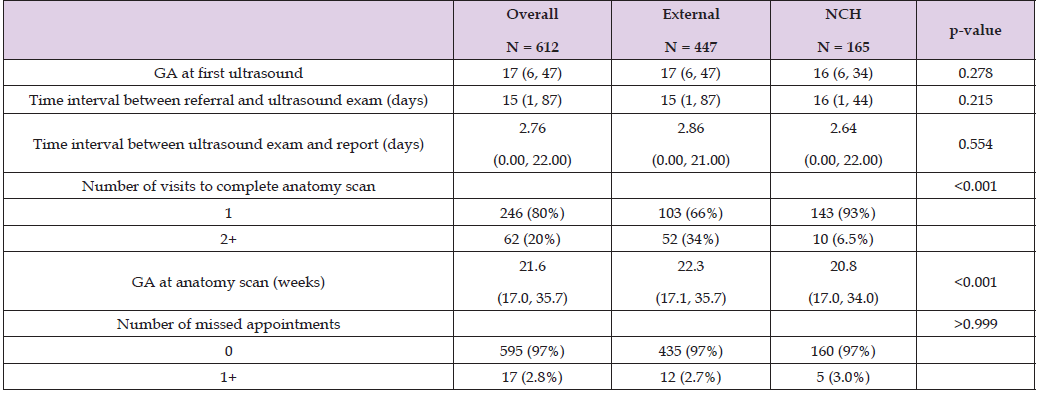
A total of 612 patients were included in this study. Of these, 447 (73%) patients were in the “preFC” group, receiving ultrasounds at external facilities, while 165 (27%) patients were in the “postFC” group, undergoing ultrasound examination in-house, following the change in institutional policy. Both groups were well-matched in terms of age, gravidity/parity, race, ethnicity, and gestational age (GA) at referral (Table 1). In tests of association, postFC patients were significantly less likely to require more than 2 visits to complete the anatomy scan as compared to preFC patients (6.5% vs. 34%; p<0.001) (Table 2). Additionally, the average gestational age at the time of anatomy scan was significantly lower for postFC patients compared to preFC (20.8 weeks vs. 22.3 weeks; p < 0.001). Although the number of missed appointments within the preFC cohort was higher than within the post- FC group, this finding did not approach statistical significance. After controlling for potential confounders, regression analysis supported the findings from tests of association. We found that the odds of requiring more than one visit to complete the anatomy scan was 88% lower for the postFC group compared to preFC group (p<0.001). Similarly, the gestational age at completion of the anatomy scan was, on average, 1.7 weeks lower for postFC patients compared to preFC patients (p<0.001). No other significant differences were found between the postFC and preFC groups for the remaining outcomes assessed.
Table 1: Patient demographics.

Table 2: Comparison of outcome measures, Pre FC Vs Post FC.
Prenatal care, originating in the late 19th century, and often initiated following a positive pregnancy test, was established to identify and prevent fetal abnormalities (1). Essentially, initial prenatal care was designed for early and accurate pregnancy dating, complex clinical assessments to identify baseline risks such as exposures to infections or toxins, mental health issues, barriers to care, early detection of fetal anomalies and potential maternal-fetal complications (18). Over time, the objectives of prenatal care shifted towards reducing both maternal-fetal morbidity and mortality. Today, prenatal care is one of the most frequently utilized preventive health service in the United States. Due to many elements of routine prenatal care lacking rigorous evidence, the effectiveness of prenatal care and best practices remain subjects of considerable debate, which is reflected in the significant variations in practice observed across different regions (19). Research efforts in prenatal care are crucial to addressing several key areas: the timing and frequency of visits, the components of medical assessments, the role of ancillary services, and the functionality of the prenatal care provider system (1). A nuanced understanding of health provision systems, with a focus on interactions between patients, providers, and organizations, is essential to optimizing the quality, accessibility, and efficacy of prenatal care. A critical factor in assessing the quality and efficacy of prenatal care is the adherence to guideline-based care, which emphasizes the importance of receiving the right care at the right time (2).
There are notable variations in the administration of guideline- based care across different regions and patient demographics. These variations highlight the need to design prenatal care systems that effectively addresses the diverse medical and psychosocial needs of patients (2). Standardizing care practices informed by established guidelines have the potential to reduce health disparities and improve overall care quality and efficacy. Addressing barriers to acquiring guideline-based prenatal care is vital to increasing accessibility and reducing disparities in care utilization and outcomes. Personal challenges such as financial constraints and lack of transportation are significant barriers, but systemic issues also play a critical role (3). Provider shortages, long travel distances, extended wait times, and brief appointment durations are commonly faced obstacles that must be addressed at a systems level. Potential solutions to enhance access and overcome these barriers include better geographic coverage, flexible scheduling, and appointment reminders (3). Tailoring prenatal care to meet the specific needs of vulnerable demographics, such as the teenage population-a focus of our study, thereby improving convenience and access to care, are essential steps in facilitating better outcomes for pregnant people and infants. Globally, approximately 11% of births occur among adolescents aged 15 to 19 years old, with a substantial decrease in this metric having been witnessed over the past two and a half decades (4). Extensive research has demonstrated that the benefits of and barriers to prenatal care are not equal across population subgroups. Adolescent pregnant people are uniquely vulnerable to risks including pregnancy-induced hypertension, anemia, obesity, low birth weight, and perinatal mortality (5).
Adolescents also typically experience higher exposure to poor nutrition, recreational drugs, tobacco, alcohol, and stress (5). Studies have demonstrated that teenage pregnant patients are more likely to smoke, be unemployed, and have higher rates of anemia and chorioamnionitis as compared to their adult counterparts (6). The deleterious effects of these risk factors are likely exacerbated by biological immaturity, lifestyle choices, and suboptimal prenatal care. Notably, adolescents are more likely to initiate prenatal care later in pregnancy compared to older pregnant individuals and are twice as likely to receive no prenatal care at all (6). Adolescents are particularly vulnerable to receiving suboptimal prenatal care due, in large part, to a characteristic higher likelihood of delays in initiating care. Recommendations for the care of pregnant adolescents includes a first trimester ultrasound, anatomy scan between 16 to 20 weeks, and assessment for fetal well-being and growth at 32 to 34 weeks (7). However, teens are among the subgroups most likely to initiate care after the 1st trimester which in turn negatively impacts guideline adherence in this population (3). A study by Gourevitch et.al. found that patients aged 12 to 24 were least likely to receive timely care with only 83% receiving anatomy scans at the recommended time compared to 90-92% of older patients (2).
This trend highlights a significant gap in the provision of guideline- based care for younger patients. Ultrasound provides significant clinical benefit. However, there remains a potential for unrecognized risk therefore best practices should be in accordance with “as low as reasonably achievable” (ALARA) principles (7). The potential for adverse biological effects secondary to fetal ultrasound exposure occurs due to thermal effects and mechanical effects (8). Animal studies performed in fetuses have demonstrated that absorption of ultrasound beams causes tissue heating of < 1.5° C and, although there is little evidence regarding the clinical significance of this, it is believed that the potential for harm increases with exposure time (8). Ultrasound also has the potential for mechanical effects via radiation force, streaming, and cavitation which create the potential for tissue breakdown (8). The fragile fetal tissue may be particularly vulnerable to these adverse effects, especially with the use of Doppler due to the higher intensity of the ultrasound beam (8). Although the adverse effects of fetal ultrasound have not been completely defined, there have been reports linking fetal ultrasound exposure to a variety outcome including growth restriction, speech delays, dyslexia, and left-handedness (9). Hence, efficient completion of anatomy scans is not only essential for the timely detection of fetal anomalies and pregnancy complications but also to minimize ultrasound exposure as much as possible. Our study focused on the impact of shifting from external ultrasound referrals to in-house examinations at our institutional teenage and adolescent pregnancy. This change aimed to streamline care coordination and improve access to timely care for adolescent patients. Our findings demonstrate that performing ultrasounds in-house resulted in earlier completion of anatomy scans and fewer visits needed to complete anatomy surveys-thereby minimizing potential for unrecognized risks, compared to “external” referrals. These improvements are crucial for timely counseling and informed decision-making, particularly regarding pregnancy termination when medically indicated or desired by the patient before the age of viability. Limitations of our study include variability in practices and skill levels across “external” provider facilities which may confound the number of ultrasounds needed to achieve a complete anatomy scan. Additionally, limited access to external records restricted our ability to fully explore barriers to timely care access. In conclusion, our findings highlight the important relationship between healthcare provision systems and the care that patients receive. By transitioning from external to in-house ultrasound services, we not only enhanced access to care but also improved the efficiency and effectiveness of prenatal services. These outcomes have significant implications for patient counseling, shared decision-making, and ultimately, the health outcomes of adolescent pregnant patients.
The authors report no conflicts of interest.

International Association of Landscape Archaeology, Czech Glass Society, Czech Republic

Department of Chemistry, Semenov Institute of Chemical Physics, USSR Academy of Sciences, Moscow, Russia

Associate Professor at Department of Breast and Thyorid Surgey, Chongqing General Hospital, China

Professor of Nuclear Medicine, Faculty of Medicine and Surgery, University of Milan, Milan, Italy

Department of Pharmaceutical Sciences, South University School of Pharmacy, USA





 Abstract
 PDF
PDF