info@biomedres.us
+1 (502) 904-2126
One Westbrook Corporate Center, Suite 300, Westchester, IL 60154, USA
Site Map
 ISSN: 2574 -1241
ISSN: 2574 -1241
ISSN: 2574 -1241
Received: October 25, 2025; Published: November 14, 2025
*Corresponding author: Urmanova Yu M, Alfraganus University, Department of Internal Medicine, Republican Specialized Scientific and Practical Medical Center of Endocrinology named after Academician EKh Turakulov, Republic of Uzbekistan, 100190, Tashkent, Yunusabad district, St. Yukori Karakamysh, 2A., building C, floor 3, Republic of Uzbekistan
DOI: 10.26717/BJSTR.2025.63.009960
The aim of the study is executing integrated analysis of risk factors recurrence of growth of non-functional pituitary
adenomas (NFPA)in the postoperative period.
Material and Methods of Research: We studied 20 patients with NFPA (Group 1 - 10 pituitary macroadenomas
and Group 2-10 giant pituitary adenomas) who underwent transnasal pituitary adenectomy.
All patients underwent examinations, including examination of the fundus, measurement of visual fields every
3 months, studies of the levels of STH, IGF-1, LH FSH, ACTH, TSH, prolactin, free thyroxine, cortisol, as well as
immunohistochemical studies of operated patients with determination of the levels of expression of Ki67, p53.
Research: The analysis showed that the most valuable predictors of tumor recurrence in NFPA are a Ki-67 labeling
index ≥4% (OR = 3.67), brain invasion (OR = 3.34), suprasellar invasion (OR = 3.24), and disease duration
(OR = 2.95). Genetic predisposition plays a significant role in the development of tumor recurrence. The frequency
of the hereditary factor in NFPA is 78.78% (OR = 2.51).
Conclusion:
1. The immunohistochemical (IHC) studies performed showed that between There is a significant correlation
between the Ki-67 marker, tumor size, and invasiveness in both groups. This marker should be used as a
prognostic criterion for recurrence and invasive growth of NFPA.
2. Using logistic regression analysis (LRA), we were able to show that all four criteria (Ki-67 (p < 0.001); OR
5.2// p53 (p < 0.001); OR 2.1// invasiveness (p < 0.001); OR 8.2)) were significant for the group with giant
NFPA s anda reliable correlation was found between them (p<0.001).
Keywords: NFPA; IHC; Proliferation Markers; Correlation
Abbreviations: WHO: World Health Organization; NII: Normalized Intensive Index; RR: Relative Risk; LRA: Logistic Regression Analysis
Relevance Although the diagnosis of atypical pituitary adenoma was introduced by the World Health Organization (WHO) over a decade ago, specific cutoff values for the criteria of “increased mitotic index” and “extensive nuclear staining for p53 immunoreactivity” remain lacking. They are also lacking for determining the behavior of NFPA in early stages to determine the potential size, invasiveness, degree of aggressiveness, and metastatic potential of the tumor. Therefore, the first important aspect of the study presented here was to propose reliable, reproducible, and easily predictable cutoff values for the mitotic rate and p53 expression level, the most readily available marker. Thus, nuclear accumulation of p53 as a prognostic marker of pituitary tumors is discussed in the literature in various areas. There are several studies with different results regarding its importance in behavior growth (aggressive/invasive) adenomas [1,2]. For atypical pituitary adenomas, German authors in 2015 proposed using a threshold value for p53 ≥2% of clearly immunoreactive nuclei. We preferred to use a cutoff value of Ki-67 ≥ 4% for our cohort because it has better discriminatory power and is more precisely defined.
The very high specificity (97%) and sensitivity (95%) indeed indicate that the proliferation index is a very good and reliable diagnostic tool (Youden index 0.92), which provides important results for the diagnosis of NFPA aggressiveness. Compared with p53 immunoreactivity (0.94), Ki-67 had the highest CI (0.98), suggesting that it is the best single parameter for the diagnosis of NFPA aggressiveness, which is in line with previous publications [3]. A total of 96% of cases were correctly classified by this single parameter alone. The probability of NFPA aggressiveness increases by 5.2 times per percentage of Ki67 immunoreactive nuclei (p < 0.001). A strong association between Ki-67, proliferation, and adenoma recurrence status was confirmed in a recently published case-control study (n = 410) analyzing an eight-year postoperative follow-up period [4]. This and several subsequent studies proposed a classification system for pituitary adenomas according to tumor size, type, and new grade of malignancy [5]. Invasive pituitary adenomas have been described as more aggressive in biological behavior and exhibiting an increased growth rate compared to noninvasive tumors [6]. However, 35 NFPA (23.2%) (n = 10/25) in our cohort showed an invasive growth pattern, which is consistent with several other observations published previously [7]. The low specificity reflects the fact that invasive growth is not limited to the giant NAG group. According to our results, invasiveness was the least effective parameter for differentiating both adenoma subtypes. It showed a particularly wide confidence range. On the other hand, invasive growth remains a crucial prognostic factor in predicting patients’ recurrence-free status and overall outcome [8]. The aim of the study is execute integrated analysis of risk factors recurrence of growth of inactive pituitary adenomas in the postoperative period.
We studied 20 patients with NFPA (Group 1 - 10 pituitary macroadenomas and Group 2 - 10 giant pituitary adenomas) who underwent transnasal pituitary adenectomy. The pituitary neurosurgery department of the Republican Specialized Scientific and Practical Medical Center of Endocrinology enrolled 12 patients between 2020 and 2022. Of these, 12 were men (60%) and 8 were women (40%). The average age of men was 48.12 years, while that of women was 46.15 years. The control group consisted of 10 healthy individuals with normal pituitary tissue. The maximum mean tumor diameter determined by MRI diagnostics was 44.7 ± 13.6 mm in 10 patients with giant NFPA, and macroadenomas > 30 mm were present in 10 patients.
All patients underwent examinations, including fundus examination, visual field measurements every 3 months, studies of the levels of STH, IGF-1, LH, FSH, ACTH, TSH, prolactin, free thyroxine, cortisol, as well as immunohistochemical studies of operated patients. with the determination of the expression levels of Ki67, p53. In addition, the AKU scale (2022) was introduced for the first time to predict the degree of tumor removal in the preoperative period. The patient’s age at surgery, gender, and histopathological tumor parameters, such as the presence of nucleoli and invasiveness, and expression of the cell cycle markers p53 and Ki-67, were recorded. Only nuclei with distinct nuclear expression were considered. In cases of heterogeneity, a second and third assessment were performed. Verification of tumor invasion into surrounding anatomical structures (e.g., meninges, bone, brain tissue, sphenoid sinus) was assessed using surgical reports, preoperative MRI samples, or confirmed by definitive histological examination. Proliferation markers Ki-67 and p53 were obtained semi quantitatively. Results were considered positive for cases with p53 ≥ 3+ (immunoexpression in 25 to 50% of cells), Ki-67 ≥ 2+ (immunoexpress ion in 10 to 25% of cells), and c-erbB2 ≥ 2+ (positivity in more than 10% of cells) according to local protocols. All samples were standardly fixed in formalin, embedded in paraffin, and stained with hematoxylin and eosin and PAS reactions.
The obtained data were processed using Microsoft Excel and STATISTICA- 6 software. The significance of differences in quantitative indicators (n> 12) was determined using the Wilcoxon signed-rank test for unrelated ranges; the nonparametric Fisher component randomization test for independent samples was used to determine the significance of small samples (n<12); and the Fisher-Irvine exact test was used for qualitative values. Differences between groups were considered statistically significant at P=0.05, correlation analysis was carried out using the nonparametric Spearman rank correlation method. Research results. Next, we performed a correlation between the Ki-67, p53 markers and demographic characteristics (Tables 1, 2).
Table 1: Correlation between the IHC marker Ki-67 and demographic characteristics of the groups.
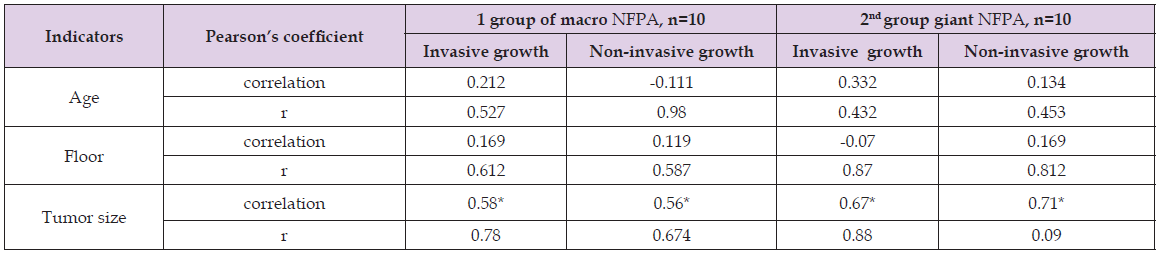
Table 2: Correlation between the IHC marker p53 and demographic characteristics of the groups.

As can be seen from (Table 1), a significant difference was found between the groupsKi-67 marker, tumor size and invasiveness in both groups. As can be seen from (Table 2), there is a significant difference between the groupsp53 marker, tumor size and invasiveness were not detected in both groups. Thus, the IHC studies performed showed that between There is a significant correlation between the Ki-67 marker, tumor size, and invasiveness in both groups. This marker should be used as a prognostic criterion for recurrence and invasive growth of NFPA. And finally, based on the completed studies of risk factors, we carried out Mathematical prediction of the risk of recurrence of NFPA growth in the postoperative period. To determine the prognosis for the development of complications, we developed risk limits for tumor recurrence using the method of normalization of intensive indicators (NIP) proposed by E.N. Shigan [1983]. For this purpose, we created a table for accounting for possible risk factors. This complex of assessed factors included: patient’s gender, age, hereditary predisposition to oncology, presence of bad habits, duration of the disease, brain invasion, suprasellar invasion, retrosellar invasion, parasellar invasion, p53 labeling index ≥2%; Ki-67 labeling index ≥4%; panhypopituitarism (deficiency of more than 3 tropic hormones), tumor size more than 3 cm, brainstem symptoms, amaurosis, etc.
Next, we calculated each risk factor using the relative risk (RR) indicator, which is the ratio of the maximum intensity level of the indicator to the minimum. In addition, we calculated the normalized intensive index (NII) using the formula: NII = r/M, where: r is the intensive indicator of NAG per hundred examined persons, M is the “normalizing indicator”. For each parameter, additional odds ratios (ORs) were calculated. “An odds ratio (OR) is a measure of the association between an exposure and an outcome. The OR represents the probability that an outcome will occur with a given exposure, compared with the probability that the outcome will occur in the absence of that exposure. Odds ratios are most often used in case-control studies [8].” The pseudo coefficient of determination (Nagelkerkes R 2) was used to measure the predictive ability of the model. The AUC (area under the curve) values were interpreted as follows: 0.5-0.7 = minimal; 0.7-0.9 = moderate; >0.9 = high discriminatory ability. Correlations between individual metric parameters (Ki-67, p53) were analyzed using Spearman’s rank correlation.
The data on the calculation of the integral assessment for tumor recurrence are presented in Table 3. The analysis showed that the greatest value for prognosticating tumor recurrence in NFPA are the Ki-67 labeling index ≥4% (OR = 3.67), brain invasion (3.34), suprasellar invasion (OR = 3.24), and disease duration (2.95). Genetic predisposition plays a significant role in the development of tumor recurrence. The frequency of the hereditary factor for NAG is 78.78% (OR = 2.51). Based on a set of possible factors and the data from the calculations and tables, we determined the possible limits of risk values. In this case, the risk limits are within the range of 19.76 - 44.59. Thus, we calculated the probable risk limits for recurrence of NFPA growth (19.76 - 44.59), as well as the borderline values. For this purpose, we divided the risk limits into three levels: low (up to 19.76), moderate (20.0–44.59), and high (45.0 or more) probability of risk of development. Recurrence of pituitary tumor growth.
Table 3: Integral analysis of risk factors recurrence of tumor growth in the postoperative period.
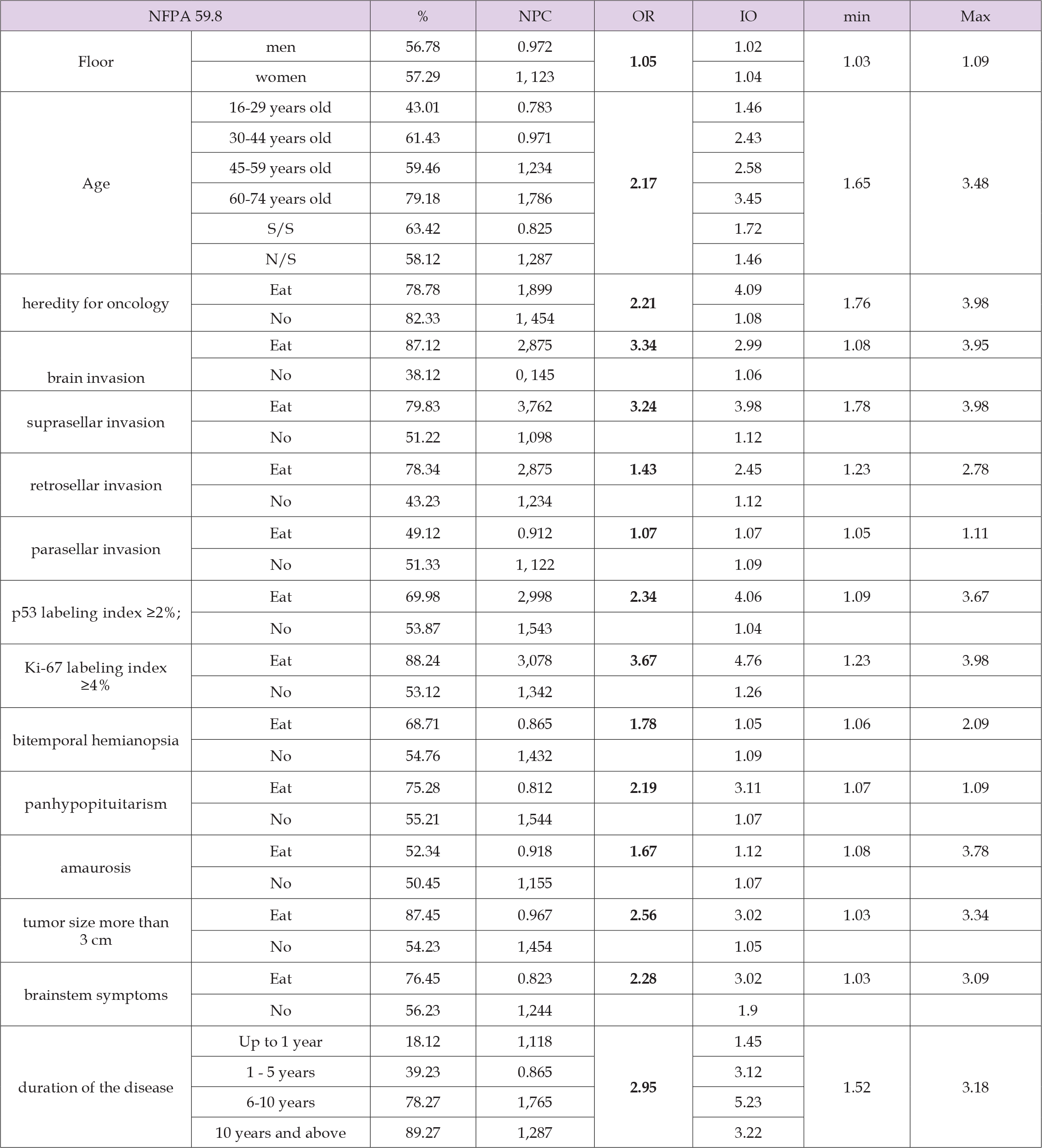
The boundaries of the probability of the risk of tumor recurrence that we developed are presented in Table 4.
Table 4: Limits of the degree of probability of the risk of tumor recurrence.

Next, having determined the total sum of the minimum and maximum scores for each risk factor, we developed a range of risk for the occurrence of tumor recurrence in patients with macro and giant NFPA
1. The lowest score (for NFPA: up to 19.76). Patients who achieve this score are considered to have a favorable prognosis and a low risk of tumor recurrence.
2. Intermediate - (for NFPA: 20.0-44.59). Patients in this subrange are at higher risk of tumor recurrence and should be a focus of medical attention.
3. Largest - (for NFPA: 45.0 and more). In this subrange, the influence of risk factors is maximum and patients falling into it have an unfavorable prognosis for recurrence of tumor growth.
By using this technique, it is possible to optimize treatment and preventive measures to reduce the incidence of tumor recurrence in patients with macro and giant NAGs in the postoperative period. Using binary logistic regression analysis (LRA), it was confirmed that all four predictors (invasiveness, mitotic rate, p53, Ki-67) significantly contributed to the determination of the dependent variables (non-aggressive/ aggressive adenoma). Correlation analysis showed that all four parameters considered were significant among themselves at the 0.001 level. Only invasiveness and p53 were significant at the 0.05 level in relation to each other. This agreement of four criteria of atypical tumor growth (i.e., Ki-67, invasiveness, mitotic count, and p53 levels) was proposed by a number of authors, in particular by German authors (Miermeister CP, et al. [9]) for atypical pituitary adenomas [9,10]. In conclusion, our results showed that in all patients with giant pituitary adenomas, the absence of parasellar invasion was associated with a higher rate of tumor stability after treatment (p = 0.0389; Pearson residual = +3). However, parasellar invasion was not associated with the outcomes of tumor regrowth/recurrence and cure/shrinkage. Infrasellar invasion and suprasellar extension were not considered good prognostic markers of clinical outcome. However, there was a tendency to associate the absence of extension into the third ventricle with a higher likelihood of tumor stability after treatment. Proliferative tumors, but mainly those classified as grade 2B (invasive-proliferative), showed a significant association with the rate of tumor regrowth/recurrence (p = 0.0127), confirming that these lesions should be considered as highly suspicious for neoplastic proliferation.
1. The conducted IHC studies showed that between There is a significant correlation between the Ki-67 marker, tumor size, and invasiveness in both groups. This marker should be used as a prognostic criterion for recurrence and invasive growth of NFPA.
2. Using logistic regression analysis (LRA), we were able to show that all four criteria (Ki-67 (p < 0.001); OR 5.2// p53 (p < 0.001); OR 2.1// invasiveness (p < 0.001); OR 8.2)) were significant for the group with giant NFPA reliable correlation was found between them (p<0.001).

International Association of Landscape Archaeology, Czech Glass Society, Czech Republic

Department of Chemistry, Semenov Institute of Chemical Physics, USSR Academy of Sciences, Moscow, Russia

Associate Professor at Department of Breast and Thyorid Surgey, Chongqing General Hospital, China

Professor of Nuclear Medicine, Faculty of Medicine and Surgery, University of Milan, Milan, Italy

Department of Pharmaceutical Sciences, South University School of Pharmacy, USA





 Abstract
 PDF
PDF



























