info@biomedres.us
+1 (502) 904-2126
One Westbrook Corporate Center, Suite 300, Westchester, IL 60154, USA
Site Map
 ISSN: 2574 -1241
ISSN: 2574 -1241
ISSN: 2574 -1241
Received: October 23, 2025; Published: November 04, 2025
*Corresponding author: Hanane Dergaoui, Hematology Laboratory, Avicenne Military Hospital, Marrakech, Morocco
DOI: 10.26717/BJSTR.2025.63.009943
Factor XI (FXI) deficiency is a rare coagulopathy characterized by poor correlation between plasma levels and bleeding risk, complicating its management. We report the case of a 24-year-old female patient with no family history of hemostatic disorders, who presented with unexplored episodes of epistaxis during childhood, without any other hemorrhagic events. An isolated prolongation of activated partial thromboplastin time (aPTT) was incidentally discovered during preoperative evaluation for tonsillectomy, with normal prothrombin time (PT) and fibrinogen levels. Investigations revealed severe FXI deficiency (1.8%). This case illustrates the importance of preoperative evaluation in screening for silent coagulation disorders and the necessity of individualized bleeding risk assessment according to the surgical procedure.
Keywords: Preoperative Evaluation; Coagulation Deficiency; Epistaxis; Factor XI; Activated Partial Thromboplastin Time
Abbreviations: FXI: Factor XI; APTT: Activated Partial Thromboplastin Time; FFP: Fresh Frozen Plasma; CAI: Circulating Anticoagulant Index
Factor XI (FXI) deficiency, also known as hemophilia C, is a rare congenital coagulopathy characterized by variable hemorrhagic expression [1]. First described in 1955, this condition is transmitted primarily through autosomal recessive inheritance. Homozygous subjects typically present with plasma FXI activity below 20%, while heterozygotes display values between 20 and 60% (vs. 50–150% for normal range). However, the occurrence of hemorrhagic episodes in certain heterozygotes suggests a more complex determinism than simple Mendelian recessivity. Clinical variability, often dissociated from plasma FXI levels, constitutes a challenge for risk assessment and management, particularly in surgical contexts. The objective of this work is to report a rare observation of isolated FXI deficiency, discovered incidentally during preoperative evaluation in an asymptomatic patient.
We present a 24-year-old female patient with no notable medical or surgical history, referred to the Hematology Laboratory of Avicenne Military Hospital in Marrakech for preoperative evaluation prior to tonsillectomy. She presented no signs of active bleeding at the time of consultation. In her medical history, she reported only episodes of moderate and spontaneous epistaxis during childhood, which were never investigated or treated. No family history of hemostatic disorders was reported. The physical examination was normal. Hemostasis evaluation revealed isolated prolongation of activated partial thromboplastin time (aPTT).
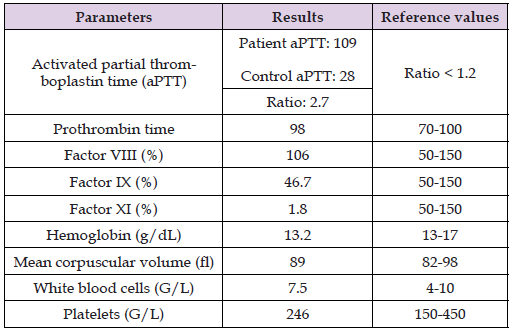
Complete blood count was normal: white blood cells 7.5 G/L,
hemoglobin 13.2 g/dL, MCV 89 fL, platelets 246 G/L (Table 1). Prothrombin
time was 98 %. The aPTT was markedly prolonged at 109
seconds (control aPTT 28 seconds) with a ratio of 2.7 (normal value
< 1.2). Given this isolated prolongation of activated partial thromboplastin
time (aPTT) and the absence of heparin anticoagulation, a
mixing study was performed by combining equal parts of the patient’s
plasma with control plasma. This “patient plasma + control plasma”
aPTT showed complete correction to 34 seconds. The Rosner index,
calculated at 5.5 (positive threshold > 15), suggests the absence of
circulating inhibitors and points toward a deficiency in coagulation
factor(s) rather than acquired inhibition. The search for lupus anticoagulant
by dRVVT and silica aPTT was negative.
The weight-based measurement of the factors showed:
• Factor VIII: 106% (N = 50–150)
• Factor IX: 46.7% (N = 50–150)
• Factor XI: 1.8% (N = 50–150)
The diagnosis of isolated Factor XI deficiency was established and
confirmed on a second sample.
Table 1: CT Exam Protocol.
Hemophilia C, or Rosenthal disease, is a rare congenital coagulopathy characterized by marked phenotypic variability. Its autosomal recessive transmission explains its higher prevalence in certain populations, notably Ashkenazi Jews. Outside these groups, as in our patient’s case, the deficiency remains exceptional [2]. The severe form, defined by plasma FXI activity below 20%, is extremely rare, with an estimated prevalence of 1–10 cases per million individuals [3]. This rarity, combined with the frequent absence of spontaneous clinical manifestations, often contributes to diagnostic delay, with patients sometimes identified incidentally during preoperative evaluation. Isolated prolongation of activated partial thromboplastin time (aPTT) is an important but non-specific warning sign. Three main etiologies may be suspected: anticoagulant treatment, deficiency of intrinsic pathway factors, and the presence of circulating inhibitors, either specific or lupus anticoagulant–type [4]. Among intrinsic factor deficiencies, abnormalities of factors VIII, IX, and XI are associated with clinical bleeding risk, while deficiencies of factor XII, prekallikrein, or high-molecular-weight kininogen are generally asymptomatic. In the absence of anticoagulation, a complete evaluation is warranted, including a mixing study, factor assays, and measurement of the circulating anticoagulant index (CAI), allowing differentiation between constitutional deficiency and acquired inhibition.
The particularity of FXI deficiency lies in the frequent dissociation between plasma levels and clinical expression. Unlike hemophilias A and B, where the severity of bleeding manifestations is proportional to factor activity, some patients with severe deficiency remain asymptomatic, while others with only moderate deficiency may develop severe bleeding, particularly in surgical or traumatic contexts [1,5]. This variability suggests the involvement of genetic modifiers, specific allelic variants, or environmental factors modulating the bleeding phenotype. Interactions with other components of the coagulation cascade and with local fibrinolytic mechanisms may also influence individual bleeding risk. Our case perfectly illustrates this heterogeneity. The patient, with severe deficiency (1.8%), was diagnosed incidentally during preoperative evaluation, without major bleeding history, apart from episodes of moderate childhood epistaxis. This situation raises a common clinical dilemma: should prophylactic replacement therapy be proposed for a severely deficient but asymptomatic patient? Available recommendations remain fragmentary and non-consensual [6], highlighting the need for an individualized approach. Management must be stratified according to the type of surgery, the mucosal or non-mucosal nature of the operative site, bleeding history, and FXI level. For low-risk procedures, careful monitoring may suffice, whereas for interventions at highly vascularized sites, such as tonsillectomy, prophylaxis with fresh frozen plasma (FFP) or specific FXI concentrates is generally recommended [7,8].
Antifibrinolytics provide a useful adjunct, particularly for limiting local fibrinolysis in mucosal tissues where bleeding risk is higher. Preoperative planning must include the exact substitution protocol, monitoring of post-transfusion plasma levels, and treatment adjustment according to intraoperative events. The role of the medical biologist is central—not only in guiding diagnosis when faced with isolated aPTT prolongation, but also in actively contributing to therapeutic decision- making in collaboration with the hematologist and surgeon. The mixing study helps determine the presence or absence of circulating inhibitors, while factor assays confirm the specific deficiency. This approach reduces unnecessary investigations, avoids diagnostic delays, and ensures safe management. In our case, this strategy enabled a rapid and precise diagnosis, allowing appropriate prophylaxis and an uncomplicated tonsillectomy. Beyond this case, the observation underscores a recurrent issue: the underestimation of rare bleeding disorders in populations without recognized risk. Even in asymptomatic patients, such deficiencies may represent a significant latent risk, justifying heightened vigilance and systematic exploration in surgical contexts [9]. Recent literature confirms that early detection and individualized prophylaxis planning improve surgical safety and significantly reduce hemorrhagic complications. The patient ultimately underwent tonsillectomy with preventive FFP administration, without hemorrhagic complications.
Thus, FXI deficiency requires a rigorous diagnostic approach, individualized bleeding risk assessment, and multidisciplinary coordination. Early recognition and proactive planning of prophylactic strategies are key to ensuring surgical safety and optimizing patient care.
Factor XI deficiency constitutes a rare but clinically significant cause of isolated aPTT prolongation. Its incidental detection, as observed in our case, requires individualized bleeding risk assessment. The therapeutic strategy must be adapted to the type of surgical intervention, degree of deficiency, and patient’s bleeding history. In asymptomatic forms, simple biological surveillance may suffice, while replacement therapy with fresh frozen plasma or specific concentrates is recommended in high bleeding risk situations. Early recognition of this pathology is essential to avoid diagnostic delays and inappropriate management [10]. Close coordination between medical biologist, hematologist, and surgeon remains indispensable to optimize surgical safety and overall patient management.
The authors declare no conflicts of interest.
• Isolated Factor XI deficiency identified incidentally in an
asymptomatic patient
• Isolated aPTT prolongation verified by mixing study and factor
assays, without inhibitor presence
• Variable clinical expression: plasma FXI level does not always
reflect bleeding risk
• Preoperative evaluation and multidisciplinary consultation
essential for adequate management.

International Association of Landscape Archaeology, Czech Glass Society, Czech Republic

Department of Chemistry, Semenov Institute of Chemical Physics, USSR Academy of Sciences, Moscow, Russia

Associate Professor at Department of Breast and Thyorid Surgey, Chongqing General Hospital, China
Professor of Nuclear Medicine, Faculty of Medicine and Surgery, University of Milan, Milan, Italy

Department of Pharmaceutical Sciences, South University School of Pharmacy, USA





 Abstract
 PDF
PDF



























