info@biomedres.us
+1 (502) 904-2126
One Westbrook Corporate Center, Suite 300, Westchester, IL 60154, USA
Site Map
 ISSN: 2574 -1241
ISSN: 2574 -1241
ISSN: 2574 -1241
Received: October 25, 2025; Published: November 03, 2025
*Corresponding author: Hui Won Kim, Department of Daily Food, Institute of Microbiology, the State Academy of Sciences, Unjong District,
Pyongyang City 355, DPR Korea
Deputy Editor: Ana Catherine V. Madrid RM RN
DOI: 10.26717/BJSTR.2025.63.009940
A way for PHA industrialization to become economically competitive is simultaneous production of PHA and another high-valuable product. Co-production of poly (hydroxybutyrate-co-hydroxyvalerate) (PHBV) and ectoine by Halomonas sp. PR-1 was investigated in two step fed-batch culture. In first-step culture the cell mass and PHBV level reached 35.3 g L−1, 20.8 g L−1, respectively. Subsequently, Halomonas sp. PR-1 cells were subjected to a salinity raising and dominantly produced ectoine in second-step culture. Finally, Halomonas sp. PR-1 produced 21.5 g L−1 PHBV and 4.5 g L−1 ectoine in two-step fermentation process.
Keywords: Poly (Hydroxybutyrate-Co-Hydroxyvalerate); Ectoine; Fed-Batch Culture; Halophile; C/N Ratio
Polyhydroxyalkanoates (PHA) are a group of bacterial polyesters synthesized by numerous bacteria. Their excellent plasticity, and their good biodegradability and biocompatibility make them profitable biomaterial for application in packing, agriculture, medical field, etc [1]. But the extensive industrial use of PHA is restricted by several factors, for example, high production cost [2,3]. A way for PHA industrialization to become economically competitive is simultaneous co-production of PHA and another high-valuable product [4,5]. Ectoine (1,4,5,6-tetrahydro-2-methyl-4-pyrimidinecarboxylic acid) is a well-known compatible solute commonly produced by halophile and has been exploited for commercial applications as an active ingredient for cosmetics, medicine, and protein and nucleic acid protection [6,7]. So far, there were several reports for co-production of PHA and ectoine during the same fermentation condition. Halomonas campaniensis produced 12.4 wt% polyhydroxybutyrate (PHB) accompanying with production of 1.4 mol ectoine per milligram of wet cells [8]. Controlling of nitrogen or phosphorus contents yielded 55% PHB and 6% ectoine within 120 h in H. elongate [9]. PHB and ectoine were synthesized of 68.5 wt. % and 13.25 wt. %, respectively, during two fedbatch fermentation by H. boliviensis [10]. It was recently highlighted that Halomonas bluephagenesis, metabolically engineered based on flux-tuning method produced ectoine of 8 g L-1 and dry biomass of 32 g L−1 containing 75% PHB during 44h fermentation [11]. In previous study we reported that Halomonas sp. PR-1 isolated from marine environment could intracellularly produce poly (hydroxybutyrate- co-hydroxyvalerate) (PHBV) from simplest carbon substrate, e.g., glucose [12]. In addition, Halomonas sp. PR-1 was capable to produce ectoine as a major osmolyte. Therefore, co-production of PHBV and ectoine by Halomonas sp. PR-1 can be considered to be a promising strategy for competitive PHBV industrialization. In currently studies on production of osmolyte and polyester by halophile, PHA families are limited primarily to PHB. Copolymers consisting of 3-hydroxybutyrate and the other hydroxyalkanoate have several advantages over homopolymer PHB, for example, low melting temperature and poor brittleness. PHBV production can be accomplished by addition of the precursors such as propionic acid and valeric acid during PHB fermentation [13]. In this study we described the co-production of PHBV and ectoine in two step fed-batch culture.
Bacterial Strain
The moderately halophile Halomonas sp. PR-1 was isolated from a saltern soil in the western of DPR Korea and accumulate intracellular PHBV, and also produce ectoine as a osmolyte in a high-salinity condition.
Culture Medium
Halomonas sp. PR-1 was grown in mineral medium consisting of (g/L): glucose (15-59), NH4Cl (4.5), KH2PO4 (1.5); MgSO47H2O (0.5); FeSO47H2O (0.05), NaCl (10-150). The medium was sterilized at 121℃ for 20 min. To examine the effect of C/N ratio and NaCl concentration on PHBV/ectoine production, glucose and NaCl contents were varied at different level. Feeding medium 1 (g/L): glucose (700), NH4Cl (4.5), KH2PO4 (1.5); MgSO47H2O (0.5); FeSO47H2O (0.05), NaCl (30), feeding medium 2(g/L): glucose (500), NH4Cl (4.5), KH2PO4 (1.5); MgSO47H2O (0.5); FeSO47H2O (0.05), NaCl (150).
Growth Conditions
For activation, a loopful of Halomonas sp. PR-1 cells was added to a 250 ml Erlenmeyer flask containing 50 ml yeast extract-casamino acid mineral salt medium and was grown in a rotary shaker at 30°C and 200 rpm for 20 hours. Cultivation later, 1 mL of inoculum was inoculated into a 250 ml Erlenmeyer flask containing 50 ml mineral medium and cultivated at 30°C and 200 rpm for the experiments. In study, how C/N ratio and NaCl concentration affect PHBV and ectoine production was investigated by performing the batch culture, respectively. The batch and fed-batch culture at a bioreactor were performed at 35°C and pH 7.5. The dissolved oxygen level was never less than 40%.
AssAays
Biomass was determined turbidimetrically: turbidity of culture broth was measured at 660 nm (OD660) and then was converted to cell dry weight via a standard curve. The PHBV concentration was determined by using a colorimetric method. One milliliter of culture broth was centrifuged at 4°C and 15,000×g for 10 min. One milliliter of sodium hypochlorite solution was then added to the pellet at 60°C for 1 h. After centrifugation again, pellet was washed with deionized water 2 times and was extracted with 1 ml of chloroform at 60°C for 1 h. The chloroform was evaporated at 100°C and 10 mL of concentrated sulphuric acid was added and heated for 10 min at 100°C in a water bath. The solution was cooled and its absorbance was determined at 235 nm. A PHBV standard curve was determined in the same way. The ectoine concentration was determined by high performance liquid chromatography (HPLC). A 1 mL sample of fermentation broth was centrifuged at 4°C and 14,000 × g for 15 min, and then washed with NaCl–Kpi buffer. After centrifugation, the pellets were resuspended in 1 mL of ethanol (80%, v/v) and then left at room temperature overnight. The suspension was centrifuged again and the supernatant was used for HPLC analysis. An Agilent Technologies 1260 Infinity HPLC (Germany) was equipped with a Nucleosil 100–5 C18 column with water/acetonitrile (95/5 v/v) as the mobile phase at 20°C. The flow rate was 1 mL min−1 and a UV detector wavelength of 210 nm was used. The ectoine retention time was determined by using commercially available authentic ectoine.
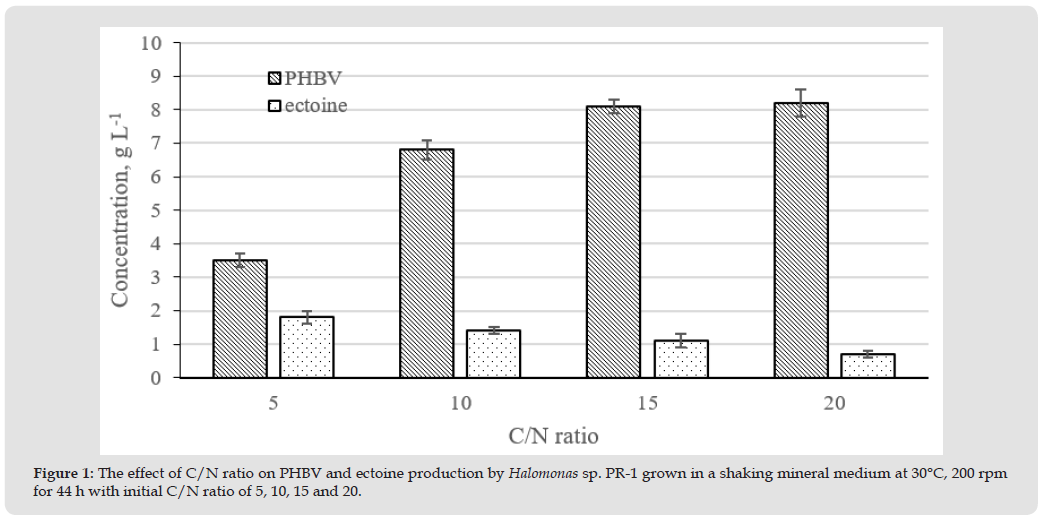
Figure 1
Effects of NaCl Concentration on PHBV and Ectoine Production
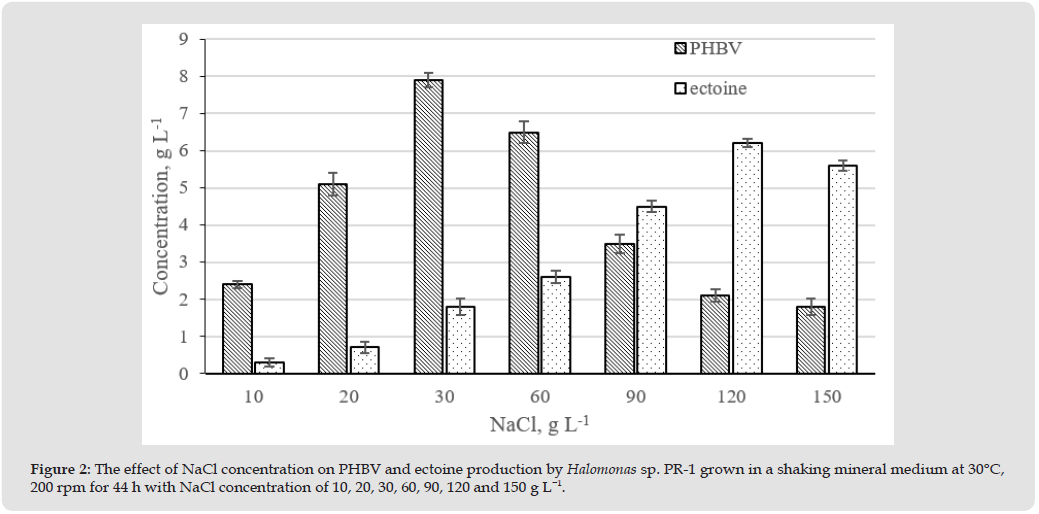
To examine the effects of NaCl concentrations on PHBV and ectoine production by Halomonas sp. PR-1, the NaCl concentrations in medium were conditioned to 10, 20, 30, 60, 90, 120 and 150 g L−1. The largest amount of PHBV (7.9 g L−1) was obtained at 30 g L−1 of NaCl concentration, while that of ectoine (6.2 g L−1) at 120 g L−1. As NaCl concentration increased at 30 - 120 g L−1, the amount of PHBV produced by Halomonas sp. PR-1 decreased dramatically and that of ectoine vice versa. In this study the optimal concentration of NaCl for PHBV accumulation was agreed with that reported by previous study, in which H. salina produced the largest amount of PHB at 30 g L−1 NaCl [14]. But H. boliviensis LC1, the other species of Halomonadaceae, accumulated the maximum amount of PHB at 45 g L−1 NaCl [10]. Ectoine is a major osmolyte found in the family Halomonadaceae and the amount of that stored in the cell increases as the salinity stress is increased. With the raise of NaCl concentration ectoine content within cell may be increased, but the volumetric productivity of ectoine in bioreactor may be reduced because of inhibition of cell mass production by overhigh salinity. The proper NaCl concentration for ectoine production by H. boliviensis LC1 was reported to be 150 g L−1 and 2 M of NaCl gaved the maximum ectoine yield in H. salina BCRC17875 [10,15]. As mentioned in previous reports, high NaCl concentration was beneficial for ectoine synthesis, but suppressive for cell growth and PHA synthesis. Both ectoine and PHA are synthesized from acetyl- CoA, and therefore metabolic flux to either of these would inevitably have an influence on the synthesis of the other [11] (Figure 2).
Figure 2
First Fed-Batch Culture for High-Density Cell and PHBV Production
Based on above experimental results, first-step culture was performed high-density cell and PHBV production. Halomonas sp. PR-1 was grown in 2.2 L of mineral medium with 15 of C/N ratio and 30 g L−1 of NaCl concentration at 5 L bioreactor. 18 h fermentation later, cell culture was performed as fed-batch fermentation with feeding medium 1 at the feeding rate of 30 mL h-1 for 10h. Two-step culture strategy can be considered to be beneficial to PHA/ectoine co-production. In previous study first-step culture was often performed with the aiming of obtaining high cell mass [10]. Here, H. boliviensis LC1T was grown in a medium with 4.5% (w/v) NaCl and sufficient levels of monosodium glutamate, NH4+, and PO43− and produced biomass of 10.7 g L−1. As shown Figure 3, Halomonas sp. PR-1 cell mass showed rapid increase at 6~20h culture, followed by slow increase, perhaps due to limitation in nutritive source. During batch culture C/N ratio was maintained at approximately 15, and gradually increased from 15 to 25 with feeding of nutritive deficient medium, which resulted in promoting PHBV accumulation. Finally, cell dry weight and PHBV content reached 35.3 g L−1, 20.8 g L−1, respectively, in first-step culture.
Second Fed-Batch Culture for Ectoine Production
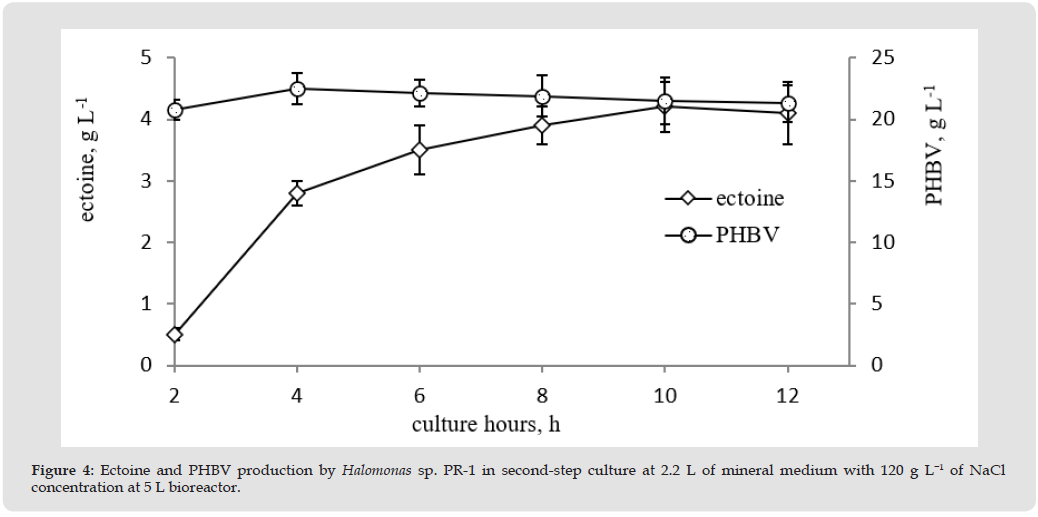
Aiming at ectoine production, in second-step culture Halomonas sp. PR-1 was subjected to a salinity raise. The cells obtained in firststep culture were transferred to a fresh batch medium containing 120 g L−1 of NaCl, followed by being set at further growth in a second fedbatch culture with feeding medium 2 at the feeding rate of 35 mL h-1. After 4h, ectoine level was began to increase and reached maximum value of 4.2 g L−1 untill 10 h. PHBV content tended to slightly decrease during fermentation. Finally, Halomonas sp. PR-1 produced 21.5 g L−1 PHBV and 4.2 g L−1 ectoine in two-step fermentation process. The prior reports have indicated that high NaCl concentration was beneficial for ectoine synthesis, but suppressive for PHB synthesis. During the PHB/Ect co-production with H. boliviensis, the ectoine concentration, maximum cell dry weight and PHB concentration were 0.4, 10 and 5.8 g L−1 respectively at 50 g L−1 NaCl (Figure 4). However the corresponding concentrations became 0.74, 6 and 1.7 g L−1 respectively when concentration of NaCl was 150 g L−1 [10]. To avoid the inhibitions of cell growth and PHB synthesis at high NaCl concentration, the present method comprised two fed-batch cultures at different NaCl concentrations.
Figure 3
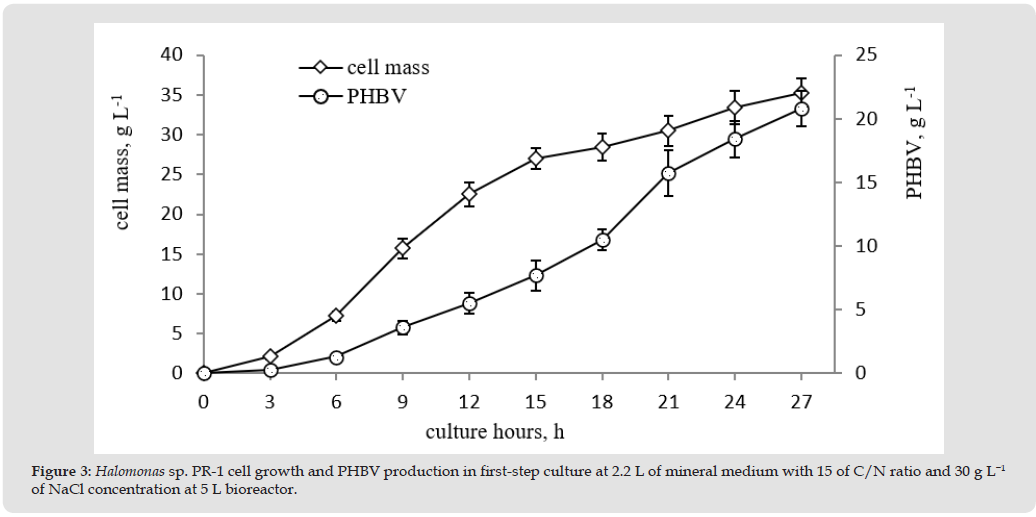
Figure 4
Co-production of poly (hydroxybutyrate-co-hydroxyvalerate) (PHBV) and ectoine by Halomonas sp. PR-1 was investigated in two step fed-batch culture. In first-step culture the cell mass and PHBV level reached 35.3 g L−1, 20.8 g L−1, respectively. Subsequently, Halomonas sp. PR-1 cells were subjected to a salinity raising and dominantly produced ectoine in second-step culture. Finally, Halomonas sp. PR-1 produced 21.5 g L−1 PHBV and 4.2 g L−1 ectoine in two-step fermentation process.
Conceptualization, CHR and HWK; methodology, RCK, JSK, GSR and WCK; software, GSR; validation, CHR, RCK and JSK; formal analysis, JSK; investigation, RCK and GSK; resources, JSK and WCK; data curation, HWK; writing—original draft preparation, HWK; writing— review andediting, HWK; supervision, CHR; project administration, CHR and HWK. All authors have read and agreed to the published version of the manuscript.
The authors hereby declare no conflict of interest.

International Association of Landscape Archaeology, Czech Glass Society, Czech Republic

Department of Chemistry, Semenov Institute of Chemical Physics, USSR Academy of Sciences, Moscow, Russia

Associate Professor at Department of Breast and Thyorid Surgey, Chongqing General Hospital, China

Professor of Nuclear Medicine, Faculty of Medicine and Surgery, University of Milan, Milan, Italy

Department of Pharmaceutical Sciences, South University School of Pharmacy, USA





 Abstract
 PDF
PDF