info@biomedres.us
+1 (502) 904-2126
One Westbrook Corporate Center, Suite 300, Westchester, IL 60154, USA
Site Map
 ISSN: 2574 -1241
ISSN: 2574 -1241
ISSN: 2574 -1241
Received: October 25, 2025; Published: October 30, 2025
*Corresponding author: Chinmay Chauhan, Managing Member at Siddhey LLC Healthcare Consulting, NCT06328010 – Clinicaltrials.gov,
215 E Warm Springs Rd, Suite 107-108, Las Vegas, NV 89119, USA.
Deputy Editor: Ana Catherine V. Madrid RM RN
DOI: 10.26717/BJSTR.2025.63.009935
Background: Chronic wounds, including diabetic foot ulcers (DFUs), venous leg ulcers (VLUs), and pressure
injuries, remain a major clinical and economic burden. Cellular, acellular, and matrix like products (CAMPs) derived
from amniotic tissue provide extracellular matrix scaffolding, growth factors, and anti-inflammatory properties
that may accelerate healing.
Objective: To evaluate wound healing outcomes with Acesso Biologics CAMPs in a prospective, NIH listed registry
(NCT06328010).
Methods: Patients were evaluated in three study arm snapshots: (1) Completed–Healed (n=15), (2) Completed–
Not Healed (n=6), and (3) Active Treatment (>4 weeks, n=18). Prior to receiving treatment with the Acesso Biologics
CAMPS, all subjects in this study received a minimum of 4 weeks of conservative treatment per standard of
care wound healing regiments. Following conservative treatment, all patients received Acesso Biologics CAMPs
in addition to standard wound care. Outcomes included percent wound area reduction (PWAR) and categorical
healing status.
Results: All wounds in the Completed–Healed snapshot achieved 100% closure, with median healing times
of 6–12 weeks. The Completed–Not Healed snapshot demonstrated a mean PWAR of 53.6% (range –25.7%
to 94.8%), reflecting heterogeneity in real world populations. The Active Treatment snapshot showed a mean
PWAR of 67.8% (range 13.4% to 96.9%), with DFUs and surgical wounds demonstrating the most rapid progress,
while VLUs healed more slowly. Kaplan–Meier style analysis indicated progressive closure, with >80% of
active wounds achieving substantial reduction by week 12.
Conclusion: Acesso Biologics CAMPs demonstrated robust healing outcomes across diverse wound types in
real world practice. These findings support their role as effective adjuncts in chronic wound management and
underscore the importance of real-world evidence in complementing randomized trial data. Larger comparative
studies are warranted to validate these outcomes and identify patient populations most likely to benefit.
Chronic wounds affect an estimated 6.5 million patients in the United States, with annual costs exceeding $25 billion^1. DFUs, VLUs, and pressure injuries are particularly challenging, often persisting despite standard wound care and leading to infection, hospitalization, and amputation. Advanced wound care therapies, including CAMPs derived from amniotic and placental tissues, provide extracellular matrix scaffolding, growth factors, and anti-inflammatory properties that promote tissue repair^2. Randomized controlled trials have demonstrated their efficacy in DFUs and VLUs^3,4, but real-world evidence (RWE) is essential to understand their performance in heterogeneous patient populations. This study presents interim results from an NIH listed registry (NCT06328010) evaluating wound healing outcomes with Acesso Biologics CAMPs. We will present and discuss an interim analysis of the Acesso Biologics treatment arm, focusing on three groups: Completed–Healed, Completed–Not Healed, and Active Treatment (subjects with more than 4 weeks but fewer than 10 weeks of ongoing therapy). This snapshot of the current dataset offers an early indication of the trends that may emerge as the study progresses.
Study Design
This is a prospective, observational registry designed to capture RWE on advanced wound care therapies. A minimum of 4 weeks of conservative or standard of care has been provided to the subject prior to initiating treatment with an advance modality of CAMPs. The registry is listed on ClinicalTrials.gov (NCT06328010).
Population
Patients with chronic wounds of varying etiologies (DFU, VLU, pressure, surgical, traumatic) were enrolled across multiple clinical sites. All patients received Acesso Biologics CAMPs in addition to standard wound care.
Study Arm Snapshots
• Completed–Healed Arm Snapshot (n=15): Wounds achieving 100% closure.
• Completed–Not Healed Arm Snapshot (n=6): Wounds completing treatment without full closure.
• Active Treatment Arm Snapshot (>4 weeks, n=18): Wounds under ongoing treatment.
Outcomes
The primary outcome was percent wound area reduction (PWAR). Secondary outcomes included categorical healing status (healed vs. not healed) and time to closure.
Analysis
Descriptive statistics were used to summarize outcomes. Visualizations included bar charts of mean healing rates, box plots of variability, and Kaplan–Meier style curves of cumulative healing in the Active Treatment snapshot.
Patient and Wound Characteristics
A total of 39 wounds were analyzed. Wound types included DFUs, VLUs, pressure injuries, surgical wounds, and traumatic wounds.
Healing Outcomes
• Completed–Healed Arm Snapshot: All 15 wounds achieved 100% closure, with median healing times of 6–12 weeks.
• Completed–Not Healed Arm Snapshot: Mean PWAR was 53.6% (range –25.7% to 94.8%). Some wounds demonstrated substantial improvement, while others worsened, reflecting real world heterogeneity.
• Active Treatment Arm Snapshot: Mean PWAR was 67.8% (range 13.4% to 96.9%). DFUs and surgical wounds showed the most rapid progress, while VLUs healed more slowly.
Visual Findings
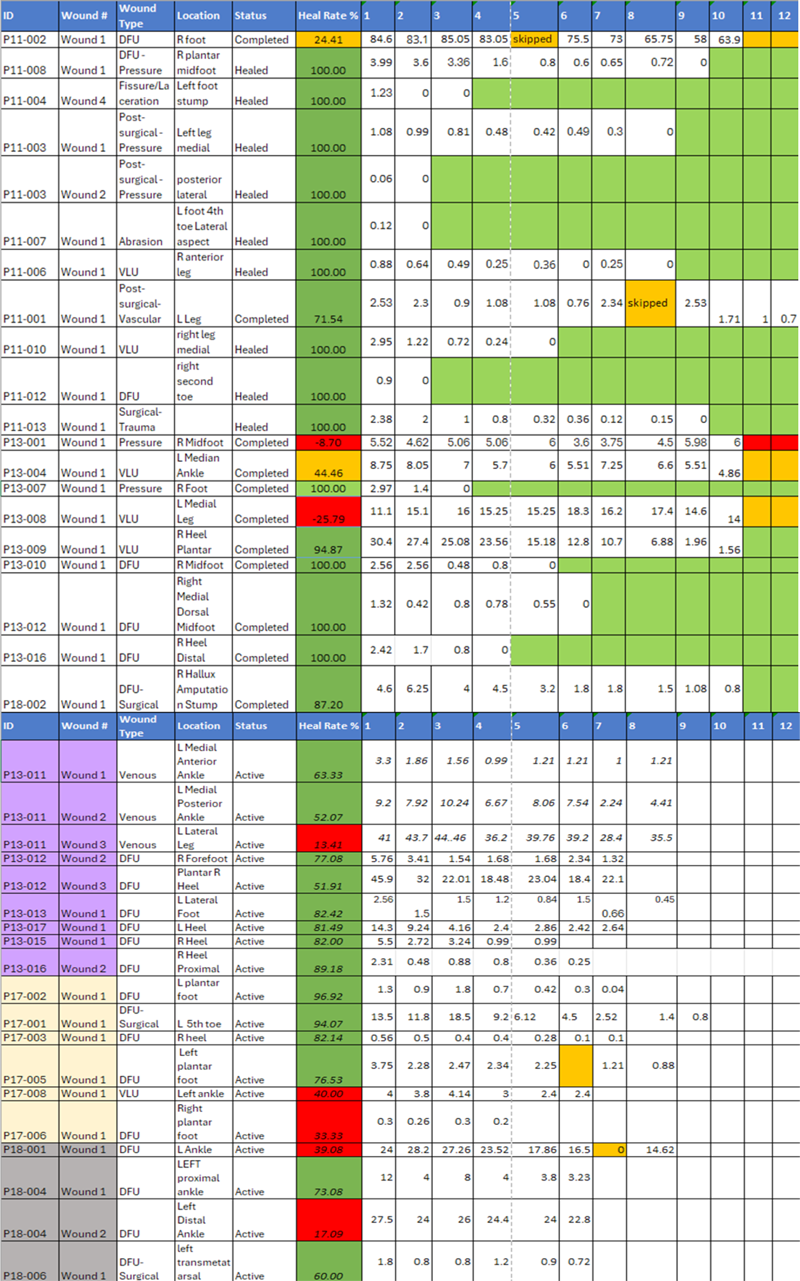
Bar chart comparing mean wound healing rates among three cohorts: Completed-Healed (n=15, 100% closure), Completed-Not Healed (n=6, mean 53.6% reduction, range -25.7% to 94.8%), and Active (>4 weeks, n=18, mean 67.8% reduction, range 13.4% to 96.9%). The figure highlights the robust closure rates achieved with Acesso Biologics CAMPs in real-world practice (Figure1-3). Box plot illustrating the variability of wound healing rates in the Completed-Not Healed and Active cohorts. The plot demonstrates heterogeneity in real-world outcomes, with some wounds showing near-complete closure while others exhibited slower or negative healing trajectories. Approximate Kaplan–Meier curve showing cumulative wound closure over 12 weeks in the Active cohort (n=18) (Table 1). The curve demonstrates progressive healing, with a substantial proportion of wounds achieving >80% closure by week 12, underscoring the effectiveness of Acesso Biologics CAMPs in ongoing treatment.
Figure 1
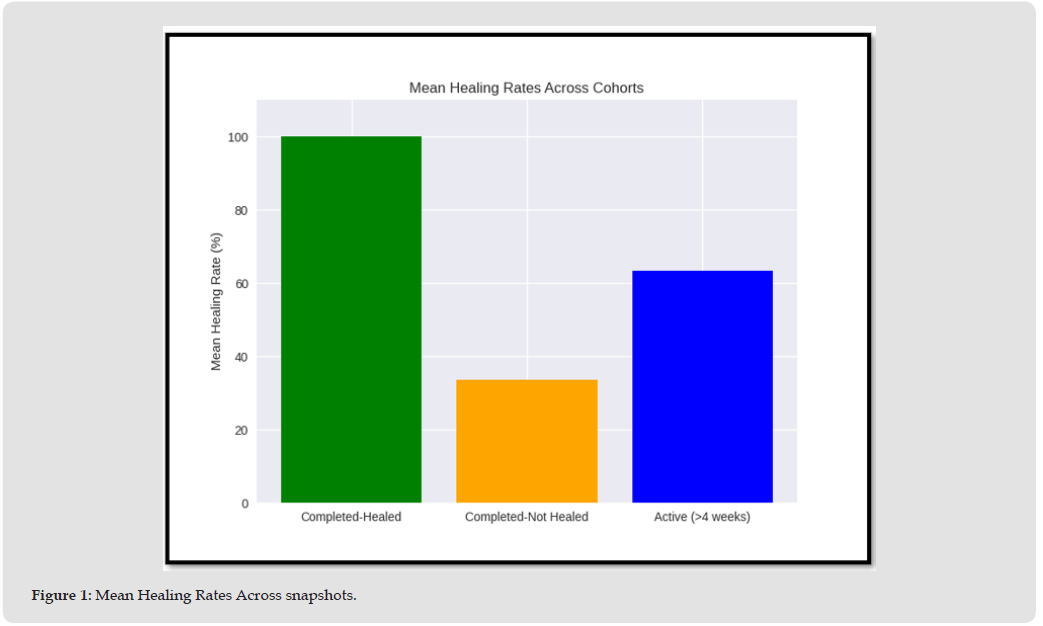
Figure 2
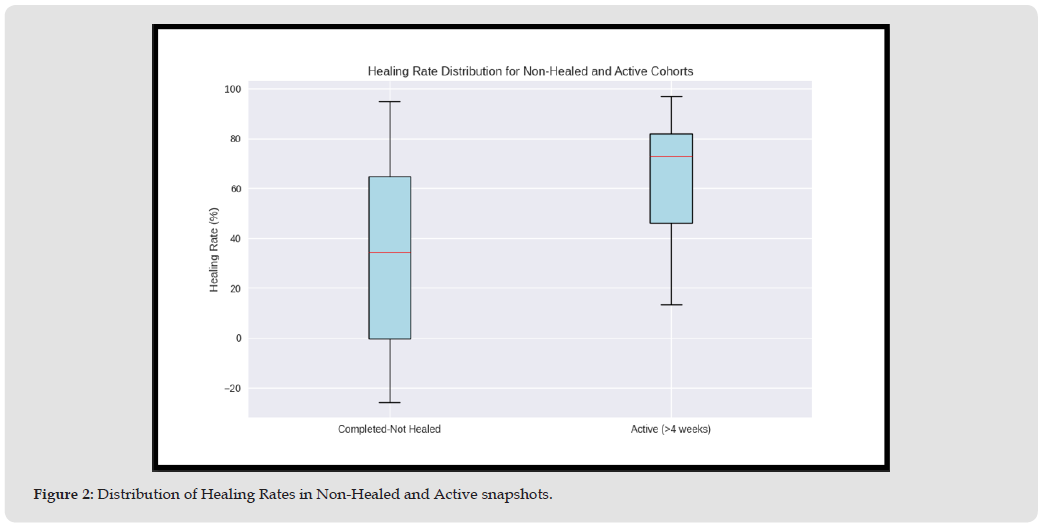
Figure 3
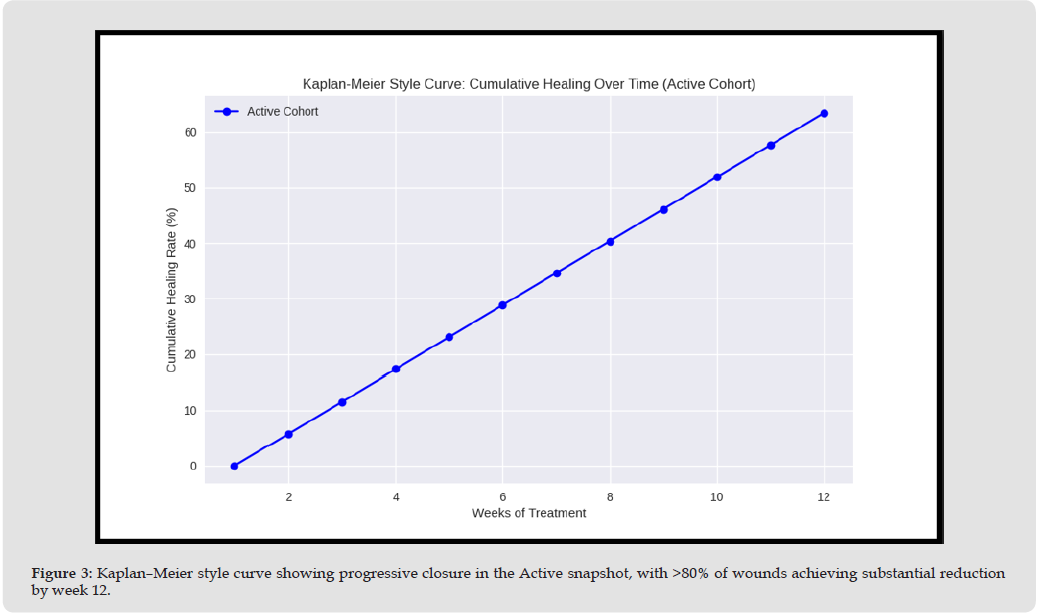
Table 1: CT Exam Protocol.

This interim analysis demonstrates that Acesso Biologics CAMPs achieved high healing rates in real world practice. All wounds in the Completed–Healed snapshot achieved closure, while the Active Treatment snapshot showed substantial ongoing progress. These findings are consistent with prior randomized trials. Snyder et al.^4 reported superior DFU healing with amniotic membrane grafts compared to standard care, while Serena et al.^3 demonstrated improved VLU outcomes with CAMPs plus compression therapy. Our registry data mirror these results, particularly in DFUs, which responded most favorably [1-4]. The variability observed in the Completed–Not Healed snapshot highlights the complexity of chronic wound care in real world populations, where comorbidities, ischemia, infection, and adherence to offloading or compression can influence outcomes.
Clinical Implications
The registry provides valuable RWE supporting CAMPs as effective adjuncts in chronic wound management. By accelerating closure, CAMPs may reduce complications, hospitalizations, and amputations, with potential cost savings.
Limitations
This interim analysis is subject to several limitations, including the relatively modest sample size, the preliminary nature of the findings, and the absence of long-term follow-up data at 6 and 12 months. These factors may limit the generalizability of the results and preclude definitive conclusions regarding durability of response. The subsequent analysis, which is expected to include approximately three times the number of subjects, will provide greater statistical power and the first opportunity to evaluate long-term outcomes, thereby strengthening the interpretability and clinical relevance of the findings.
This real-world registry snapshot demonstrates that Acesso Biologics CAMPs achieved robust wound healing outcomes across diverse chronic wound types. All wounds in the Completed–Healed snapshot achieved closure, while the Active Treatment snapshot showed substantial ongoing progress. These findings support the clinical utility of CAMPs in chronic wound management and underscore the importance of RWE in complementing randomized trial data. Larger comparative studies are warranted to validate these outcomes.
This real-world registry snapshot demonstrates that Acesso Biologics CAMPs achieved robust wound healing outcomes across diverse chronic wound types. All wounds in the Completed–Healed snapshot achieved closure, while the Active Treatment snapshot showed substantial ongoing progress. These findings support the clinical utility of CAMPs in chronic wound management and underscore the importance of RWE in complementing randomized trial data. Larger comparative studies are warranted to validate these outcomes.
This data is also available on clinicaltrials.gov.

International Association of Landscape Archaeology, Czech Glass Society, Czech Republic

Department of Chemistry, Semenov Institute of Chemical Physics, USSR Academy of Sciences, Moscow, Russia

Associate Professor at Department of Breast and Thyorid Surgey, Chongqing General Hospital, China
Professor of Nuclear Medicine, Faculty of Medicine and Surgery, University of Milan, Milan, Italy

Department of Pharmaceutical Sciences, South University School of Pharmacy, USA





 Abstract
 PDF
PDF



























