info@biomedres.us
+1 (502) 904-2126
One Westbrook Corporate Center, Suite 300, Westchester, IL 60154, USA
Site Map
 ISSN: 2574 -1241
ISSN: 2574 -1241
ISSN: 2574 -1241
Received: September 19, 2025; Published: September 29, 2025
*Corresponding author: Saher Srour, MSK Radiololgist, Director Radiology department, Ziv Medical Center, Safed, Azrieli Faculty of Medicine, Bar Ilan university, Safed, Israel
DOI: 10.26717/BJSTR.2025.63.009885
Introduction: Triquetrohamate Impaction Syndrome (THIS) is a frequently underdiagnosed cause of chronic
ulnar-sided wrist pain, primarily reported in athletes.
Case presentation: We present a rare case of this condition in a non-athletic middle-aged patient. Accurate diagnosis,
facilitated by radiological imaging and interdisciplinary collaboration, led to effective management. This
case highlights the importance of considering THIS in differential diagnoses even among non-athletic individuals
presenting with ulnar wrist pain.
Conclusion: Triquetrohamate Impaction Syndrome, although traditionally associated with high-impact athletic
activities, is an important cause of ulnar-sided wrist pain in non-athletic patients as well. A comprehensive diagnostic
approach—including a detailed clinical history, meticulous physical examination, and a multimodality
imaging strategy—is critical for accurate diagnosis and effective management.
Keywords: Triquetrohamate Impaction Syndrome; Ulnar Side Impaction Syndrome
Triquetrohamate Impaction Syndrome (THIS) is a rare form of carpal impaction syndrome, most observed in athletes, particularly those involved in sports requiring repetitive wrist motions such as golf or baseball. The condition often presents with ulnar-sided wrist pain in the non-dominant hand and is frequently misdiagnosed or overlooked. Symptoms typically persist for more than a year before diagnosis, with patients reporting exacerbation during ulnar deviation and relief following intra-articular corticosteroid injections [1- 4]. The average patient age is approximately 40 years. THIS is one of three recognized ulnar-sided wrist pathologies associated with repetitive motion: the others being ulnar impaction syndrome and hamate arthrosis-lunotriquetral ligament syndrome. In non -athletic patients, the clinical presentation of THIS can be insidious. Unlike athletes who typically report pain at the exact moment of impact (e.g, during a golf swing or bat impact), non-athletic individuals may report chronic discomfort that arises gradually from repetitive microtraumas or degenerative changes. Key clinical signs include localized pain predominantly over the TH joint, often 1-2 cm distal to the triangular fibrocartilage complex (TFCC), exacerbating movements pain worsens with passive dorsiflexion and ulnar deviation. The physical examination in non-athletic patients should be comprehensive, aiming to localize pain precisely and assess for accompanying signs such as crepitus or instability. A novel examination technique emphasizes palpation over the TH joint while positioning the wrist in a specific alignment (dorsiflexion and ulnar deviation) to accentuate the pathology.
It is notable that detailed physical examination may differentiate THIS from concomitant pathologies such as TFCC injuries or ECU tendinitis and lack of acute trauma. Non-athletic patients might not recall a definitive moment of injury; thus, history taking should include inquiries about occupational exposures, repetitive daily stresses, ergonomic factors, and history of previous minor wrist traumas. The delay in diagnosis, as noted in the reviewed case series, averaged 7.4 months, underscoring the necessity for increased diagnostic vigilance in non-athletic cohorts. Diagnosis relies on clinical evaluation supported by MRI findings, with fluoroscopy-guided injections providing confirmatory evidence. While conservative treatment is the initial approach, surgical intervention offers superior long-term outcomes, with studies indicating an 80% return to normal activities of daily living (ADL) following surgery.
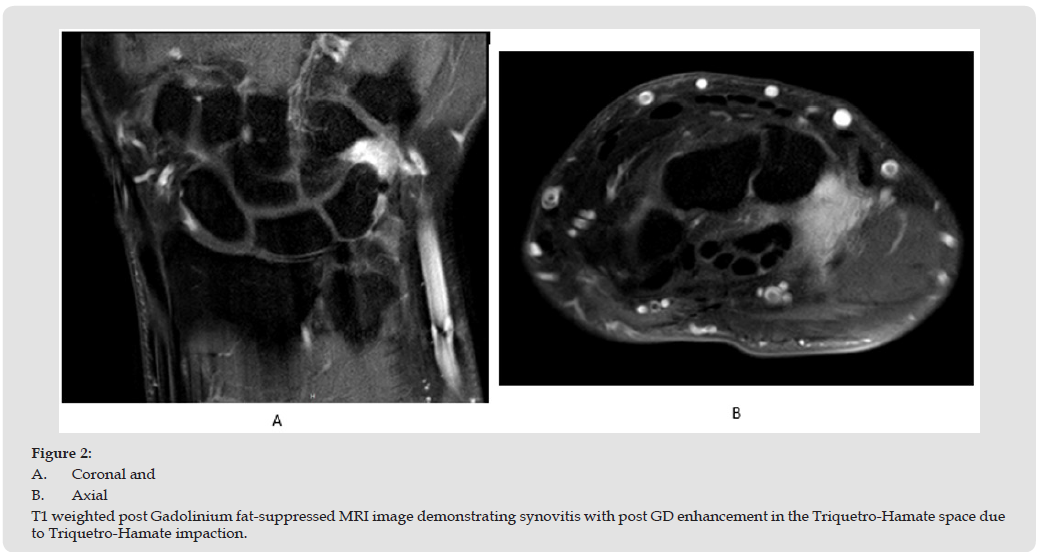
A 47-year-old right-hand dominant male social worker presented with persistent pain localized to the ulnar aspect of the wrist, without any preceding trauma. Initial evaluation by physical examination inspection revealed no swelling or deformity of the wrist. There was tenderness localized over the fovea region. Pain was elicited during passive dorsiflexion and ulnar deviation; no tenderness or prominence was noted over the ulnar head. The piano key sign was negative. The press test and synergy test were also negative. The range of motion was full with no limitation or pain, grip hand did not provoke any pain. Standard wrist radiographs (Figure 1) showed mild narrowed joint space between the triquetrum and hamate especially with ulnar deviation, and subcortical irregularity in the triquetral bone, but no fractures or dislocations. MRI imaging (Figure 2) demonstrated synovitis with post GD enhancement in the Triquetro-Hamate space due to Triquetro-Hamate impaction. Collaborative assessment by a hand orthopedic specialist and a musculoskeletal radiologist led to a conclusive diagnosis of Triquetrohamate Impaction Syndrome. The orthopedic surgeon did a corticosteroid injection in the Triquetro- hamate space with good results.
Figure 1
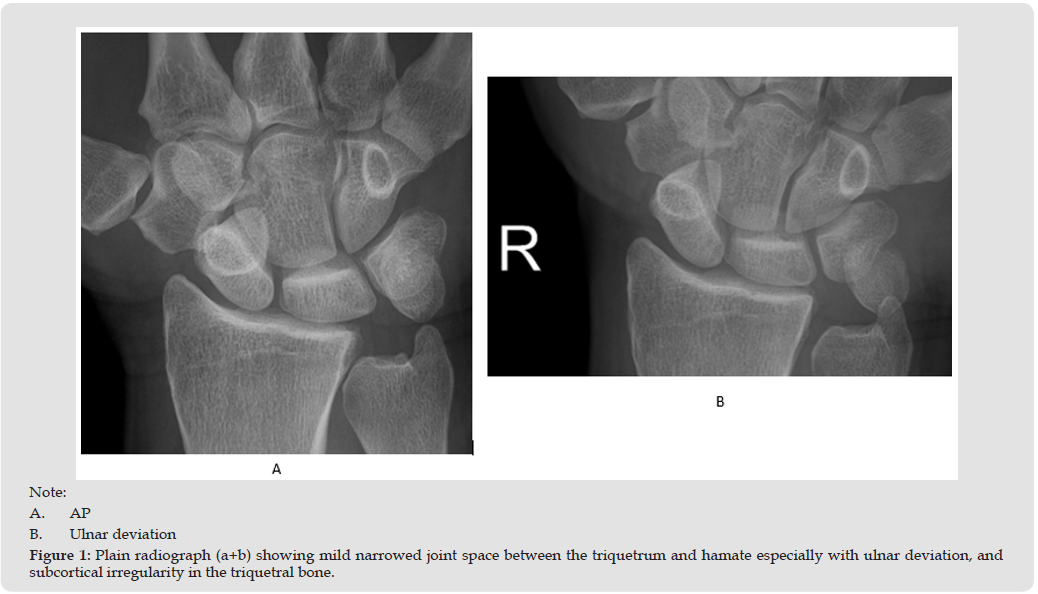
Figure 2
Triquetrohamate impingement syndrome is an uncommon but clinically significant etiology of ulnar-sided wrist pain. Differential diagnoses include TFCC tears, lunotriquetral instability, and ulnar impaction syndrome. The underlying pathology involves repetitive contact and degeneration between the triquetrum and hamate, leading to joint space narrowing, sclerosis, and osteophyte development. Radiological evaluation is essential, with CT and MRI offering detailed visualization of bone morphology and soft tissue changes. Plain radiographs4 may miss subtle changes, but radiographs with ulnar deviation may show narrowing of joint space, osteophytes and bone irregularities. Management typically begins conservatively, using NSAIDs, immobilization, and physiotherapy. In cases refractory to non-invasive measures, corticosteroid injections and surgical options such as arthroscopic debridement or partial resection may be considered. Surgical intervention generally yields favorable outcomes and improves functional restoration.
Triquetrohamate Impaction Syndrome should be included in the differential diagnosis for patients presenting with chronic ulnar-sided wrist pain—even those without a history of athletic activity. Early recognition and tailored intervention are critical to preventing degenerative progression and preserving wrist function. While conservative treatment is often sufficient, surgical management remains a reliable option for those with persistent or recurrent symptoms.

International Association of Landscape Archaeology, Czech Glass Society, Czech Republic

Department of Chemistry, Semenov Institute of Chemical Physics, USSR Academy of Sciences, Moscow, Russia

Associate Professor at Department of Breast and Thyorid Surgey, Chongqing General Hospital, China

Professor of Nuclear Medicine, Faculty of Medicine and Surgery, University of Milan, Milan, Italy

Department of Pharmaceutical Sciences, South University School of Pharmacy, USA





 Abstract
 PDF
PDF



























