info@biomedres.us
+1 (502) 904-2126
One Westbrook Corporate Center, Suite 300, Westchester, IL 60154, USA
Site Map
 ISSN: 2574 -1241
ISSN: 2574 -1241
ISSN: 2574 -1241
Received: September 18, 2025; Published: September 26, 2025
*Corresponding author: Jian Ai, Yunnan University of Traditional Chinese Medicine First Affiliated Hospital, Kunming, China
Chunlin Wang, Yunnan University of Traditional Chinese Medicine First Affiliated Hospital, Kunming, China
DOI: 10.26717/BJSTR.2025.63.009883
Background: Knee osteoarthritis (KOA) is the most common type of diseases in middle-aged and older adults
and it is the main cause of chronic pain and falls. It has seriously affected people’s daily lives. Tuina treatment
for knee osteoarthritis has achieved clear results in clinical practice. However, there are no high-level systematic
reviews to support its role at present. The purpose of this study is to evaluate the safety and efficacy of Tuina in
the treatment of KOA.
Methods: We will search the articles in the following electronic databases: PubMed, Embase, Wan-fang Database,
and the Chinese Biomedical Literature Database (CBM), China National Knowledge Infrastructure (CNKI),
Web of Science, the Cochrane Library, Chinese Scientific Journal Database (VIP) and 1 clinical trials register platform:
WHO International Clinical Trials Registry Platform. The time is from the establishment of the database
to September 2025. Two researchers will separately assess the quality of the papers included, extract the data
with Excel and Express, and store the relevant content in electronic charts. Titles and abstracts will be screened
separately in the databases by two investigators, full-text and data extraction will be performed independently
and statistical analysis will be performed with RevMan 5.3.0.
Results: This study will evaluate the efficacy and safety of Tuina in the treatment of KOA and provide a reference
and basis for clinical practice.
Conclusion: This study will provide reliable, high-quality evidence on whether Tuina is safe and effective for the
treatment of KOA.
Keywords: Randomized Controlled Trial; KOA; Tuina; Protocol; Meta-Analysis
Abbreviations: RCT: Randomized Controlled Trial; KOA: Knee Osteoarthritis; TCM: Traditional Chinese Medicine; CBM: The Chinese Biomedical Literature Database; CNKI: The China National Knowledge Infrastructure; EBM: Evidence-Based Medicine; ICTRP: WHO International Clinical Trials Registry Platform; MD: Mean Difference; RR: Risk Ratio; SMD: Standard Mean Difference; VIP: Chinese Science and Technology Periodical Database; Wan-Fang: Wan Fang Database
Knee osteoarthritis (KOA) is the most common chronic osteoarthritis disease [1]. Cartilage damage is the main tissue affected by KOA and may lead to subsequent symptoms including joint pain, joint swelling, stiffness, and reduced range of motion [2]. It is the most common cause of chronic pain [3,4] and fall disability in middle-aged and older adults [5-9]. According to the World Health Organization, more than 150 million people worldwide have osteoarthritis (OA) [10]. The KOA imaging epidemiological survey found the prevalence rate of people aged 50 and over in United States was 37.4% [11], the prevalence rate of urban 40-49 years old in China was 17.7%, 60-69 years old was 38.2%, over 70 years old was 55.8% [12], and the prevalence rate of rural areas over 40 years old in Heilongjiang Province has reached 78% [13]. At least 60% of patients with the KOA population have knee instability [14]. With the aging of the population, the changes in the social environment and people’s lifestyles, and the incidence and complexity of knee osteoarthritis are increasing year by year [15], which has brought great impact and economic burden to the society and patients and has been considered as an extremely important global health problem [16]. KOA has become a hot spot and difficulty in clinical and scientific research.
Traditional Chinese medicine (TCM) Tuina has a certain effect on knee osteoarthritis, which is conducive to relieving knee pain and promoting the recovery of joint function and activity [17-20], and has been widely used [21]. However, there are no systematic reviews to prove its role, and this systematic review will provide strong and reliable evidence for the efficacy and safety of Tuina in the treatment of knee osteoarthritis.
Study Registration
The protocol was registered in the International Register of Systematic Reviews and Meta-Analysis Platform (INPLASY) on October 12, 2024 (registration number: INPLASY 2024100054). This can be accessed from https://inplasy.com/inplasy-2024-10-0054/.
Inclusion Criteria
Study Type: All randomized controlled trials (RCTs) will be included in Tuina for the treatment for KOA, with no language restrictions. Observational studies, case-control studies, laboratory studies, literature presentations, cohort studies, and case series will be excluded.
Participants: All patients diagnosed with KOA regardless of age, ethnicity, duration of disease or gender.
Type of Interventions and Comparisons: Tuina is included as the experimental intervention in this study. It also includes other similar Tuina interventions such as massage, Chinese Tuina, Chinese massage, Traditional Chinese medicine massage, etc. Multiple control comparisons will be included as well: drug therapy, physiotherapy, behavioral therapy and no treatment, acupuncture, and placebo will also be included.
Type of Outcome Measures:
Outcomes: The main outcomes: Clinical effectiveness, Visual analogue scale, Incidence of any adverse events. The additional outcomes: Western Ontario and McMaster Universities Osteoarthritis Index.
Exclusion Criteria
The exclusion criteria are as follows: observational studies, laboratory studies, case studies, literature presentations, and cohort studies, It is not possible to extract relevant data from published results, and the original data are not available after the authors are contacted.
Search Strategy
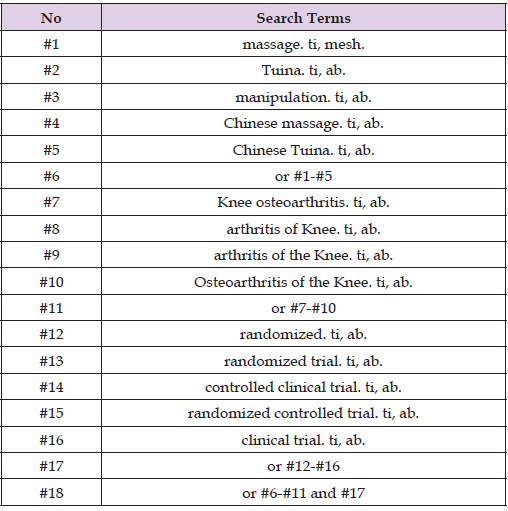
We will search articles in the following electronic databases: PubMed, Embase, Wan-fang Database, and the Chinese Biomedical Literature Database (CBM), China National Knowledge Infrastructure (CNKI), Web of Science, the Cochrane Library, Chinese Scientific Journal Database (VIP), and 1 clinical trials register platform: WHO International Clinical Trials Registry Platform. The time is from the establishment of the database to September 2024. We will strictly follow the PRISMA [22] statement. The main search terms: “Knee osteoarthritis”, “arthritis of Knee”, “Osteoarthritis of the Knee” ;“Tuina”, “manipulation”, “Chinese massage”, “massage”,“ Chinese Tuina”; “randomized”, “randomized trial”,“ controlled clinical trial”,“ randomized controlled trial”, “clinical trial”. We will also screen other relevant medical journals for supplements that meet the inclusion criteria and are not included. The main search strategy is shown in Table 1.
Table 1: Search strategy for PubMed.
Study Selection
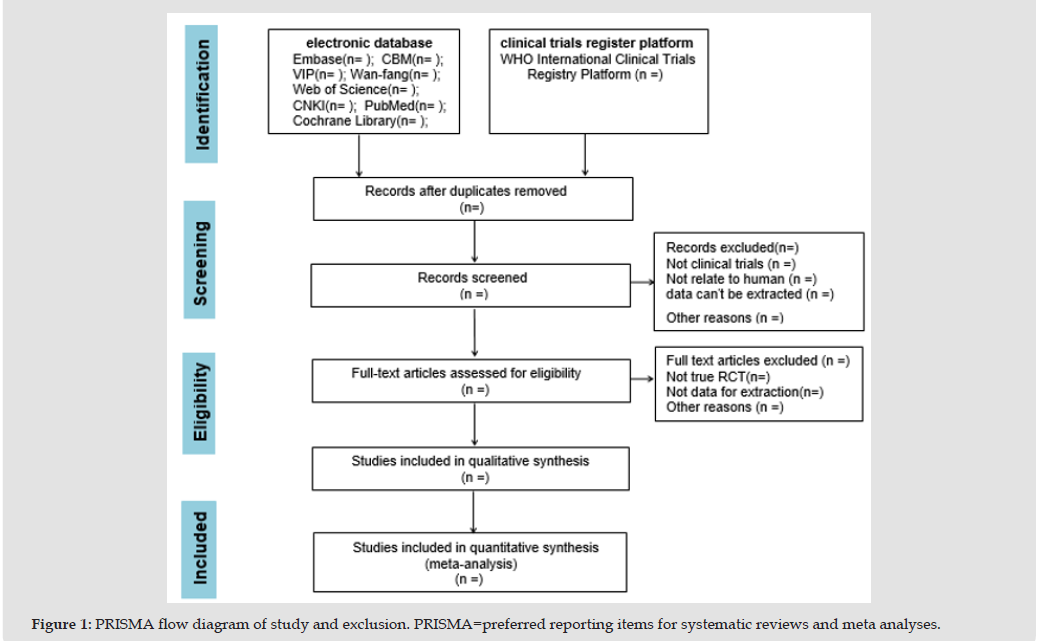
We will use Express Version 3.2 for document management. Duplicate documents will be deleted with this software. Two reviewers (Chao Liu and Jin Zhou) will screen the titles and abstracts and removed irrelevant articles independently according to the above inclusion and exclusion criteria. For the data in question, we will resolve it by contacting the first author or corresponding author for the full text and deciding whether to include or not, and record the reasons for all excluded studies. The chart for this study is shown in Figure 1.
Figure 1
Data Extraction and Management
Two investigators (Chao Liu and Guangchang Qiu) will extract the data independently. The basic information extracted are: author, country, year, mean age, sample size, intervention, randomized methods, follow-up timing, outcome measures, control measures, and adverse effects. Two reviewers will check the results independently. They are Guangchang Qiu and Jin Zhou. We will contact the corresponding author or the first author in a timely manner to obtain objective and truthful data for incomplete or missing study data.
Assessment of Risk of Bias in Included Studies
The bias risk of the included studies will be assessed by two independent reviewers (Yujie Su and Qidong Tian) using the assessment tool of Cochrane Reviewer Handbook 5.0.24. The assessment included the risk of bias in the following domains: blinding of personnel and outcome assessors, allocation sequence generation, incomplete information, allocation sequence concealment, outcome selective reporting, outcome data, and other sources of data bias. It will be assessed on three levels: low risk, high risk, and unclear risk by contacting the appropriate author to query for unclear items and obtain the details. Dissenting data will be resolved through experts (Jian Ai and Chunlin Wang) consultation or inter-investigator discussions.
Data Synthesis
Measures of Treatment Effect: Data statistics will be performed using RevManV.5.3.0 software for data analysis and quantification. For dichotomous data, we will use a risk ratio analysis with 95% confidence intervals (95% CI). We will use mean difference or standardized mean difference with 95% CI [23] to analyze continuous data, and for fewer than two studies, we will describe the results using descriptive analysis.
Heterogeneity Analysis: We will test heterogeneity with the X2 test, assess the data with a fixed-effect analysis model if the heterogeneity of the studies is smaller (P > .05, I2 < 50%), and assess with random-effects model analysis if heterogeneity is high (P ≤ .05, I2 ≥ 50%). Publication bias will be assessed using funnel plots and the Begger’s test.
Subgroup Analysis: If the data are reliable and sufficient, the following subjects will be analyzed in subgroups: age, study quality, duration of treatment, intervention in the study group, and control group, etc.
Sensitivity Analysis: To verify the robustness of the assay results, we will perform a sensitivity analysis. Sensitivity analyses will be performed for the following decision points: missing data results, sample size, and methodological quality. Duplicate analyses will be performed after low-quality studies are excluded.
Publication Bias: For eligible RCTs the number is γ10, [24] the funnel plot developed by the Egger test will be used to detect publication bias.
Grading the Quality of Evidence: The quality of each study will be evaluated using the tiered proposal development, assessment and evaluation methodology. The following domains will be assessed: consistency, risk of bias, directness, publication bias, precision, and other scores. Assessed on 4 levels: high, medium, low, and very low quality.
Ethics and Dissemination: The research papers included are publicly available data and do not require ethical approval, and the results of this review will be published in peer-reviewed journals.
Knee osteoarthritis is a major cause of pain, impaired function, and reduced quality of life. This disease has brought great economic, physical and psychological troubles to people. Tuina may be applied to the treatment of different diseases through different Tuina methods, such as hand pressuring, kneading, pressing, and pushing by doctors [25], it has been widely used in clinical treatment in China and many other countries because of the significant efficacy in reducing pain [26] and improvement of symptoms. Tuina is a common method used for the treatment of KOA, and it has a long history of use. Tuina is an effective natural remedy, with no associated effects [27]. But there is no relevant systematic review has reported its effects. There may be certain limitations in this study because some of the studies are small-sample and single-center studies. The purpose of this article is to conduct a systematic review of the existing domestic and foreign literature on the use of Tuina for the treatment of KOA, and to provide evidence for related research and clinical application.
Chao Liu and Jin Zhou are responsible for the selection, data extraction, assessment, and quality of the included studies. Guangchang Qiu and Jin Zhou will take part in the screening, evaluation, and quality of the included studies. Guangchang Qiu will participate in the selection of studies. Yujie Su and Qidong Tian are responsible for part of the study selection and data extraction. Jian Ai and Chunlin Wang are responsible for the design and direction.
Ethical approval is not required, and it will be in printed or disseminated through electronic copies.
This paper is funded by National Natural Science Foundation of China(No. 8226150627), Yun cai she (2024) No. 118 Yunnan Provincial Traditional Chinese Medicine Tuina Clinical Medical Center Construction Fund. Key project of the stroke innovation team of Yunnan University of Traditional Chinese Medicine ZTNB201,and Yunnan Province Clinical Medical Center Project, (2024YNLCYXZX0384).
The authors declare that there is no conflict of interest.

International Association of Landscape Archaeology, Czech Glass Society, Czech Republic

Department of Chemistry, Semenov Institute of Chemical Physics, USSR Academy of Sciences, Moscow, Russia

Associate Professor at Department of Breast and Thyorid Surgey, Chongqing General Hospital, China

Professor of Nuclear Medicine, Faculty of Medicine and Surgery, University of Milan, Milan, Italy

Department of Pharmaceutical Sciences, South University School of Pharmacy, USA





 Abstract
 PDF
PDF



























