info@biomedres.us
+1 (502) 904-2126
One Westbrook Corporate Center, Suite 300, Westchester, IL 60154, USA
Site Map
 ISSN: 2574 -1241
ISSN: 2574 -1241
ISSN: 2574 -1241
Received: September 08, 2025; Published: September 16, 2025
*Corresponding author: María Castineiras-Tourino, Galician Public Healthcare Service, Área Sanitaria Pontevedra Salnés. Previous affiliation: University Hospital Complex of Santiago de Compostela (CHUS), 15706 A Coruña, Spain
DOI: 10.26717/BJSTR.2025.63.009867
Milk fistula is an uncommon condition that occurs when there is an abnormal connection between the skin surface and the lactiferous duct in the lactating woman’s breast. This results in spontaneous drainage of milk. The authors present an unusual case of milk fistula that occurred after draining a galactocele with posterior superinfection and draining the abscess in a lactating woman. The wound was treated locally and breastfeeding was not stopped. Since it was difficult for the wound to heal and it had to be drained constantly, the baby was breastfed only from the non-affected breast.
Keywords: Milk Fistula; Mammary Fistula; Breastfeeding; Lactation; Breast; Complication
Milk fistula occurs when the skin surface connects to a lactiferous duct in the lactating woman’s breast. This implies the constant or sporadic milk drainage [1]. It is an uncommon condition and it can occur on ectopic mammary tissue, after a surgical intervention or a breast biopsy [1-4]. Milk fistula produced by an intervention where the breast parenchyma is damaged, it could appear as a consequence of draining the breast abscess, performing needle aspiration, placing a drainage catheter or because of a spontaneous abscess drainage [5]. A previous study reported a prevalence of 10% after drainage of puerperal breast abscesses [6]. In another cohort study, the incidence of breast fistula in lactating women one week after the invasive procedure was 1.4%, and the overall prevalence was 2.8%. [7] Milk fistula usually resolves spontaneously. Conservative treatment and support are used to treat this condition [2-7]. Published studies report that, in some cases, it is recommended to stop breastfeeding to reduce the milk production and to allow the fistula to heal [4-7]. With a lactating specialist’s assistance, breastfeeding from the affected breast could be stopped and it could continue on the other breast [7].
A 38-year-old lactating woman arrived to the clinic because of a mass on her right breast. She was providing exclusive breastfeeding to her 2-month-old son since birth. She was previously diagnosed with bilateral fibroadenoma and she came to the clinic when she noticed that one lump on her right breast had grown since gestation. On the first clinical examination, an acute mastitis and/or breast abscess was ruled out. Once a biopsy was performed, the presence of a galactocele was confirmed and it was drained. Three days later, she went to the emergency room with an open surgical wound that looked infected and they proceeded to drain the abscess. After the drainage, antibiotic treatment was provided for 10 days. Twelve days after the abscess drainage, she went to the midwife examination room with an open indurated surgical wound of 0.5 cm that drained milk. Physical examination (Figure 1) revealed that the breast was soft and there was no diffuse edema. At the 9 o’clock position, there was a wound on the skin of 1.5 cm x 0.5 cm with ulceration. The underlying mammary tissue was exposed in an open wound where milk was continuously drained. There was a minor erythema nodosum. Treatment was provided during for 4 weeks and patient continued breastfeeding (Figures 2 & 3). The wound was treated every two days with a Vaseline and zinc oxide (12%) ointment, which was applied on the healthy perilesional skin and covered with foam dressing that allowed humidity evaporation and for the wound to heal in a humid environment, as it gels when in contact with the exudate.
Figure 1

Figure 2
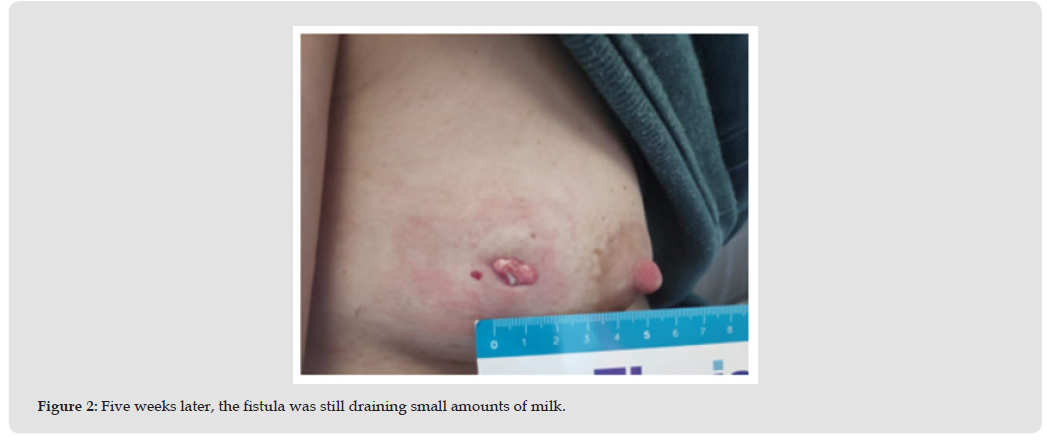
Figure 3

Fifteen days later, the induration persists and the wound still drains milk from different places. Since it was difficult for the wound to heal and it was constantly draining, it was decided that breastfeeding from the affected breast should be stopped. The treatment was changed and a hydrogel with pectin and hydrocolloid dressings was used to retain humidity. In order to reduce the milk production on the affected breast, breastfeeding from that breast was progressively reduced for a week. After that, only a small amount was extracted using manual extraction when there was a feeling of fullness or discomfort. The milk production on the affected breast was reduced significantly in two weeks, as well as the amount drained from the fistula. From that moment, the treatment was stopped and only a gauze swab was used to cover it. The milk production from that breast stopped almost completely after 6 weeks, as well as the milk drainage from the wound. The patient had a weekly check-up for about 6 weeks. After 6 months, the wound healed completely and the patient continued breastfeeding the baby only from the non-affected breast. During the healing process, there were no records of infection on the breast. In the last clinical examination, the area was healed with a small scar and the skin was covered.
The diagnosis of a milk fistula is based on the clinical examination [8]. Milk fistula is usually caused by a surgical intervention where the breast parenchyma is damaged. If a fistula appears, it will heal on its own, even though on most published cases surgeons recommended to stop breastfeeding in order to reduce the milk production. That way, the drainage will be reduced and the wound would heal faster [5-8]. In published studies until now about milk fistula a specific treatment was not followed. There were different approaches to heal the wound such us take care of the wound, apply pressure on the fistula while breastfeeding to try to reduce the amount of milk drained, antibiotic treatment, weaning process, lactation suppression using medication or surgery [5]. In our case, our main priority was to protect the breastfeeding in this surgical complication, so we never considered the lactation suppression and the weaning process as priority treatments. The low risks of a patent fistula and the possibility of spontaneous closure motivated the decision to continue breastfeeding, reducing the flow of milk from the affected breast and prioritizing suction on the healthy breast. Continuation of breastfeeding represents an ideal management strategy [3,9]. Furthermore, discontinuation of breastfeeding carries multiple health risks for both mother and infant [10].
Keep breastfeeding is not a danger to the mother or the baby, even though open fistula and wounds could increase the risk of infection [11,12]. Breastfeeding from only one breast could be an interest approach to allow the wound to heal and also to keep breastfeeding for the mother-son dyad benefits.
The authors declare no conflict of interest in relation to the publication of this clinical case report.

International Association of Landscape Archaeology, Czech Glass Society, Czech Republic

Department of Chemistry, Semenov Institute of Chemical Physics, USSR Academy of Sciences, Moscow, Russia

Department of Educational Sciences, Research Centre Qualities of Teachers, School of Education – HAN, Nijmegen, Netherlands

Associate Professor at Department of Breast and Thyorid Surgey, Chongqing General Hospital, China

Neurology, LA BioMed Research Institute, USA





 Abstract
 PDF
PDF



























