info@biomedres.us
+1 (502) 904-2126
One Westbrook Corporate Center, Suite 300, Westchester, IL 60154, USA
Site Map
 ISSN: 2574 -1241
ISSN: 2574 -1241
ISSN: 2574 -1241
Received: July 22, 2025; Published: August 05, 2025
*Corresponding author: Majid Rezaei Basiri, Ph.D, Fellowship, Assistant Professor. Research Fields: Clinical Laboratory Sciences, Toxicology, Drugs Prescription Regulatory, Iran
DOI: 10.26717/BJSTR.2025.62.009809
Aims: Fourty Saliva samples of abusers were examined for the presence of alkaloid abuse drugs in Saliva liquid.
Alkaloids of Saliva liquid and their extracts were directly confirmed with rapid and TLC- UV methods. All of the
study population were male and their age range was (Mean ±SD) = (40±20). All study population filled satisfy
form to participating in study. At the same time a thin-layer chromatography (TLC) procedure for the screening
and confirmation of salivary codeine and morphine and amphetamine and methamphetamine and etc have been
developed.
Methods: Saliva samples were daily collected from abusers of Tabriz/Iran. Saliva extracts were prepared by
using LPE method. The extraction was made by 9% saline solution and organic solvents of methanol and pure
ethanol and cholorophorm and ammoniac then after centrifugation under section of tube concentrated. After
separation to dryness with heater, the residue was dissolved in organic solvent of methanol to reach 10 to 40 fold
concentration. For screening, the extraction residues were directly exposed with rapid strip tests then spotted
on TLC plates for thin layer chromatography. So the limit of detection was a concentration of 300ng/ml.
Results: The data analyzed by SPSS and IMAGEJ The result of this study has shown that 95 percent of Saliva samples
from abusers in welfare organization of Tabriz /Iran were contained alkaloid abuse drugs and 25 percent of
these samples have shown drug interaction.
Conclusion: This study describes importance of liquid phase extraction (LPE) and drug testing such as TLC
analysis in comparison of other rapid tests.
Keywords: LPE; Saliva Extracts; Rapid Strip Tests; TLC-UV; Alkaloid Abuse Drugs; Abusers
Nowadays abuse drugs are globally used and make one of the alarming to public health problem. The treatment and prevention related policy issues not adequate give information about the nature and distribution of abuse drugs in the globalization. The perfect data in abuse drugs are lacking as a view point of generalizations and regional variations. The geographical of some east countries location make transit of abuse compounds possible across from Middle East to the west countries. According to clinical situation of abusers and facilities in different countries of Middle East such as Iran, diagnostic and treatment in these regions are different. The main goal of this study refer to diagnosis abusers too. However testing for presence of abuse drugs in biological samples such as saliva fluid also helps to screening improvement of patients in treatment. Because opioids and their metabolites detections are achievement in biological samples, therefore in this study we have not only just done to screening of opioid through deep stick rapid tests but also confirmed of them by TLC method analysis in saliva liquid of abusers. Thin layer chromatography (TLC) application has been let’s a broad spectrum of confirming for detection of abuse drugs. However this epidemiological study supported by the clinical laboratory of welfare organization, hereby has been extremely helpful in quick diagnosis of opioid abusers who had denied history of their any drug use or their abuse conditions at the first contact of them to the treatment team. So several studies including screening and confirmation of opioids by thin layer chromatography, an evaluation of TLC-UV system for analysis of abuse drugs and also use of thin layer chromatographic analysis in forensic laboratories for distinguish of abuse compounds have been reported. With this background we carried out diagnosis of alkaloid abuse drugs at toxicology laboratory of welfare organization in Tabriz/Iran [1-5].
Samples Providing
2ml of saliva samples reached to 5ml with saline solution and one droplet of amoniaque to readying liquid phase extraction process (LPE). First some of samples were directly examined for presence or absence of some drugs and abuse compounds such acetaminophen codeine, BNZ, TCA, methadone, buprexin, THC, Tramadol, opium syrup and etc, … by rapid strip tests. Each addicted subject was asked to give a fresh sample of his saliva to the laboratory before detoxification. Opioid abusers take opioid drugs on street; they refer for their recovery to welfare organizations clinics. The alkaloid drug abuse kits were designed for TLC analysis from some of special companies. Then according to these methods all samples were examined. Saliva liquid samples were daily collected from abusers in Tabriz/Iran duration since 2010 till 2024 [1-10]. Besides providing samples, agreed to complete a questionnaire focusing on their conditions and abuser history and life conditions characteristics. Table 1: Shows number of drugs and abuse drug lists in the consumption term between the study population of this research. All data were obtained from questioners and analyzed with softwares. Data confounding factors were such as medication of them with methadone, sublingual 0.2mg buprexin, naloxan, nalterxon, acetaminophen codeine, cimetidine, dextromethorphan and theophylline syrup and tobacco smoking, etc... and other small interaction factors were also considered. Overall 40 saliva samples were daily collected.
Table 1: Shows number of drugs and abuse drug lists in the term Consumption between the study population.

Note: Ages mean>20, N=400, BNZ: Bezodiazepines, TCA: Three cyclic antidepressants, BAR: Barbiturates, AMP: Amphetamine, TRL: Tramadol PCP: Phencyclidine-THC: Canabis-COC: Cocaine
All of participants were male mean aged were 40±20 years. All of them were smokers too. The study was submitted and approved by the local ethical committee. All gave their informed consent prior to their in the study. All of saliva samples were daily collected from abusers and stored in refrigerator, then pH of saliva samples changed to alkaline condition with adding one ammoniac droplet. The pH regulated with pH paper for each sample. Extraction tubes were added with 1 ml pure96% Merck company ethanol and 2ml of cholorophorm and 2ml methanol and 5ml of saliva samples. Afterwards the shaking of all tubes, the content were centrifuged with 5000rpm. Liquid phase extraction were available and performed under section of all tubes. Tubes under sections were separated in vials. After evaporation to dryness with heater, the residue was dissolved in organic solvent of methanol to reach a 10-40 fold concentration. Saliva extracts were kept to plates spotted use. All of plates were precoated with silica gel and provided in kit collection. For confirming, the extraction residues were spotted on TLC plates which are developed in saturated Tank with content of saturated with chloroform: methanol: Ammoniac (12:1.4:0.2) ml. After the TLC process for confirmation the spots for the all alkaloids in comparison of their standard spots were visualized with acidified iodoplatinate, hexachloroplatinate and other special indicators, and by UV cabinet too. For correction of drug interaction problems, application of other TLC process technique repeating by plates spot tests were recommended. In the detection limit concentration( 300nanograms/ml) all alkaloid standards are well separated and detected from each other and salivary samples on the TLC plates [1-15].
All of the abusers had conditions history of smoking, alcohol, pain relief and sedative medications. Majority of the addicts had relatively long history of using addictive substances or drugs for more than four years. Some biochemical tests such as liver enzymes experiments were conducted on the blood samples of the study additives and then their results were recorded. Moreover, some studies were also carried out to investigate anemia level of the abusers. First, All saliva samples were examined with rapid strip tests then all saliva extracts were screened with TLC analysis method. However the results of saliva strip test for drug abusers while they were under detoxification and treatment were positive. Because abusers take some other medication under their physicians’ orders, then their results might be explaining to drug Interaction. All calculation data was performed using SPSS and IMAGEJ softwares. The data were analyzed by using of variance (ANOVA ONE WAY) by post hoc comparison between groups were examined with student Newman kelus test and t-test. Differences in which p<0.05 were considered statistically significant. The results of this study show that 95 percent of saliva samples from opioids abusers in Tabriz /Iran were contained alkaloid substances and drug interaction were happened in 33 percent of these samples. Some of positive and also drug interactions results were reported on Tables 2 & 3 [1-15].
Table 2: Some of Saliva rapid strip test results during the period of before and after detoxification in population study of men groups.

Note: >300ng/ml: weak positive results (±) positive results (+), <300ng/ml: Negative results (-) N=40, Rapid strip test, opiod(Heroin, opium,Methadone, Codein,cannabis,Metamphetamine) detection in abusers men Saliva samples. Anowa one way,p=0.0001
Table 3: Some of Saliva test results have shown drug interaction after detoxification process of some cases.
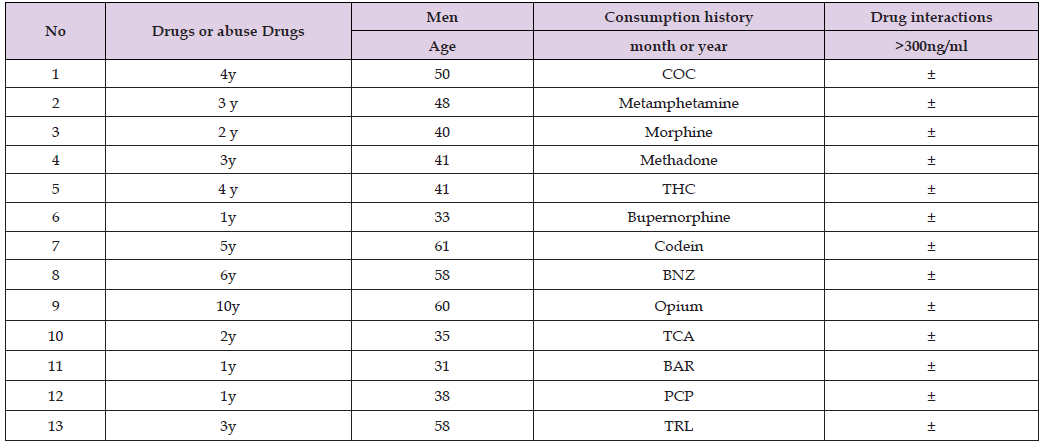
Note: Age>35, N=40, Drug interactions (±) have after detoxification through TLC (Thin layer chromatography) method.
Common clinics and General Medical setting of welfare Organization support abusers in Iran. There are three types of opioids. First, the poppy alkaloids: morphine, codeine, thebaine, noscapine and papaverine. Also the semi-synthetic and synthetic derivatives used in therapy as antitussives and analgesics, such as pholcodine, ethylmorphine and dextrometorphan. Opioids, diacetyl-morphine (heroin) and opioids are used as substitutes in treatment of addiction also sublingual buprenorphine and methadone syrup. Opium is usually consumed by Iranian abusers .At the first step of treatment, patients take naloxon & naltrexon for own detoxification, then they continue their medication with methadone and buprenorphine,but at the same time they also take other drugs such as adult cold, chlorodizpoxide, natrium voltaren.antihistamine deconjuant, amitriptiline, acetaminophen codeine, imipramine, flouxitine, perphenazine, diazpam, atenolol, phenobarbital,theophiline, pantazosine, cimitidine, ranitidine, difenoxilate, spironolactone, caffeine, phenilbutazone.Some of these drugs are used under physicians’ orders and some of them are accidentally or intentionally used. Which one of the drugs, mentioned above, or any other substance can cause drug interaction in the results of Rapid Strip Tests, also leads to false positive or false negative. Morever some of abuse drugs might be distinguished in these studies such Heroin, Morphine, Cannabis, Methadone, Tramadol, Beprexin, Amphetamine, Metamphetamine, Methylen Dioxy metamphetamine, Cocaine, Phencyclidine, Benzodiazepine, Three cyclic antidepressant, Phenobarbital and etc, through this method.
The term of drug interaction refers to other drugs except of abuse compounds which overlap on plates of TLC at the same time. For resolving drug interaction we must repeat tests on the new saliva samples of abusers by TLC method, but probably we can’t see drug interaction results on TLC plates so we should continue TLC-UV way on plate spot tests. Since all samples were screened by rapid tests, the rapid strip screening tests has less specificity and a high likelihood give of false positives and false negatives results. The brand rapid test of this study commercially available by Iranian or foreign products. Toxicologist recommended that positive results should be considered as presumptive and be tested by TLC and to be confirmed. Studying of the results for identifying the opioids (morphine, codeine and their synthetic analogue heroin) in saliva samples during the toxicology chemical examinations by using the method of thin layer chromatography (TLC) are described, and this study attends to this topic. The main found of this study is the comparison of the results taken from Rapid Strip Test and Thin Layer Chromatography Test to distinguish the presence of opioid in abusers’ saliva samples for their detoxifications and treatment. Several studies showed false positive or false negative results of abusers’ saliva samples which improved by this way. However, they must be repeated by laboratory diagnostic team. Therefore results taken by TLC will help physicians & abusers in all steps of detoxification & medication process [15-27].
This study describes the importance of saliva drug tests such as TLC analysis in comparison with other rapid tests. Since 20% of these saliva samples have shown drug interaction, for final confirmation we used TLC analysis test to be able for remove this problem. According to the findings of the present investigation rapid strip tests were useful in biological samples and TLC was accessible confirmation method to abusers’ saliva samples. We conclude that between all drugs progressive analytical methods the cheapest and easiest tests of opioids and other drugs in urine and blood and saliva samples is strip test for rapid diagnosis and TLC (thin-layer chromatography) is accessible method to drugs abuse detection, also doing test on biological samples have importance to immediate distinguishing of drugs abuse and other drugs poisoning in clinical laboratories [1-27].
We are grateful to the department of Welfare Organization Laboratory for supporting abusers. We also acknowledge Welfare Organization in Tabriz/Iran for its financial support during this study. At the end we are grateful to Hygiene central clinical Laboratory department, Tabriz University of Medical Sciences, Tabriz, Iran.

International Association of Landscape Archaeology, Czech Glass Society, Czech Republic

Department of Chemistry, Semenov Institute of Chemical Physics, USSR Academy of Sciences, Moscow, Russia

Neurology, LA BioMed Research Institute, USA

Associate Professor at Department of Breast and Thyorid Surgey, Chongqing General Hospital, China
Professor of Nuclear Medicine, Faculty of Medicine and Surgery, University of Milan, Milan, Italy





 Abstract
 PDF
PDF



























