info@biomedres.us
+1 (502) 904-2126
One Westbrook Corporate Center, Suite 300, Westchester, IL 60154, USA
Site Map
 ISSN: 2574 -1241
ISSN: 2574 -1241
ISSN: 2574 -1241
Received: June 10, 2025; Published: July 02, 2025
*Corresponding author: Youngman Oh, Department of Pathology, Medical College of Virginia Campus, Virginia Commonwealth University, Richmond, VA 23298, USA.
DOI: 10.26717/BJSTR.2025.62.009754
Insulin-like Growth Factor Binding Protein-3 (IGFBP-3) is a pleiotropic glycoprotein that controls cellular physiology via both independent and dependent pathways on insulin-like growth factor (IGF). Although IGFBP-3 has previously been investigated for its endocrine transport roles, more recent research reveals its crucial significance in ocular illness. This review compiles the most recent data supporting IGFBP- 3’s role as a crucial regulator in the two main ocular diseases of diabetic retinopathy (DR) and dry eye disease (DED). IGFBP-3 is upregulated in DR in response to retinal hypoxia and hyperglycemia. It limits pathological angiogenesis by modifying VEGF-induced permeability, encourages reparative endothelial progenitor cell (EPC) migration, and strengthens the blood-retinal barrier integrity through the SRB1/PI3K/Akt/eNOS pathway. Both wild-type and IGF-nonbinding mutant IGFBP-3 can restore vascular function and lower inflammation in DR models. Similarly, IGFBP-3 enhances retinal insulin sensitivity and suppresses pro- inflammatory signaling through NF-κB. Under hyperosmolar stress, on the other hand, IGFBP-3 expression is markedly downregulated in DED, which results in mitochondrial malfunction, compromised oxidative phosphorylation, and modified mitophagy in corneal epithelial cells. Exogenous IGFBP-3, a stress response protein on the surface of the eye, has been demonstrated to restore epithelial viability and mitochondrial hyperfusion. These two functions, preserving mitochondrial integrity on the ocular surface and stabilizing the retina’s vasculature, underline IGFBP-3’s growing importance as a therapeutic target in diseases of the anterior and posterior segments.
Keywords: Diabetic Retinopathy; Dry Eye Disease; IGFBP3; Insulin-like Growth Factor; Diabetes Mellitus; Eye Disease; Ophthalmology; Mitochondrial Dysfunction; Inflammation; Hyperosmolar Stress
Abbreviations: DR: Diabetic Retinopathy; DED: Dry Eye Disease; IGFBP-3: Insulin-like Growth Factor Binding Protein-3; LRP1: Lipoprotein Receptor-Related Protein-1; SR-B1: Sphingosine-1-Phosphate Receptor 1; OIR: Oxygen-Induced Retinopathy; BRB: Blood-Retinal Barrier; EPCs: Endothelial Progenitor Cells; EPC: Endothelial Progenitor Cell; NO: Nitric Oxide
Diabetic retinopathy (DR) and dry eye disease (DED) are two prevalent ocular pathologies that significantly impact global vision health. DR is a progressive microvascular complication of diabetes mellitus characterized by vascular leakage, capillary dropout, and ultimately neovascularization, leading to visual impairment or blindness. Vascular leakage, capillary dropout, and eventually neovascularization are the hallmarks of DR, a progressive microvascular consequence of diabetes mellitus that can result in blindness or visual impairment. The pathophysiology of DR includes oxidative stress, inflammation, and metabolic dysregulation brought on by persistent hyperglycemia, which primarily affects endothelial cells in the retinal vasculature [1]. Dry Eye Disease (DED) is a multifactorial disorder of the ocular surface, characterized by a loss of tear film homeostasis, resulting in a spectrum of ocular symptoms and potential visual impairment. DED encompasses both aqueous-deficient forms and evaporative forms, primarily due to excessive tear evaporation often linked to meibomian gland dysfunction [2]. Common clinical manifestations include ocular dryness, grittiness, foreign body sensation, burning, stinging, and redness [3]. While DED can affect individuals across the lifespan, its incidence and prevalence significantly increase with age, with a marked predisposition in post-menopausal women due to hormonal influences [4].
However, lifestyle factors, such as prolonged digital device use, are contributing to an earlier age of onset and increased prevalence in younger populations [5]. The mechanisms of DED involve a cycle driven by tear film instability and subsequent hyperosmolarity, which causes ocular surface inflammation [6]. This hyperosmolar stress activates intracellular signaling pathways in corneal and conjunctival epithelial cells, leading to the release of pro- inflammatory cytokines, which perpetuate cellular damage and recruit immune cells to the ocular surface [7]. Environmental factors, including low humidity and air pollution, exacerbate tear evaporation and ocular irritation, further contributing to the disease progression [8]. Additionally, chronic inflammation and nerve damage can result in corneal denervation or neuropathic pain [9].
Overview of IGFBP-3 Mechanisms in Ocular Physiology
Insulin-like Growth Factor Binding Protein-3 (IGFBP-3) is the most abundant IGF-binding protein known for its role in modulating the bioavailability of IGF-1 and IGF-2, in turn regulating cellular proliferation, differentiation, and apoptosis [10]. However, IGFBP-3 also facilitates IGF-independent processes through its interactions with specific cell surface receptors such as low-density lipoprotein receptor- related protein-1 (LRP1), sphingosine-1-phosphate receptor 1 (SR-B1), and the IGFBP-3 receptor (IGFBP-3R), which has recently been identified as a membrane receptor exerting anti-inflammatory and anti- tumor functions [11-14]. Depending on the cell type and physiological context, these interactions can activate various downstream signaling cascades, including the PI3K/Akt, MAPK, and TGF-β/ Smad pathways. In ocular tissues, IGFBP-3 regulates endothelial cells, epithelial cells, and immune signaling in a context-dependent manner. It contributes to cryoprotection in endothelial cells by increasing nitric oxide production and stabilizing vascular permeability via eNOS activation, while simultaneously diminishing inflammatory signaling through modulation of NF-κB and ICAM/VCAM expression [15,16]. In corneal epithelial cells, IGFBP-3 plays a role in preserving mitochondrial integrity, metabolic homeostasis, and mitophagy regulation under hyperosmotic stress, probably through direct localization at the mitochondria and modulation of mitochondrial membrane potential. These varied mechanisms position IGFBP-3 as a key regulatory center in ocular pathophysiology, with the ability to perform pro-survival and anti-inflammatory functions in diseases affecting both the anterior and posterior segments [17].
IGFBP-3 Expression and Modulation in Diabetic Retinopathy’s Mechanistic Development
In diabetic retinopathy, hyperglycemia-induced retinal hypoxia upregulates IGFBP-3 expression, which subsequently restores vascular integrity. In the oxygen-induced retinopathy (OIR) neonatal mouse model, intravitreal delivery of IGFBP-3 plasmid preserved vascular morphology and enhanced blood-retinal barrier (BRB) stability by preventing VEGF-induced junctional dissociation [18]. A group of researchers confirmed IGF-independent IGFBP-3 activity: both wildtype and IGF-nonbinding mutant IGFBP-3 (IGFBP-3NB) enhanced eNOS activation, NO release, and vasorelaxation in retinal endothelium via the SRB1/PI3K–Akt pathway [10]. These effects were nullified by SRB1 or PI3K inhibitors, highlighting a non- IGF-centric signaling mechanism, revealing how IGFBP-3 restores vascular integrity without relying on IGF signaling [19]. IGFBP-3NB reduces retinal vascular permeability, correlating with decreased acid sphingomyelinase activity and tighter junctional complexes in VEGF-challenged endothelium [20]. This supports a barrier- protective role that complements the barrier stabilization observed. IGFBP-3 attenuates cytokine-induced NF-κB activation and reduces ICAM-1/VCAM-1 expression through receptor-mediated, IGF-independent signaling. Although these studies were in endothelial cells, such anti-inflammatory actions are highly relevant to retinal vascular homeostasis in DR [20].
By encouraging the function of endothelial progenitor cells (EPCs), IGFBP-3 also promotes vascular healing. IGFBP-3 promotes human CD34⁺ EPC development, migration, and tube formation--all of which are essential for revascularizing ischemic retinal areas in DR models. This response demonstrated the direct role of IGFBP-3 in tissue repair and was independent of IGF-1. In a diabetic rat model, intravitreal IGFBP3 administration normalized insulin receptor phosphorylation and downstream signaling, while simultaneously reducing inflammatory cytokines in the retina [21,22]. This demonstrates IGFBP3’s ability to modulate insulin/IGF pathways alongside its vascular actions.
Altered IGFBP-3 Expression and its Role in DED Pathophysiology
Altered IGFBP-3 expression contributes to DED pathogenesis by affecting cellular energy metabolism and mitochondrial structure and function in ocular surface epithelial cells. Under conditions of hyperosmolar stress, a defining feature of DED, substantial downregulation of IGFBP-3 occurs in both cultured corneal and conjunctival epithelial cells and in in vivo models of aqueous-deficient DED [17]. This reduction in IGFBP-3 correlates with impaired mitochondrial function, which is characterized by decreased oxidative phosphorylation. The exogenous application of recombinant human IGFBP-3 has been shown to effectively reverse these metabolic and mitochondrial aberrations, promoting healthy mitochondrial hyper fusion and restoring overall corneal epithelial cell viability [23,24]. These findings emphasize the role of IGFBP-3 as a regulator of metabolic balance and the structural and functional integrity of mitochondria on the ocular surface when confronted with environmental stressors. Beyond its metabolic regulatory functions, IGFBP-3 serves as a stress response protein within ocular surface epithelia, modulating cellular adaptation to hyperosmolar stress. Although IGFBP-3 primarily regulates IGF-1 bioavailability, it also exerts important IGF-independent effects that support cell survival and stress adaptation [25]. In DED, chronic hyperosmolar stress reduces IGFBP-3 levels, impairing the ocular surface’s protective and adaptive responses.
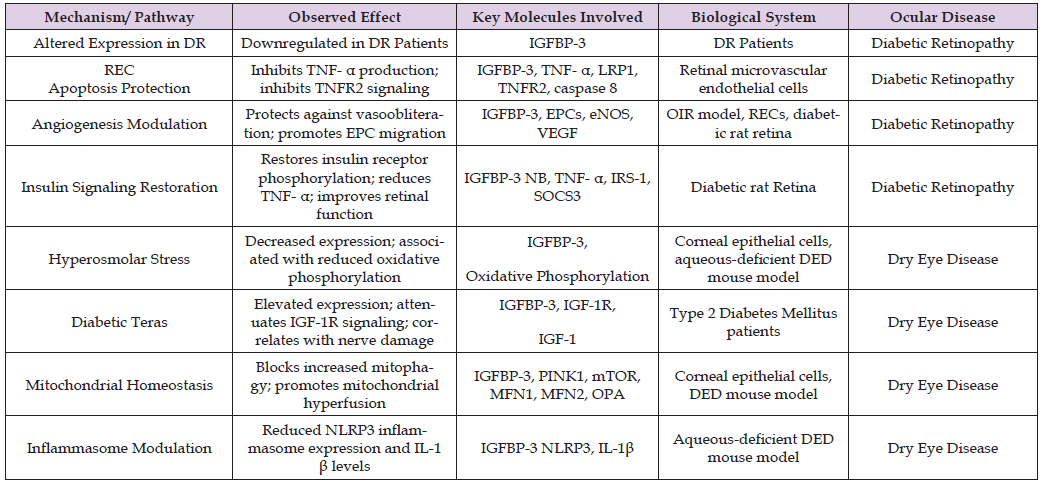
IGFBP-3 plays a role in regulating mitochondrial quality control, including mitophagy. Under hyperosmolar stress, mitophagy is induced but suppressed by exogenous IGFBP- 3, suggesting its importance in preserving mitochondrial integrity and enhancing cellular resilience in DED [26]. Moreover, the dysregulated expression of IGFBP-3 contributes to the imbalance between cell survival and apoptosis in ocular surface cells. Although IGFBP-3 exerts IGF-independent pro-apoptotic and anti- proliferative effects in other physiological contexts, its downregulation under hyperosmolar stress in DED may increase ocular surface cell vulnerability by removing a key element of the stress response [27]. This deficiency may contribute to epithelial cell damage and loss that are characteristic features of DED progression. Research suggests that IGFBP-3 regulates the nuclear translocation of IGF-1R, a pathway critical for cell survival under stress, underscoring its multifaceted role in corneal epithelial homeostasis. Table 1 summarizes the mechanistic pathways through which IGFBP-3 exerts its effects in ocular diseases, specifically DR and DED. The table identifies key molecular players, experimental models or biological systems utilized, and categorizes the relevance of each mechanism to either DR or DED.
Table 1: Summary of IGFBP-3’s Mechanistic Roles in DR and DED.
The capacity of IGFBP-3 to restore metabolic balance and optimize mitochondrial functions represents one potential approach to addressing the primary cellular abnormalities of DR and DED. In DR, IGFBP-3 is upregulated under hyperglycemic and hypoxic conditions, where it acts via IGF-independent pathways to stabilize the blood-retinal barrier (BRB), reduce inflammation, and promote vascular repair through endothelial progenitor cell (EPC) function and enhanced nitric oxide (NO) signaling via the SR- B1/PI3K/Akt/eNOS axis. In DED, IGFBP-3 could potentially alleviate symptoms and modify the course of the disease by targeting the basic cellular mechanisms of DED. Additionally, the potential for IGFBP-3 to also serve as a valuable biomarker for related ocular neuropathies, such as diabetic nerve changes in the cornea further emphasizes the broader clinical relevance of IGFBP-3 in ocular disease. Exogenous application of IGFBP-3 has been shown to restore both vascular integrity in the retina and metabolic homeostasis in corneal epithelium, underscoring its therapeutic potential in anterior and posterior segment pathologies. These dual roles position IGFBP-3 as a promising candidate for broad-spectrum ocular therapies, especially in diseases characterized by barrier dysfunction, chronic inflammation, or oxidative mitochondrial injury.
The authors declare no conflict of interest.

International Association of Landscape Archaeology, Czech Glass Society, Czech Republic

Department of Chemistry, Semenov Institute of Chemical Physics, USSR Academy of Sciences, Moscow, Russia

Neurology, LA BioMed Research Institute, USA

Associate Professor at Department of Breast and Thyorid Surgey, Chongqing General Hospital, China

Professor of Nuclear Medicine, Faculty of Medicine and Surgery, University of Milan, Milan, Italy





 Abstract
 PDF
PDF



























