info@biomedres.us
+1 (502) 904-2126
One Westbrook Corporate Center, Suite 300, Westchester, IL 60154, USA
Site Map
 ISSN: 2574 -1241
ISSN: 2574 -1241
ISSN: 2574 -1241
Received: June 12, 2025; Published: June 25, 2025
*Corresponding author: Segundo Juan López Cubas, Universidad Nacional Pedro Ruiz Gallo, Lambayeque, Perú
DOI: 10.26717/BJSTR.2025.62.009746
The objective of this study was to determine the effect of population density on the growth of Dormitator latifrons “pocoche”, in an intensive culture system with recirculation; For this, the Experimental Design of Increasing Stimulus was applied with two treatments and a control, without repetition: 200 fish/m3 (Control: Tank 1), 300 fish/m3 (Tank 2) and 400 fish/m3 (Tank 3); being the populations of 50 fish (Control: Tank 1), 75 fish (Tank 2) and 100 fish (Tank 3). The fish were fed with a diet of 28 % protein and the biometric control and the physical- chemical characteristics of the water were determined based on time; to determine significant differences between treatments, analysis of variance and Duncan’s test were applied. The growth of D. latifrons was affected by the population density in a direct relationship, being higher in the density of 400 fish/m2 (133, 636 mm and 37, 045 g); the same trend was observed in total production and per cubic meter. The physical-chemical characteristics of the water were within the adequate levels for the development of this species.
Keywords: Intensive Cultivation with Recirculation; Dormitator Latifrons; Population Density
D. latifrons “pocoche”, a native fishing resource of commercial importance in the department of Lambayeque, is a species with good qualities for its fish farming, since it occupies the low level of the trophic chain (herbivore), it is highly resistant to extreme water quality conditions and it has good quality meat, which is appreciated by the population; In addition, in the neighboring country of Ecuador, it constitutes an export product to countries such as the United States, Canada and countries of the Asian and European continent. Its fish farming in our department has been experimenting since 1993, having carried out monocultures and polycultures with native species and introduced in the semi-intensive culture system and an intensive one under laboratory conditions. Among these we have: López, Lora [1], established that this species grows better at a density of 2 fish/ m2: 105.93 g., supplementing it with chicken manure for nine months; likewise, Torres [2], determined that D. latifrons presented better growth when the balanced food (40%, 30% and 20% protein) was administered at two frequencies, for seven months: 348.88 g, in the density of 2 fish/m2; while López, Lora [3], experimenting with diets of 15%, 20% and 25% protein, found that it grows better with the 25% protein diet: 164.70 g, in six months of culture and density of 3 fish/m2; In intensive culture under laboratory conditions, López [4], determined that its growth is better in brackish water (15 ‰ - 17 ‰): 135.23 mm and 42.03 g, for 4 months, fed with 40 % diets. and 30% protein; On the other hand, Rivera, Vega [5], achieved 87.00 g at a density of 0.5 fish/m2, in polyculture with Trichomycterus punctulatus and “Hybrid Tilapia”, for five months, fed with a Puritilapia diet. Experiences that have made it possible to advance in the knowledge of its cultivation technology, related to planting and feeding density, with quite flattering results that envision a promising future; still missing to elucidate some of its aspects to consolidate a technological package. However, no culture experiences have been carried out in the intensive system with recirculation of this species, a system to which it is considered that it can be easily adapted due to the fact that it is a fish with gregarious behavior.
On the other hand, in an intensive culture system with recirculation, the water used in the culture ponds is then treated and used again, to adequately cover the requirements of the species being cultivated and that the treatments generally comprise various processes. , such as the physical removal of suspended and solution solids through a mechanical filter, the biological removal of ammonia (NH3) and nitrites (NO2-) through a biological filter, and aeration and oxygenation of water (Ingle de la Mora [6] ). For these reasons, the present research work has been carried out in which the effect of population density on the growth of D. latifrons has been determined, posing the problem: How does population density affect the growth of D. latifrons cultivated in the intensive system? with recirculation?, formulating the hypothesis: Since D. latifrons is a fish with gregarious habits, then its growth will be greater in the highest population density; the same one that was contrasted with the Experimental Design of Increasing Stimulus.
The cultivation of D. latifrons, which spanned the months of February to October 2013, was carried out in three fiberglass tanks with a capacity of 500 liters, filled with water up to 250 liters, properly conditioned with water entering from the top and drain at the bottom, as well as its respective aeration system (Figure 1). Likewise, a pump was located inside to raise the water to a filter located in the upper part, in which the water treatment was carried out to eliminate impurities and return them to the culture tank; likewise, every two days 30 % of the water was replaced. The contrasting of the hypothesis was carried out through the Experimental Design of Increasing Stimulus with two treatments and a control, without repetition (Table 1): 200 fish/m3 (Control: Tank 1), 300 fish/m3 (Tank 2) and 400 fish/m3 (Tank 3); being the populations of 50 fish (Control: Tank 1), 75 fish (Tank 2) and 100 fish (Tank 3). The juveniles of D. latifrons were obtained by captures made in the lower part of the Reque River. The fish were fed with a diet of 28 % protein, being the feeding indices of 2 % of the biomass for the first and second month of culture and then 1 % of the biomass from the third to the eighth month. Food was delivered at 10:00 a.m. (Figures 2A & 2B).
Figure 1
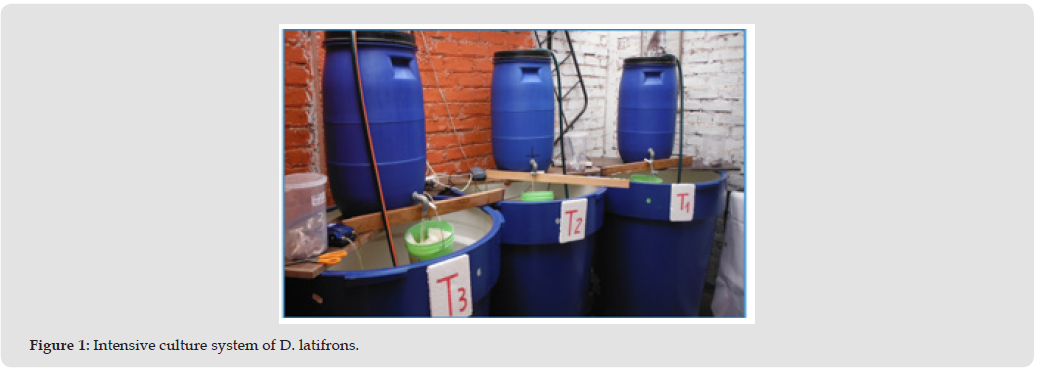
Table 1: Experimental design, denomination of dams, total population, length and weight mean planting of D. latifrons “pocoche” cultivated in three planting densities in the intensive culture system with recirculation, february - october 2013.

Figure 2

The biometric control of the growth of the fish was done monthly until the fourth sampling and every two months the fifth and sixth sampling, taking a random sample of 11 fish from each treatment, using a hand calc. Total length was recorded with an ichthyometer graduated in millimeters and total weight with a 0.1 g sensitive SF-400 digital scale (Figures 3 & 4). The surface and ambient water temperature was recorded with a Boeco digital thermometer (-40 ºC - 230 ºC), at 07:00 and 18:00 hours. Dissolved oxygen, ammonium, nitrites, nitrates, ammonium, and pH of the water were recorded monthly, using La Motte AQ-2 Water Analysis Kits. To determine the effect of population density as well as time on fish growth, the analysis of variance was applied for a factorial model of two fixed factors (Ostle [7]):

Where:
Yijk: Any measurement.
U: True average length or weight.
Ai: Effect of the population density factor on growth.
Bj: Effect of the time factor on growth.
(AB)ij: Effect of the interaction of the two factors on growth.
Eijk: Experimental bug.
For this, the hypotheses were formulated:
• Ho: The population density factor, time and their interaction
do not affect the growth of the fish.
• Ha: The population density factor, time and their interaction
do affect the growth of the fish.
Decisions are made based on:
• Accept Ho if F calculated is less than or equal to F tabulated.
• Accept Ha if F calculated is greater than F tabulated.
Subsequently, using Duncan’s test (Ostle [7]), it was evidenced in
favor of which treatment the significant differences in growth were
presented. The data was statistically processed with an Hp Core I3
Laptop, using the Excel 2010 program for Windows 7, with a significant
value at the 0.05 level.
Figure 3
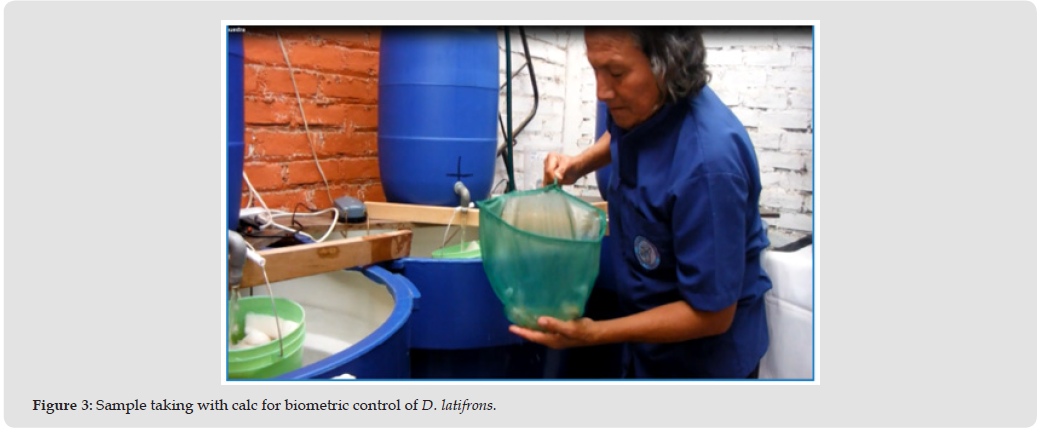
Figure 4

Growth of D. latifrons “Pocoche”
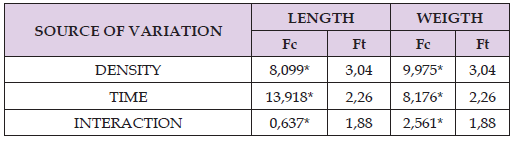
After eight months of culture, it was observed that the growth of the fish increased with the increase in population density, being higher in the density of 400 fish/m3 (Tank 3): 133, 636 mm and 37, 045 g. The graphic representation of the monthly growth (Figure 5), (Table 2) evidenced that the best growth in favor of the aforementioned treatment, occurred from the first month of cultivation until the end of the experiment. The analysis of variance (Table 3) established that the differences observed in growth, in length and weight, were statistically significant, showing the effect of population density on fish growth, in addition to time and the interaction of both factors. The statistical comparison of the means, through the Duncan test, for length (Table 4) and weight (Table 5), showed that the growth of the fish cultured in the density of 400 fish/m3 (Tank 3) was superior those with a density of 200 fish/m3 (Tank 1: Control), only in the fifth sampling for length and in the fifth and sixth sampling for weight; on the other hand, no significant differences were found in growth with respect to the density of 300 fish/m3 (Tank 2), nor between this last treatment and the Control.
Figure 5
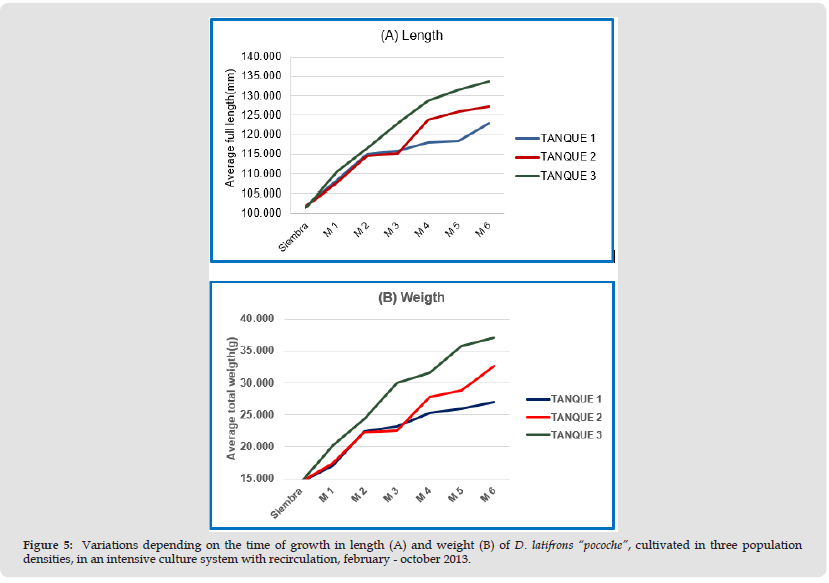
Table 2: Mean lengths and weights of sowing and by sampling of D. latifrons “pocoche”, cultivated in three population densities in an intensive system with recirculation, february - october 2013.
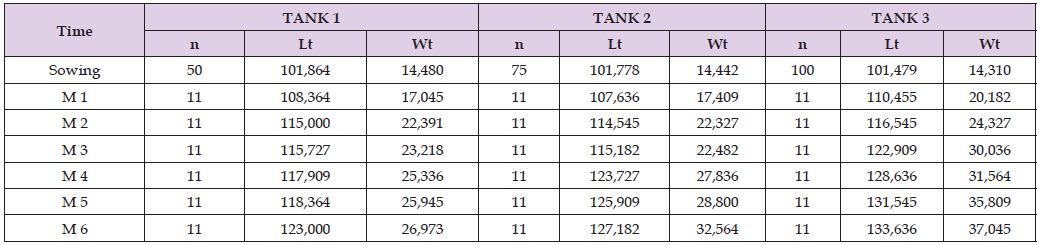
Note:
• n: Number of fish.
• Lt: Average full length (mm).
• Pt: Average total weight (g).
• S: Sowing.
• M: Sampling.
Table 3: Analysis of variance to determine the effect of density, time and their interaction on the growth, in length and weight of D. latifrons “pocoche”, cultivated in an intensive culture system with recirculation, february - october 2013.
Note:
• Fc: Calculated value of F.
• Ft: F Value from Tables.
• *: Significant value at the 0.05 level.
Table 4: Duncan’s test to determine significant differences between the mean lengths of D. latifrons “pocoche” cultivated in three population densities, in an intensive culture system with recirculation, february- october 2013.

Note:
• A. E:D: Duncan’s Studentized Amplitude.
• *: Significant value at the 0.05 level.
Table 5: Duncan’s test to determine significant differences between the average weights of D. latifrons “pocoche” cultivated in three population densities, in an intensive culture system with recirculation, february - october 2013.

Note:
• A.E.D: Duncan’s Studentized Amplitude.
• *: Significant value at the 0.05 level.
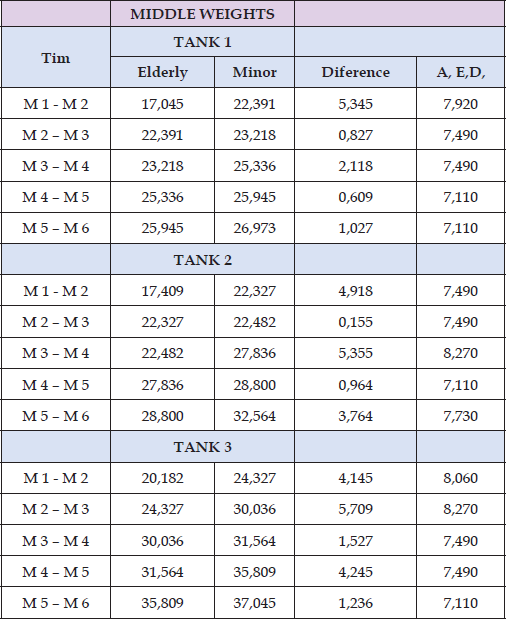
In relation to time, Duncan’s test (Tables 6 & 7) established that the growth, in length and weight, of the fish was not significant during the entire culture process in the three treatments. The rates of increase in length and weight (Table 8), showed an alternation of fast and slow growth of the fish in the three treatments; presenting the highest values in the density of 400 fish/m3.
Table 6: Duncan’s test to determine significant differences over time between the mean lengths of D. latifrons “pocoche” cultivated in three population densities, in an intensive culture system with recirculation, february - october 2013.

Note:
• A, E, D: Duncan’s Studentized Amplitude
• *: Significant value at 0.05.
Table 7: Duncan’s test to determine significant differences over time between the average weights of D. latifrons “pocoche” cultivated in three population densities, in an intensive culture system with recirculation, february - october 2013.
Note:
• A, E, D: Duncan’s Studentized Amplitude
• *: Significant value at 0.05.
Table 8: Increases in lengths and average weights depending on the time of D. latifrons “pocoche”, cultivated in three population densities in an intensive system with recirculation, february - october 2013.

Note:
• n: Number of fish.
• Lt: Average full length (mm)
• Pt: Average total weight (g).
• S: Sowing.
• M: Sampling.
Production Yield
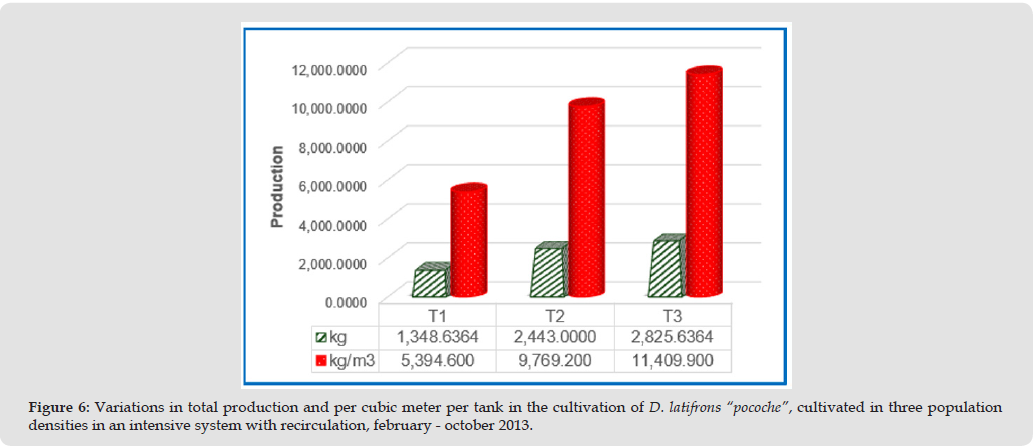
The total productions and per cubic meter increased their value with the increase in population density, being: 1.3487 kg, 2.4423 kg and 2.8525 kg, in the first case and 5.3946 kg/m3, 9 .7692 kg/m3 and 11.4099 kg/m3, for the second case, in Tanks 1, 2 and 3, respectively (Figure 6).
Figure 6
Feed Conversion Factor
The feed conversion factor decreased its value with the increase in population density: 3,659 (200 fish/m2), 2,553 (300 fish/m2) and 2,550 (400 fish/m2).
Mortality
At the end of the culture experience, no fish mortality was observed in Tanks 1 (200 fish/m3) and 2 (300 fish/m3), on the other hand, in Tank 3 (400 fish/m3) the death of 23 specimens, which represented 23 %.
Water and Environmental Temperature
The water temperature was very similar in the three culture tanks, with a tendency to decrease its value as the time of the experiment elapsed (Table 9). Their values varied from 26.70 °C to 20.25 °C. The environmental temperature experienced the same trend but with slightly higher values, ranging from 27.70 °C to 21.30 °C (Table 9).
Table 9: Ambient and surface temperature (ºC) of the water in the tanks of D. latifrons “pocoche”, cultivated in three population densities in an intensive system with recirculation, february - october 2013.

Dissolved Oxygen
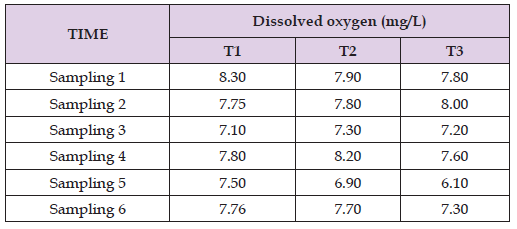
The levels of dissolved oxygen concentration in the water were high in the three treatments, with a slight tendency to decrease its value with the increase in population density (Table 10). In general, it ranged from 6.10 mg/L to 8.30 mg/L.
Table 10: Dissolved oxygen (mg/L) of the water from the tanks of D. latifrons “pocoche”, cultivated in three population densities in an intensive system with recirculation, february - October 2013.
pH
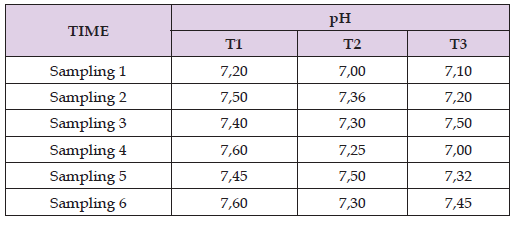
El pH del agua de los tanques estuvo por encima de 7,00y con valores muy similares, siendo su variación desde 7,00 a 7,60 (Table 11).
Table 11: pH of the water from the D. latifrons “pocoche” tanks, cultivated in three population densities in an intensive system with recirculation, February - October 2013.
Amonio
El amonio estuvo presente en los tres tratamientos en cantidades que incrementaron su valor a medida que varió la densidad poblacional, siendo mayor en la densidad de 400 peces/m3 (Table 12). Su variación general fue de 0,33 mg/L a 0,75 mg/L.
Table 12: Ammonium (mg/L) of the water from the D. latifrons “pocoche” tanks, cultivated in three population densities in an intensive system with recirculation, february - october 2013.

Nitritos
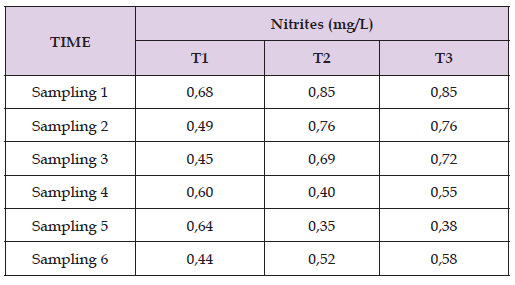
Los nitritos no observaron la tendencia que se presentó en el amonio, sin embargo, los mayores valores correspondieron a la densidad más alta, siendo menores en aquella más baja (Table 13). De manera general, se observó una variación de 0,35 mg/L a 0,85 mg/L.
Table 13: Nitrites (mg/L) of the water from the tanks of D. latifrons “pocoche”, cultivated in three population densities in an intensive system with recirculation, february - october 2013.
Nitratos
Los nitratos ostentaron concentraciones muy cercanas entre los tres tratamientos, con una ligera tendencia a incrementar suvalor con el aumento de la densidad poblacional (Table 14). Sus valores fluctuaron entre 45,00 mg/L y 67,00 mg/L.
Table 14: Nitrates (mg/L) of the water from the D. latifrons “pocoche” tanks, cultivated in three population densities in an intensive system with recirculation, february - october 2013.

Considering the results achieved in the present study, the fulfillment of the hypothesis raised in the sense of a greater growth of D. latifrons in the highest density was confirmed, since in this intensive culture system with recirculation, the fish reached the greater length and weight average in the density of 400 fish/m3, which was corroborated by the analysis of variance and Duncan’s test; fact that would be explained in that being this species a fish of gregarious habits, the greater population density would be favoring its growth. However, it is necessary to indicate that although the growth is greater in the density of 400 fish/m3, it does not differ statistically from that reached in the density of 300 fish/m3. The rates of increase in length and weight as a function of time show a similar behavior in the three treatments, confirming Duncan’s test and consequently the greater growth of the fish in the higher density. The best growth of D. latifrons achieved at a density of 400 fish/m3, at the fourth month of culture, surpassed López [4] who achieved 123.73 mm and 29.77 g in the freshwater treatment and 119.03 mm and 26.17 g in seawater, however, they are surpassed by this author in the treatment of brackish water: 135.23 mm and 42.03 g. These facts would be explained because the higher population density would be favoring the growth of the fish in the first case and in the second case, because the brackish water would have allowed a greater growth of this species, since the aforementioned author found that salinity influences on the growth of this species, being best in brackish water.
If the results of the present study are compared with those achieved in the semi-intensive system, they are lower than the reports of: López, Lora [1], who achieved 105.93 g in nine months, supplementing it with chicken manure and a density of 2 fish/m2.; Torres (2000), who achieved 348.88 g in seven months, feeding it balanced 40%, 30% and 20% protein and a density of 2 fish/m2; López, Lora [3], who obtained 164.70 g in six months, with a diet of 25% protein and a density of 3 fish/m2. This is explained because in the semi-intensive system the fish, in addition to the artificial food that is given to them, have access to the natural food produced in the pond and also because the population densities are much lower. The total productions and per cubic meter were higher in the highest density (400 fish/m2) and this was due to the greater growth achieved in this treatment as well as the greater number of cultured fish. On the other hand, this production per cubic meter exceeds that obtained by López [4], in cultivation of this species in brackish water: 8,406.00 kg/m3, which would be due to the greater growth achieved, the greater population density and the greater culture time of this experiment.
The best feed conversion factor was reached in the highest population density (400 fish/m2), agreeing with the highest growth of the fish. However, its value was very close to the density of 300 fish/m2 and it was due to the mortality observed in this treatment, which affected the value of this parameter, raising it to 2,550. However, this feed conversion is better than that achieved by López [4]: 3.05 for culture in brackish water; which is explained by the higher feeding indices used in this crop, which were higher: 5%, 4% and 3% of the biomass, in relation to the present study. The variations of the water and environmental temperature in relation to time, obeyed the seasonal changes: summer - autumn - winter. Its values fall within the range of 20 °C - 28 °C, which according to Boyd [8], is adequate for tropical fish farming; instead, during most of the cultivation it was found below the range of 24 °C - 27 °C, considered by Haz [9] as the tolerance level for this species.
The dissolved oxygen in the water in the tanks reached good concentration levels, indicating the good quality of the water in terms of this parameter. Its value was above the values of 4 mg/L, considered optimal by Kubitza [10], for crops in recirculating systems, and 0.4 mg/L, considered by Haz [9] as the minimum tolerable by this species. Likewise, it was above the values found by López [4]: 3.25 mg/L to 6.75 mg/L, in culture of this species under laboratory conditions. The pH of the water, in the three treatments, showed values that were located within the range of 7 to 8, considered by Kubitza [10] as adequate for these cultivation systems. Similarly, they were found within the levels of 6.5 and 9.0, which according to Boyd [8], are the most suitable for fish production; being similar to the values found by López [4]: 7.42 - 7.82. The increase in ammonium concentration due to the higher population density would be explained because having a greater number of fish, the amount of food provided was greater and also because of the greater amount of waste produced by the fish. Their values were located above 0.2 mg/L, which is the adequate upper limit for these culture systems, according to Kubitza [10] finding, instead, around 0.6 mg/L, which this same author considers as a level of care; however, this species has tolerated them very well, with no significant mortality, although it could have affected their growth.
Nitrites, although they were above the adequate level of 0.3 mg/L, did not reach the level of attention of 1 mg/L, considered by Kubitza (Op. cit.) for crops in recirculation systems. Nitrates, likewise, were above the adequate level of 50 mg/L, but did not reach the lethal level of 400 mg/L, according to Kubitza (Op. cit).
1. The growth of D. latifrons in the intensive culture system with recirculation, was affected by the population density in a direct relationship, being higher in the density of 400 fish/m2.
The physical-chemical characteristics of the water were within the adequate levels for the development of this species...

International Association of Landscape Archaeology, Czech Glass Society, Czech Republic

Department of Chemistry, Semenov Institute of Chemical Physics, USSR Academy of Sciences, Moscow, Russia

Neurology, LA BioMed Research Institute, USA

Associate Professor at Department of Breast and Thyorid Surgey, Chongqing General Hospital, China

Professor of Nuclear Medicine, Faculty of Medicine and Surgery, University of Milan, Milan, Italy





 Abstract
 PDF
PDF



























