info@biomedres.us
+1 (502) 904-2126
One Westbrook Corporate Center, Suite 300, Westchester, IL 60154, USA
Site Map
 ISSN: 2574 -1241
ISSN: 2574 -1241
ISSN: 2574 -1241
Received: June 16, 2025; Published: June 24, 2025
*Corresponding author: Juan Manuel Sánchez-Yáñez (syanez@umich.mx). Environmental Microbiology Laboratory, Research Institute in Chemistry and Biology. B. B3. University City, Universidad Michoacana de San Nicolás de Hidalgo, Francisco J Mujica S/N, Col Felicitas del Rio ZP 58030, Morelia, Michoacán, México
DOI: 10.26717/BJSTR.2025.62.009745
temperature increases in the manufacture of engine alloys. Due to the chemical nature of aliphatic and aromatic
hydrocarbon fluids, there are cosmopolitan aerobic heterotrophic microorganisms in the environment capable
of using these hydrocarbons as a source of carbon and energy, resulting in damage to the engine alloys manufactured.
Therefore, biocides that inhibit this microbial capacity are applied. However, it is necessary to evaluate the
inhibitory potency as a basis for the phenolic coefficient method. Therefore, the objectives of this research were:
a) determine the potential biocidal activity of the biocides Antisep-60 and Antisep-1127, Grotan, and
Nalco-7320, by the phenolic coefficient standard method
b) analyze the effect of the biocides Antisep-60 and Antisep-1127, Grotan, and Nalco-7320 on con- trolling
the biodegradation of a cutting fluid by the CO2 production method. For this purpose, a phenolic coefficient
was used to determine the biocidal potential compared to phenol against the target bacteria genus and species
Staphylococcus aureus. Then, in the cutting fluid, the activity of each biocide was measured when contaminated
with S. aureus based on the production of CO₂ derived from the degradation of the cutting fluid, as well as the
percentage of degraded cutting fluid or trapped oil and the pH dynamics. The results showed that according to
the phenolic coefficient method Nalco-7320 at 100 ppm was equivalent to the potency of phenol in killing S. aureus,
while Antisep-1127 required 350 ppm to achieve the same level of inhibition of S. aureus while both Grotan
and Antisep-60 only at 1500 ppm concentration had the biocidal potency to kill S. aureus. However, when these
concentrations of Antisep-60 and Antisep-1127, Grotan and Nalco-7320 were tested in cutting fluids only the
Grotan biocide had an inhibition effect on cutting fluid degradation, or less trapped oil and minimized pH variability
in the fluid. Based on the above, it is concluded that a method other than the phenolic coefficient should
be used to determine the potential inhibition of these chemical agents in cutting fluids. This method is based
on the CO2 production derived from fluid degradation, the amount of trapped oil, and the pH to ensure engine
manufacturing under clean working conditions, thus avoiding contamination of the fluid cutting and damage to
engine parts causing economical loss in the automotive industry.
Keywords: Cutting Fluids; Biodegradation; Biocides; Biological Activity; Sanitary Cleaning Measures
Despite their cell size, prokaryotes possess a wide genetic diversity of metabolism that allows them to colonize any natural or artificial environment, or a combination of both [1]. Consequently, it is not uncommon for a mixture of oils of natural or synthetic origin to grow in cutting fluids as fundamental cooling and lubricating properties in automotive manufacturing [2,3]. These oils or cutting fluids are essentially coolants and lubricants of an organic chemical nature, carbon compounds that require an accompanying biocide to prevent common microorganisms in the dust of the air, machinery, the operator’s body from contaminating them, causing loss of lubrication and cooling, consequently damage to the metal alloy parts of automobiles, industrial machinery also some of this microorganisms are causing health problems for operators [3]. The evidence shows that the main microorganisms that contaminate cutting fluids consume the organic base that causes the loss of cooling and lubricating capacity. Some microorganisms able to degrade cutting fluid, are of heterotrophic metabolism such as genera and species of Pseudomonas aeruginosa, P. alcaligenes, P. luteola, as well as other species and genera of microbials that include actinomycetes, filamentous fungi, and yeast have the ability to use the oils in cutting fluids as their sole source of carbon and energy over a period of hours to days, destroying the rheological properties and plastic viscosity of the fluid [4-6]. To prevent this problem, biocides of diverse chemical composition are used, such as methyloxazolidine, isothiazolone, morpholine, as well as those that are added later to cutting fluids, such as quaternary ammonium compounds, especially when microbial contamination is high [7-10], since without the effectiveness of the biocide, the cutting fluid is destroyed, which causes problems in automotive parts, production machinery, and even causes dermatitis and other health problems in operators [10,11]. Therefore, the objectives of this research were:
a) determine the potential biocidal activity of the biocides Antisep- 60 and Antisep-1127, Grotan, and Nalco-7320, by the phenolic coefficient standard method.
b) analyze the effect of the biocides Antisep-60 and Antisep- 1127, Grotan, and Nalco-7320 on controlling the biodegradation of a cutting fluid by the CO2 production method, in automotive manufacturing.
Phenolic coefficient technique to determine the effectiveness of biocides for microbial control to evaluate the effectiveness of the biocides Antisep-60, Antisep-1120, Grotan, and Nalco-7320, the phenolic coefficient technique was performed with Staphylococcus aureus as the target organism. S. aureus cell concentration was adjusted using the MacFarland nephelometer technique, in suspension with 0.85% saline solution and 0.001% detergent, at a density of 120 x 107 CFU/ ml. Then, from the biocidal concentrates: Antisep-60, Antisep-1127, Grotan, and Nalco-7320, 10 ml of each biocide were taken and sterilized by filtration with a millipore membrane. of 0.2μ sterile, then diluted to have the following concentrations 350, 400, 450, 500, 550, 600 and 650 ppm in sterile tubes with nutrient broth [12,13] for a compared with the nutrient broth nutrient broth with the following composition (g / L): 10.0 glucose, 5.0 casein peptone and 1.0 yeast extract, pH adjusted to 6.8-7.0 sterilized at 12 °C / 15 min, incubated at 37 oC for 24-48 h [14,1,2]. without S. aureus, or biocide or negative control, another tube with nutrient broth with S. aureus without any biocide or positive control; Nutrient broth incubated at 37 °C for 24 h [1,14,15]. To test the germicidal action of biocides in cutting fluid in the laboratory, the respiratory activity method was used, which measures the release of CO2, produced by the degradation of hydrocarbons in the cutting fluid test units were used, as shown in Figure 1, consisting of: two flasks, one of 500 ml. attached to a test tube, with 50 ml. of emulsion and 2 ml. of 1N NaOH respectively, the second of 1000 ml. attached to a 250 ml flask with 100 ml. of emulsion and 4 ml. of 1N NaOH.
The average amount of CO2 detected in both flasks represents the metabolic activity per test unit. The emulsion contained Hocut-733 oil, this is a semi-synthetic, emulsifiable coolant, forms an opaque emulsion, does not contain nitrites, diluted to 8% in sterile water, 2.0% weight / vol. of aluminum fragments, 1.0% weight / vol. of cottonseed, 0.5% hydraulic fluid. The flasks were sealed with rubber stoppers and incubated while shaking at 150 rpm (Lab-Line Orbital Incubator-Shaker No.3595) at a temperature of 30 °C 3 °C, titrations were made every 24 h, initially the emulsion presented a pH of 10 which was maintained by regulating daily with 5N NaOH for 15 days. To test the biocides under aerated conditions, the model described above was used, but in 500 ml flasks in triplicate covered with a swab and kept shaking at 150 rpm, regulating the pH every 24 h. in the manner already mentioned. Every 7 days, 5 ml of sterile distilled water was added to compensate for evaporation. At the end of the test period, 10 ml of oil was taken from each flask, previously shaken, and centrifuged at 3300 rpm/10 min in graduated tubes to determine the amount of trapped oil and obtain the percentage [1,12-15]. All experimental data were analyzed at (P<0.05) according to ANOVA-Tukey. Determination of the effectiveness of Antisep-60, Antisep-1127, Grotan, and Nalco-7320 in controlling Staphylococcus aureus-induced cutting fluid called Hocut-733 destruction during automotive manufacturing.
To determine the amount of CO2 released from cutting fluid mineralization, from the first minute to the 15th minute, a 40 g sample of soil treated with the biocides Antisep-60, Antisep-1127, Grotan, and Nalco-7320 was taken. Dosage was adjusted to 1500 ppm, compared to the same cutting fluid with and without S. aureus. Each cutting fluid and biocide were then placed in a Bartha flask. 10 ml of 0.1 N NaOH was added to the arm as a CO2 absorbent, and closed with a stopper. rubber, then incubated at 29 °C for 24 h. 0.1 N NaOH was then placed in a 250 ml Erlenmeyer flask, 2 drops of phenolphthalein were added, and the mixture was titrated with 0.1 N HCl. The CO2 concentration was calculated using the following formula: mg CO2 = ((ml NaOH) (N of NaOH) - (ml HCl spent) (N of HCl).. All experimental data were analyzed at (P<0.05) according to ANOVA-Tukey (12,18), as is shown in Figure 1.
Figure 1
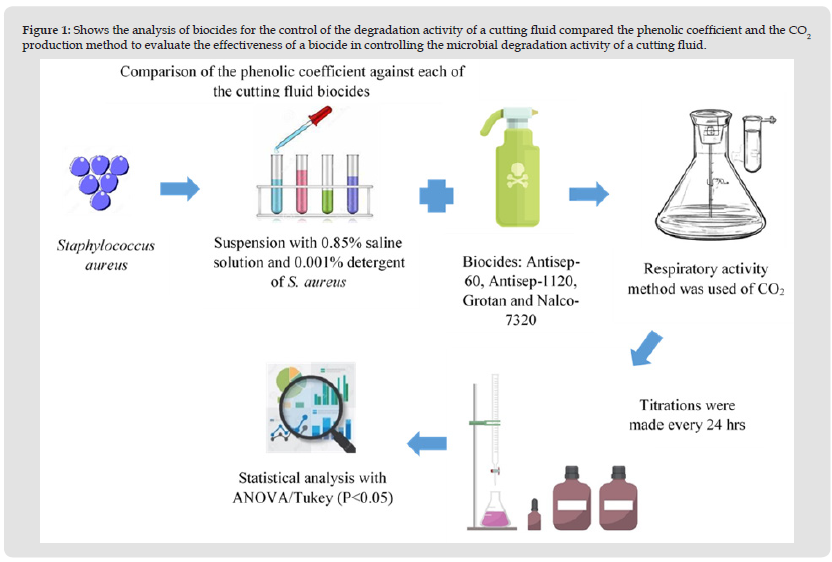
Table 1 shows the comparison of the biocidal capacity of Antisep- 60, Antisep-1127, Nalco-60 and Grotan according to the phenolic coefficient. According to the results, Nalco-60 with 75 ppm would have biocidal activity against S. aureus in contrast to Grotan which only showed biocidal activity at a concentration of 1,500 ppm, a value that indicates zero biocidal activity compared to the phenolic coefficient. In contrast, Nalco 7320 at concentrations from 75 to 100 ppm would have a biocidal activity like phenol, and with a lower biocidal capacity than phenol at concentrations between 350 to 450 ppm of Antisep-1127. When Antisep-60, Antisep-1127, Nalco-60 and Grotan were added to the nutrient broth, S. aureus grew without problems, compared to the biocidal action of phenol that quickly kills S. aureus in a relatively short time, similar to what happened with Nalco-60. This first test served for the following experiment where each biocide was applied to the cutting fluid with the maximum concentration of Nalco-60 with 100 ppm, with Antisep-1127 with 450 ppm and the maximums of Antisep-60 and Grotan. In this case, the biocidal activity was determined based on the production of CO2 derived from the degradation of the cutting fluid where the results were different from those registered by the phenolic coefficient method [16-18].
Table 1: Effectiveness of biocide for the control of microbial contamination in cutting fluid compared to the phenolic coefficient.

Note: (+) = inhibits bacterial growth (-) = does not inhibit bacterial growth. (NA) = not applicable concentration that no useful for the phenolic coefficient technique in this case.
Table 2 registered the pH dynamics of the cutting fluid called Hocut- 733 used for lubrication and cooling. It consists of emulsifiable fatty oils, with sulfur, chlorine or phosphorus compounds, colloidal emulsions of surfactants, wetting agents and corrosion inhibitors, nitrite salts and organic amines used in metal machining, it was protected by Antisep-60 and Antisep-1127 at a concentration of 1500 ppm, with Nalco-7320 with 1000 ppm and Grotan 1500 ppm when contaminated with S. aureus, compared to the cutting fluid without application of biocide contaminated with S. aureus and the cutting fluid contaminated with S. aureus without biocide. There it was observed that the pH in the cutting fluid without biocide or contaminated by S. aureus only varied 9 to 10, indicating that it retains intact the lubricating and cooling properties. In contrast when the fluid was contaminated with S. aureus without biocide part of the organic plant fraction was oxidized which lowered the pH with the loss of the lubricating and cooling capacity, hence the need to apply a biocide appropriate to the properties of the cutting fluid as happened when Grotan was applied at a concentration of 1500 ppm which effectively controlled the degrading activity of S. aureus in contrast when Nalco-7320 was applied at a concentration of 1000 ppm which did not control the activity of S. aureus with the consequent drop in pH during the first 6 days, a situation similar to that observed with Antisep-1127 and Antisep 60 which despite being applied at a concentration of 1500 ppm during the first few days did not prevent a decrease in pH causing the partial loss of the lubricating and cooling properties of the fluid.
Table 2: pH values registered in the cutting fluid with different biocides under aeration conditions at 37 ± 5 °C.
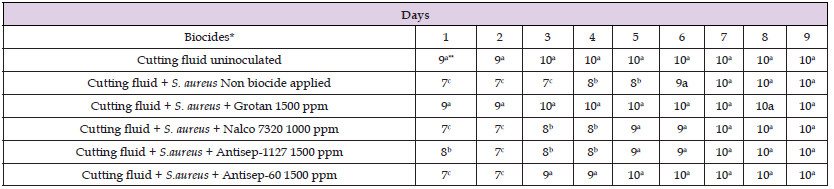
Note: *n=6, **values with different letters indicate statistical difference (P<0.05) according to ANOVA-Tukey.
The difference in biocidal capacity is due in principle to its chemical composition and compatibility with the chemical components of the cutting fluid, which make it possible to effectively control the degradation activity of the cutting fluid by S. aureus [19,20]. Table 3 shows the biocidal activity of Antisep-1127 at 450 and 1500 ppm, Antisep- 60, Nalco, and Grotan at 1500 ppm, compared to cutting fluid without biocide or S. aureus contamination, as well as to cutting fluid without biocide contaminated by S. aureus under aerobic, microaerophilic, and two S. aureus concentrations: low 1 x 10⁶ CFU/ml cutting fluid and high:10 x 106 CFU/ml cutting fluid on CO2 production and the percentage of trapped oil as indicators of cutting fluid degradation resulting in loss of lubrication and cooling. It can be seen there that in the cutting fluid without biocide or contamination by abiotic reactions, part of the hydrocarbon fraction is lost as 667.04 mg CO2/ ml in microaerophilic and 744 mg/ CO2/ml in aerobiosis without generating trapped oil in any case; in contrast, when the cutting fluid without the protection of a biocide is degraded by S. aureus, 1519.4 mg CO2/ml are released in microaerophilic and 1300 mg CO2/ml in aerobiosis. A similar thing was observed when Nalco 1500 was applied to the cutting fluid with 891mg CO2/ml and 4% oil trapped in, but not in microaerophilic and aerobic condition. Similarly, when Antisep-1127 was applied to the fluid, 515mg CO2/ml were released with 2% oil trapped in microaerophilic condition and 939mg/CO2 with 5% oil trapped in aerobiosis. In clear contrast to the cutting fluid with 1500 ppm Grotan in both microaerophilic and aerobic conditions without CO2 generation and no percentage of trapped oil. This result showed that Grotan whose active ingredient paraformaldehyde reaction products with 2-hydroxypropylamine was compatible with the chemical composition of Hocut-733 cutting fluid under the operating conditions of microaerophilic conditions with relatively low and high cell density of S. aureus, one of the main contaminants of this fluid whose origin is human by operators of the automotive industry [11,16,18-20].
Table 3: Total CO2 production by microbial activity and percentages of trapped oil detected at the end of the tests with and without Staphylococcus aureus.
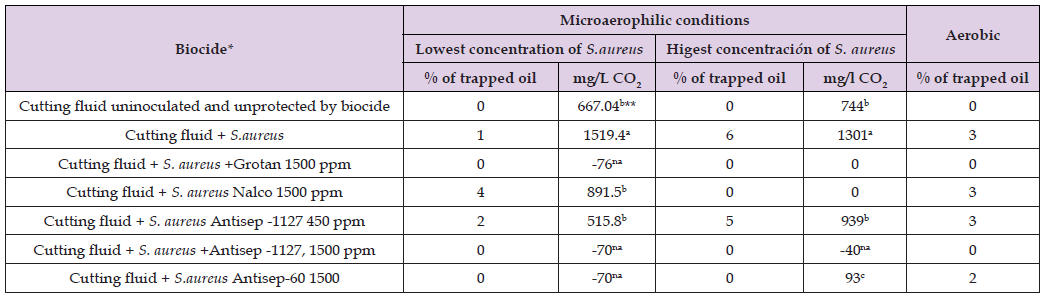
Note: *n=6, **values with different letters indicate statistical difference (P<0.05) according to ANOVA-Tukey na=negative CO2 production values.
Figure 2 shows an option for measuring biocide efficacy for cutting fluids that is better than the phenolic coefficient method. It was demonstrated that Grotan, at a concentration of 1500 ppm, effectively controlled the degrading activity of S. aureus in the cutting fluid for the first 15 minutes and up to 10 days thereafter (data not shown), preventing the loss of lubrication and cooling. The effectiveness of Grotan in preventing deterioration was similar to the cutting fluid not being contaminated with S. aureus in clear contrast when the cutting fluid was contaminated with S. aureus without applying Grotan 1500 ppm it was registered that the fluid lost all lubricating and cooling properties consequently causing industrial damage to engine parts, corrosion and deformation of auto parts with a high economic value hence the importance of using the detection of CO2 production as a method to adequately evaluate the biocidal capacity [1,2,7,21].
Figure 2

Phenolic coefficient method, compared to the microbial activity method, produces false positives and false negatives. It was previously known that this method was not the most appropriate for evaluating this type of product, mainly due to the differences in the action conditions of phenol and biocides for soluble oils. However, the phenolic coefficient is the only established method for evaluating disinfectants. Therefore, we believe that the microbial activity method can be a basis for the development of more accurate methods. This technique offers advantages from an economic perspective, as it does not require expensive reagents or sophisticated media, and it is easy to observe the action of the biocide on a total population. Aerobic and microaerophilic conditions represent a determining factor in the effectiveness of biocides. According to the results obtained, the ideal biocide, based on its cost and efficiency, is Hexahydro 1-3-5-tris-(2- hydroxyethyl)-S-triazine (Grotan) [22-25].
A Chrysler de México, Ramos Arizpe, Coahuila, México, A la Universidad Autónoma de Nuevo León, Facultad de Ciencias Biológicas por las facilidades para realizar esta investigación. Monterrey, N.L. México. To Project 2.7 (2025) supported by the Scientific Research Coordination-UMSNH: “.Aislamiento y selección de microorganismos endófitos promotores del crecimiento vegetal para la agricultura y la biorremediación del suelo. To Phytonutrimentos de México and BIONUTRA S.A de CV, Maravatío, Michoacán, México for helping us to publish the present research.
The authors declare that there is no type of conflict of interest in its planning, execution and writing with the institutions involved, as well as those that financially supported this research.

International Association of Landscape Archaeology, Czech Glass Society, Czech Republic

Department of Chemistry, Semenov Institute of Chemical Physics, USSR Academy of Sciences, Moscow, Russia

Neurology, LA BioMed Research Institute, USA

Associate Professor at Department of Breast and Thyorid Surgey, Chongqing General Hospital, China

Professor of Nuclear Medicine, Faculty of Medicine and Surgery, University of Milan, Milan, Italy





 Abstract
 PDF
PDF



























