info@biomedres.us
+1 (502) 904-2126
One Westbrook Corporate Center, Suite 300, Westchester, IL 60154, USA
Site Map
 ISSN: 2574 -1241
ISSN: 2574 -1241
ISSN: 2574 -1241
Received: June 11, 2025; Published: June 20, 2025
*Corresponding author: Muhammad Aamir Latif, Department of Research Facilitation, RESnTEC, Institute of Research, Bahawalpur, Pakistan
DOI: 10.26717/BJSTR.2025.62.009738
Artificial intelligence (AI) seems to revolution diagnostics, treatment modalities, and personalized care all around the world. The mini-review is aimed at narrating the recent developments and challenges while incorporating AI into the contemporary healthcare. In 2023, a surge of 133.7% was seen in research publications involving the role of AI in various fields of healthcare, with main focus in radiology, gastroenterology, and ophthalmology. Some of the most commonly laid challenges with AI revolve around consistency and reliability of data, algorithm bias, and ethical as well as privacy concerns. Addressing the challenges at hand around the utilization and role of AI in healthcare systems is of utmost priority as development of targeted and adaptable medical tools can transform the global healthcare in the future.
Keywords: Artificial Intelligence; Diagnostic; Gastroenterology; Ophthalmology; Therapeutics
Artificial Intelligence (AI) is becoming a force of change in medical research that is having profound impacts across areas such as diagnostics, therapeutics, and imaging [1]. Since it has the potential and the capacity to work with and evaluate large amounts of data, AI has been reported to redefine conventional research methods for more personalized and effective healthcare process [2,3].
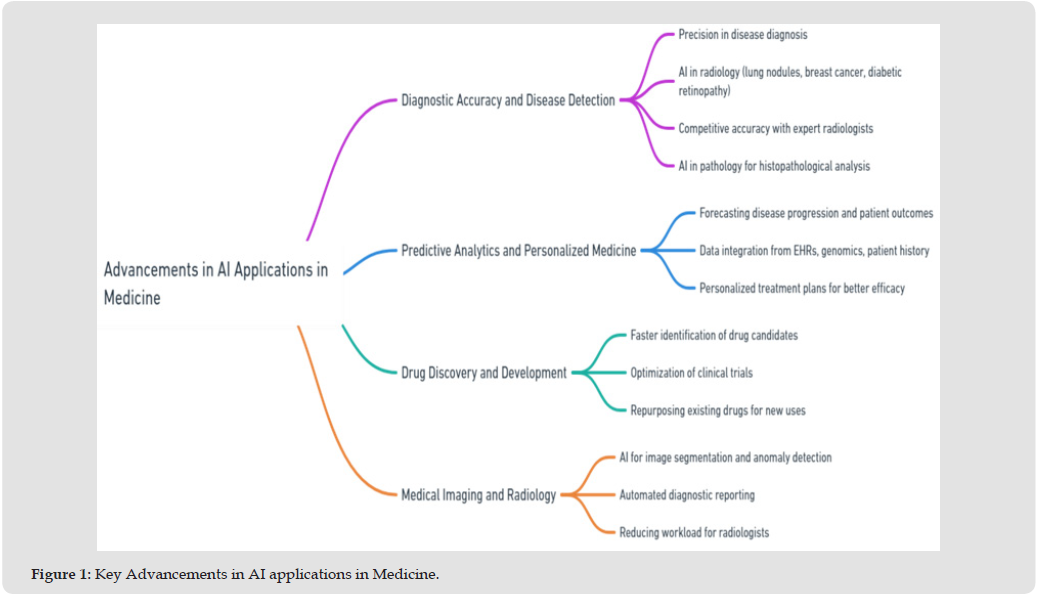
AI is transforming healthcare by enhancing precision, prediction, and efficiency across these domains. Figure 1 is highlighting key advancements in AI applications within medicine, focusing on areas such as diagnostic accuracy, predictive analytics for personalized care, drug discovery, and advancements in medical imaging and radiology.
Figure 1
Diagnostic Accuracy and Disease Detection
Artificial intelligence is developing significantly to enhance the accuracy of disease diagnosis. In radiology, deep learning algorithms have been used to detect abnormalities, e.g., lung nodules on computed tomography scans, breast cancer lesions on mammograms, and diabetic retinopathy signs in retinal images [4-7]. AI systems have been shown by researchers to be capable of achieving diagnostic accuracy that is comparable, if not superior to, that of experienced radiologists. Evidence is emerging that AI algorithms can identify breast cancer with improved sensitivity compared to the human radiologists and thereby decrease the false positive and false negative rates [8]. In pathology, AI algorithms are being used to analyze histopathological slides to identify cancerous cells with high precision, aiding pathologists in making more accurate and faster diagnoses [9,10].
Predictive Analytics and Personalized Medicine
AI-driven predictive models are being utilized for forecasting disease progression and related [11]. Advanced models have the potential to integrate data from various sources like electronic health records (EHRs), genomic data, and patient history to use for predicting the risk of adverse outcomes (e.g., cardiovascular events or cancer recurrence) [11,12]. AI can also help in personalized where medicine where it can assist tailoring treatment plans that are based on individual case profiles, subsequently resulting in improved therapeutic efficacy and minimizing related adverse events [13].
Drug Discovery and Development
AI has been marked to revolutionize the drug discovery process by accelerating the identification of potential drugs and optimizing clinical trial designs [14]. Machine learning algorithms have been shown to predict the interaction between drugs and relevant targets, progressing into the identification of newer therapeutic agents. AI models are also being utilized to redefine existing drugs for newer indications, thereby minimizing the cost and time related to drug development [15].
Medical Imaging and Radiology
Medical imaging and radiology have been the most common avenues for the utilization of AI. In 2023, imaging turned out to be the most prevalent segment employing AI, and accounted for a vast chunk of AI-related research publications. AI models are also being utilized for image segmentation, anomaly detection, and automated reporting, which have been shown to improve diagnostic accuracy along with reducing the overall workload of radiologists [16,17].
In 2023, a substantial surge was noted in AI-related publications to healthcare, with a total of 23,306 articles, representing a 133.7% rise from 2022 [18]. Imaging, gastroenterology, and ophthalmology were among the leading specialties adopting AI technologies. Imaging alone accounted for 75.2% of publications, highlighting the dominant role of AI in this field. The adoption of large language models (LLMs) in general healthcare and surgery was also notable, indicating the growing influence of natural language processing (NLP) in clinical settings [19]. These trends suggest that while traditional imaging and diagnostic applications remain strongholds for AI, there is an expanding scope in other specialties, including surgical planning and clinical documentation.
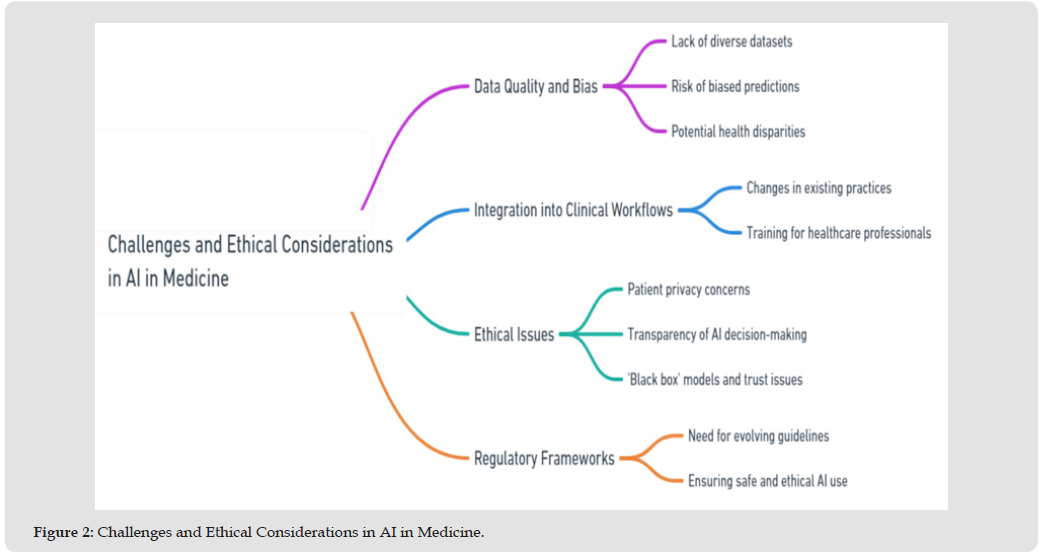
While AI promises to revolutionize medicine, there are challenges that must be proactively addressed to ensure equitable, ethical, and seamless integration into healthcare systems (Figure 2). Effective solutions will require collaboration among technologists, healthcare providers, regulators, and policymakers.
Figure 2
Data Quality and Bias
1. Lack of Diverse Datasets: Many AI models are trained using data that do not represent the full spectrum of patient populations. For example, datasets may have fewer samples from minority or underserved communities, resulting in algorithms that may not perform equally well for all groups.
2. Risk of Biased Predictions: When AI tools rely on incomplete or biased data, they can generate skewed predictions, leading to unequal healthcare outcomes.
3. Potential Health Disparities: Bias in AI model Integration into Clinical Workflows
1. Changes in Existing Practices: Introducing AI into medical practice requires modifying workflows, which can be disruptive. Physicians and clinical staff are needed to adapt to newer systems, that can result in slowing down operations initially.
2. Training for Healthcare Professionals: Effective utilization of AI may require healthcare professionals to understand and trust the technology. This could involve major trainings to bridge knowledge gaps and assist clinicians feeling comfortable with AI-powered decision making.
Ethical Issues
Patient Privacy: AI applications are prone to raise concerns regarding the security and confidentiality of participants data.
Transparency of AI Decision-Making: Many AI models, especially deep learning systems, have been thought to function as “black boxes,” that can make it difficult for clinicians to acknowledge and understand how a particular outcome / decision was reached / made.
Trust Issues: AI related models can raise trust issues as healthcare researchers can hesitate to act on recommendations they cannot interpret or justify to patients.
Regulatory Frameworks
Need for Evolving Guidelines: Current regulatory frameworks are still catching up with the rapid development of AI technologies in healthcare. New standards are needed to ensure that AI tools are safe, effective, and ethically sound.
Ensuring Safe and Ethical AI Use: Regulations must address concerns related to accountability, transparency, and fairness to prevent harm to patients and maintain public trust in AI-powered healthcare systems.
AI in medicine has a bright future where it will have the potential to integrate multiple data types, monitor patients continuously via wearables, and expand telemedicine capabilities. Joint research efforts and open data initiatives will keep AI models effective and fair across diverse populations. AI-based training tools have the potential to dramatically change medical training, with immersive and tailored educational experiences. Complementing one another, all these advances hold the promise to revolutionize the healthcare system toward being more proactive, patient-empowering, and equitable. Figure 3 is depicting mind map of potential future directions for AI in medicine.
Figure 3

Advancements in AI Models
Future AI systems will be able to integrate various types of data— like MRI scans, patient medical history, and genetic data—into a single framework. This will provide more precise predictions and greater insights into patient health. AI could identify associations among genetic mutations and some diseases by cross-checking with clinical images and patient histories. Since AI has the capacity to tap into various datasets, it can present a complete image of patient well-being. The comprehensive approach can enhance the ability to diagnose complex conditions like cancer and predict disease progression, enabling customized and more effective interventions. AI systems that can process several streams of data concurrently can provide more precise predictions. For example, these can predict the likelihood of chronic disease onset (e.g., heart disease) from imaging, genetic, and lifestyle data.
AI and Wearable Tech
Wearable devices (such as smartwatches and fitness trackers) can continuously monitor data like activity levels, heart rate, and blood oxygen. AI can monitor these data streams in real time, identifying early signs of health issues. Artificial intelligence systems can remind patients or healthcare providers to take preventive action. For instance, when a wearable device detects abnormal heart rhythms, the patient can be warned to seek medical intervention before a life-threatening cardiac episode occurs. AI can personalize reminders to individual requirements, deciphering individual patterns of health. A diabetic patient, for example, could be alerted by a wearable monitor to swap insulin levels as a function of current glucose concentrations.
Telemedicine and Remote Care
AI is capable of supplementing remote medicine by assisting doctors during online consultations. For example, real-time diagnostic aid can highlight unusual test results on the screen when the doctor is conversing with the patient. Follow-ups, reminders, and regular care can be handled by automated systems. AI chatbots can respond to patient inquiries between visits, increasing engagement and satisfaction. Wearable data can sync with telemedicine platforms, which can give immediate feedback to doctors on the health of patients. Through real-time data exchange, treatment plans could be modified accordingly.
Collaborative Research and Open Data
Joint studies can be designed to collect information from populations with diverse demographics so that well-informed AI models can function at their best on different groups. This maintains unequal healthcare outcomes in balance by avoiding bias. Open data initiatives can allow researchers all over the world to employ big data sets, which accelerates innovation. Research on rare diseases can leverage common global knowledge to develop better treatments. New structures can focus on the detection and elimination of bias in AI algorithms so that forecasts are accurate as well as just. This supports healthcare equity by preventing discriminatory algorithms.
AI in Medical Training and Education
AI can create interactive simulations, where professionals and students can practice surgery, diagnostics, and rescue operations in a safe environment. Tutoring systems powered by AI can adapt to the learner’s needs, focusing on areas that require improvement. For example, a student struggling with cardiology can be provided with extra practice through tailored quizzes and content. Artificial intelligence can be programmed to help healthcare practitioners stay up-todate by giving them personalized recommendations for fresh courses, research papers, and treatment guidelines based on their field of practice.
AI is increasingly taking a central role in driving medical research and healthcare delivery. The meteoric rise in AI-related publications and the diversified application of AI across medical specialties are testaments to the transformative power of this technology. However, addressing data quality issues, ethical concerns, and implementation within clinical practice will be essential to realizing the maximum potential of AI in medicine. As research and development go on, AI will probably become an integral instrument in enhancing healthcare and patient outcomes.
None.
None.

International Association of Landscape Archaeology, Czech Glass Society, Czech Republic

Department of Chemistry, Semenov Institute of Chemical Physics, USSR Academy of Sciences, Moscow, Russia

Neurology, LA BioMed Research Institute, USA

Associate Professor at Department of Breast and Thyorid Surgey, Chongqing General Hospital, China

Professor of Nuclear Medicine, Faculty of Medicine and Surgery, University of Milan, Milan, Italy





 Abstract
 PDF
PDF



























