info@biomedres.us
+1 (502) 904-2126
One Westbrook Corporate Center, Suite 300, Westchester, IL 60154, USA
Site Map
 ISSN: 2574 -1241
ISSN: 2574 -1241
ISSN: 2574 -1241
Received: May 26, 2025; Published: June 05, 2025
*Corresponding author: Alber Fares, Assistant Professor of Biochemistry, Orlando, Florida, USA
DOI: 10.26717/BJSTR.2025.62.009709
This study explores the effects of anesthesia on cognitive function. As the use of these medications is widespread in clinical settings, understanding their potential impact on cognitive outcomes is crucial. The research discusses the short-term and long-term effects, utilizing a range of methodologies to assess changes in cognitive performance. Findings indicate that while some anesthetics may impair cognitive function temporarily, others may have more lasting effects, influencing neuroplasticity and memory consolidation. The study also discusses potential mechanisms underlying these effects and highlights the importance of tailoring anesthetic protocols to minimize cognitive risks, ultimately aiming to improve patient care and outcomes.
Keywords: Anesthesia; Cognitive Function; Short-Term Effects; Long-Term Effects; Postoperative Cognitive Dysfunction
Abbreviation: POCD: Postoperative Cognitive Dysfunction; CPB: Cardiopulmonary Bypass Technique; CABG: Coronary Artery Bypass Graft Surgery; DSM-V: The Diagnostic and Statistical Manual of Mental Disorders ; MoCA: Montreal Cognitive Assessment; WMS: Wechsler Memory Scale; WAIS: Wechsler Adult Intelligence Scale; MMSE: Mini-Mental State Examination; PNDS: Postoperative Neurocognitive Disorders; USFDA: The U.S. Food and Drug Administration; GAs: General Anesthetics; PANDA: The Pediatric Anesthesia Neurodevelopment Assessment
Cognitive development progresses along a natural continuum throughout the human lifespan [1,2]. Alongside age- related cognitive decline, various health issues such as hypertension, diabetes mellitus, and cardiovascular disease significantly contribute to a faster deterioration in cognitive function [3-5]. Within anesthesiology, there are apprehensions about how surgery and anesthesia may accelerate cognitive decline [6,7]. This concern is amplified by the aging population’s growing demand for surgical procedures performed under general anesthesia throughout their lives [8]. To understand the impact of anesthesia on cognitive function. A few decades ago, undergoing surgery with anesthesia was considered highly perilous, as the rates of mortality and morbidity related to surgical procedures and anesthesia were alarmingly high [9]. It was often said that a patient did not tolerate anesthesia if perioperative mortality occurred. At that time, surgeries had to be brief to minimize the risks associated with anesthesia. Today, anesthesia is exceptionally safe, with perioperative mortality rates approaching extinction. When such incidents do happen, they tend to make headlines [9]. While we no longer face the same lethal risks from anesthesia, it raises the question: can both anesthesia and surgical procedures have short- and long-term effects on cognitive function? [9].
Postoperative cognitive dysfunction (POCD) refers to a decline
in neurocognitive function that follows anesthesia and surgical procedures,
representing a complication of the central nervous system
[10]. This condition is most seen in individuals aged 65 and older [6]
and primarily presents as decreased memory, attention, language fluency,
orientation, and social skills after surgery [11]. Since its identification
[10], extensive research has been conducted on POCD; however,
a universally accepted specific pathogenesis remains elusive. It
is currently acknowledged that POCD results from a combination of
various factors, including: [12-16].
1) Patient age
2) Type of surgery
3) Anesthesia method
4) Pain intensity
Postoperative cognitive dysfunction (POCD) is commonly observed in patients who have undergone cardiac or orthopedic surgeries [17]. Notably, among individuals receiving coronary artery bypass grafting and cardiopulmonary bypass, 50–70% develop POCD one week after surgery [18]. Furthermore, 10–30% of these patients experience long-term cognitive effects six months post-operation [19]. In the context of hip arthroplasty, 20–50% of patients encounter POCD within one week of surgery [20,21], with 10–14% still showing signs of POCD three months after the procedure [22,23]. Additionally, POCD is more common among elderly patients, with its incidence increasing with age [24]. Research indicates that in non-cardiac surgery patients, those over 60 years old are 1.5 times more likely to develop POCD compared to younger individuals. The duration of POCD is also longer in older patients than in their younger counterparts [4]. Moreover, various studies indicate that Postoperative Cognitive Dysfunction (POCD) may persist for weeks to years. This condition can hinder patient recovery, prolong hospital stays, and potentially lead to further physical and mental health complications, increased mortality rates, and significant burdens for both patients and their families [25]. The ongoing trend of an aging population, in conjunction with economic development, presents a challenge for anesthesia surgery due to the growing number of elderly patients. As the age of surgical patients increases, so does the risk of developing postoperative cognitive dysfunction. Therefore, addressing the identification and prevention of POCD has become a critical priority [26].
Postoperative cognitive dysfunction (POCD) was initially identified following cardiac surgeries that utilized the cardiopulmonary bypass (CPB) technique. POCD is characterized by subtle impairments in one or more cognitive areas, with memory often being notably affected. It is crucial to differentiate these cognitive changes from postoperative delirium, which is defined as an acute deficit in attention and cognition, accompanied by fluctuating levels of consciousness and disrupted sleep-wake cycles [27]. Unlike POCD, postoperative delirium generally occurs within the first few days after surgery and is typically regarded as a temporary condition [9]. On a subjective note, patients, particularly older adults, often report issues such as forgetfulness and difficulty concentrating on surgery and anesthesia. These challenges can manifest as trouble recalling familiar names or remembering articles read earlier in the day. However, similar complaints are also reported among older adults who have not undergone surgery, complicating the assessment of POCD. This emphasizes the need for neuropsychological evaluations to identify subtle cognitive changes post-surgery and anesthesia. Family members frequently observe that their loved ones seem different after the operation. Though such observations are primarily anecdotal, there is a scarcity of studies employing more objective measures, like questionnaires, to assess the incidence of these issues [28]. In clinical environments, the trend of aging surgical patients is clear, leading to a notably high percentage of elderly individuals experiencing POCD after surgery [24]. Research shows that approximately 30% of younger patients and around 40% of older patients develop POCD upon being discharged from the hospital. Notably, 12.7% of elderly patients continue to experience POCD three months post-surgery, in contrast to only 5% of younger patients [4]. The natural physiological decline in older patients, along with the risk of respiratory, cardiovascular, and cerebrovascular diseases, significantly reduces their ability to tolerate anesthesia [29,30]. As a result, the incidence of POCD is considerably higher among elderly patients.
[26,31] POCD primarily arises from:
1) Inadequate perfusion during cardiac surgery
2) Cerebral microembolism
3) Inflammation
During the CPB process, the cardiopulmonary bypass machine can circulate microemboli such as air bubbles, fat, and blood clots into the brain. Additionally, the clamping of the aorta during surgery may dislodge atherosclerotic plaques, resulting in embolism. A study noted the presence of minute emboli in the brains of patients who died following Coronary artery bypass graft surgery (CABG) with CPB [32]. Head MRI studies have confirmed that approximately 50% of CABG recipients experience brain microembolic infarction, leading to mild neurological impairment [33].
[26] Postoperative cognitive dysfunction (POCD) is classified as a mild neurological disorder by the Diagnostic and Statistical Manual of Mental Disorders (DSM-V), arising from routine surgical procedures while excluding conditions like deafness, dementia, or amnesia [34]. POCD is marked by a prolonged cognitive decline that can last for weeks, months, or even years. It is important to distinguish it from postoperative delirium, which presents as an acute and fluctuating disturbance of consciousness typically occurring within 1 to 3 days after surgery [25,35]. The diagnosis of POCD primarily depends on neurocognitive function scales. Commonly utilized assessments include [36-39]:
1) Montreal Cognitive Assessment (MoCA)
2) Wechsler Memory Scale (WMS)
3) Wechsler Adult Intelligence Scale (WAIS)
4) Mini-Mental State Examination (MMSE)
To minimize biases that may arise from external factors such as cultural background, education levels, and emotional or environmental states, multiple scales are often used in conjunction when evaluating patients’ neurocognitive function [11,40].
Osteoarthritis is a common joint condition among older adults, frequently managed through hip and knee arthroplasty procedures [41]. Although these surgeries have proven effective in improving joint function and reducing pain [42,43], the risk of postoperative cognitive dysfunction (POCD) remains higher than in general surgical cases. This increased risk can be attributed to factors such as extended surgery times, greater surgical trauma, and the possible development of fat embolism [22]. Coronary artery disease is a highly deadly condition that affects populations globally, with recent increases in both incidence and fatality rates. Coronary artery bypass grafting (CABG) is widely recognized as the most effective treatment for this disease; however, it carries a heightened risk of postoperative cognitive dysfunction (POCD), especially after CABG and cardiopulmonary bypass (CPB) [44].
It is established that the immune system gets activated during CPB due to the interaction of blood components with artificial materials. This activation prompts widespread systemic inflammatory responses, which can result in reperfusion injury to organs. Moreover, peripheral inflammatory factors can cross the blood-brain barrier, inducing inflammation within the central nervous system and contributing to POCD [45].
Postoperative neurocognitive disorders (PNDs) arise from a complex interplay between a patient’s inherent vulnerability and various risk factors. Commonly recognized non-modifiable risk factors for PNDs include: [46,47].
1) Age
2) Compromised higher-level cognitive abilities.
3) Characteristics of the procedure such as invasiveness, duration,
and urgency
4) Postoperative admission to an intensive care unit
The identification of these risk factors necessitates a comprehensive evaluation of the patient, along with detailed discussions involving the patient, their family or caregivers, and the perioperative team [47]. Before a patient undergoes elective surgery, clinicians should conduct a thorough health assessment to address and optimize modifiable risk factors for PNDs. These preoperative modifiable risk factors encompass a range of risks that are often linked to, but not always causative of, PNDs [47]. Furthermore, the exact relationship between the duration of interventions aimed at reducing risk and their clinical impact remains largely unclear. Nevertheless, a multi-faceted approach to reduce preoperative risk is advisable, as most interventions will ultimately enhance the patient’s overall health [47]. Postoperative neurocognitive disorders serve as an umbrella term encompassing both postoperative delirium, which is an acute state characterized by confusion and inattention, and postoperative cognitive dysfunction (POCD), a prolonged state impacting higher-level cognitive functions and memory. While delirium and POCD were once viewed as separate conditions, recent findings indicate a possible connection between them, particularly for patients whose brains may be susceptible to cognitive decline following the stress of surgery and anesthesia [47].
Although the proposed mechanisms for postoperative neurocognitive decline are still speculative, they may include:
1) Neuroinflammation is resulting from perioperative stress.
2) Vascular disorders.
3) Acceleration of cognitive decline in patients with undiagnosed neurodegenerative conditions, such as preclinical dementia. A study involving older patients (aged sixty-five and above) who underwent noncardiac surgery revealed that covert strokes occurred in 7% of 1,114 participants, which was linked to a heightened risk of postoperative delirium and long-term cognitive deficits [48].
Among individuals aged sixty-five and older, it is estimated that up to 65% experience delirium, while 10% may face long-term cognitive decline following noncardiac surgery. Complications linked to delirium include [Vacas], Mahanna-Gabrielli] [46,47]:
1) Prolonged hospital stays
2) Increased days on mechanical ventilation
3) Functional decline
After leaving the hospital, patients who undergo postoperative delirium face a heightened risk of:
1) Deteriorating functional and psychological health
2) Progressive cognitive decline
3) Dementia
4) Increased mortality
Although postoperative cognitive dysfunction (POCD) has not been studied as extensively as delirium, it is associated with a decline in quality of life, loss of function, and a rise in mortality rates [46,47].
The effects of anesthesia and surgical procedures on neurocognitive function and behavioral development in infants and young children remain a topic of concern [49], with ongoing debates and no definitive conclusions. The U.S. Food and Drug Administration (USFDA) has issued warnings regarding the potential risks of anesthetic neurotoxicity in pediatric patients under the age of three, identifying this stage as a critical “vulnerable window” for synaptogenesis [50,51]. During this crucial period of development, significant processes take place, including dynamics related to cranial, subarachnoid, and cerebrospinal fluid, alongside unique anatomical and pathophysiological features of the brain [52]. Consequently, undergoing anesthesia and surgery between the ages of 0 and 3 years is recognized as a pivotal event that may contribute to abnormalities in neurocognitive development and brain function. A substantial body of preclinical evidence indicates that the developing brain is susceptible to stressors, including anesthetic drugs and surgery, with outcomes significantly influenced by age and drug dosage. Earlier exposure and higher doses correlate with more severe effects [49]. However, clinical investigations into the neurotoxic effects of anesthesia and surgery have produced mixed results. Many of these studies have concentrated on evaluating cognitive performance in young children shortly after anesthesia exposure, typically during their hospital stay or within seven days following it. Recent findings suggest that there are no consistent, significant impacts of anesthesia on general intelligence, memory, or language skills [50,51]. A systematic review of thirteen retrospective studies revealed that exposure to general anesthesia before the age of three may moderately elevate the risk of neurodevelopmental disorders [53]. In a case-control study involving forty-seven infants and toddlers aged 1 to 36 months undergoing noncardiac surgery, no significant differences in overall cognitive performance were found [54]. It is important to note that inhalation anesthetics, which are frequently used as primary agents in pediatric general anesthesia, have been associated with cognitive effects such as postoperative delirium [55].
Additionally, general anesthesia can lead to delirium upon awakening and behavioral abnormalities in preschoolers’ post-surgery [56]. While short-term monitoring after anesthesia or surgery can improve case observation, findings may be complicated by factors such as pain, anxiety related to hospitalization, perioperative medications like analgesics and sedative-hypnotics, and other neurocognitive disorders [52,57]. Furthermore, the nutritional status of children during hospitalization may impact their behavioral and cognitive performance, possibly contributing to the variability seen in study results [49]. Extended observation periods effectively reduce the perioperative effects on neurocognitive and behavioral performance in young children, leading researchers to be increasingly concerned about the long-term implications of early exposure to anesthesia and surgery. Recent studies have shown that this early exposure does not have a significant correlation with later intelligence and developmental outcomes when age and genetic factors are considered [58,59]. However, several studies suggest the opposite; for example, exposure to anesthesia or surgery before the age of four is associated with lower academic achievement and intellectual performance during late adolescence (16–18 years) [60]. As a result, a clear consensus regarding the lasting effects of early anesthesia and surgical experiences remains elusive. Retrospective cohort studies have indicated that repeated exposure to anesthetics, particularly in young children aged 2 to 4 years, is associated with learning difficulties and academic underachievement during childhood and adolescence [61,62]. Conversely, a single, brief exposure to anesthetics in pediatric patients under 3 years old has not been linked to neurocognitive or behavioral impairments [63]. However, one study found that both single and multiple anesthetic exposures were associated with deficits in language and abstract reasoning [64]. This discrepancy may stem from selection bias typical of retrospective study designs, variations in assessment criteria, and/or differences in the age at which assessments were conducted.
Two prospective clinical studies have investigated the impact of single general anesthetic exposure at a young age on future neurocognitive performance. The General Anesthesia compared to Spinal Anesthesia (GAs) trial revealed that general anesthesia is not associated with cognitive impairment when compared to awake spinal anesthesia at 2 years of age [65]. Similarly, the Pediatric Anesthesia Neurodevelopment Assessment (PANDA) trial did not find significant declines in cognitive, behavioral, and memory capabilities in subjects exposed to general anesthesia when compared to their unexposed siblings at ages 8 to 15 [58]. Nevertheless, these findings do not eliminate the possibility that prolonged or repeated anesthetic exposure could negatively impact the developing brain. These studies present several confounding factors that necessitate careful interpretation of the findings. Since anesthetics are seldom administered in isolation, these investigations primarily evaluated the relationship between surgical procedures combined with anesthetic exposure and cognitive or behavioral deficits, rather than the specific risks linked to anesthetics themselves [66,67]. In this context, isolating the impact of surgery on neurocognitive development proves challenging. Additionally, children who require surgery at an early age often differ in various aspects from those who do not, and these developmental variations may contribute to the neurocognitive deficits attributed to surgery and/or anesthesia. Moreover, confounding factors such as hypotension, body temperature, and hypoxia during surgery are infrequently reported or controlled for in these studies and could potentially influence the results. Given these complexities, establishing a causal link between general anesthetics and cognitive or behavioral deficiencies, or related conditions, becomes quite difficult. Therefore, future large-scale observational studies and randomized trials with extended exposure to general anesthetics, thorough follow-up, more sensitive outcome measures, and rigorous control of confounding variables are essential to yield more definitive and informative data [68].
Cerebral hypoxic brain injury is a significant contributor to perinatal mortality and morbidity globally, affecting approximately 4 in every 1,000 births [69]. It results in permanent neurological deficits in 25% of those affected. Each year, an estimated four million infants die during the neonatal period, with birth asphyxia accounting for 23% of these fatalities [70]. The long-term repercussions of perinatal hypoxic-ischemic encephalopathy impact not only the infants but also on their families and society, highlighting the urgent need for innovative neuroprotective strategies. Hypoxic brain injury occurs when the oxygen supply to brain tissue is compromised, typically resulting from cardiac arrest or cerebrovascular incidents [71]. In adults, this usually manifests as a stroke, whereas in infants, the most frequent type of hypoxic brain injury arises from ischemia compounded by hypoxia [72]. During or after birth, a decrease in cerebral blood flow or further reduction in blood oxygenation leads to pathological asphyxia. The primary cause of hypoxic brain injury in newborns is the disruption of placental blood flow and impaired gas exchange [73]. This type of brain injury is diffuse rather than focal, affecting the entire brain uniformly [72]. During hypoxia/ischemia, energy depletion occurs because hypoxemia shifts cellular metabolism from aerobic to anaerobic processes. Unfortunately, anaerobic metabolism cannot satisfy cellular energy requirements, resulting in the depletion of stored ATP, creatine phosphate, and other energy sources [74,75]. Basic cellular proteins, such as Na+/K+-ATPase, begin to malfunction, leading to an influx of Na+ and Ca+, which causes cytotoxic edema and cell lysis [75,76]. The brain tissue in the affected regions exhibits a biphasic response to hypoxic-ischemic injury [77,78]. Initially, primary cell death occurs, characterized by necrosis of the affected cells during or shortly after hypoxia [79]. This is followed by secondary cell death through apoptosis 8 to 72 hours later, or via autophagosomal or lysosomal pathways [80].
Modern anesthesia has made it possible to safely conduct increasingly complex surgical and diagnostic procedures, significantly advancing the field of human medicine. Initially, it was thought that general anesthetics (GAs) only had a reversible, temporary impact on the central nervous system, returning to its original state once the anesthetic was no longer administered. However, the long-term effects, including changes in cellular signaling after exposure, are substantial [68,81].
1) These effects can be either beneficial or harmful.
2) Research has shown that anesthesia received during surgery can be linked to brain dysfunction in both young and elderly patients.
Over the years, a wealth of preclinical studies and growing clinical evidence has bolstered the belief that anesthetics may lead to morphological changes and long-term functional impairments in the brains of those at the extremes of age [82,83]. Considering increasing evidence connecting GAs to neurocognitive impairment, the United States Food and Drug Administration issued a precautionary statement regarding the use of GAs in patients aged three and under, highlighting public health concerns related to anesthesia [84]. Mechanism studies revealed that GAs act through various receptor proteins to modulate neuronal activities, to exert their amnesic, analgesic, sedative and immobilizing effects. The most recognized receptor targets include GABAA receptor (propofol, etomidate, isoflurane, sevoflurane), NMDA receptor (nitrous oxide, xenon, ketamine), glycine receptor and two- pore potassium channel [85,86]. Inhibitory and activating receptors are prevalent throughout the mammalian brain and may contribute to unwanted off-target effects of general anesthetics (GAs), leading to long-term cognitive dysfunction. In this context, the remarkable plasticity and connectivity of developing brains, along with the diminished compensatory capacity of aging brains, may render them particularly susceptible to the widespread, adverse effects of general anesthetics [68].
The molecular mechanisms behind GA’s lethality in developing neurons have been thoroughly investigated. In vitro, studies have consistently highlighted the role of mitochondria and intrinsic (mitochondrial) apoptosis in GA-induced neurotoxicity. In neuronal cultures and brain slices derived from immature rodents, exposure to isoflurane significantly lowered the anti-apoptotic BCL-2/pro-apoptotic Bax ratio, increased reactive oxygen species (ROS), and promoted the release of cytochrome C from mitochondria along with caspase 3 cleavage [87-89]. Subsequent research identified the inositol 1,4,5-trisphosphate receptor (InsP3R) on the endoplasmic reticulum (ER) as a new target for GA and an upstream signaling component of mitochondria. Under normal physiological conditions, activation of the InsP3R results in Ca²⁺ release from the ER lumen into the cytosol, initiating calcium- dependent signaling. It was demonstrated that isoflurane directly opens InsP3R channels, causing excessive Ca²⁺ release from the ER into the cytosol and mitochondria. This leads to mitochondrial calcium overload, failure in ATP production, cytochrome C release, and caspase activation [90-92]. Furthermore, recent findings indicate that GA-induced cytosolic calcium accumulation also disrupts the functions of autophagosomes and autolysosomes, thereby diminishing cytoprotective autophagy and pushing the cell towards apoptosis [93] (Figure 1). Figure 1 illustrates the relationship between Neurotoxicity and Volatile Anesthetics. Volatile anesthetics have been found to activate the mitochondrial apoptosis pathway by [93]:
1) Increasing mitochondrial reactive oxygen species (ROS) production
2) Reducing the anti-apoptotic Bcl-2/pro-apoptotic Bax ratio
3) Promoting the release of cytochrome C from the mitochondrion into the cytosol, facilitating the formation of the apoptosome, which then cleaves pro-caspase 3 into active caspase 3.
Figure 1
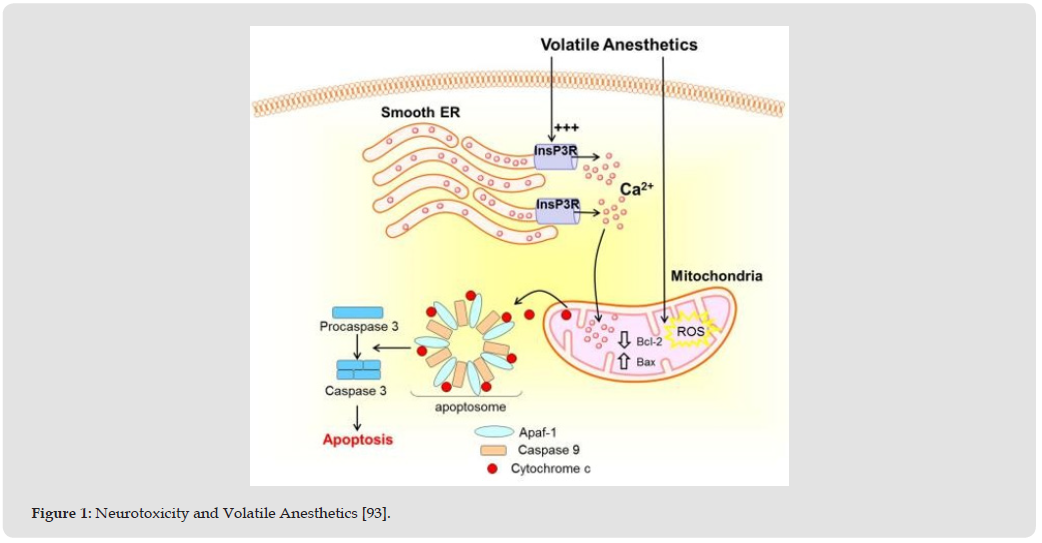
Additionally, the volatile anesthetic isoflurane has been shown to directly activate and open the inositol 1,4,5- trisphosphate receptor (InsP3R) calcium channel located on the smooth endoplasmic reticulum.
1) The excessive opening of the InsP3R calcium channel by isoflurane causes significant calcium ion (Ca²⁺) leakage from the endoplasmic reticulum (ER), leading to mitochondrial Ca²⁺ overload.
2) This overload can further exacerbate cytochrome C release and the caspase cleavage pathway. Key Terms:
3) Apaf-1: Apoptotic protease-activating factor 1
4) Bax: Bcl-2-associated X protein
5) Bcl-2: B-cell lymphoma 2 protein
6) Ca²⁺: Calcium ion
7) InsP3R: Inositol 1,4,5-trisphosphate receptor ROS: Reactive oxygen species
Postoperative cognitive dysfunction (POCD) involves cognitive decline, particularly in memory, concentration, and executive function, primarily affecting older adults but also younger individuals depending on surgery type and complexity. Contributing factors include age, surgery duration, pre-existing health conditions, and anesthesia type. Patients with coronary artery disease are at higher risk due to potential cerebral perfusion issues during surgery. Systemic inflammatory responses from surgery may also contribute to cognitive decline. Understanding the distinctions between POCD and delirium is essential for targeted interventions. Factors like oxidative stress and neuroinflammation can exacerbate cognitive decline, especially in older surgical patients. Research into anesthesia’s long-term effects on children’s neurodevelopment is crucial, as is the exploration of neuroprotection strategies for brain injuries. Current advancements in anesthesia aim to reduce cognitive side effects while ensuring safety. Understanding the molecular mechanisms of general anesthetics on developing neurons is vital to prevent adverse outcomes.
In summary, although we have made notable strides in comprehending POCD and its related conditions, it is crucial to continue research to untangle the complexities of these disorders. This will help us develop effective prevention and treatment strategies that cater to the unique needs of each patient. Ongoing collaboration among researchers, clinicians, and patients will be vital in enhancing our understanding and improving outcomes. By promoting an interdisciplinary approach, we can combine insights from neuroscience, psychology, and medicine to create comprehensive care models. Additionally, public awareness campaigns and educational initiatives can significantly contribute to destigmatizing these conditions and promoting early intervention. As we advance, embracing innovative technologies and personalized medicine holds the potential to revolutionize care for individuals affected by POCD and its challenges. Together, we can strive for a future where cognitive disorders are not only better understood but also effectively managed, ultimately enhancing the quality of life for countless individuals around the globe.

International Association of Landscape Archaeology, Czech Glass Society, Czech Republic

Department of Chemistry, Semenov Institute of Chemical Physics, USSR Academy of Sciences, Moscow, Russia

Neurology, LA BioMed Research Institute, USA

Associate Professor at Department of Breast and Thyorid Surgey, Chongqing General Hospital, China

Professor of Nuclear Medicine, Faculty of Medicine and Surgery, University of Milan, Milan, Italy





 Abstract
 PDF
PDF



























