info@biomedres.us
+1 (502) 904-2126
One Westbrook Corporate Center, Suite 300, Westchester, IL 60154, USA
Site Map
 ISSN: 2574 -1241
ISSN: 2574 -1241
ISSN: 2574 -1241
Received: May 26, 2025; Published: June 05, 2025
*Corresponding author: D Starokadomsky, Chuiko Institute of Surface Chemistry, NAS of Ukraine, 17 Generala Naumova street, Kyiv 03164, Ukraine
DOI: 10.26717/BJSTR.2025.62.009706
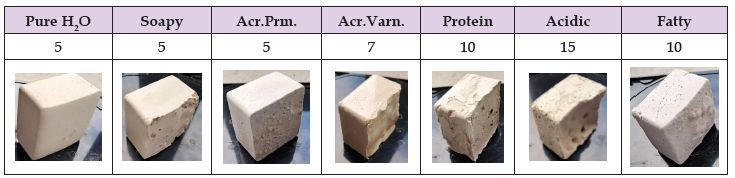
The results of the work prove that the type of solution is an influential factor for the mechanical and even visual properties of gypsum stone. Thus, the use of soapy and especially acidic water gives very porous samples - due to the formation of bubbles. Water-soluted protein gives a heterogeneous structure of the stone. Fatty water (with corn oil) and especially acrylic emulsions make gypsum stone more solid. Only acrylic emulsions and soapy-water strengthens hardened gypsum (Table 1). Acidic water forms strong gypsum material, however, the presence of pores reduces the strength parameters. The strength of gypsum stone increases in series protein≦soapy≦acidic*≦ fatty≦pure≦acrylic primer≦ acrylic varnish. After hard heating of the samples at 200 °C, most of the samples lose their original strength. But gypsum with fatty water is significantly strengthened, which can be explained by the self-polymerization of oil inclusions in gypsum upon heating, with the formation of a polymer reinforcing framework. Thus, it is shown that the type of aqueous solution greatly affects the structural surface, appearance, hardening time, and mechanical properties of gypsum stone.
Table 1: The samples of gypsum materials, and his time of primary hardening.
Gypsum has been used for over 7,000 years. In ancient Egypt it was an important material for architecture, art and medicine. Gypsum was used to make plaster for pyramids and temples, statues, reliefs and ornaments [1-5]. Gypsum allowed the construction of strong, lightweight structures for columns, arches and walls, which determined the grandeur of Egyptian architecture. In medicine, gypsum was used to fix and immobilize fractures and became the basis of modern medicine. Easily molded, gypsum was also used to treat injuries, and today it is used as a material for plaster casts and recycled wood. Gypsum is usually mined in open pits because it occurs close to the surface. After mining, large blocks are broken into smaller pieces for easier transportation and processing. Gypsum processing involves grinding, drying to remove moisture, and firing at 150-180°C [3-5]. This process changes the chemical properties of the material, making the semi-moist alabaster suitable for a variety of applications.
There are several main types of gypsum, each with unique properties and applications:
1. Selenite: A transparent or milky-white crystalline gypsum, known for its smooth texture. In decorative arts, it is used to make figurines, jewelry, and decorative panels. Its softness makes it easy to work with.
2. Alabaster: A white or cream gypsum, widely used to make sculptures, vases, and decorative objects. Its softness and plasticity allow it to be used to create the smallest details. At the same time, it is porous and sensitive to mechanical damage, so it should be handled with care.
3. Layered Gypsum: Used in construction for the production of drywall, plaster, and other building materials. The layered structure makes it light and durable, which makes it a popular material for interior decoration. Both types of gypsum play an important role in various fields, from art to architecture, due to their physical and mechanical properties. For many centuries, the question of how to strengthen gypsum more effectively and cheaply has been relevant for representatives of the construction industry, so the goal of my work is to find out how to improve the properties of gypsum products.
Materials
The white decorative Alabaster G-4 is used for investigations.
Methods
Preparation of Gypsum Samples
1. Pure H20: Using two measuring cups, measure 100 ml of G-4 building alabaster (Figure 1) and 80 ml of distilled water. Mix the gypsum and water in one bowl and stir until there are no lumps in a homogeneous mixture. Pour the liquid into silicone molds, leave for 1-2 weeks.
2. Soapy: Using 3 measuring cups, measure 100 ml of G-4 building alabaster (Figure 1) and 60 ml of distilled water and 20 ml of Fairy Lemon detergent (composition: 15-30% anionic surfactants, 5-15% nonionic surfactants, <5% inorganic and organic salts, ethyl alcohol, caustic, flavors, polypropylene glycol, preservatives, dyes). Mix gypsum1., water and detergent in one bowl and stir until there are no lumps in a homogeneous mixture and bubbles form. Pour the liquid into silicone molds. Wait a week until it hardens completely
3. Acidic: Using 3 measuring cups, measure 100 ml of G-4 building alabaster (Figure 1) and 60 ml of distilled water and 20 ml of 9% acetic acid.
4. Proteinic: Using 3 measuring cups, measure 100 ml of G-4 building alabaster (Figure 1) and 60 ml of distilled water and 20 ml of chicken egg white
5. Fatty: Using 3 measuring cups, measure 100 ml of G-4 building alabaster (Figure 1) and 60 ml of distilled water and 20 ml of Oleyna refined sunflower oil.
6. AcrylPrimer: Using 3 measuring cups, measure 100 ml of construction alabaster G-4 (Figure 1) and 50 ml of distilled water and 30 ml of acrylic primer “Silic” AK-0512 (Composition: Acrylic resins, pigments, fillers, anti-corrosion pigments, modifying additives, aromatic solvents) Can see (Tabel 1) that additives in H2O can increase a time of primary hardening (analyzed by Suttard method) of gypsum.
Figure 1
Gypsum stone is not very resistant to water and swells strongly in it. When hardened with ordinary water, in distillate it swells by almost 40% in a day, and later reaches 50% (Table 2). The same can be said about “Acidic” (with vinegar water), while other samples are more resistant to swelling. Fatty and “Proteinic” samples are especially resistant (swelling decreases by 1.2-1.5 times), which may indicate the hydrophobicity of gypsum with fatty water. In soapy water, the ordinary sample (as well as “Proteinic”) reaches the same degree of swelling as in ordinary water (Table 2). It is interesting that gypsum with alkaline and acidic water (Soapy and Acidic) show much greater resistance (than in ordinary water). Gypsum on acidic water (Acidic, only 32% swelling) is most resistant in soapy water, which can be considered interesting. The weak resistance to swelling of the acrylated sample (simple “Acr.Prm”) is difficult to explain, since polyacrylate in gypsum should reduce water permeability. The behavior in acidic water for the normal sample does not change. It is interesting that gypsum hardened with soapy (alkaline) water shows significantly higher resistance here than in normal and alkaline (soapy) environments (33% instead of 39-59%). Gypsum is most resistant to fatty water (Fatty) [6].
Table 2: Weigth of samples(g) after 4 days in water
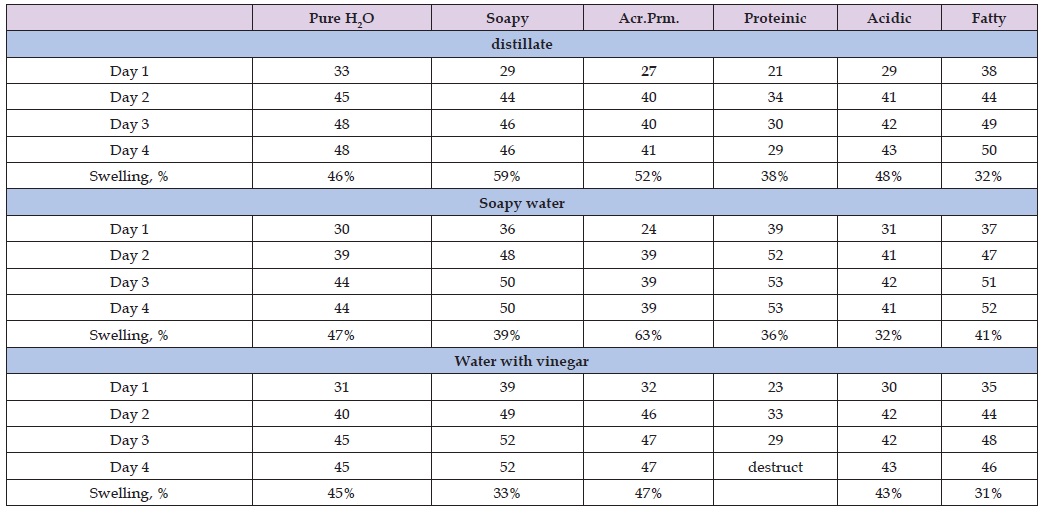
Thus, gypsum swelling with ordinary water reacts little to the acidity of the medium. On the contrary, the use of acidic, polymeric or fatty solutions makes it sensitive to the acidity of the medium, and can significantly increase or decrease the resistance to swelling. The use of acrylic suspension does not provide advantages for resistance to swelling for any aqueous medium. Curing with alkaline or acidic water leads to a noticeable increase in resistance to swelling to water, especially if it has an opposite pH to the curing solution (Figure 1).
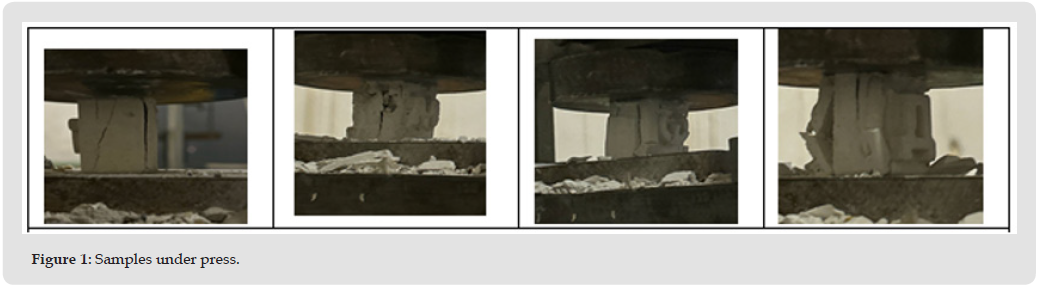
Compressive strength is a key characteristic of gypsum stone, which determines its grade. As a rule, gypsum stone has a strength of 4-5 MPa (i.e. 40-50 kgf/cm2). In our case, the original gypsum stone (sample “Pure H2O”) has high strength (50 kgf/cm2), which decreases sharply when acidic, protein or fatty additives are added to water (Table 3). Regarding acidic water, the reason obviously lies in the high porosity of the resulting sample - due to abundant CO2 release during hardening (which indicates the presence of chalk in the original gypsum). Without these pores, sample “Acidic” could well be considered a durable material. However, soapy water (sample “Soapy”) and acrylic primer (sample “Acr.Prm.”) instead of distillate form a much more durable gypsum stone. An even higher indicator is given by gypsum on acrylic varnish (75 instead of 50 kgf/cm2), which indicates the creation of a strengthening polyacrylic structure in gypsum. The behavior of the samples after strong heating is interesting. The original gypsum stone terzetto strength by 20% (up to 40 instead of 50, Table 3). Sample “Proteinic” collapses the already low indicator - which can be explained by the burning out of the protein structure in gypsum. Acrylic samples also burn out and sharply (by half) reduce strength. Against this background, the result of hardened gypsum “Fatty” (H2O+ sunflower oil) is very interesting. The tendency of sunflower oil to self-polymerization and polymerization during angrevation in January leads to the formation of more stable structures in gypsum stone. As a result, the initial low values for unheated gypsum (30 kgf/cm2) after 200 °C heating change to a record high (80 kgf/cm2), i.e.the process of thermal strengthening of “Fatty” gypsum is evident (Figure 2).
Figure 2
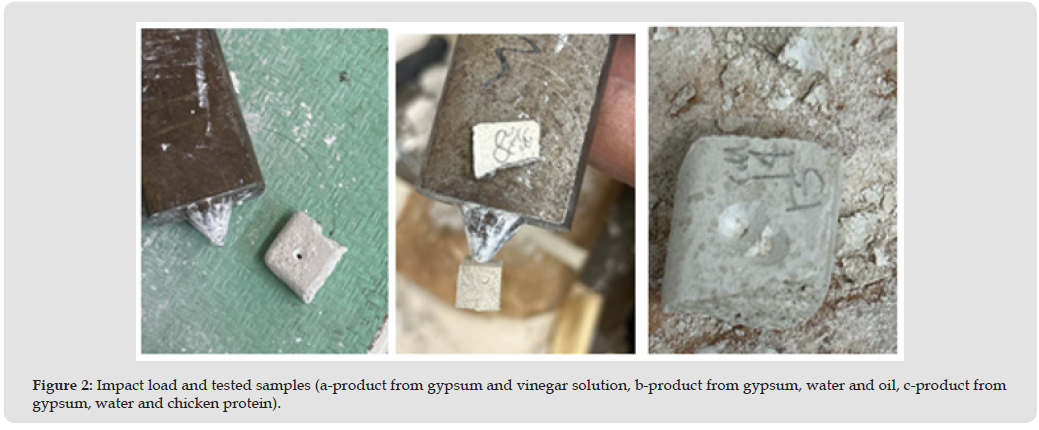
Table 3: Parameters of the studied gypsum samples (* - estimated).

It can be seen that gypsum with Pure H2O (without additives) gives quite good indicators of bending strength - both at a short (3 cm) and at a long distance between the supports. As a rule, additives to water worsen it, but there are exceptions. Yes, “AcrylPrimer” used instead of water gives a higher result, soapy water allows you to make gypsum much stronger in bending (Table 4).
Table 4: Bending strength.

Impact Resistance
This experiment let check from what height the gypsum cubes will destruct under impact of an object weighing 1.4 kg and with an impact area of 1 mm2. We took gypsum cubes from gypsum samples measuring 1x1x1 cm or quadrangles 2x1.5x1 cm. The impact load was an object weighing 1.4 kg and with an impact area of 1 mm2. A vertical ruler determined the height of the fall of the load. The sample is considered broken if it has destroyed into fragments (the formation of a funnel from the load is not considered destruction). It can be seen that all additives improve the impact strength of gypsum (regardless of the shape of the samples). The best result is for Soapy and Fatty (2-3 times increase), several times increase is recorded for Protein-water. The strengthening for acrylic and acidic solutions is somewhat more modest. Tsu speaks of reducing brittleness (suppression of cracking) by water additives (Table 5).
Table 5: Height of destructed falling on samples.

1. In our scientific research, the hypothesis of a significant influence of the nature and composition of the aqueous solution on the properties of gypsum stone was confirmed. Gypsum samples with more than 5 aqueous solutions of different composition were analyzed. It was shown that the nature of the aqueous solution can change the hardening time of the primary gypsum-water mixture by 2-3 times (when hardening with distilled water, the hardening time is 5 minutes, while with acidic water - 15). The nature of the solution imposes conditions on the time and temperature of complete drying of the samples.
2. An experiment on the stability of hardened gypsum samples in neutral, acidic and alkaline solutions showed a significant influence of the nature of the hardening solution on the swelling of gypsum stone in aqueous solutions. Thus, gypsum swelling with ordinary water reacts little to the acidity of the medium. On the contrary, the use of acidic, polymeric or fatty solutions makes it sensitive to the acidity of the medium, and can significantly increase or decrease the resistance to swelling. For example, use of acrylic suspension does not provide advantages for resistance to swelling for any aqueous medium. Curing with alkaline or acidic water leads to a noticeable increase in resistance to swelling 3. A study of compressive strength showed that the weakest products
are gypsum with protein and vinegar, and the strongest are gypsum with soap water and acrylic primer. Heating worsens the strength of all samples, except for gypsum with vinegar and oil. Heated gypsum with oil additive (samples ”Fatty”) was three times stronger, and with vinegar - 20% stronger than unheated samples with pure H2O. Compressive strength is highest for acrylic and soapy water samples, while proteinic and fatty curing solutions gave the weakest strength.
4. In several series of the obtained samples, the effect of thermal strengthening (uncharacteristic of normally hardened gypsum) of gypsum stone after hard thermal heating. So, after 150-200 °C, the samples hardened with ordinary and distilled water lost their compressive strength significantly (which is an obvious consequence of the transformation of relatively strong gypsum into a weak overheated product - “draerite”). But gypsum hardened with oil water (sample “Fatty”) and acrylic emulsion - significantly increased their strength after 150-200 °C. On this basis, a scientific hypothesis was put forward about the pre-polymerization of the organic components of the aqueous solution during heating, with the formation of a strengthening polymer framework in gypsum stone.
5. The bending experiment showed that the strongest products were gypsum products with soapy water and acrylic primer. Samples with distilled water and water with oil withstood somewhat less weight. Products made of gypsum with vinegar and chicken protein turned out to be the weakest.
6. The resistance of gypsum samples to falling loads was experimentally determined. The best result was shown by gypsum “Fatty” (hardened by water +oil), followed by soapy water. Samples with chicken protein and distilled water withstood somewhat less. Gypsum with acrylic primer and vinegar showed the lowest strength.
This study opens up wide opportunities for strengthening or changing in the desired direction the properties of gypsum stone, by simply varying or optimizing the composition of the hardening aqueous solution. Analysis of the scientific literature showed that the effects discovered in the work and such a comprehensive study in general were carried out for the first time in scientific practice.

International Association of Landscape Archaeology, Czech Glass Society, Czech Republic

Department of Chemistry, Semenov Institute of Chemical Physics, USSR Academy of Sciences, Moscow, Russia

Neurology, LA BioMed Research Institute, USA

Associate Professor at Department of Breast and Thyorid Surgey, Chongqing General Hospital, China

Professor of Nuclear Medicine, Faculty of Medicine and Surgery, University of Milan, Milan, Italy





 Abstract
 PDF
PDF



























