info@biomedres.us
+1 (502) 904-2126
One Westbrook Corporate Center, Suite 300, Westchester, IL 60154, USA
Site Map
 ISSN: 2574 -1241
ISSN: 2574 -1241
ISSN: 2574 -1241
Received: May 15, 2025; Published: May 30, 2025
*Corresponding author: Hassan Mahmud, Senior Registrar, Pediatric Surgery, University of Child Health Sciences and Children’s Hospital, Lahore, Pakistan
DOI: 10.26717/BJSTR.2025.62.009700
Introduction: Hernia of the umbilical cord is congenital herniation of the small bowel into the base of the umbilical
cord. It is less commonly associated with other congenital anomalies. Herein, we describe a newborn with
a hernia of the umbilical cord along with an imperforate anus.
Case Presentation: A 2-day-old male infant presented to us with meconium being passed through a swelling
in the umbilical cord. Examination showed an umbilical swelling with an opening through which the meconium
was draining. Buttocks were well developed with an imperforate anus. Ultrasound abdomen and echocardiography
were normal. The prone cross-table lateral radiograph showed a high-variety anorectal malformation.
After resuscitation, umbilical exploration was done, and perforated Meckel was found. Excision and end-to-end
anastomosis were done and a descending colostomy was made for the imperforate anus. Postoperative events
were unremarkable and the patient was discharged on the 5th postoperative day.
Conclusion: Hernia of the umbilical cord associated with imperforate anus is a rare and complex anomaly, requiring
careful planning and decision-making for treatment as both anomalies require different treatment approaches.
Keywords: Case Report; Hernia of Umbilical Cord; Imperforate Anus; Perforated Meckel’s Diverticululm
Congenital herniation of the small bowel and occasionally other viscera into the umbilical cord due to incomplete closure of the umbilical ring or incomplete return of physiologically herniated bowel back to the abdomen is known as a congenital hernia of the umbilical cord. Herniation extent varies from a small part of the small bowel to the entire small bowel as well, and a portion of the colon may herniate into the umbilical cord [1,2]. Although the frequency of associated anomalies is lower in cases with umbilical cord hernia compared to omphalocele, a recent paper from Ohio documented a greater frequency of complex anomalies associated with this anomaly [3]. Its association with imperforate anus is not reported before to the best of our knowledge. Here, we describe the association between umbilical cord hernia and imperforate anus and discuss treatment options for these conditions in the neonatal period.
Patient Information
A 2-day-old term male infant was brought to the neonatal emergency by his parents due to meconium passage through an umbilical swelling since birth and an imperforate anus. The patient was the first child of the family, and no such anomaly was present in the family. Parents belong to the lower middle socioeconomic status. The antenatal scan did not show any abnormality. The baby was born via normal vaginal delivery at term in a tehsil headquarters in Sharakpur. He was meconium stained but, no aspiration was present. The APGAR score was 7 at 1 min and 9 at 5 mins. His birth weight was 2.3 kg.
Clinical Findings
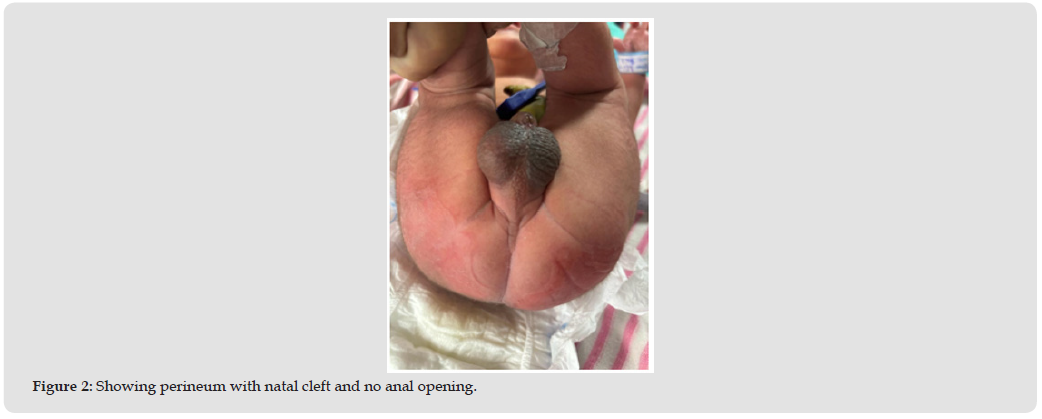
The patient had 2x2 cm swelling in the umbilical cord on examination. The gut was present in the swelling, attached to the left side of the cord, and a pinpoint opening was visible at the site of attachment, from which the meconium was being drained (Figure 1). The rest of the abdominal examination was unremarkable. During the perineal examination, the patient had well-formed buttocks, a sacrum, and a dimple, but no anal opening was present, and the tip of the coccyx was not palpable (Figure 2). There was a ventral chordee in the penile shaft, which showed concealed hypospadias.
Figure 1
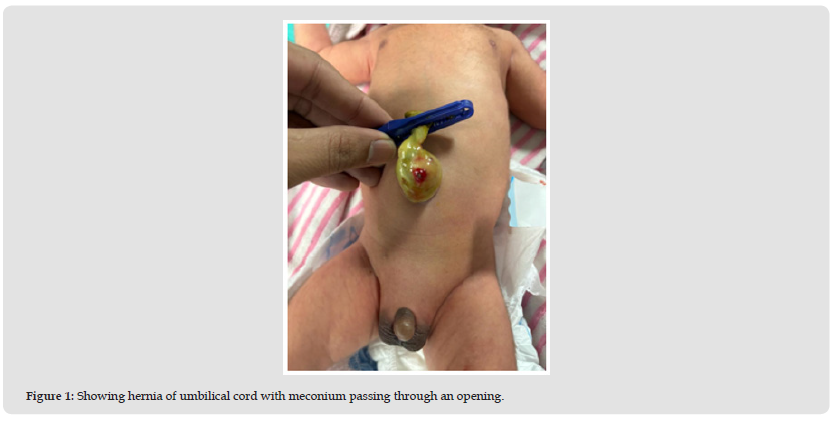
Figure 2
Timeline
The patient was born via normal vaginal delivery at a tehsil headquarters in Sharakpur. They were referred to our tertiary care hospital due to swelling in the umbilical cord and an imperforate anus.
Diagnostic Assessment
The patient was kept fasting, and a nasogastric tube was passed to rule out associated esophageal atresia. Laboratory tests, including CBC, LFTs, BUN, and creatinine, were all within normal limits. The chest x-ray and echocardiogram performed were also normal. Ultrasound of the abdomen and swelling showed herniation of the small bowel into the base of the umbilical cord. The prone cross-table lateral radiograph showed a high-variety anorectal malformation.
Intervention
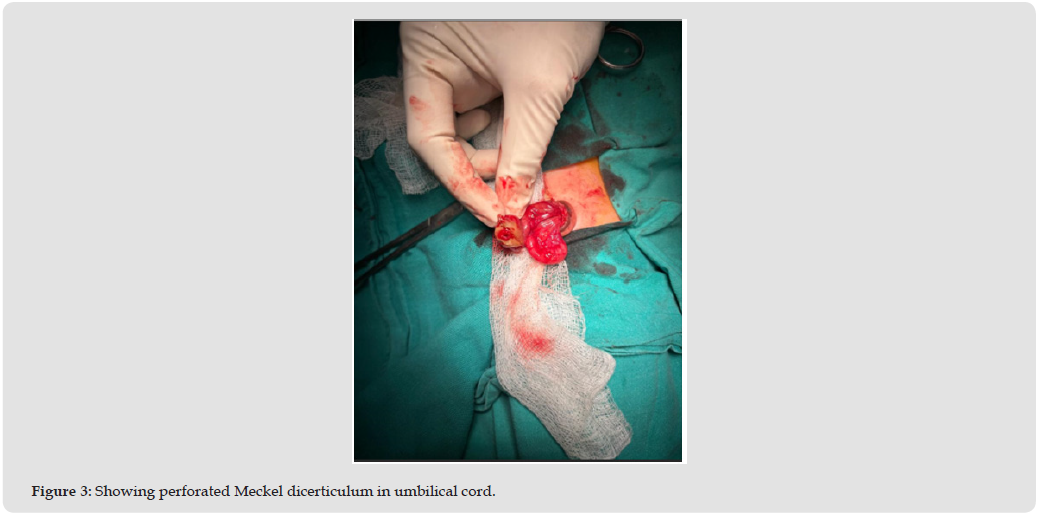
IV lines were inserted, and fluids were administered for resuscitation. Prophylactic antibiotics were given, and blood grouping and cross-matching were performed. The patient was counseled and informed consent was obtained for surgery. After optimization and investigation, the patient underwent operation 24 hours later. Exploration was carried out through the umbilicus. The umbilical cord was opened, and the ileum was separated from the cord. It was discovered that the perforated Meckel was attached to the cord and was draining meconium through a small hole in the wall of the umbilical cord (Figure 3). The Meckel’s diverticulum was resected along with a segment of the bowel. An end-to-end anastomosis was then performed. In addition, for the imperforate anus, a loop colostomy was created at the distal descending colon. After surgery, the patient was transferred to the surgical neonatal ICU for postoperative care. For the first two days, the patient was kept fasting and clear liquids, followed by regular feeding, which was started after 48 hours. The patient’s recovery was uneventful, and he was discharged with instructions for wound care and colostomy care. A follow-up appointment was scheduled for 7 days later.
Figure 3
Outcome
The newborn showed remarkable recovery postoperatively, with no complications observed.
Follow-Up
The patient had a good wound condition during follow-up and was passing stool from the colostomy. The stitches were removed, and colostomy care was discussed again. The next follow-up was advised after one month. Our next plan is to perform a pressure-augmented distal colostogram and definitive surgery before the stoma is reversed.
Hernia of the umbilical cord is a rare congenital anomaly with an incidence of 1 in 5000 live births [4]. It presents as swelling in the umbilical cord, resulting from the congenital herniation of the small bowel into the base of the umbilical cord through a patent umbilical ring. The etiology of this condition is largely unknown but is often associated with a failure of the complete return of the bowel to the abdomen following the physiological herniation of the gut into the umbilical coelom [4]. Hernia of the umbilical cord (HUC) is classified into four categories:
1. Simple HUC,
2. HUC with intestinal obstruction,
3. HUC with mucosal prolapse, and
4. HUC with bowel evisceration [4,5].
Our case, due to its association with anorectal malformation (ARM), falls into type 2. However, the presence of a perforated Meckel diverticulum causes local rupture of the umbilical cord wall, resulting in a defect in the umbilical cord through which meconium drainage occurs. In instances of larger defects, mucosa starts prolapsing through the opening (type 3). It is suggested to revise the name of this type to “HUC with cord defect with/without mucosal prolapse.” Therefore, our index case can also be categorized as type 3 of HUC [4]. Hernia of the umbilical cord is linked to various anomalies, such as cleft lip and palate, G6PD deficiency, congenital glaucoma, tetralogy of Fallot, congenital amputation of the thumb, ear tag, pulmonary stenosis, small and large bowel atresias and stenosis, short bowel syndrome, PVID, and Meckel syndrome [3-7]. Initially, HUC was regarded as an isolated anomaly with infrequent associations. However, recent data indicate associated anomalies in over half of the patients, including complex and chromosomal defects [3]. Consequently, the recommended workup for omphalocele should also be performed for HUC. To the best of our knowledge, no case of HUC has been reported in association with imperforate anus [7]. Our case presented a challenging scenario due to the simultaneous occurrence of a perforated Meckel’s Diverticulum with Hernia of the Umbilical Cord (HUC) and the presence of an imperforate anus. Managing these coexisting anomalies requires careful planning and decision-making, considering their distinct management approaches.
For high-variety imperforate anus cases, the standard initial step involves the creation of a diversion colostomy, typically performed in the neonatal period [8]. On the other hand, the management of HUC with a Meckel’s Diverticulum entails resection and anastomosis with umbilicoplasty [9]. In our case, we successfully performed both procedures simultaneously. While some may argue for creating an ileostomy at the level of Meckel’s diverticulum resection to avoid multiple procedures and associated risks, managing an ileostomy is often more cumbersome compared to a colostomy. Additionally, an ileostomy would hinder the performance of a pressure-augmented distal colostogram, a crucial test for planning definitive surgery. Therefore, our decision to perform colostomy and Meckel’s diverticulum resection simultaneously was based on careful consideration of the unique challenges posed by each anomaly and the necessity of specific diagnostic procedures.
Hernia of the umbilical cord is a rare anomaly, and even rarer is its association with imperforate anus. The simultaneous presence of these conditions introduces unique management challenges that demand meticulous planning and decision-making.
The authors declare that they have no known competing financial interests or personal relationships that could have appeared to influence the work reported in this article.

International Association of Landscape Archaeology, Czech Glass Society, Czech Republic

Department of Chemistry, Semenov Institute of Chemical Physics, USSR Academy of Sciences, Moscow, Russia

Neurology, LA BioMed Research Institute, USA

Associate Professor at Department of Breast and Thyorid Surgey, Chongqing General Hospital, China

Professor of Nuclear Medicine, Faculty of Medicine and Surgery, University of Milan, Milan, Italy





 Abstract
 PDF
PDF



























