info@biomedres.us
+1 (502) 904-2126
One Westbrook Corporate Center, Suite 300, Westchester, IL 60154, USA
Site Map
 ISSN: 2574 -1241
ISSN: 2574 -1241
ISSN: 2574 -1241
Received: May 17, 2025; Published: May 30, 2025
*Corresponding author: Neha A Godase, Research Scholar, College of Management, MIT Pune, dist. – Pune, State- Maharashtra, County- India, Associate Professor, Department of Management, College of Management, Mit Pune, State- Maharashtra, India
DOI: 10.26717/BJSTR.2025.62.009699
Background: The fruit and vegetable processing industry play an important role in processing of agricultural products. India ranks third in the production of dried fruits and vegetables. Vegetables are perishable in nature and are consumed in fresh form. The arrivals of vegetables in the market in a peak season are more and producers are not getting remunerative prices. Vegetables are available in flush during season, due to several intermediaries involved in the movement of vegetables from producer to consumer, vegetables lose its freshness and considerably the price also decreases the cold storage in case of all vegetables is not economical and hence dehydration of vegetables is important. Dehydrated fruits and vegetables projects are a new product of value addition series where the shelf life is increased & space for storage is reduced along with easy transportation. Demand for fruits and vegetables are prevalent across length and breadth of the country throughout the year. Ambadi is a good source of folic acid and iron. It is without the side effects of constipation that come with an iron pill. The research outlook was studied with following points.
1. To evaluate the capital expenditure of the processing industry
2. To figure out the performance and feasibility parameters of the processing industry
Methodology: The dehydration unit “Naturals Agro Private Limited” located at Manjari Budruk in Pune district has been selected purposively for working out of dehydration of fruits and vegetables with special reference to Onion flex. Primary data were collected with the help of personal interaction with the Company Managing Director and Workers. Secondary data were collected from annual report, internet and company records. Analysis of Data: This is done with the help of various type of mathematical & statistical tools like graph, table, charts & various formulas. The data phased on fixed cost, variable cost, Net Present worth, Breakeven point, Benefit cost ratio and payback period to work out the efficiency and feasibility of processing industries.
Result:
1. The total procurement of Ambadi was 1375kg. which cost Rs. 27,500 which was procured for whole year from owners own farm.
2. B:C Ratio of Dry Ambadi is 1.8, it indicates that the B:C ratio is more than 1 so the product is profitable to run the processing unit.
Keywords: Dehydration; Dehydrated Products; Project Cost; Onion Flex; Processing; Financial Ratio
Agro-processing is now regarded as the sunrise sector of the Indian economy in view of its large potential for growth and likely socio-economic impact specifically on employment and income generation. Some estimates suggest that in developed countries, up to 14 per cent of the total work force is engaged in agro-processing sector directly or indirectly. Vegetables are perishable in nature and are consumed in fresh form. The arrivals of vegetables in the market in a peak season are more and producers are not getting remunerative prices. Vegetables are available in flush during season, due to several intermediaries involved in the movement of vegetables from producer to consumer, vegetables loose its freshness and considerably the price also decreases the cold storage in case of all vegetables is not economical and hence dehydration of vegetables is important.
Fruits and vegetables are seasonal as well as perishable in nature. Through processing (dehydration) vegetables can be used as raw vegetables for cooking. With the help of fresh fruits and vegetables value added products such as pickle, sauce, chips etc. can be prepared. Dehydration of seasonal fruits and vegetables are good bet for long term storage even up to 5 years or beyond if hermetically sealed and can be made available to the consumers during off season. Dehydrated vegetables are used to manufacture instant vegetable noodles, soups, snacks and fast food.
The research outlook was studied with following points.
1. To evaluate the capital expenditure of the processing industry 2. To figure out the performance and feasibility parameters of the processing industry
The dehydration unit “Naturals Agro Private Limited” located at Manjari Budruk in Pune district has been selected purposively for working out economics of dehydration of onion flex. Primary data were collected with the help of personal interaction with the Company’s Managing Director and Workers. Secondary data were collected from annual report, internet and company records.
Dehydrated Products Range
There is wide range of agricultural products which can be dehydrated
and marketed locally or internationally. The information on
dehydrated products viz; vegetables, fruits and medicinal plants of
selected unit is given in
Tables 1-3 respectively.
Table 1: Dehydrated Vegetables produced in Naturals Agro unit.

Table 2: Dehydrated Fruits produced in Naturals Agro unit.

Table 3: Dehydrated Medicinal plants produced in Naturals Agro unit.

Project Cost
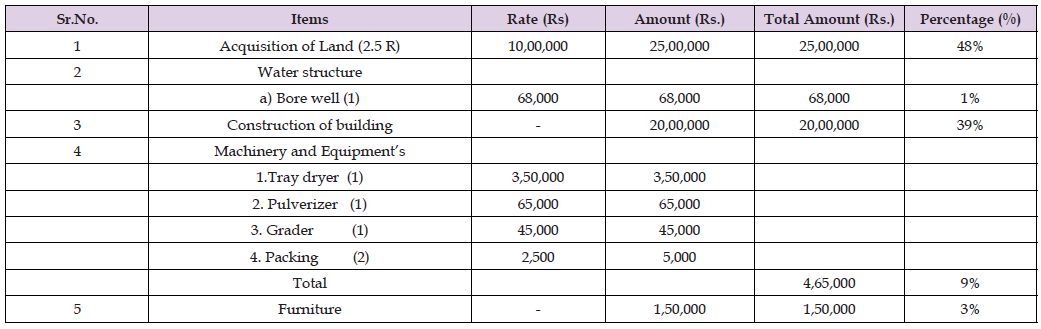
This research suggests a plant with an average capital investment Rs. 51,83,000, with minimum human resource requirement of five people, where at least one manager is mandatory. The average electricity and water costing for processing unit is 3,90,000 (Table 4).
Table 4: Dehydrated Medicinal plants produced in Naturals Agro unit.
Human Resource Requirements
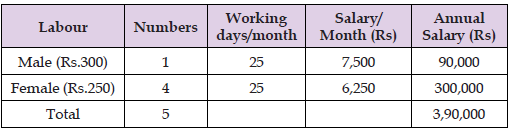
For running a small processing unit, a single manager is sufficient for managing all the activities which are carried out in processing unit and minimum human resource requirement is as follows: For running a small processing unit, a single manager is sufficient for managing all the activities which are carried out in processing unit and minimum human resource requirement is as follows: (Tables 5 & 6).
Table 5: Dehydrated Medicinal plants produced in Naturals Agro unit.
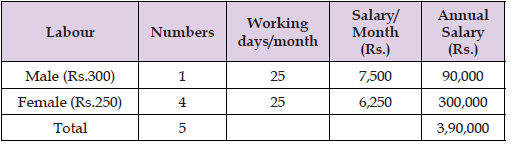
Table 6: Dehydrated Medicinal plants produced in Naturals Agro unit.
Electricity and Water Charges
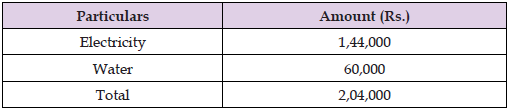
The fruits and vegetables processing unit average electricity and water charges as given below (Table 7).
Table 7: Dehydrated Medicinal plants produced in Naturals Agro unit.
About Ambadi
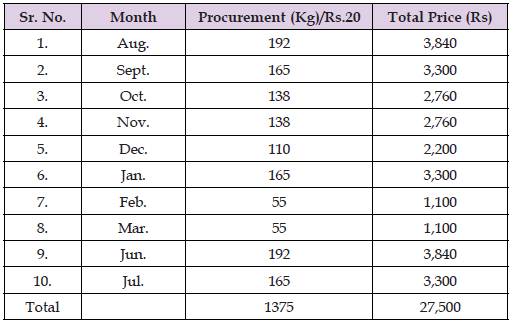
Ambadi is a good source of folic acid and iron. It is without the side effects of constipation that come with an iron pill. According to studies, the ambadi leaves are also a great way to keep your bones strong. This mineral-rich plant has calcium, magnesium, and phosphorus in abundance, all of which are important for maintaining strong and healthy bones. The Table 8 provides the information about the maximum quantity of fresh Ambadi was procured 192 kg in the month of August and June respectively and minimum quantity was procured 55 kg in the month of February and March.
Table 8: Procurement prices at different time period of Fresh Ambadi.
Detail Procedure of Dry Ambadi
1. Fresh Ambadi
Take fresh green color ambadi leaves without any yellow spots
on leaves
2. Washing and Cleaning
Wash all leaves with water and clean with cotton cloths and
spread it on cotton cloth.
3. Drying
Dry in shadow for 2-4 hours.
4. Dehydration
Put leaves on the tray and put trays into dehydrator at 45o c to
50o c for 12 hours. and check it with every 2-3 hours and turn
the leaves.
5. Cooling
After 12 hours remove the trays from dehydrator and cool leaves
at room temperature and crush it manually.
6. Weighing and packaging
After crushing ambadi leaves weigh it and pack it.
7. Labelling
Label the packets according to different sizes.
The Processing Quantity of Dry Ambadi and Price of Raw Ambadi
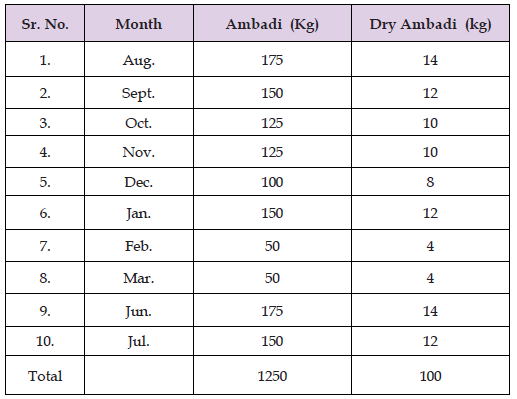
The processing Quantity of dry Ambadi and price of raw Ambadi mentioned in the Table 9. The Table 9, provides the information about the quantity of dry ambadi is processed in whole year. Maximum production is taken in the month of August and June that was 14 kg and minimum in the month of February and March that was 4 kg respectively.
Table 9: Processing Quantity of dry Ambadi (2021-22).
Per Unit Cost of Processing of Ambadi
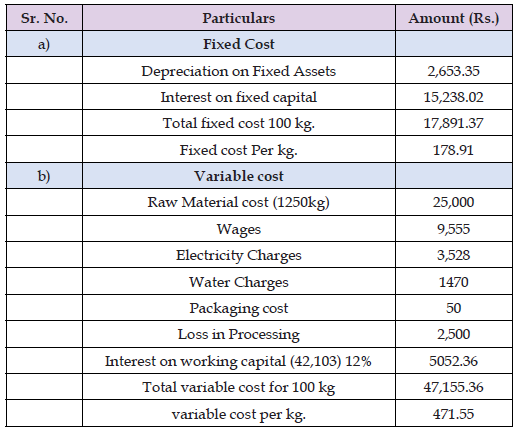
The process of converting raw material into final product having some added values. So that, there is some cost required to process the product. Per unit Cost of processing of Dry Ambadi mentioned in the following Table 10. The above table shows that fixed cost and variable cost required for processing. Total fixed cost and variable cost required for processing is ₹17,891.37 and ₹47,155.36 respectively. The fixed cost and variable cost per kg are ₹ 178.91 and ₹ 471.55.
Table 10: Per unit Cost of processing of Dry Ambadi.
Total Cost for Processing
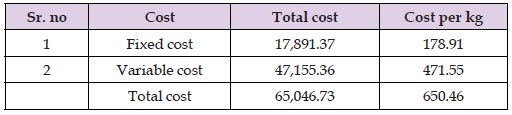
Total cost for processing mentioned in the following Table 11. Table 11, indicates that the total fixed cost of processing of dry ambadi was Rs. 17,891.37 and fixed cost per kg was Rs.178.91. Total Variable cost was Rs. 47,155.36 and Variable cost per kg was Rs. 471.55.
Table 11: Total cost for processing.
Income During the Year 2021-22
Income during the year 2021-22 is given in Table 12. From Table 12 it is observed that company gets profit Rs 54,954 by sale of 100 kg of dry ambadi. Price per kg of dry ambadi is Rs.1200 and cost of production is Rs. 650.46 hence total cost is also Rs 65,046. and total income is Rs 1,20,000.
Table 12: Income during the year 2021-22.

Benefit Cost Ratio of Dry Ambadi
BCR = Gross income / Total cost of production BCR = 1,20,000 /
65,046
BCR = 1.8.
Here, we compare the Present worth of Gross income with Present
worth of Cost. BCR was more than one, i.e. 1.8 was indicate Project
was satisfactory. B:C Ratio indicates the, how much amount of money
is received after investing Rs 1/-For Natural agro project B:C Ratio is
1.8 means, when we investing Rs 1/- then we received Rs 1.8/- [1-7].
1. The total procurement of Ambadi was 1375kg. which cost
Rs. 27,500 which was procured for whole year from owners own
farm.
2. Processing cost of Dry Ambadi is Rs 650/Kg and its sale
price is Rs 1200/Kg. Company gets profit of Rs.550 /Kg.
3. The per kilogram processing cost of dry Ambadi was Rs.
650/-.
4. B:C Ratio of Dry Ambadi is 1.8.
5. The given financial ratios analysis concluded that the processing
unit of fruits and vegetable with small capacity can also
give optimum profit and which is far more profitable for further
investments.

International Association of Landscape Archaeology, Czech Glass Society, Czech Republic

Department of Chemistry, Semenov Institute of Chemical Physics, USSR Academy of Sciences, Moscow, Russia

Neurology, LA BioMed Research Institute, USA

Associate Professor at Department of Breast and Thyorid Surgey, Chongqing General Hospital, China

Professor of Nuclear Medicine, Faculty of Medicine and Surgery, University of Milan, Milan, Italy





 Abstract
 PDF
PDF



























