info@biomedres.us
+1 (502) 904-2126
One Westbrook Corporate Center, Suite 300, Westchester, IL 60154, USA
Site Map
 ISSN: 2574 -1241
ISSN: 2574 -1241
ISSN: 2574 -1241
Received: May 12, 2025; Published: May 26, 2025
*Corresponding author: Vanshita Mittal, Amity Institute of Psychology and Allied Sciences, Amity University, India
DOI: 10.26717/BJSTR.2025.62.009693
The usage of social networking sites like Instagram, Facebook, etc has been increasing due to their easy access and availability. Taking into consideration the negative impact it is having on psychological and physical well-being being the research study was conducted was appropriate questionnaires designed for specific variables. The study primarily focuses on understanding the direct impact of social media on automatic negative thoughts and body image in young adults using a correlation approach on 198 participants selected randomly from mainly the urban population. Another small sections in the study also aim at understanding the differences in the impact of social media seen in males and females, and also between young and middle-aged adults, using the same sample. Results revealed a positive correlation between the increase in the use of social media and automatic negative thoughts and body image dissatisfaction. The further results are discussed in detail in the study.
Keywords: Social Media; Automatic Negative Thoughts; Body Shape; Cross-Sectional Study; Correlation Research Design
Overview of Social Media Usage in Young Adults
In today’s times, social media has been an important and undivisable part of our lives for people of all age groups, providing scope and means for communication, self-expression, entertainment, and information consumption, offering users the ability to connect with others, share their experiences, and engage with all forms of content that interests them. However, with the advancements in technology and the ease with which it can be accessed, it has been observed that individuals majorly fall in the age group of 18 to 25; the young adults are among the most widely influenced group of individuals. Even though the widespread use of social media has improved connectivity and has opened unmatched ways for people to continue their relationships with others, it has also paved the way for people to fall prey to major psychological and emotional devastation (Aslan, et al. [1]). The support, self-expression, and validation that social media offers cannot be denied, but on the other side, its contribution to online harassment, cyberbullying, and social isolation cannot be overlooked. One of the significant aspects of social media’s influence on young adults is the phenomenon of Automatic negative thoughts, primarily stemming from feelings of comparison (Vogel, et al. [2]). The continuous exposure to glamour-filled images and lifestyles close to their idealistic ones is the primary manifesto followed by social media algorithms, which they become familiar with through tracking activities across various other applications, that contributes in manifesting in the targeted individuals the feelings of inadequacy, lower self-esteem, and increased dissatisfaction with one’s life. People frequently engage in upward social comparison (Meier, et al. [3]), which involves comparing oneself to people they believe to be more successful, attractive, socially desirable, and adequate. Individuals may experience excessive pressure to maintain a beautiful and socially acceptable online presence, which can exacerbate worry, stress, and a fixation on one’s appearance.
Automatic negative thoughts, or ANTs, are the unplanned, involuntary, and frequently illogical ideas that come up in reaction to circumstances, events, or perceptions (Kitson [4]). These thoughts, which affect a person’s feelings, actions, and general sense of mental well-being, are frequently negative, self-critical, and upsetting. A fundamental feature of cognitive-behavioral theories, ANTs are especially relevant when discussing anxiety, depression, and problems with self-esteem. They frequently adhere to cognitive distortions (Yurica, et al. [5]) that cause people to adopt an unduly negative perspective of themselves and their situation, such as overgeneralization, personalization, and catastrophizing. Concerning social media usage the frequency of ANTs is majorly set in by the constant, and unmanaged exposure to the idealized illusion created by validation-seeking behaviors, appearances, and control over all aspects of the flawless lives lived by people around them, influencers, or even celebrities are likely responsible for fueling the feelings the body dissatisfaction, self-doubt, and inadequacy amongst people. Young adults, still at a moldable age, also moving forward with the societal and cultural beauty standards when exposed to all sorts of filtered and edited images come across an unrealistically set idea of body image and beauty standards (Re, et al. [6]) which play an immense role in shaping individuals’ beliefs and thoughts about their body shape and size (Xie [7]). This scenario also excludes any room for the real-life set conditions of diverse skin tones, body types, and natural features, and its effect extends to great lengths, where people even indulge in unhealthy behaviors and methods to find a way for themselves to fit in the set standards. Not only do these behaviors promote body dissatisfaction and thoughts of anxiety, depression, loneliness, and sadness (Papapanou et al. [8]), but also one of the leading reasons for people to engage in unhealthy eating habits, often developing long-term eating disorders.
Rationale
In the recent past, social media has been able to earn the reputation of the most used and relied upon advancement. Along with the genuine gift of connection, it also brings with it the power of influencing culture. With the rise in the time and energy that people are ready to spend, particularly young adults, on WhatsApp, TikTok, Instagram, Snapchat, and others, their own beliefs of self-worth and evaluation have been affected tremendously. Only validating the glamorous and unfiltered lives has triggered a plethora of distorted and self-demeaning thoughts, the Automatic negative thoughts (ANTs) that are eventually seeping in and eroding all levels of self-worth and body satisfaction. This has fostered concerns over rising mental health disorders, unmanageable stress, depression, and anxiety, along with a common and shared sense of body dissatisfaction among all young adults (Reer, et al. [9]). Determining at-risk persons and creating preventative mental health initiatives requires an understanding of the relationship between social media use and the prevalence of ANTs and body image issues. The rationale for this study is thus the growing worry about the rising rates of anxiety, sadness, and disorders connected to body image among young adults as a result of their increased use of social media. Even though social media promotes self-expression and connections, there are negative cognitive and psychological effects present, especially when it comes to self-image, which requires more research. By examining this connection, the study hopes to provide further light on how young adults’ use of social media may influence the development or maintenance of unhealthy thought habits and body dissatisfaction.
Research Problem
A diverse range of research has been conducted on the crosstalk between increased social media usage and dissatisfaction with body image and mental health issues. However, some gaps still prevail, including the very limited focus that has been given to the automatic negative thoughts and their relationship with social media usage and body dysmorphia, and even fewer of these have focused on the triggers that sustain automatic negative thoughts arising through the increased use of social media. It has also been widely accepted and agreed upon that such research, pointing towards social media evaluation, portraying oneself in a glamorous light, maintaining and abiding by certain set beauty standards, is more for women than men. Therefore, another gap in the study is the lack of participation of males, hindering research from understanding the effect of the thoughts and negative feelings stemming from men against themselves and their bodies because of the set image of handsomeness publicized on social media. The limitations of these studies to Westernized beauty standards and cultures are vast. The gap that arises due to the cultural and societal norms forcing people to fit in a certain set of boundaries when talking about beauty is also yet to be covered
An exploratory mediation analysis was conducted to assess whether comparison processes related to sexual attractiveness and self-assessment of sexual attractiveness mediated the relationship between image exposure and body dissatisfaction (Silva, et al. [10]). Although the mediation was not statistically significant, the study found meaningful associations among these variables. Further exploratory analyses suggested that individuals’ perceptions of their sexual attractiveness influenced their social comparison behaviors, and that the extent of engagement with Instagram content could predict levels of body dissatisfaction. The study (Charmaraman, et al. [11]) underscores the potential socioemotional health implications of social media exposure, especially when adolescents engage with content featuring celebrities. The researchers highlight the necessity for parents, educators, and practitioners to be vigilant about the content that early adolescents are exposed to on social media. They advocate for interventions tailored to mitigate the adverse effects of such exposure, aiming to promote a healthier body image among young users.
The research (Jiotsa, et al. [12]) focuses on how frequently individuals compare their physical appearance to those they follow on social media platforms and how these comparisons relate to body dissatisfaction and the drive for thinness. The study’s findings reveal a significant association between the frequency of appearance-based comparisons on social media, increased body dissatisfaction, and a heightened drive for thinness. Individuals who regularly compared themselves to others on social media platforms were more likely to experience negative body image perceptions and a stronger desire to achieve a thinner physique. These results underscore the influential role of social media in shaping body image attitudes among young adults. The study highlights the importance of developing interventions aimed at reducing the prevalence of appearance-based comparisons on social media to promote healthier body image perceptions and mitigate the risk of developing body image disorders. The study reveals that increased time spent on Instagram is associated with heightened body image concerns and greater self-objectification among young women (Fardouly, et al. [13]).
This relationship is mediated by two key factors: the internalization of societal beauty standards and the tendency to make appearance- based comparisons with others. In essence, frequent Instagram use may lead individuals to adopt and internalize unrealistic beauty ideals, prompting them to compare their appearances to those portrayed on the platform. These comparisons often result in dissatisfaction with one’s body and an increased focus on self-objectification. The authors emphasize the importance of addressing these mediating factors when developing interventions aimed at mitigating the negative impact of social media on body image. By fostering critical awareness of beauty ideals and reducing the propensity for appearance- based comparisons, it may be possible to alleviate some of the adverse effects associated with Instagram use. The study also contributes to a growing body of literature highlighting the complex interplay between social media engagement and body image concerns, underscoring the need for strategies that promote healthier social media consumption habits among young women.
The study the following study (Marques, et al. [14]) explored the bidirectional relationship between social media engagement and body dissatisfaction among adults. Utilizing data from the New Zealand Attitudes and Values Study, the researchers analyzed responses from 6,258 participants aged 19 to 92 over five years (2015–2019), revealing a significant, albeit small, bidirectional association: increased social media use predicted higher body dissatisfaction one year later, and vice versa. Notably, this reciprocal relationship was evident in women but not in men. When examining age groups, the pathway from social media use to subsequent body dissatisfaction was significant across all ages. However, the reverse—body dissatisfaction leading to increased social media use—was significant only among middle-aged and older participants. These results suggest that the interplay between social media use and body dissatisfaction extends beyond adolescence, affecting adults across various age groups. The study underscores the importance of promoting positive social media engagement strategies to mitigate body image concerns in the broader adult population. In their study titled “Instagram Use and Body Dissatisfaction: The Mediating Role of Upward Social Comparison with Peers and Influencers among Young Females,” Pedalino, et al. [15] investigated how different types of Instagram engagement influence body dissatisfaction in female adolescents and young women. The research specifically examined the roles of browsing, commenting, and posting behaviors, and how upward social comparisons with peers and social media influencers mediate these relationships. The study found that browsing Instagram was positively associated with body dissatisfaction, with upward social comparisons acting as a mediating factor. This suggests that passive consumption of content, particularly when it involves comparing oneself to others perceived as more attractive or successful, can lead to increased dissatisfaction with one’s own body. Conversely, active behaviors such as commenting and posting did not show a direct correlation with body dissatisfaction. Furthermore, the research highlighted that comparisons with both peers and influencers contributed to body dissatisfaction. However, the impact of comparisons with influencers was more pronounced, indicating that interactions with idealized representations on social media platforms may have a stronger influence on body image concerns than comparisons with peers. These findings underscore the complex dynamics of social media use and its impact on body image among young females. The study emphasizes the importance of fostering critical awareness regarding the content consumed on platforms like Instagram and developing strategies to mitigate the negative effects of upward social comparisons. In their cross-cultural study titled “The Relationships among Self-Worth Contingency on Others’ Approval, Appearance Comparisons on Facebook, and Adolescent Girls’ Body Esteem,” Prieler, et al. [16] examined how adolescent girls’ reliance on others’ approval for self-worth and their tendency to compare appearances on Facebook relate to body esteem.
The study involved 1,819 adolescent girls from Israel and Germany, aiming to explore these dynamics across different cultural contexts. The findings indicated that a higher dependence on others’ approval for self-worth was associated with more frequent appearance- based comparisons on Facebook. These comparisons, in turn, were linked to lower body esteem among the participants. Notably, the pattern of these relationships was consistent across both Israeli and German cohorts, suggesting that the impact of social media on body image concerns transcends cultural boundaries. These results underscore the significant role that social media platforms like Facebook play in shaping adolescent girls’ perceptions of their bodies. The study highlights the importance of fostering self-worth that is independent of external validation and encourages critical engagement with social media content to mitigate its potential negative effects on body esteem. In the review article, “Social Media and Body Image: Recent Trends and Future Directions,” Cohen, et al. (2021) examine the evolving landscape of social media and its impact on body image concerns. The authors highlight the unique features of various social media platforms, such as Instagram, Facebook, and Snapchat, and how these features facilitate appearance-focused behaviors and content sharing. They discuss the role of visual-centric platforms in promoting idealized body standards and the prevalence of appearance-related comparisons among users. The review also addresses the psychological mechanisms underlying the relationship between social media use and body dissatisfaction, including social comparison processes and internalization of societal beauty ideals. Cohen et al. emphasize the need for future research to consider platform-specific features and user behaviors to develop targeted interventions aimed at mitigating the negative effects of social media on body image.
Primary Objectives
To investigate how the engagement in social media applications is heightened in the lives of young adults.
To study social media’s contribution to the inculcation of negative perceptions of self, leading to the distorted image of self and exaggerated thought patterns. The following study is a cross-sectional, correlational approach to finding the impact of social media usage on automatic negative thoughts and body image, primarily in the lives of young adults. The variables used in the study are:
• Independent Variable (IV) = Social Media Usage (SMU)
• Dependent Variable (DV) = Automatic Negative Thoughts (ANT); Body image dissatisfaction
Secondary Objectives
To study the impact of social media exposure on body dissatisfaction and consequently on stemming the feelings of comparison and negative affect in young adults. The study investigates whether the subjection to idealized body images on social media negatively influences dissatisfaction with own body because of the automatic negative thoughts that originate. To understand if gender has any role to play in how the elevated use of social media negatively affects the perceptions of body image and body dissatisfaction. To also understand the impact of age on social media exposure, body dissatisfaction, and the development of automatic negative thoughts.
Hypothesis of the Study
Through this study, the following two hypotheses and being tested:
• “The elevated use of social media by the young adults shows
a positive correlation with the development of automatic negative
thoughts and distorted perceptions of self and body image.”
• “The impact of heightened social media usage among different
gender and age groups.”
Research Design
The study aimed at understanding the impact on different age and gender groups on the development and reinforcement of automatic negative thoughts and distorted perceptions of body image, following a cross-sectional and correlational research design due to an elevated use of social media applications. The study divided the entire collected sample into 2 groups based on gender, Males and Females, and also into another 2 groups based on age, the individuals falling in the age range of above and below 25. For the two groups, a cross-sectional research design is followed to understand the potential differences that may arise in the results due to age and gender groups. The major approach used is the correlational research design for finding the primary results of the study, i.e., to understand the relationship between the selected independent and dependent variables, Overusage of social media, Automatic negative thoughts, and Body image.
Participants
To understand the impact of social media usage on automatic negative thoughts and body image, a sample size of almost 200 participants was taken. Randomised sample collection was done, spreading the survey mainly to the urban population. The participants below the age group of 25 years were mostly college students, and the participants above 25 years of age were both college students and working individuals.
Instruments
The study aims at understanding three variables, the independent variable, impact of social media usage, for which the Social Network Addiction Scale, by Shahnawaz and Rehman. The questionnaire consists of 21 questions measured on a Likert scale. The participants were made to choose between options from Strongly Disagree to Strongly Agree, marked on the following basis:
1. Strongly Disagree,
2. Disagree,
3. Somewhat Disagree,
4. Neutral,
5. Somewhat Agree,
6. Agree, and
7. Strongly Agree.
The second variable, dependent variable, was the Automatic negative thoughts, for which the Automatic Negative Thoughts questionnaire, comprising 30 questions on a Likert scale, was developed by Kendall and Hollon. The participants chose between 5 options, ranging from Strongly Disagree to Strongly Agree, that were marked as Strongly Disagree:
1. Point, Disagree
2. Neutral
3. Agree
4. Strongly Agree
The third variable, also a dependent variable, was Body image, for which the Body Shape Questionnaire was used. The questionnaire developed by Evans and Dolan consists of 16 questions. The questionnaire is also scored on a Likert scale, with the participants choosing from the options ranging from Never to Always, with the following scores: Never:
1. Rarely:
2. Sometimes:
3. Often:
4. Very often:
5. Always
Procedures
The three questionnaires used for data collection, the Social network addiction scale, the Automatic negative thoughts questionnaire, and the Body Shape questionnaire, were compiled into a survey form which was distributed randomly to the urban population, involving people of both genders, and following no criteria for age for data collection. It took an average of 20 minutes for the participants to finish filling out the survey. However, there was no time limit. The participants’ information was kept confidential, and anonymity was maintained. The participants had the liberty to withdraw from the survey whenever they wanted.
Data Analysis
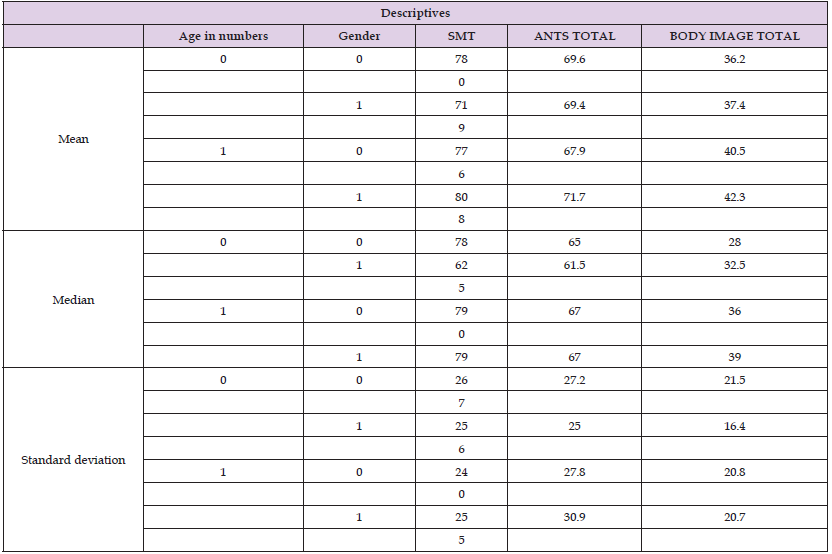
After the data collection was completed, the scores were coded. The three questionnaires used were compiled into one post coding, and using the Jamovi software, the data was analysed. Since the research followed a cross-sectional and a correlational research design, in the software, for the coded data, first, the correlation between the three variables, Social media, Automatic negative thoughts, and Body shape, was found. The research was also divided into two groups to find the potential age and gender differences in the impact of social media usage on automatic negative thoughts and body shape perceptions. The groups for gender were Male and Female, and the groups for age were individuals above the age of 25 and individuals below the age of 25. Since the data was found to not be normally distributed and was highly skewed, therefore, for running the comparisons between the two groups, Mann Whitney U Test, the non parametric equivalent, was used. The correlation matrix presents the relationships between Social Media Usage, Automatic Negative Thoughts, and Body Image using Spearman’s rho, a non-parametric measure since the collected data is not normally distributed, which assesses the direction and strength of associations between variables used for the research.
Descriptives
(Table 1).
Table 1:
Correlation Matrix
The correlation matrix presents the relationships between Social Media Usage, Automatic Negative Thoughts, and Body Image using Spearman’s rho, a non-parametric measure since the collected data is not normally distributed, which assesses the direction and strength of associations between variables used for the research (Table 2).
Table 2:
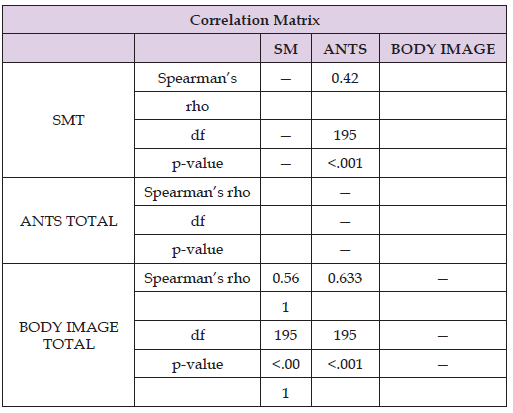
Social Media Usage and Automatic Negative Thoughts: A positive correlation of moderate effect (r = 0.420, p < .001) indicative of with the increase in the engagement of individuals in social media sites, the frequency of automatic negative thoughts also tends to rise. This suggests that individuals who spend more time operating social media may be more prone to negative and distorted thought patterns, which can either be explained by the possibility of being exposed to the glamorous and edited lives of people they seem to follow that inculcates a sense of comparison or self hate or possibly due to other stressors which might be associated with increased social media use. Social Media Usage and Body Image: A positive correlation with a stronger effect, (r = 0.561, p < .001) is suggestive of the poor body image is linked to an increased amount of time spent on social media. This could indicate that repeated and prolonged social media exposure, especially to idealized and filtered body standards, may contribute to dissatisfaction with one’s own body or wrong perceptions of an idealized body type, leading to increased self-loathing, self-criticism, and concerns about appearance.
Automatic Negative Thoughts and Body Image: The strongest correlation (r = 0.633, p < .001) between negative thoughts and body image concerns was found. This suggests that individuals who frequently experience automatic negative thoughts are also more likely to have poor body image perceptions. Since automatic negative thoughts often involve self-criticism and distorted thinking, this strong relationship implies that cognitive distortions might play a critical role in shaping negative body image. The results indicate that social media usage, negative thinking patterns, and body image concerns are intertwined, i.e., an increase in the time spent on social media may contribute to both the development of automatic negative thoughts and body image dissatisfaction. Furthermore, negative thinking patterns appear to have a particularly strong influence on body image concerns, suggesting that cognitive factors may be an important mechanism in understanding body image issues among young adults.
Independent Samples T-Test for Gender Groups
(Table 3)
Table 3:
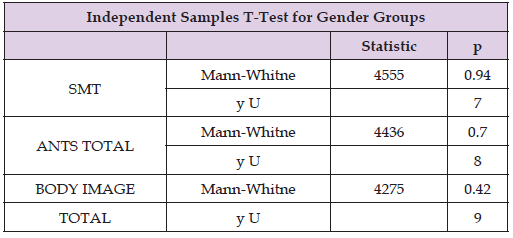
Social Media Time: Mann-Whitney U = 4555, p = 0.947: The p-value of 0.947 is much greater than 0.05, indicating that there is no significant difference in social media usage between males and females.
This means that the two groups spend almost the same amount of time on social media, and any small differences observed in the data can be explained through random chance events and do not hold any meaningful interpretation.
Automatic Negative Thoughts: Mann-Whitney U = 4436, p = 0.708: The p-value of 0.708 is also much greater than 0.05, suggesting that there is no significant difference in automatic negative thoughts between the two groups. Thus, the two groups are equally prone to developing negative thoughts when exposed to specific stimuli.
Body Image: Mann-Whitney U = 4275, p = 0.429: The p-value of 0.429 is still above 0.05, meaning that there is no statistically significant difference found in the body image concerns between males and females, suggesting that both groups are equally invested in their body shape and image perceptions.
Independent Samples T-Test for Age Groups
(Table 4)
Table 4:
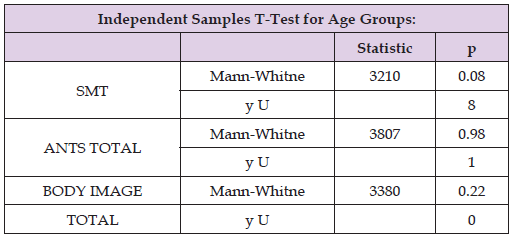
Social Media Time: Mann-Whitney U = 3210, p = 0.088: The p-value of 0.088 is slightly above the 0.05 threshold, suggesting only a weak possibility of a difference, if any, though it is not strong enough to be considered insignificant enough to be able to draw any reliable conclusions.
Automatic Negative Thoughts: Mann-Whitney U = 3807, p = 0.981: The p-value is extremely high (0.981), suggesting that both age groups (above and below 25) react almost similarly to negative thoughts triggering stimuli. The age range an individual is in does not seem to influence the possibility of developing or not of automatic negative thoughts.
Body Image: Mann-Whitney U = 3380, p = 0.220: The p-value of 0.220 is also above the 0.05 significance threshold, again suggesting no significant difference between the two groups. The two groups both seem to be driven by the thoughts of their body image and may experience discomfort and complaints when their own body types do not seem to match with their idealized body figures.
The results obtained from the study showed a positive correlation between the three variables, social media usage, automatic negative thoughts, and body image perceptions, suggesting that with an increase in the amount of time spent on social media, the possibility of developing automatic negative thoughts is exceptionally high. The results also showcased that as there is an increase in the engagement with social media apps and an increase in the automatic negative thoughts, individuals’ body image perceptions are impacted in the same direction. It can be interpreted that as the time and energy spent on social media apps is increasing, and they are being exposed to visual media that portrays a blend of a very perfect lifestyle, and idealized body images, they are bound to experience the development of negative thoughts, primarily originating automatically. These negative thoughts are the result of the influence individuals find themselves trapped in as they enter the social media world, where the illusion of being flawless is ruling.
With the advancement and exponential spread of social media usage and access, every individual is in some way or the other fallen prey to these thoughts, comparing ones’ originality to the world on their social media apps, leaving no room for self-acceptance due to diversity in skin colour, body shape, and body type. Every individual is craving their ideal body image and shape, and has developed immense dissatisfaction with what their body is already like. Even though the ideal way to get over any experienced body dissatisfaction is to accept their current body shape and strive to get better but one interpretation to the results can also be that with an increase in the usage of social media and getting exposed to the faultless images of influencers, and celebrities triggers the feelings of comparison and if the current body type seems too out of shape or that the negative thoughts are giving rise to increased body dissatisfaction then it can also be seen as the reason for people to start making an effort towards their expected body shape which may in future yield a positive impact.
An additional cross-sectional study was also conducted to study the difference between males and females in the impact of social media usage on automatic negative thoughts and body image. The results showed no statistically significant difference in the data of the two groups. It is a very expected pattern of thought that being exposed to an ideal body type and shape would impact females more than males. However, with the obtained results, it can be interpreted that both groups, males and females, with exposed to idealised and flawless body shapes and images, mainly due to an increase in the usage of social media, both groups experience a sense of dissatisfaction with their own body type. Another cross-sectional study was conducted to examine the difference in the mindset of people below 25 (18-25 years) and above 25 (26-40 years) years of age related to social media- driven automatic negative thoughts and body image. Similar to the cross-sectional study on gender, the results obtained in the two groups were statistically insignificant, suggesting both age groups are equally bothered when exposed to the exceptional body image. From this result, it can also be interpreted that the earlier notions of only the young adults being affected by how their body looks, and that the middle-aged people aren’t as concerned, are also falsified. It can be interpreted that in recent times, with the access of social media to everyone and when people of all age groups showcase an exquisite body shape and image, all individuals are equally affected if their current body shape and their ideal body shape aren’t in sync which may prove reason for people of all groups to make an effort towards achieving their longed body shape [17-30].
Informed Consent
After the participants were chosen for the research study, they were given a complete understanding of the research purpose, the topic, and the areas being measured through the survey. They were given a complete explanation about the study, and the data collection only proceeded once the participants’ queries were answered and they were ready to participate in the study.
Confidentiality
The demographic details collected during the procedure of data collection were kept confidential with utmost sincerity. No personal information of the participants was mishandled or shared further.
Voluntary Participation and the Right to Withdraw
Every participant was informed well in advance about their rights during the study. The participation was completely voluntary, and the participants had the freedom to withdraw from the research study whenever they wished.
Fair and Inclusive Participant Selection
No bias in data collection. A fair, randomised method of data collection was used, and all participants interested in the study were given an equivalent chance to participate.

International Association of Landscape Archaeology, Czech Glass Society, Czech Republic

Department of Chemistry, Semenov Institute of Chemical Physics, USSR Academy of Sciences, Moscow, Russia

Neurology, LA BioMed Research Institute, USA

Associate Professor at Department of Breast and Thyorid Surgey, Chongqing General Hospital, China

Professor of Nuclear Medicine, Faculty of Medicine and Surgery, University of Milan, Milan, Italy





 Abstract
 PDF
PDF



























