info@biomedres.us
+1 (502) 904-2126
One Westbrook Corporate Center, Suite 300, Westchester, IL 60154, USA
Site Map
 ISSN: 2574 -1241
ISSN: 2574 -1241
ISSN: 2574 -1241
Received: April 22, 2025; Published: May 26, 2025
*Corresponding author: PD Dr. med. Sven OSchneider, Department for Anaesthesiology, Intensive care medicine and Pain therapy, Saarland University Hospital 66421 Homburg / Saar, Germany
DOI: 10.26717/BJSTR.2025.62.009692
Numerous of factors affect the immunological response during surgery. Despite intensive research, the impact of different anesthetic techniques on the immune system remains unclear. Aim of this ex vivo / in vitro study was to determine the effects of general and neuraxial anaesthesia on monocyte subset alteration and the release of prototypical pro- and anti- inflammatory cytokines.
Methods: Twenty patients undergoing total knee replacement surgery were randomly assigned to receive either general anaesthesia (ITN) or combined spinal/epidural anaesthesia (CSE). Samples of venous blood were taken from the patients before and after induction of anaesthesia, immediately, 6 hours, 24 hours, and 48 hours after surgery. All blood samples were incubated in presence or absence of LPS (lipopolysaccharide; 1 μg/ml) for 24 hours. CD14 and HLA-DR expression patterns on monocytes and intracellular TNF-α production were quantified via flow cytometry. TNF-α and IL-10 release were measured via enzyme linked immunosorbent assay (ELISA).
Results: Compared to ITN, the CSE group showed a significant increase in the spontaneous and the endotoxin- stimulated TNF-α release as well as the endotoxin-stimulated IL-10 release. Also, the amount of CD14bright monocytes was significantly increased and CD14dim monocytes were decreased. HLA-DR surface receptor expression and intracellular TNF-α production were significantly lower in the ITN group.
Conclusion: General anaesthesia and neuraxial anaesthesia show different impact on monocytes. While neuraxial anaesthesia stimulates, general anaesthesia seems to downregulate the immune function. We suggest that there might be a correlation between the choice of the anesthetic technique and the postoperative immune competence.
Keywords: General Anaesthesia; Neuraxial Anaesthesia; Monocytes; Immune System; Total Knee Arthroplasty
During surgery, the patient’s immune system is affected by various factors. Especially surgical trauma and the resultant release of stress hormones (e.g. epinephrine and cortisol) were found to be the most important coefficients [1]. Previous studies showed that anaesthesia also significantly alters the immune system [2,3]. The release of stress hormones and other immunologic mediators was found to be more affected by inhalational anaesthesia than by total-intravenous anaesthesia [3]. It is suspected that general anaesthesia modulates the host defense indirectly by affecting the afferent neuronal input from the operative site, thus modulating the neurohumoral response which influences the functionality of the immunocompetent cells. In contrast, neuraxial anaesthesia not only blocks the afferent and efferent signal of the spinal cord, but also the sympathetic pathways resulting in a profound suppression of the stress response to surgery [4]. However, several studies comparing neuraxial anaesthesia with general anaesthesia with respect to circulating cytokine levels or white blood cell count did not find significant differences between both methods [5-7].
A valuable method of evaluating the immune competence of white blood cells is investigating their surface expression of marker proteins. Especially an altered expression of CD14 surface receptor on monocytes in combination with alterations in the cytokine release upon a bacterial stimulus is a valuable concept to detect clinically significant immune dysfunction [8]. Monocytes per se are suggested to be one of the key cells linking the innate to the acquired immune response [9] and can be separated in different subsets by their CD14 surface protein expression level [10]. Monocytes with low levels of CD14 expression (CD14dim) which primarily produce pro-inflammatory cytokines [11] are rarely found in healthy humans but increase significantly during bacterial sepsis [12]. In contrast, monocytes expressing high levels of CD14 (CD14bright) predominantly produce anti- inflammatory IL-10.Another important surface protein on monocytes is the HLA-DR receptor. This receptor is responsible for the presentation of antigens to lymphocytes which are necessary for theinitiation of the adaptive immunity [13]. Downregulation of HLADR by e.g. surgical stress seems to correlate with septic complications and increased mortality [14]. Whether general and spinal anaesthesia affect the monocyte function differently has not been investigated so far. The aim of this study was to investigate alterations in the monocyte function by measuring prototypical anti- and pro-inflammatory cytokine release and surface protein expression after either general anaesthesia or combined spinal/epidural anaesthesia in patients undergoing knee arthroplasty.
After approval of the Ethical Committee of the Ärztekammer des Saarlandes (Medical Chamber of Saarland), Germany and after written informed, the study was registered on ClinicalTrials.gov (Registration number: NCT03431532).20 male patients undergoing elective total knee replacement were enrolled in this study. Exclusion criteria were clinical signs of infection, neoplasia, and treatment with immunomodulatory agents or any kind of immune mediated disease. All patients received antibitotic prophylaxis as indicated by the standard operating procedure (SOP) from the department for orthopedic surgery. Potential immunomodulatory drugs as dexamethasone for postoperative nausea and vomiting prophylaxis were not administered in this study. For comparable surgical conditions, all patients were operated by the same surgeon. All patients included in this study were randomly allocated into one of two groups. One group received general anaesthesia (ITN), the other group combined spinal/epidural neuraxial anaesthesia (CSE). Patients in the ITN group received fentanyl 2 μg/kg and propofol 1-2 mg/kg for induction and atracurium 0.5 mg/kg to facilitate tracheal intubation. Anaesthesia was maintained with desflurane [0.5 MAC] and remifentanil [0.25-0.50 μg/kg/ min]. Patients allocated to the CSE group received a spinal/epidural anaesthesia inserted at L4-L5. The initial subarachnoidal bolus of local anesthetics was 3.5 ml isobaric bupivacaine 0.5%. During surgery, epidural injections were performed with isobaric bupivacaine 0.25% when the level of anaesthesia was below T5. After surgery no additional bolus of bupivacaine was given.The postoperative pain therapy was sustained in both groups with metamizole and piritramide boluses.
Drugs and Chemicals
All chemicals used, including lipopolysaccharide (E. coli O111:B4) and saponin were obtained from Sigma-Aldrich (Munich, Germany). For cytokine measurements, the enzyme-linked immunosorbent assay (ELISA) kit was obtained from Roche Molecular Diagnostics( Mannheim, Germany). Phosphate buffered saline containing 5% fetal calf serum was achieved from PAA Laboratories GmbH (Linz, Austria) and FACS lysing solution was obtained from BD Biosciences (Heidelberg, Germany). The following antibodies were used: Anti-CD 86- PE (Beckmann-Coulter, Krefeld, Germany), anti-HLA-DR APC, anti- CD14 PerCP, and anti- TNF-α FITC (all from BD Biosciences, Heidelberg, Germany).
Processing of Samples
Venous blood samples of the patients were collected aseptically into pyrogen-free lithium- heparin containing tubes (Sarstedt Monovette, Nuembrecht, Germany) at six different time points:
• T0: before induction of the anaesthesia,
• T1: immediately after induction of anaesthesia,
• T2: after the end of surgery in the post-anaesthesia care unit (PACU),
• T3: 6 hours after the end of surgery, T4: 24 hours after the end of surgery,
• T5: 48 hours after the end of surgery.
All samples were processed immediately after collection as described by Wilson, et al. [25] with minor modifications. Briefly, blood samples from each patient were diluted 1:5 with cell culture medium RPMI (Roche Molecular Diagnostics). One aliquot was immediately stained for flow cytometry. The other aliquots of the diluted blood were cultured on a 24 well plate (Falcon, Becton Dickinson, Lincoln Park, NY) and incubated in a humidified atmosphere with 5% carbon dioxide at 37°C. For each time point, wells were cultured in the absence (“spontaneous”) or presence of the gram-negative stimulus lipopolysaccharide (LPS, Escherichia coli O111:B4; 1 μg/ml). This dose was chosen based on dose response experiments indicating that at the given dose LPS produced a maximum TNF-α release (data not shown). In a time course investigation, maximal stimulation after LPS was found after 12-24 h. Thus, an incubation period of 24 hours was chosen for our experimental setting. The bacterial toxin was added after 1 hour of preincubation. Then, the samples were returned to the incubator and werecultured for another 24 hours. 25 hours after onset of culture, the plasma of the LPS-stimulated and of the aliquots with spontaneous cytokine release was removed and stored at -70°C until assay for cytokine assay, whereas the other aliquot was processed immediately for flow cytometry.
Cytokine Assays
All cytokine concentrations were measured using a specific enzyme- linked immunosorbent assay (ELISA). Before the measurements, all aliquots of the supernatant were thawed at room temperature. The LPS-stimulated samples were diluted up to 1:10 [IL-10], respectively 1:20 [TNF-α] with the provided diluent to stay within the linear range of the assay. Positive controls of each cytokine provided with the kit were measured routinely with each assay. The calculated inter-assay and intra-assay coefficients of variance were 7.5% and 4.4% for TNF- α and 3.7% and 3.5% for IL-10. The minimal detectable concentrations for TNF-α and IL-10 as estimated from the average optical density (OD) reading of the zero standard plus two standard deviations were approximately 1.7 pg/ml for TNF-α and 1.0 pg/ml for IL-10.
Flow Cytometry
The expression pattern of the monocyte receptors CD14 and HLADR on PBMCs was measured by fluorescence-activated cell sorting analysis as described by Ziegler-Heitbrock [14]. The samples were washed with phosphate buffered saline containing 5% fetal calf serum (PAA Laboratories GmbH, Linz, Austria), 2.5 % bovine serum albumin (Sigma Aldrich; Taufkirchen, Germany), and 0.07% sodium azide (Sigma Aldrich, Taufkirchen, Germany) to remove any plasmatic substances. Thereafter, the white blood cells were subsequently stained with monoclonal antibodies directed against CD14, CD 86, and HLA-DR. After 20 min, the red cells were removed by addition of 2 mM EDTA and red cell lysing solution (BD Facs lysing solution, BD Biosciences Heidelberg, Germany) followed by an additional washing step. The residual PBMCs were resuspended in phosphate-buffered saline and immediately subjectedto flow cytometry analysis. Flow cytometry was performed by using a FACS Calibur (BD Biosciences, Heidelberg, Germany) and the Cell Quest software (BD Biosciences, Heidelberg, Germany).
Monocytes were characterized by cell size and granularity in the forward/sideward scatter. Cells expressing HLA-DR are reported as percentage of all cells found to express CD14. The expression density of the LPS-recognition molecule CD14 is reported semi quantitatively according to published data (14,15). CD14bright reflects a monocyte population of strongly positive cells in the monocyte gate as opposed to a subpopulationexpressing low levels of CD14 (CD14dim). The different monocyte subpopulations release a specific cytokine pattern after stimulation. CD14dim monocytes are suggested to produce mainly pro-inflammatory cytokines, whereas CD14bright monocytes seem to release anti-inflammatory cytokines upon stimulation.
Staining of Intracellular TNF-α
The intracellular production of TNF-α was performed by using a four-color analysis: After an incubation period of 2 hours at 37 °C in 5% CO2, brefeldin A 0.4 mg/ml (Abmole Biosciences, Houston/Texas, USA) was added. Four hours later, monocyte subsets were determined similarly as described above. Additionally, to the antibodies directed against the monocytic surface receptor (anti-CD86, anti-HLA-DR, and anti-CD14), anti-TNF-α-FITC and Saponin 10% (Sigma Aldrich; Taufkirchen, Germany) for intracellular staining were added.
Statistical Analysis
The data were analyzed using Sigmastat Software (Jandel Scientific, San Jose, CA). A statistical power analysis was performed. The power of all target values was above 80%. Dichotomous variables were compared with Fisher´s exact test. Continuous variables were not normally distributed after Komolgorov-Smirnov test and were compared with Mann-Whitney U-test. Data were presented as median and interquartile range. Statistical significance was accepted at a two-sided significance level of α = 0.05.
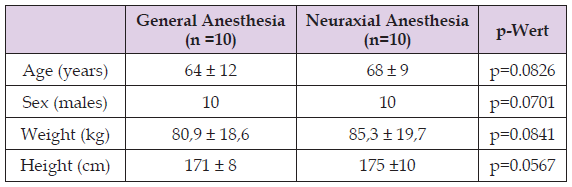
20 Patients were enrolled between June 2013 and August 2015. Demographics and clinical data are shown in Table 1. There was no significant difference between both groups.
Table 1: Patients´characteristics. Data a represented as mean +/- SD.
Spontaneous and Endotoxin-Stimulated Release of TNF-α and IL-10
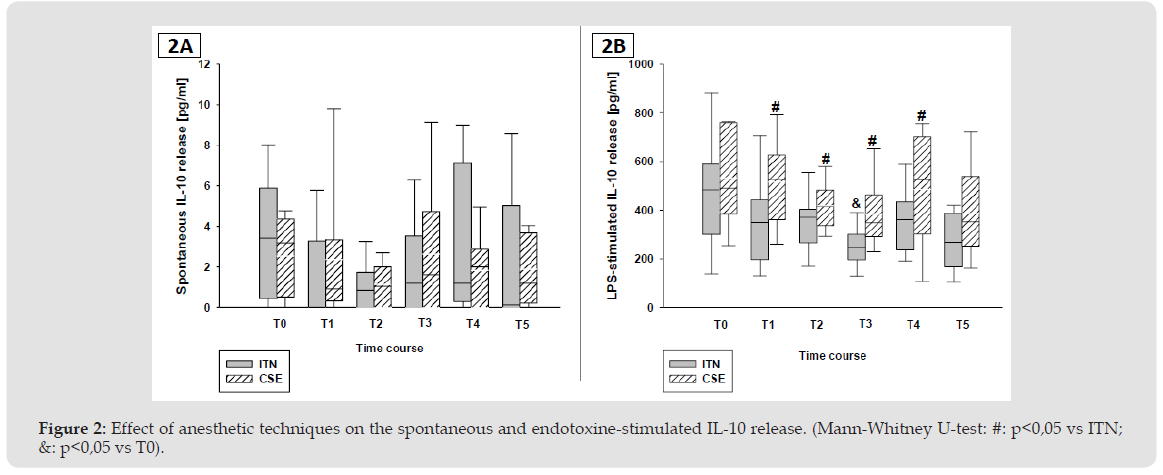
The spontaneous TNF-α release tended to decrease in both groups. At all postoperative time points the spontaneous TNF-α release was significantly higher in the CSE group compared to the ITN group (Figure 1A).Both groups showed a decrease in the stimulated TNF-α release at 6 hours after surgery compared to the level before induction of anaesthesia. At the time points 24 hours and 48 hours after surgery, this reduced TNF-α release raised again in both groups. Immediately after induction of anaesthesia and 24 hours post-surgery, the endotoxin stimulated TNF-α release was significantly higher in the CSE group compared with the ITN group (Figure 1B).The spontaneous IL-10 release did not differ significantly within and between the groups (Figure 2A). In contrast, the stimulated IL-10 release in the CSE group was significantly higher at all time points after anaesthesia induction compared to the ITN group (Figure 2B).
Figure 1
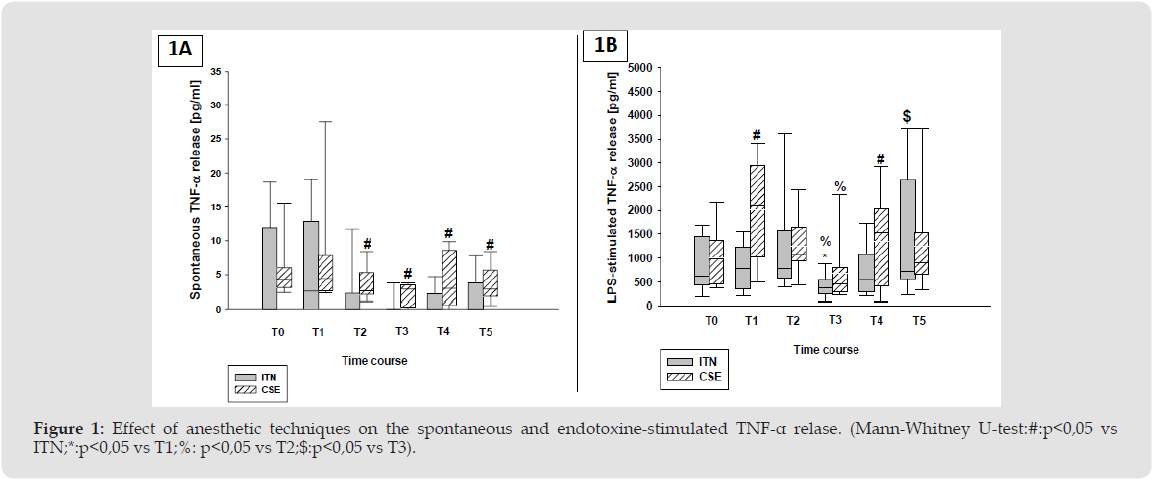
Figure 2
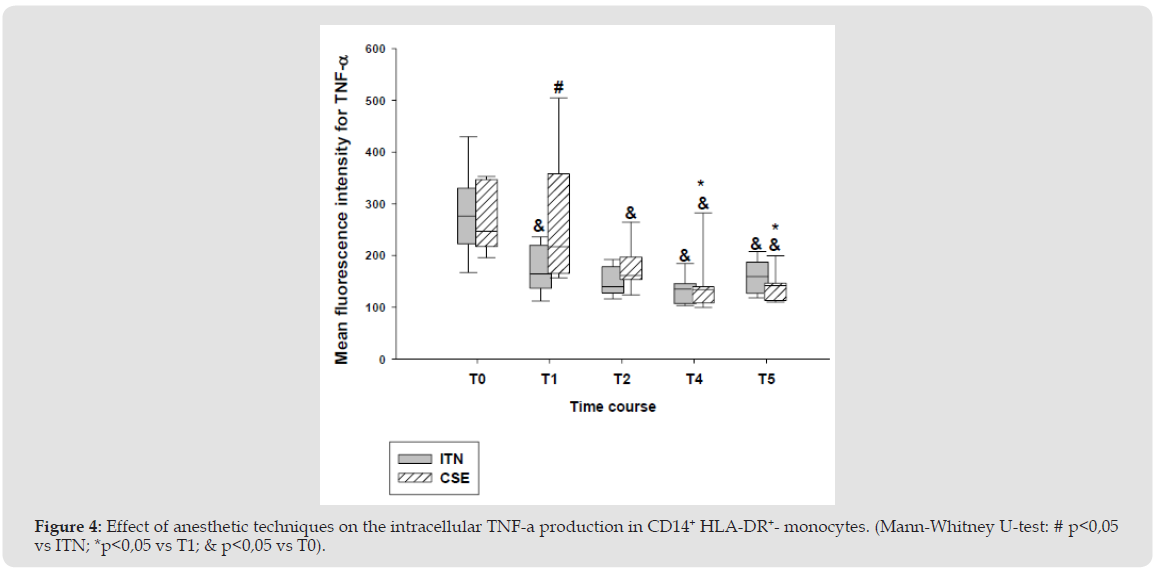
Analysis of Monocyte Subgroup Receptor Expression In the CSE group, the percentage of CD14dim monocytes decreased significantly 24 hours and 48 hours after surgery compared to the values on the day of surgery (Figure 3B), whereas the CD14bright monocytes showed an increase on both postoperative days (Figure 3A).The percentage of CD14bright monocytes was significantly higher in the CSE group compared to the ITN group immediately after induction of anaesthesia, 24 hours, and 48 hours after surgery.The amount of HLADR+ CD14 monocytes decreased significantly immediately after induction of anaesthesia in the ITN group.HLA-DR receptor expression tended to decrease first at the end of the surgical procedure in the CSE group (Figure 3C). Comparing both groups, the amount of HLA-DR+ monocytes was significantly higher in the CSE group immediately after anaesthesia induction and at the end of the surgical procedure.In the ITN group, the intracellular TNF-α production began to decrease immediately after induction of anaesthesia, whereas in the CSE-group the TNF-α production decreased after the surgical procedure (Figure 4).
Figure 3
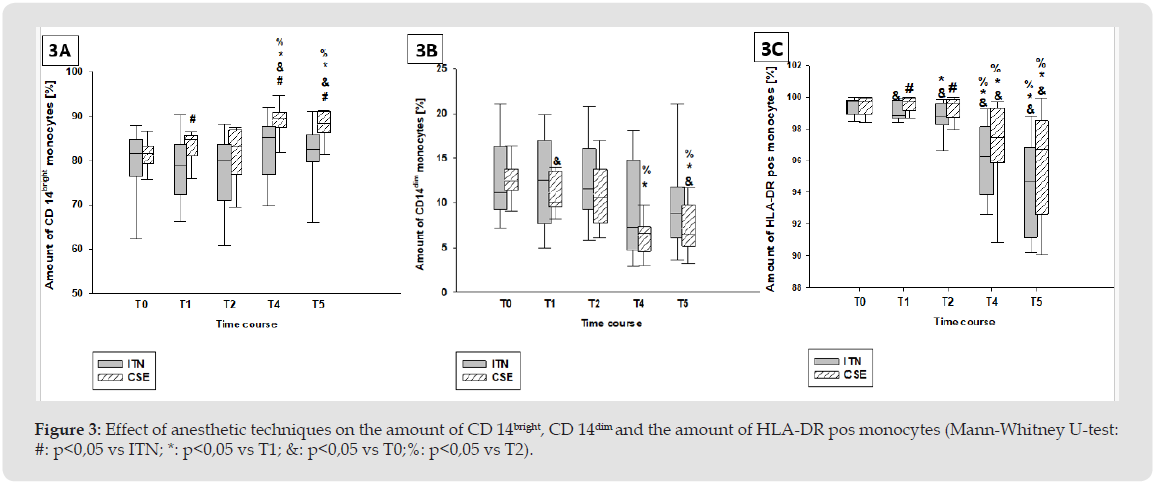
Figure 4
Systematic analyze and evaluation of perioperative outcome is of outstanding significance to apply the optimal anesthetic regimen for our patients. However, several investigations compared neuraxial anaesthesia in contrast to general anaesthesia for total knee arthroplasty. Eligible randomized controlled trials or prospective comparative studie investigating morbidity and mortality (Johnson, Kopp, Burkle 2016). It has become apparent that the patients’ immune system is significantly impaired after surgery [15], which may lead to an increased susceptibility to postoperative infections [16,17]. The underlying reason is not only the surgical trauma. Also, other perioperative factors like the given anaesthesia are suggested to contribute to the observed immunological effects. Despite intensive research, the precise impact of regional anaesthesia in contrast to general anaesthesia is not yet clear. In our investigation, both types of anaesthesia showed significant impairment of the immune response. However, the extension of the dysfunction of the monocytic system was higher after general anaesthesia.
For this study, we used a previously established [18,19] ex vivo/in vitro model to particularly assess the contribution of anaesthesia to the immunological changes that can be observed after surgery. Monocytes are part of the innate immunity and recent evidence suggests that they play a crucial role in sepsis and postoperative infection [20]. In this context, cytokines, a heterogenous group of proteins released by monocytes and other cells of the immune system, have an important impact on the cell-to-cell communication. Several studies reported that a balanced release of pro- and anti-inflammatory cytokines is essential for an adequate host response [19,21,22]. A decreased endotoxin-stimulated cytokine release after major surgery, especially for TNF-α, is suspected to be directly associated with an unfavorable postoperative course (e.g. 19). In our investigation, consistent with a potential contribution of general anaesthesia to monocytic dysfunction, we observed a depressed pro- and anti-inflammatory cytokine release as shown by a decreased release of TNF-α and IL-10 after endotoxin stimulation. Comparing both groups, only neuraxial anaesthesia resulted in a significantly higher release of TNF-α and IL-10. Corresponding results were found by the intracellular flowcytometry. After general anaesthesia, the intracellular TNF-αproduction by CD14 cells was downregulated immediately after induction of general anaesthesia but not after implementation of neuraxial anaesthesia. This difference between the two anesthetic techniques resolved after 24 hours. It can be speculated why these differences disappear after 24 hours. One reason might be that the specific immunological changes due to anaesthesia are masked by the known TNF-α suppressing effects induced by surgical stress. However, neuraxial anaesthesia for total knee arthroplasty compared with general anaesthesia appeared to be equally effective concerning patients outcome (Johnson, Kopp, Bukle 2016).
Previous investigations found a decrease of CD14dim monocytes during sepsis producing more TNF-α and much less IL-10 on LPS-stimulation [12], whereas CD14bright monocytes have been found to be the main producer of IL-10 in response to LPS. In our investigation, we observed a different CD14 subset alteration: Besides the impact on the cytokine release, the monocyte CD14 subsets were also significantly altered by anaesthesia. After neuraxial anaesthesia, we found an increased amount of CD14bright monocytes and a decreased amount of CD14dim compared to the group undergoing the surgical procedure in general anaesthesia. These differences may be due to a modulation of the postsurgical stress response, which we only found with regional anaesthesia, but not with general anaesthesia. In the neuraxial anaesthesia group, the amount of CD14bright monocytes increased significantly directly after induction of anaesthesia. Simultaneously, the IL-10 release also increased in this group. On the other hand, the amount of CD14dim cells decreased in both groups after induction of anaesthesia, reaching significance, however, only in the neuraxial anaesthesia group.
Previous investigations found a significantly reduced expression of HLA-DR on monocytes after major and long-lasting surgery [23]. Our results showed that HLA-DR is downregulated immediately after induction of general anaesthesia compared to neuraxial anaesthesia suggesting a potential impact of general anaesthesia on the immune system. Previous studies found such a downregulation of HLA-DR combined with a decrease in IL-10 release to be associated with postoperative septic complications and increased mortality [9,24,25]. Several studies reported a specific impact of anesthetic drugs on the immune system. Balanced anaesthesia e.g. seems to pronounce surgery- induced inflammation and alteration in cell-mediated immunity [3]. In our study, we used the hypnotic propofol for anaesthesia induction in the general anaesthesia group which is suggested to decrease IL-8 in cultured polymorphonuclear leukocytes [26] and to reduce the migration of human leukocytes [27]. Moreover, in a polymicrobial sepsis model, propofol inhibited NFkb resulting in a decreased production of TNF-α and IL-10 after activation with bacterial toxin [28,29]. In our investigation, we found this same pattern in the patients undergoing general anaesthesia. They released lower TNF-α and IL-10 concentration. Previous investigations reported that volatile anesthetics such as isoflurane, enflurane, and halothane modulate the inflammatory response to bacterial stimuli by a decreased cytokine release [30,31].
Similar to our results, Boost et al. observed significantly reduced TNF-α release in rats ventilated with desflurane [32]. Obviously, both the inhalational drugs as well as propofol may have contributed to the observed modulation of the cytokine release in our study. In contrast to general anaesthesia, previous investigations found that regional anaesthesia attenuates the neuroendocrine stress response during surgery and attenuates perioperative immunosuppression [33]. Moreover, local anesthetics per se are known to directly alter the neutrophil function in vitro [34]. Our results showed a significantly higher release of IL-10 and TNF-α in patients after regional anaesthesia, than after general anaesthesia. Moreover, the amount of CD14bright cells was significantly higher compared to the general anaesthesia patients in the first 24 hours after surgery. In our results, we could not detect any immunosuppressive influence – suppression of cytokine release or downregulation of the monocytic receptor expression after neuraxial anaesthesia in contrast to the changes in the group undergoing general anaesthesia. There are two possible explanations:
1. Bupivacaine in doses used in our study does not affect the immune response and
2. The lack of neuroendocrine stress is responsible for the observed changes in the study group. This second possibility is supported by recently published investigations [35,36].
Our major limitation of this study is the small number of patients, but the differences on the immune system we found in our investigation may be supported also in a recent clinical investigation. Jiabin et al. studied 16,555 patients undergoing knee arthroplasty in general anaesthesia or spinal/epidural anaesthesia [37]. They demonstrated that neuraxial anaesthesia was associated with a lower incidence of pneumonia and systemic infection in patients undergoing knee arthroplasty [37]. Further systematic reviews and metanalyses reported a limited evidence to suggest neuraxial anaesthesia with improved perioperative outcomes [Johnson Burkle Kopp 2016]. However, the underlying mechanism for the advantage of neuraxial anaesthesia in their study is still unknown and might be explained in parts by our findings.
In this study, we demonstrated that the innate immune response was suppressed by general anaesthesia as indicated by a lower proand anti-inflammatory cytokine release and reduced HLA-DR expression. Compared to general anaesthesia, neuraxial anaesthesia protected patients from this immunosuppression. More studies are needed to evaluate the significance of these immunological changes due to general and neuraxial anaesthesia on postoperative complications.
This investigation was supported by a grant from Else Kröner-Fresenius- Stiftung [P03/05//A64/04].
The authors declare no conflict of interest.

International Association of Landscape Archaeology, Czech Glass Society, Czech Republic

Department of Chemistry, Semenov Institute of Chemical Physics, USSR Academy of Sciences, Moscow, Russia

Neurology, LA BioMed Research Institute, USA

Associate Professor at Department of Breast and Thyorid Surgey, Chongqing General Hospital, China

Professor of Nuclear Medicine, Faculty of Medicine and Surgery, University of Milan, Milan, Italy





 Abstract
 PDF
PDF



























