info@biomedres.us
+1 (502) 904-2126
One Westbrook Corporate Center, Suite 300, Westchester, IL 60154, USA
Site Map
 ISSN: 2574 -1241
ISSN: 2574 -1241
ISSN: 2574 -1241
Received: April 25, 2025; Published: May 15, 2025
*Corresponding author: Omotoso AB, Agricultural Technology Department, Oyo State College of Agriculture and Technology, PMB 10, Igboora, Oyo State, Nigeria
DOI: 10.26717/BJSTR.2025.61.009669
Indiscriminate cutting of trees for charcoal production has resulted in land degradation, erosion, air pollution as well as climate change which are detrimental to human health. Therefore, this study investigated the perceived hazards associated with charcoal production in Southwestern, Nigeria. The population of the study comprised of all charcoal producers in Southwestern Nigeria. Multistage sampling technique was employed in selecting 381 respondents from the study area. The study described the socio-economic characteristics of charcoal producers, identified the charcoal production methods, identified the perceived hazards associated with charcoal production and the methods used to manage hazard associated with charcoal production. Data collected were analyzed with descriptive statistics such as frequency count, percentage, mean, Weighted Mean Score (WMS) and standard deviation while inferential statistics such as Chi Square and Pearson Product Moment Correlation (PPMC) were used to test the hypotheses of the study. Earthen mound method of charcoal production was the most (84.25%) used method in charcoal production across the states. The hazards experienced by charcoal producers in order of importance were spinal cord disorder (WMS = 4.87), respiratory diseases (WMS = 4.8), skin and respiratory tract irritation and infection (WMS = 4.65). Unavailability of health care facilities (WMS = 4.36), unstable government policy in charcoal production, forest guard (WMS = 1.91) and unpredictability of returns from charcoal (WMS = 1.87) were constraints limiting strategies to manage the hazards. The PPMC analysis showed significant relationships between age (p = 0.050), years of formal education (p = 0.012), income from primary occupation (p = 0.021), household size (p = 0.046), years of experience in charcoal production (p = 0.041) and perceived hazards associated with charcoal production. Conclusively, charcoal production had impacted negatively on the health status of the charcoal producers. The study therefore recommended the use of appropriate safety measures to mitigate the effects of hazards associated with charcoal production.
Keywords: Perceived; Hazard; Health Hazard; Environmental Hazard; Charcoal Production
Forests have been an important source of energy throughout human history. Traditional forms of forest biofuel include firewood and charcoal for heating and cooking, which it is still used in many parts of the world (Global, forest Atlas [1]). Charcoal production and demand as reported by (Global, forest Atlas [1]) are on the increase in developing countries and international market respectively. Charcoal is one of the major components or fractions of wood fuel. Charcoal is processed from wood and wood materials from trunk, branches and other parts of trees and shrubs, processed by burning to form charcoal (Jamala, et al. [2]). Charcoal is the dark grey residue consisting of carbon and any remaining ash, produced by the slow process of heating wood and other substances in the absence of oxygen, called pyrolysis. It is an impure form of Carbon, which contains ash. Charcoal is an excellent domestic fuel, and can be made from virtually any organic material like wood, it has been reported that hardwood species like Acacia, Mangroves and etc. are preferred for charcoal production (Kammen, et al. [3]). Charcoal been an old source of energy is as well still a modern source of energy for cooking in both rural and urban centers. (Kammen, et al. [3]) reported that half of the world’s population use charcoal for cooking and that in the year 2002, 24 million tonnes of charcoal were consumed worldwide, with developing countries accounting for nearly all consumption while Africa alone accounted for 50 percent. Adeniji, et al. [4] reported that charcoal provides a reliable, convenient and accessible source of energy for cooking at a stable cost in developing countries. The authors further stated that while electricity and gas might be considered the most desired cooking fuels in urban areas, even if these were available, the majority of poor households may not be able to afford both the energy resources and the devices required to use these forms of energy. Many households, therefore, turn to the use charcoal for cooking and domestic use.
The importance of charcoal as a source of energy cannot be over emphasized when considering its domestic and industrial use. About 2.4 billion people rely on traditional biomass, mainly for cooking and heating (Bada, et al. [5]). In addition to its export value, charcoal trade at the local level provides income opportunities for many people in the rural and urban areas through small scale retail and wholesale businesses. It is an important and simple means of earning an income (Eniola, et al. [6]). Charcoal is the most important commercial fuel derived from wood. Smoke free, capable of controlled use in a small and cheap stove, and also capable of producing greater heat than wood (Akinbami [7]). Adverse impact that are already apparent but which would increase if the trend continues are soil erosion, less biomass available for all other uses, traditional economic forest products such as fruits, nuts, and medicinal trees becoming scarce. According to (Eniola, et al. [6]), while considering the rate of deforestation attested that despite the laws promulgated by the Federal Government prohibiting illicit felling of these trees, charcoal producers keep increasing in the quantities of charcoal produced. Indiscriminate cutting of trees for charcoal production has resulted in land degradation, erosion, air pollution, climate change, to mention but few, which consequently affect human health. Excessive heat posed by cutting of trees has serious implications for environment and health. Various forms of injuries and health hazards such as respiratory diseases, headaches are also associated with charcoal production, this study therefore examines the perceived hazards associated with charcoal production in southwestern, Nigeria. Therefore, the study provides answers to the following research questions:
a) What are the socio-economic characteristics of charcoal producers in southwestern, Nigeria?
b) What are the methods used for charcoal production and the activities involved in charcoal production?
c) What are the perceived hazards associated with charcoal production?
d) What are the methods used to manage hazards associated with charcoal production? And
The aim of the study is to examine the perceived hazards associated with charcoal production in Southwestern, Nigeria. The specific objectives were to:
Describe the socio-economic characteristics of charcoal producers.
Examine the methods used for charcoal production and the activities involved in charcoal production.
Determine the perceived hazards associated with charcoal production.
Identify the methods used to manage hazards associated with charcoal production, and
Hypotheses of the Study
The hypotheses of the study were stated in null form as follows:
• H01: There is no significant relationship between selected socio- economic characteristics of the charcoal producers and perceived hazards associated withcharcoal production.
• H02: There is no significant relationship between methods used in charcoal production and perceived hazards associated withcharcoal production.
The study was carried out in Southwestern geopolitical zone of Nigeria which comprises of six states namely Lagos, Ogun, Oyo, Osun, Ondo and Ekiti. Meanwhile Oyo, Osun and Ogun states were purposively selected for this study due to the prominence of charcoal production in the area. Multistage sampling technique was used for the selection of charcoal producers (both registered and non-registered) for this study. Hence, a total of three hundred and eighty-one (381) charcoal producers from both the registered and non-registered population were sampled size for this study.
• Age: it was revealed that 64.57% and 17.84% of the charcoal producers were between the ages of 36-45 and 26-35 years of age respectively 64.57% while 11.02% and 6.56% were above 55 years and less or equal to 25years of age respectively in south western Nigeria and the mean age of the respondents across the three states selected was found to be 42 years. This finding show that charcoal producers in the study area were mature, energetic, productive and economically active which categorized them as individual that are still ready to acquire relevant training that will aid improvement in their source of income. This result is in consonance with the study on (Eniola, et al. [6]), which reported that charcoal production appears to be dominated by the active people with age-range of between 36-45 years of age.
• Sex: Majority (80.83%) of the respondents indicated that they were males while 19.16% were female. The implication of this result is that charcoal production is usually a male dominated ocCopyright@ : Omotoso AB | Biomed J Sci & Tech Res | BJSTR.MS.ID.009669. 54112 Volume 61- Issue 5 DOI: 10.26717/BJSTR.2025.61.009669 cupation because of the rigorous activities involved. This finding agreed with CHAPOSA [8], who reveals that males were more involved in charcoal production. also in a related study by Charcoal production in South Africa CHAPOSA [8], it was revealed that 70.0% of charcoal producers were males.
• Marital Status: Result from Table 1 revealed that majority 67.19% of the respondents was married, 26.50% were single, 3.67% were divorced while 2.62% were widowed/separated. This result is an indication that respondents value the social institution in the study area through their adherence to the marriage institutions. The marital status is expected to influence their level of production and also increases their income level to adequately cater for the welfare of their family members. This result corroborates with the findings of Olujobi [4] where more than half of his respondents were married. The majority of the respondents’ being married is an indication that an increase in the labour force is required as the dwellers’ heads have the responsibility of feeding the family and providing for their immediate needs, hence the need to divert into charcoal production is enhanced.
• Year Spent in School: Also from Table 1 indicate that (32.28%) of the respondents spent between 1-6 years in school, 12.60% of the respondents spent between 7-12 years in school and12.60% had no formal education while very few 1.84% spent above 12 years in school with mean of years in school of 11years.This result is an implication that charcoal producers in the study area have varied level of education. The importance of education and high literacy level is needed to optimally manage the hazards that are associated with charcoal production. In a similar view, Kumar (2012) stresses that low literacy among the rural population tends to limit their ability to understand the dangers of excessive forest resources exploitation, they only based their activities of forest resources collection on economic gain and to improve their income.
• Household Size: also, below average (46.72%) of the respondents had between 5-10 members in their household, 38.85% had above 10 members in their household while 14.44% had less than five 5 members in their household. The mean household size in the study area was revealed to be 9 members. This result is an indication that southwestern people have a fairly large household size and this might be attributed to the dominance of charcoal production in the zone which influences the respondents to have more members in their household to shoulder the responsibility of charcoal production labour. Bada, et al. [5]) in a related study reveal that most charcoal producers have household size of between 6 and 10 which has positive implications on the family labour availability for charcoal production which increase their production. Annual Income from Charcoal Production: the results, 41.21% of the respondent revealed that they realized between ₦250,001 - ₦500,000 in a year from charcoal production, 31.76% of the respondents realized between ₦250, 000 per annum, 24.15% of the respondents realized between ₦500,001 - ₦1,000,000 per annum from charcoal production while only few (2.85%) realized above ₦1,000,000 per annum from charcoal production in the study area and the mean annual income was found to be ₦425,866.10. The result implies that charcoal production is a major contributor to economic activities in the study area. This finding supports the finding of Inoni [9] who reported that most (77%) rural households in Nigeria were low income earners due to subsistence level of crop production, livestock production, forestry activities and other agricultural activities.
• Year of Experience in Charcoal Production: Table 2 revealed that in Table 1 that (38.06%) had between 11-15 years of experience in charcoal production, 24.67% had between 5-10 years of experience in charcoal production, 21.00% had between 16- 20 years of experience in charcoal production while few 3.15% had below 5 years of experience in charcoal production in the study area. The mean year of experience of respondents in charcoal production was 14 years. This implies that the respondents had acquired much experienced in charcoal production. This will enhance charcoal producers to use various methods to curtail the hazards incurable in charcoal production. The study corroborates the findings of Bada, et al. [5]), it was revealed that the years of experience in charcoal producers in south western, Nigeria is between 5 and 19 years.
Table 1: Socio-Economic Characteristics of Charcoal Producers in the Study Area.

Note: Source: Field Survey, 2024
Methods Used for Charcoal Production in the Study Area The result in Table 2 revealed that (84.25%) of the respondents made use of earthen mound method for charcoal production, 53.80% used pit method for charcoal production, 44.09%used mud kiln method while 33.86% used metal kiln method for charcoal production. The study revealed that earthen mound method was very prominent in the southwestern Nigeria. In a related study in Bada, et al. [5]), surface (earthen mound) method was found to be the most commonly used method of charcoal production in many parts of Nigeria. The result was in conformity with (Eniola, et al. [6]) that using earthen mound to produce charcoal is mostly commonly used method in Nigeria since it is very cheap to construct and easy to use.
Table 2: Methods used in Charcoal Production in the Study Area.

Note: Source: Field Survey, 2024
Perceived Hazards Associated with Charcoal Production in Southwestern, Nigeria. (n=381)
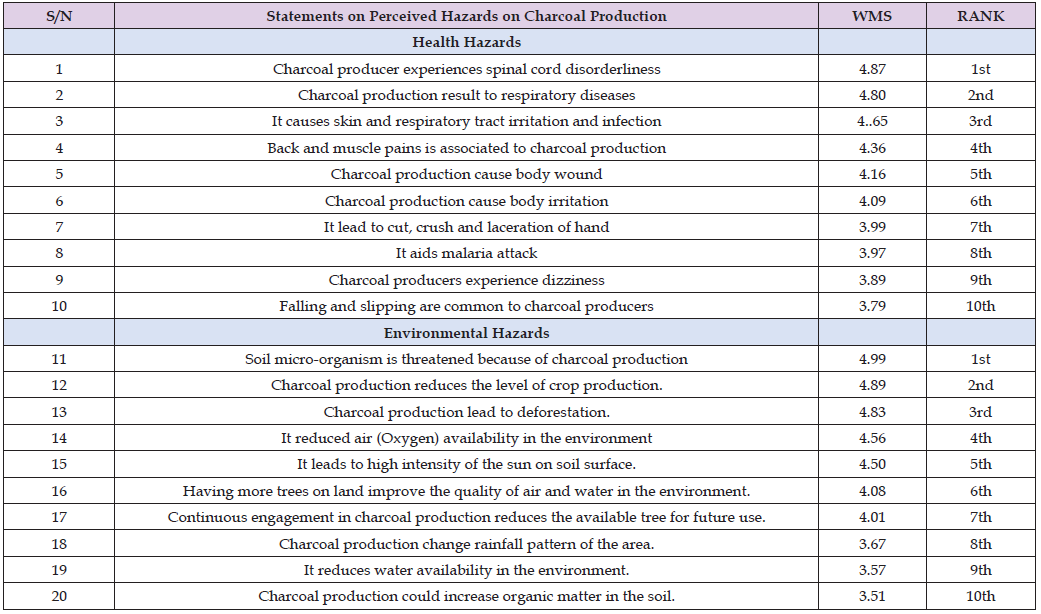
Result from Table 3 presents the perceived hazards associated with charcoal production in southwestern, Nigeria. The results from the table revealed the Weighted Mean Score (WMS) result which indicate that charcoal producers’ experiences spinal cord disorderliness during charcoal production was ranked 1st with the (WMS = 4.87) and charcoal production result to respiratory diseases were ranked 2nd with (WMS = 4.80), while, charcoal production causes skin and respiratory tract irritation and infection was ranked 3rd with (WMS = 4.65). Charcoal production causes back and muscle pains was ranked 4th with (WMS = 4.36), it causes body wound was ranked 5th with (WMS = 4.16), it causes body irritation was ranked 6th with WMS of 4.09 while leads to cuts, crush, and laceration of hands with (WMS = 3.99) was ranked 7th. However, charcoal production aids malaria ranked 8th with (WMS = 3.97), charcoal production auses dizziness was ranked 9th with (WMS = 3.89), charcoal production causes falling and slipping was ranked 10th with (WMS = 3.79). The result implies that respondents had been feeling the negative effects of hazards associated with charcoal production, the result also implies that respondents perceived that charcoal production could likely to cause body irritation. The result in line with (Eniola, et al. [6]) who opined that during the burning of charcoal production, workers are exposed to incomplete combustion of wood burning and noxious smoke gases for several hours per day. Charcoal producers significantly experience symptoms such as cough, sputum production, sneezing, dyspnea, and hemoptysis. Also, Results in Table 4 revealed the environmental hazards associated with charcoal, soil micro-organism is threatened because of charcoal production ranked 1st with Weighted Mean Score (WMS = 4.99), charcoal production reduces the level of crop production was ranked 2nd with (WMS = 4.89), charcoal production leads to deforestation was ranked 3rd with (WMS = 3.83) while , charcoal production reduces air (oxygen) availability in the environment was ranked 4th with (WMS = 4.56), charcoal production leads to high intensity of the sun in soil surface was ranked 5th with (WMS = 4.50) while having more stress on land improve the quality of air and water in the environment was ranked 6th (WMS = 4.08). Continuous engagement in charcoal production reduces available trees for future use was ranked 7th with (WMS = 4.01). Charcoal production changes rainfall pattern of the area was ranked 8th with (WMS = 3.67), it reduces water availability in the environment was ranked 9th with (WMS = 3.57). This result implies that respondents had been feeling the negative effects of charcoal production on their environment. The result is in line with United Nation [9] that during charcoal production a lot of heat is generated over several days due to the high temperature attained. This heat destroys all plants at the kiln site, air pollution occur, wildlife too is affected.
Table 3: Perceived Hazards Associated with Charcoal Production in Southwestern, Nigeria. (n=381).
Note: Source: Field Survey, 2024, WMS- Weighted Mean Score.
Table 4: Categorization of Perceived Hazards Associated with Charcoal Production in the Study Area (n = 381).

Note: Source: Field Survey, 2024.
• Minimum score = 1.1
• Maximum score = 45.3
Categorization of Perceived Health Hazards Associated with Charcoal Production in Southwestern Nigeria. (n=381)
Table 4 revealed the perceived hazards of the respondents associated to charcoal production in the study area. It shows the distribution of the respondents into three categories (High, moderate and low) hazard using their weighted mean score. The results revealed that 70.34% of the respondents moderately perceived hazard associated to charcoal production while 16.54% of the respondents have a high level of perception of hazards toward charcoal production and 13.12% of the respondents have low perception of hazards associated with charcoal production.This implies that majority of the respondents’ experience several hazards such as spinal cord disorderliness, respiratory disease, body irritation, headache and chest pain relating to charcoal production, land degradation, Soil fertility, flooding among others but were minimal and not severe. (Eniola, et al. [6]) also inferred that charcoal production attracts various hazards on producers and environment which could be kept minimal, if proper mitigation options adopted.
Methods Used to Manage Hazards Associated with Charcoal Production in the Study Area. (n=381)
Table 5 present the methods used to manage hazards associated with charcoal production. The results reveal that wearing of glove during charcoal production was ranked 1st with (WMS = 4.54), replanting of trees used for charcoal production was ranked 2nd with (WMS = 4.05), reduction in time of visit to charcoal kiln during production was ranked 3rd with (WMS = 3.75), also employment of paid labour to carry out tedious work during charcoal production was ranked 4th with (WMS = 3.74), while wearing of boots during charcoal production was ranked 5th with (WMS = 3.52). However, regular visitation to health care centers by charcoal producers, putting in breathing filter/nose mask during charcoal production and regular medical checkup by producers were ranked 6th with (WMS = 3.52), I take bath regularly after each day job was ranked 7th with (WMS = 3.34), siting of charcoal production site far away from residential area was ranked 8th with (WMS = 3.25), preventing under age children from the use of charcoal for cooking was ranked 9th with (WMS = 3.24), establishment of tree plantation mainly for charcoal production and fuel wood and public awareness of the hazards associated with charcoal production through appropriate campaign by government were jointly ranked 10th with (WMS = 3.18), government regulation on charcoal production was ranked least of 12th with (WMS = 3.13) while putting on breathing filter/nose mask during charcoal production was ranked last with (WMS = 2.87). The result implies that respondents are not taking cognizance of the methods used to manage hazards associated with charcoal production and this might be due to non-availability and unaffordability in the study area, The results is in line with the findings of (Eniola, et al. [6]) which reveal that methods used to manage hazards associated with charcoal production were known to charcoal producers but due to the nonchalant attitudes and literacy level of the charcoal producers they don’t take proper attention to this methods during charcoal production.
Table 5: Methods used to Manage Hazards associated with Charcoal Production in the Study Area. (n=381).

Note: Source: Field Survey, 2024, WMS- Weighted Mean Score.
Test of Hypotheses of the Study
The hypotheses of the study were tested and results presented below. It is to be noted that all the hypotheses were stated in null form.
H01: There is no significant relationship between selected socio-economic characteristics of the charcoal producers and perceived hazards associated with charcoal production. (n=381).
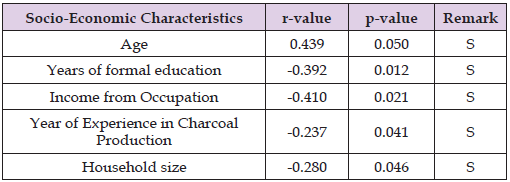
The test of significant relationship between the selected socioeconomic characteristics (age, income from primary occupation, years of formal education, year of experience in charcoal production and household size) of the respondents and perceived hazards associated with charcoal productionwas presented in Table 6. Pearson Product Moment Correlation (PPMC) analysis revealed that age (r = 0.439, p<0.05), years of formal education (r = 0.392, p<0.05), income from primary occupation (r = 0.237, p<0.05), household size (r = 0.280, p<0.05) and years of experience in charcoal production (r = 0.237, p<0.05) have a significant relationship with perceived hazards associated with charcoal production in the study area. All the significant variables apart from age of respondents exert a negative significant influence on perceived hazards associated with charcoal production in the study area. This shows that the higher these variables, the lower the perceived hazards associated with charcoal production in the study area. Therefore, the null hypothesis was rejected. To corroborate this study, kato, et al. (2005) and Ellegard, et al. [10-13] observed charcoal production has a lot of hazards on the health of the producers but the higher the education, income and years of experience of the charcoal producers will minimize the hazards associated with charcoal production and increases their production level.
Table 6: Summary of Pearson Product Moment Correlation analysis showing Relationship between selected socioeconomic characteristics of the respondents and perceived hazards associated with charcoal production. (n=381).
Note: Source: Computed data, 2024, Significant level: p < 0.05, S = significant; NS = not significant.
There is no Significant Relationship Between Methods Used in Charcoal Production and The Perceived Hazards Associated with Charcoal Production in the Study Area. (n=381)
The test of significant relationship between methods used (Earthen mound method, pit method, metal kiln, mud kiln and traditional method) in charcoal production and perceived hazards associated with charcoal production were presented in Table 7. Chi-Square result revealed that significant association exists between Earthen mound method (χ2 = 52.13, p < 0.05) and Pit method (χ2 = 62.90, p < 0.05) used in charcoal production in the study area and the perceived hazards associated with charcoal production, therefore, the null hypothesis is hereby rejected for earthen mound method and pit method. The result implies that earth mound method and pit method of charcoal production was very prominent in the study area. The result is in line with the findings of Bada et al. (2009) who reported that earthen mound method and pit method of charcoal production were found to be the most commonly used method in many parts of Nigeria.
Table 7: Summary of chi-square test establishing relationship between methods used in charcoal production and perceived hazards associated with charcoal production. (n=381).

Note: Significance level: p < 0.05
S = significant
Source: Computed Data, 2024
From the empirical findings of this study, the following conclusions are drawn:
1. Majority of the respondents were male and married with mean age of 39years, Respondents’ primary occupation was charcoal production with 14 year of charcoal production experience in the study area.
2. The predominant method used for charcoal production was earthen mound method in the study area.
3. The charcoal producers are actively involved in the activities of charcoal production which include; selection of site for kiln construction, felling of trees, cross cutting of trees into log, Kiln insulation with grass and soil, sorting of charcoal, storing of charcoal and packaging of charcoal into bags in the study area.
4. Also, because of the rigorous activities that are involved in charcoal production, health of the charcoal producers may be worsening if they continue to produce charcoal with the use of crude methods.
5. The methods used to manage hazards associated with charcoal production e.g. wearing of glove during charcoal production, wearing of boots during charcoal production, regular visitation to health care centres amongst others were not affordable and accessible in the study area.
Based on the findings of this study the following recommendations were made:
1. Active involvement of community leaders and stakeholders in forest management through voluntary patrolling of the production sites to avoid indiscriminate felling of trees for charcoal production.
2. Other livelihood activities which are environmentally friendly such as bee keeping, fish farming, snailery and vegetable production among others should be promoted among rural dwellers.
3. In view of the negative perceived health effects of charcoal production among the rural dwellers, awareness campaign on the health and environmental consequences of charcoal production should be promoted.
4. Upon observation of charcoal practice and that despite the hazards involved in charcoal production, ban on the production are not likely to slow down or eliminate charcoal production altogether, there should be clear guidelines to ensure proper charcoal production to minimize the hazards to health.

International Association of Landscape Archaeology, Czech Glass Society, Czech Republic

Department of Chemistry, Semenov Institute of Chemical Physics, USSR Academy of Sciences, Moscow, Russia

Neurology, LA BioMed Research Institute, USA

Associate Professor at Department of Breast and Thyorid Surgey, Chongqing General Hospital, China

Professor of Nuclear Medicine, Faculty of Medicine and Surgery, University of Milan, Milan, Italy





 Abstract
 PDF
PDF



























