info@biomedres.us
+1 (502) 904-2126
One Westbrook Corporate Center, Suite 300, Westchester, IL 60154, USA
Site Map
 ISSN: 2574 -1241
ISSN: 2574 -1241
ISSN: 2574 -1241
Received: May 01, 2025; Published: May 08, 2025
*Corresponding author: Abdol Ghaffar Ebadi, Department of Agriculture, Jo.C, Islamic Azad University, Jouybar, Iran
DOI: 10.26717/BJSTR.2025.61.009654
Marine plants are a comparatively untapped reservoir of bioactive compounds with promise for application in the treatment of chronic inflammatory and neurodegenerative diseases. Unlike plants on land, marine plants are adapted to saline, oxidative, and UV-rich conditions, leading to the evolution of structurally sophisticated and biologically active molecules. Polysaccharides, polyphenols, phlorotannins, and sterols from marine animals such as Ecklonia cava, Zostera marina, and Avicennia marina have been found to have potent anti-inflammatory and neuroprotective properties. They modulate key signaling pathways such as NF-κB, MAPK, and PI3K/Akt and thereby inhibit the release of pro-inflammatory cytokines and oxidative neuronal damage. Preclinical studies show that these marine-derived molecules can protect against diseases such as Alzheimer’s disease, Parkinson’s disease, and multiple sclerosis, and reduce systemic inflammation in metabolic diseases. Despite promising pharmacological profiles, limitations such as low bioavailability and lack of clinical validation remain. This mini-review recapitulates the recent advances in marine plant-derived compounds with anti-inflammatory and neuroprotective properties, outlining their mechanisms of action, therapeutic potentials, and future perspectives. The integration of marine pharmacognosy and modern drug development strategies could pave the way for novel, safe, and efficacious therapeutics for some of the most incapacitating health conditions of our time.
Keywords: Marine Pharmacognosy; Anti-Inflammatory Agents; Neuroprotection; Seaweed Extracts, Natural Therapeutics
Marine algae such as macroalgae (seaweeds), seagrasses, and mangroves are a diverse source of structurally diverse bioactive compounds. These species inhabit dynamic coastal ecosystems with intense salinity, high ultraviolet (UV) radiation, mechanical stress, and fluctuating temperatures. Marine algae have evolved sophisticated metabolic pathways in response to such stressful conditions, producing secondary metabolites with potent pharmacological activities. Remarkably, the bioactives exhibit antioxidant, anti-inflammatory, antimicrobial, and neuroprotective activities [1-7]. In the past several decades, inflammatory and neurodegenerative disorders such as rheumatoid arthritis, Alzheimer’s disease, and Parkinson’s disease have experienced explosive growth. Disadvantages of available therapeutic medications—e.g., side effects, cost, and resistance—have prompted efforts to seek out alternative treatments. Marine-derived products offer promising drug candidates since they demonstrate novel modes of action and are biocompatible [8-10]. The neuroprotective and anti-inflammatory potential of marine plants, based on both in vivo and in vitro evidence, is thus receiving growing scientific attention (Table 1).
Table 1: Representative Marine Plant Species and Their Pharmacological Activities.

Polysaccharides
Sulfated polysaccharides such as fucoidan, alginate, carrageenan, and laminarin-mainly from brown algae (Phaeophyceae) have been found to possess different bioactivities. Fucoidan, for instance, controls immunity by inhibiting pro-inflammatory cytokines like IL-6 and TNF-α and inducing macrophage phagocytosis. Such polysaccharides are structurally heterogeneous depending upon species, season, and habitat and affect potency and specificity [11].
Polyphenols and Phlorotannins
Polyphenols, especially phlorotannins from brown algae such as Ecklonia cava, have significant antioxidant and anti-inflammatory activities. Phlorotannins act as free radicals scavengers (reactive oxygen species, ROS), inhibit nuclear factor-kappa B (NF-κB), and modulate mitogen-activated protein kinase (MAPK) signaling. Experiments showed that these compounds can inhibit cyclooxygenase-2 (COX-2) and inhibit nitric oxide production in lipopolysaccharide-stimulated macrophages [12,13].
Sterols and Terpenes
Marine sterols like fucosterol and terpenes like squalene, derived from seaweeds and mangroves, exhibit antioxidative and anti-inflammatory effects. Fucosterol inhibits the expression of IL-1β, IL-6, and COX-2 and regulates PI3K/Akt pathways for cell survival and immune response. These molecules also decrease oxidative damage by enhancing endogenous antioxidant enzyme activity based on Table 2 [14].
Table 2: Bioactive Compounds from Marine Plants: Types, Mechanisms, and Therapeutic Potentials.
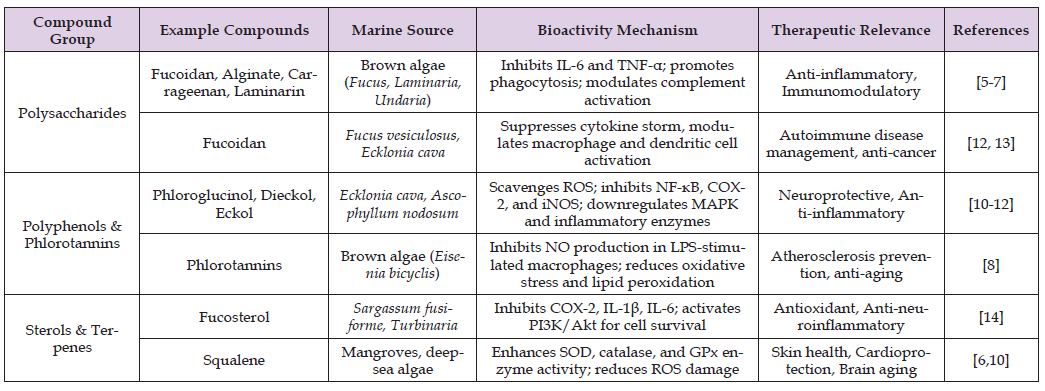
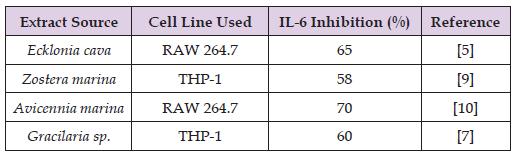
Marine compounds target several molecular pathways associated with inflammation. The major mechanisms include inhibition of NF-κB and MAPK pathways, COX-2 enzyme expression inhibition, and reduction in the secretion of pro-inflammatory cytokines such as IL- 1β, IL-6, and TNF-α. For example, extracts from Zostera marina and Avicennia marina are effective in inhibiting NF-κB activation and cytokine secretion in macrophage cell models. The extracts also reduce intracellular ROS, inhibiting oxidative stress-mediated inflammation according to Table 3 [5,9,13].
Table 3: Anti-Inflammatory Potential of Marine Plant Extracts (% Inhibition of IL-6 Production).
Marine plant metabolites exhibit neuroprotection through diverse mechanisms, including ROS scavenging, mitochondrial protection, and modulation of key signaling pathways like PI3K/Akt and Nrf2. Phlorotannins from Ecklonia cava and sulfated polysaccharides from red algae were shown to suppress apoptosis in neuronal cells in Alzheimer’s and Parkinson’s disease models (Tables 4 & 5). These metabolites also improve cognitive functions by suppressing β-amyloid aggregation and neuroinflammation [10,11,14].
Table 4: Neuroprotective Effects of Marine-Derived Compounds (% Reduction in ROS Production).

Table 5: Signaling Pathway Modulation by Marine Plant Extracts (% Change from Control).

Despite their auspicious pharmacological activities, drugs from marine plants are also plagued with some translational issues. These include low oral bioavailability, rapid metabolism rates, and undesirable pharmacokinetic profiles. In addition, geographical and season factors influence metabolite content, rendering standardization problematic. The lack of clinical trials is also a limiting factor to regulatory approval and therapeutic applications. All of these are to be overcome with good analytical devices and scale-up extraction protocols [6,8].
In order to achieve complete therapeutic potential of seaweed compounds, future research should give high priority to nanoformulation techniques, synthetic analog design, and systems biology tools. Nanoencapsulation will likely enhance bioavailability and specificity of targeting, while synthetic analogs would be able to improve stability and efficacy. Integration of omics-based tools will also enable better understanding of bioactive mechanisms. Furthermore, sustainable harvesting and aquaculture practices should be adopted to save the environment and deliver resources [7,12-14].
Marine algae are a rich, untapped source of highly bioactive molecules of high anti-inflammatory and neuroprotective potential. Their mechanisms of action encompass a range of biological pathways and offer promising therapeutic options to current treatments for chronic inflammatory and neurodegenerative diseases. Despite ongoing challenges, ongoing research and technical development hold promise for translation of therapeutics from marine-derived products to clinically effective medicines.

International Association of Landscape Archaeology, Czech Glass Society, Czech Republic

Department of Chemistry, Semenov Institute of Chemical Physics, USSR Academy of Sciences, Moscow, Russia

Neurology, LA BioMed Research Institute, USA

Associate Professor at Department of Breast and Thyorid Surgey, Chongqing General Hospital, China
Professor of Nuclear Medicine, Faculty of Medicine and Surgery, University of Milan, Milan, Italy





 Abstract
 PDF
PDF



























