info@biomedres.us
+1 (502) 904-2126
One Westbrook Corporate Center, Suite 300, Westchester, IL 60154, USA
Site Map
 ISSN: 2574 -1241
ISSN: 2574 -1241
ISSN: 2574 -1241
Received: May 01, 2025; Published: May 08, 2025
*Corresponding author: Abdol Ghaffar Ebadi, Department of Agriculture, Jo.C, Islamic Azad University, Jouybar, Iran
DOI: 10.26717/BJSTR.2025.61.009653
Marine plants, including seaweeds, seagrasses, and mangroves, have been indentified as rich sources of bioactive compounds that have significant pharmacological activities. These plants live in extreme and diverse marine environments, which have led to the evolution of new secondary metabolites not found in terrestrial plants. In the past several decades, an increasing number of studies have reported the anticancer and antimicrobial potential of marine-derived substances like alkaloids, flavonoids, polysaccharides, and phenolic compounds. Seaweed species like Sargassum, Ulva, and Gracilaria have been found to exhibit cytotoxic activity against various cancer cell lines, while mangroves’ compounds have been shown to exhibit potent antibacterial activity against multidrug-resistant microorganisms. Their mechanisms of action involve apoptosis induction, modulation of oxidative stress, and inhibition of biofilm formation by microbes. While in vitro and in vivo results are promising, large-scale extraction, purification, and clinical translation remain challenging. This mini-review provides an overview of recent progress in the discovery and development of marine plant-derived anticancer and antimicrobial agents and their potential as leads for new therapeutics. It also addresses current limitations and the future direction of research, including the use of biotechnology and synthetic biology in compound production enhancement. By harnessing the plant biodiversity of the ocean, drug discovery can be propelled into a new era of innovation to fight global health challenges such as cancer and antibiotic resistance.
Keywords: Marine Plants; Anticancer Agents; Antimicrobial Resistance; Seaweed Metabolites; Drug Discovery
The marine environment, covering over 70% of the surface of the planet Earth, houses a diverse flora with specialized biochemical pathways yielding structurally varied secondary metabolites [1-4]. Marine angiosperms, most notably macroalgae (seaweeds), mangroves, and seagrasses, have been actively searched as treasure troves for bioactive metabolites with very high therapeutic activities [5-7]. Compared to land plants, marine plants have to endure drastic environmental stresses in the guise of salinity, temperature fluctuation, and intense UV radiation. These stresses have shaped the course of evolution of specialized metabolites that exhibit defense, antifouling, and stress-resistance activities, some of which have pharmacological properties active within the human body [7-12].
Recent research has emphasized the antimicrobial and anticancer potential of compounds isolated from sea algae. Sargassum and Gracilaria algae, for instance, have indicated cytotoxic activity against certain cell lines of cancer, whereas mangrove compounds act against drug-resistant microorganisms. Certain of these compounds from nature are alkaloids, terpenoids, flavonoids, sulfated polysaccharides, and phenolics, certain of which have activity by induction of apoptosis, DNA intercalation, and microbial membrane disruption [13]. While they are therapeutically potential, the manufacture of drugs from marine plants is hampered by a series of challenges, including large-scale culturing and extraction of compounds, structural complexity, and poor in vivo validation. However, with the advent of biotechnological means, including omics technologies and synthetic biology, new technologies for large-scale production and enhance ment of bioactivity have emerged [14]. This mini-review provides an overview of recent studies on anticancer and antimicrobial marine plant-derived anticancer and antimicrobial agents. It explains their mechanisms of action, highlights major bioactive compounds, and suggests future directions in drug development based on marine botanical resources (Figure 1).
Figure 1
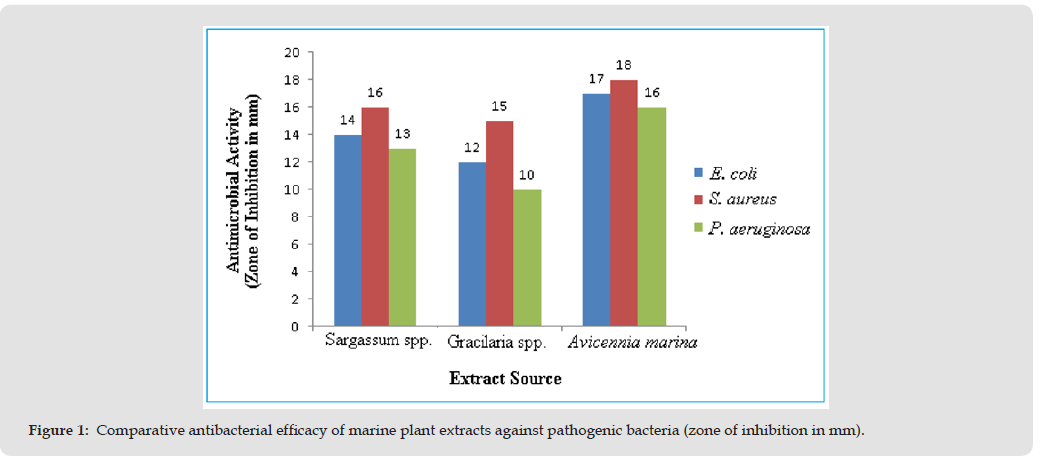
Marine algae such as brown, red, and green, and halophytic mangroves harbor a diverse array of metabolites of medicinal value. Brown algae such as Sargassum harbor high concentrations of terpenoids such as fucoxanthin, a molecule widely reported for its pro-apoptotic and antioxidant activities [5]. Red algae (Gracilaria spp.) produce sulfated polysaccharides such as carrageenan with antiviral and cytotoxic activity [7,9]. Certain mangrove species, such as Avicennia marina and Rhizophora mucronata, produce alkaloids and phenols with high antimicrobial activity. These are highly diverse plant-specific molecules formulated for survival under a stress-borne sea habitat, thereby suggesting a vast bank of yet undiscovered pharmacophores. In addition to their inherent biological activity, these bioactive compounds also have the prospect of having useful effects on a variety of anticancer therapeutic approaches and the management of infectious diseases (Table 1).
Table 1: Marine plant taxa and their major bioactive compounds.

Marine compounds exhibit diverse mechanisms against cancer cells and pathogenic microorganisms. Fucoxanthin induces apoptosis in cancer cells through mitochondrial-dependent pathways and ROS production [5]. Carrageenan inhibits tumor growth by cell cycle arrest and immune system modulation [9]. Avicequinone C and its related compounds exert antibacterial effects by inducing membrane damage and oxidative stress in bacterial cells [6]. Notably, some of these compounds also modulate host immunity, making combination therapies possibilities [14]. Their ability to disrupt microbial membranes, inhibit viral replication, and cause oxidative stress makes them highly versatile drugs in the fight against drug-resistant bacterial strains as well as viral infections (Table 2 & Figure 2).
Figure 2

Table 2: Mechanisms of action of marine-derived anticancer agents.

The pharmacological potential of marine vegetation is often undermined by problems of compound extraction, reproducibility, and bioavailability [13]. To surmount the aforementioned limitations, new technologies such as metagenomics, omics-based profiling, and synthetic biology are increasingly being utilized [15-18]. These methodologies allow for detection of gene clusters involved in biosynthesis, provide heterologous expression in model systems, and enhance the production of compounds. Interactions among marine biologists, pharmacologists, and bioengineers play a pivotal role to initiate translation of marine drug leads into clinics. Advances in eco-friendly extraction method and sustainable harvesting process will also be equally essential for large-scale production of such bioactive compounds (Table 3).
Table 3: Current biotechnological strategies for marine drug discovery.

Seaweeds represent an untapped treasure house of bioactive compounds with full anticancer and antimicrobial potential. Their metabolites possess multifaceted mechanism of action and are ideal leads for the establishment of new drugs. Yet more studies are essential to standardize extraction, ascertain in vivo activity, and assure sustainable harvesting. Future research integrating molecular biology, ecological modeling, and pharmacological screening will be of prime importance to unlock the entire potential of marine botanical therapeutics. With the increasing menace of antimicrobial resistance and the immediacy of identifying new antiviral drugs, marine plants are a special and precious platform to expand the pharmaceutical arsenal against infectious diseases and cancer.

International Association of Landscape Archaeology, Czech Glass Society, Czech Republic

Department of Chemistry, Semenov Institute of Chemical Physics, USSR Academy of Sciences, Moscow, Russia

Neurology, LA BioMed Research Institute, USA

Associate Professor at Department of Breast and Thyorid Surgey, Chongqing General Hospital, China
Professor of Nuclear Medicine, Faculty of Medicine and Surgery, University of Milan, Milan, Italy





 Abstract
 PDF
PDF



























