info@biomedres.us
+1 (502) 904-2126
One Westbrook Corporate Center, Suite 300, Westchester, IL 60154, USA
Site Map
 ISSN: 2574 -1241
ISSN: 2574 -1241
ISSN: 2574 -1241
Received: May 01, 2025; Published: May 07, 2025
*Corresponding author: Zakharyeva NN, Professor of the Department of Physiology, Chief Researcher at the Sports Medicine Laboratory of the Research Institute of Sports and Sports Medicine, Russian State University of Physical Education, Sports, Youth and Tourism, Moscow, University Federal State Budget Educational Institution of Higher Education ‘The Russian University of Sport ’GTSOLIFK’, Russia
DOI: 10.26717/BJSTR.2025.61.009647
This study presents the test results of 30 elite female athletes who are engaged in figure skating. All athletes were divided into two comparison groups, depending on the athletes’ performance in the competition. The results of computer stabilometry revealed statistically significant differences in the indicators: “Average spread”, “Area of the ellipse” and its derivative, the indicator “Quality of the equilibrium function”. The most informative test for identifying successful single skaters in competitions is the “Stability in a specific imitation pose” test – a “Roll- out” stand performed on a supporting leg with visual control and its limitation. This test reflects the presence of significant differences in the main indicator of stabilometry “Ellipse area”. When performing test tasks in difficult conditions of limited surface area with visual control, the advantages of vertical stability of g1 skaters were revealed. Significant differences in the values of the indicators were established: “Average spread” and “Spread along the frontal and sagittal planes”, which emphasizes the lower deviation of the center of pressure along the corresponding planes and the better vertical stability of the skaters from group 1.
Keywords: Single Figure Skaters; Stabilometry; “Stability in Simulated Stance” Test; Ellipse Area; Sports History
Figure skating is an Olympic sport that develops coordination abilities and physical qualities of figure skaters, which allows them to show results beyond the limits of human physical capabilities [1]. This reflected in the performance of the content of movement programs: complex turn jumps, “twizzles” and combined rotations and other elements [2]. However, further growth of athletic achievements and increase in the technical potential of figure skaters is impossible without the use of high-quality scientific support of the training process [3]. The method of computerized stabilometry with the possibility of mobilizing a strain gauge platform is actively used to assess the coordination abilities of athletes, which allows us to assess the quality of the balance function, average linear and angular velocity, to assess the indicators of displacement of the center of pressure along the frontal and sagital, to assess the indicators of the average velocity of displacement of the center of pressure and the area of the elipse [4- 6]. According to the results of the assessment of vertical stability by methods of stabilometric testing, it becomes possible to develop new criteria for selecting promising skaters [7,8], which formed the basis of the presented article.
Purpose of the Study
Identify informative tests for identifying successful female figure skaters according to the data of stabilometric testing.
In the course of the physiological experiment 30 female figure skaters with high sports titles (masters of sports and candidates for masters of sports) were examined. All athletes were engaged in single figure skating and had high sports achievements. The average age of the female athletes amounted to: 18.82 ± 0.66 years, the average length of figure skating experience was: 12.6±3.6 years; the volume of training load on average amounted to: 26.6±0.9 hours per week. According to the success of figure skaters’ performances in competitions, we distinguished 2 groups of athletes comparison: group 1 (gr1) (n=8) - figure skaters, successful in competitions, champions and prize-winners of the Russian Federation junior championships, international tournaments, Moscow and Moscow region figure skating championships; group 2 (gr2) (n=22) - athletes, actively participating in competitions, but not taking prizes.
Criteria for Inclusion of Female Athletes in the Study Groups:
1. The presence of a sport category from candidate to master of
sports to master of sports
2. More than 10 years of experience in figure skating
3. Figure skaters’ performances at Russian and international
championships
4. High sports ratings
5. Absence of Covid -19 and exacerbations of chronic diseases
at the time of examination
6. Absence of premenstrual and the first three days of menstrual
phases of the ovarian- menstrual cycle at the time of the
study
The questionnaire conducted in a face-to-face format. Figure skaters answered 30 questions of the questionnaire reflecting the characteristics of sports anamnesis (age, experience in the chosen sport (TDF), the presence of injuries and chronic diseases, sports activities in addition to the main physical activity, the highest sports achievements. Recreational activities). Special attention is paid to the analysis of sports genetics taking into account the occupation of parents and forebears in sports. The differences in the vertical stability of figure skaters judged according to the data of stabilometric testing performed on a domestic device Stabiloanalyzer - 01-2, CJSC “OKB” “RITM”, Taganrog. We performed the tests “Target”, the test “Stability of figure skaters in a specific stance” and “EXIT” on the supporting leg. All stabilometric tests performed with visual control and its limitation. The definition of the leading leg was determined by the results of the tests: 1. climbing 3 steps of the stairs, 2. the test of scoring a ball into an open goal based on the results of intuitive choice of the leg by the athletes. Mathematical processing of the obtained data carried out in Microsoft Excel and IBM SPSS Statistics 25 programs. To calculate statistically significant indicators between independent samples, the nonparametric Mann-Whitney U-test used. The nonparametric Wilcoxon T-criterion used to calculate statistically significant indicators between dependent samples.
Thirty highly qualified female figure skaters were examine. It was noteworthy, that in the gr1 group the dominance of sports genetics on the part of figure skaters’ fathers noted. Dads of gr1 group female figure skaters in 50% of cases (4 people) were engaged in playing sports (soccer, rugby, hockey, motorcycling), where they were successful athletes and had high sports titles (masters of sports and candidates for masters of sports, less often - 1 adult sports title). The mothers of gr1 figure skaters were more often engaged in cyclic activities (athletics, swimming), where they were also marked by high sports discharges. One gr1 figure skater has a mother who is a master of sports in figure skating. Figure skaters from gr2 were less often engaged in sports games (hockey, soccer, rugby) -13,63% (3 persons), less often in boxing and shooting (4,54% each, respectively). In 60% (3 persons) of figure skaters gr1 injuries of the musculoskeletal apparatus (MSA) were noted: sprains of ankle joint ligaments and bruises. Ankle skin abrasions on skates noted in 100% of cases. In the gr2 group, traumatic lesions noted slightly more often than in gr1 and accounted for 70% of cases. In gr2 the severity of sports injuries is increasing and combinations of traumas of musculoskeletal injuries with central nervous system injuries were noted in 20% of cases (2 people) in the form of cerebral concussion, which is absent in gr1. By the nature of traumatic lesions in gr2 the following were noted: concussion of the brain - 10% (1 person), fractures of the distal humerus - 10% (1 person) and of the sacrum - 10% (1 person), sprain - 10% (1 person). According to the results of the test, it was found, that 29 examined female athletes had the right leg as the leading leg and the left leg as the swing leg. Only one athlete had the left leg as the leading leg and the right leg as the swing leg. The results of the stability testing presented in Table 1.
Table 1: Results of the performance of single figure skaters of the stabilometric test “Target” and “Stability in the Romberg pose” on 2 – legs.
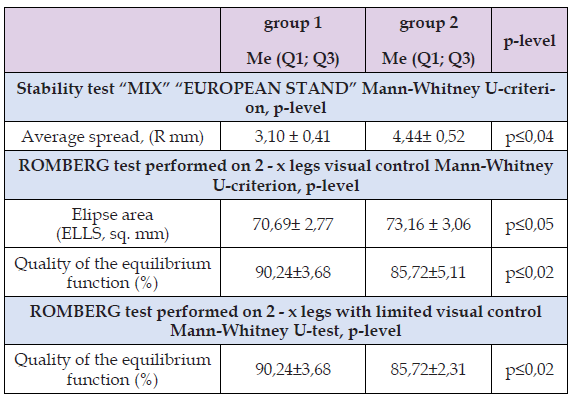
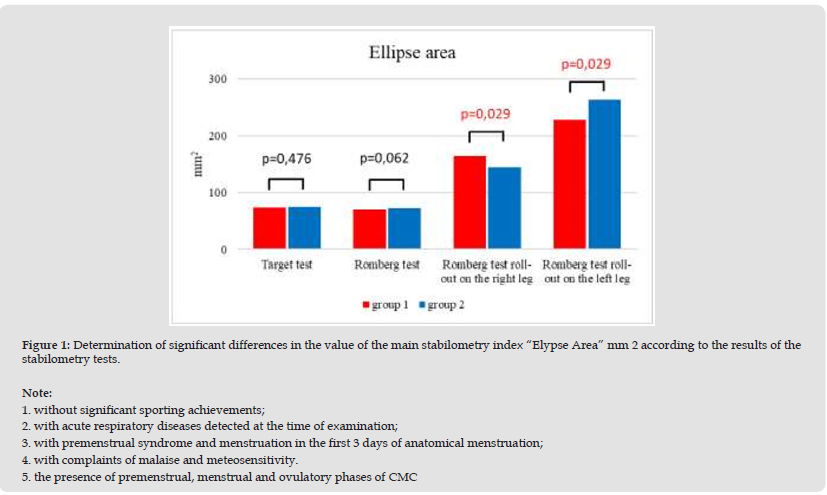
As can be seen from the data presented in Table 1, in the “Target” test with biofeedback and the “Romberg” test, performed on 2 - x legs with visual control and its limitation, reliable differences were observed in the indicators: “Average spread”, (R mm) and ‘Elipse area’ (ELLS, sq. mm) and its derivative - the indicator ‘quality of balance function’ (%). Trends were noted with respect to the indicators “Average velocity of movement of the center of pressure, (mm/s) and ‘Rate of change of statokinesiogram’ (sq. mm/s), however, no significant differences in these tests were found. The most informative test for identifying successful female figure skaters - singles, according to the data obtained by us, is the test “Stability in a specific imitation pose” - the “EXIT” stance, performed on the supporting leg with visual control and its limitation. When performing the imitation stance “Roll out” on the body of female athletes affected by complicated conditions of reducing the area of support and changes in afferentation in the absence of visual control while maintaining vertical balance. Such impact allows to judge the stability of the posture of the athlete through its ability to resist external forces that disturb the balance (Figure 1). Figure 1 reflects the presence of reliable differences in the main indicator of stabilometry “Area of elipse”, revealed by mathematical processing of the data in the test “Stability in imitation imitation stance ‘Roll out’”, performed by figure skaters on the supporting and fly legs. Similar differences are absent in the tests “Target” and “Stability in Romberg pose”, performed with visual control on 2 legs and separately on the fly and supporting legs. When performing the test tasks in difficult conditions of surface area limitation under visual control, clear advantages of vertical stability of g1 skaters revealed. An important indicator of the test, characterizing the postural stability of figure skaters, is the indicator “Area of confidence ellipse”, the smaller values of which were found in the figure skaters from g1. Reliable differences in the values of the following indicators found: “Average spread” and “Spread in frontal and sagital planes”, which emphasizes the smaller deviation of the CD in the corresponding planes and better vertical stability in the figure skaters from g1.
Figure 1
The figure skaters who take prizes at competitions note 2 times lower values of the index “Length of the trajectory of the center of pressure along the sagittal plane”, in comparison with g2 athletes. Single figure skaters from g1 have lower values of the following indicators in comparison with athletes from g2: “Average velocity of movement of the pressure center”, “Velocity of change of the statokinesigram area”, “Average linear velocity” and “Average linear velocity along the frontal and sagittal planes”, which determines a high degree of involvement of regulatory systems in the process of maintaining an upright posture and speaks about their normal work. Low values of the velocity of the center of pressure movement in g1 skaters are accompanied by significantly lower values of the indicator “Amplitude of variation of linear velocity”, which emphasizes a smaller displacement of CD to the sides and a more optimal state of bioelectrical activity of the central link of the postural system. When performing the test with the absence of visual control, both groups of female athletes perform worse on the task. Figure skaters from g1 noted lower values of the index “Amplitude of variation of angular velocity”, which indicates a smaller displacement of the CD. However, skaters from g2 have lower values of the indicator “Frontal plane spread”.
1. Among the tests characterizing the vertical stability of a person,
the test “Stability in imitation stance - ‘OUTPUT’, with
visual control, performed on the supporting and fly legs, has
the greatest informative value for the selection of skaters
successful in competitions. The test allows to reveal more
informative criteria of differences in the main indicators of
stabilometry and marks a high degree of their reliability.
2. Figure skaters who are successful in performing the content
of movement programs, according to the data of sports anamnesis,
have greater motor accuracy in performing mandatory
elements and note less severity of sports injuries, which
gives them the opportunity to recover faster after training
and competitions.

International Association of Landscape Archaeology, Czech Glass Society, Czech Republic

Department of Chemistry, Semenov Institute of Chemical Physics, USSR Academy of Sciences, Moscow, Russia

Neurology, LA BioMed Research Institute, USA

Associate Professor at Department of Breast and Thyorid Surgey, Chongqing General Hospital, China

Professor of Nuclear Medicine, Faculty of Medicine and Surgery, University of Milan, Milan, Italy





 Abstract
 PDF
PDF