info@biomedres.us
+1 (502) 904-2126
One Westbrook Corporate Center, Suite 300, Westchester, IL 60154, USA
Site Map
 ISSN: 2574 -1241
ISSN: 2574 -1241
ISSN: 2574 -1241
Received: April 24, 2025; Published: May 01, 2025
*Corresponding author: Juan Manuel Sánchez-Yáñez, Environmental Microbiology Laboratory,. Research Institute in Chemistry and Biology. B. B-3. University City, Universidad Michoacana de San Nicolás de Hidalgo. Francisco J Mujica S/N, Col. Felicitas del Rio, ZP 58030, Morelia, Michoacán, Mexico syanez@umich.mx
DOI: 10.26717/BJSTR.2025.61.009634
The phytopathogenic fungi Lasiodiplodia theobromae, Fomitiporia maxonii, Fusarium solani, Neofusicoccum mangiferae, and Phaeoacremonium sp. cause serious damage to fruit in Cuba. Therefore, effective chemical pesticides have been sought to control them, with the least negative impact on the fruit trees, the environment, and consumers. The objective of this study was to analyze the effect of the active ingredients of 16 fungicides of diverse chemical composition on these fungi isolated in Cuba from fruit trees with symptoms of dry branches, dieback, and defoliation. Triplicate assays were conducted in Petri dishes with H culture medium with the following fungicides: dimethomorp + mancozeb, fosetyl-aluminum, azoxystrobin, benomyl fludioxonil, chlorothalonil, propi- conazole, copper oxychloride, prochloraz, mancozeb, tebuconazole, propamocarb, pyraclostrobin metalaxyl + mancozeb, tebuconazole + prochloraz, and zineb. To determine mycelial inhibition of the phytopathogenic fungi, discs of the colonies were sown with: Fomitiporia maxonii IIFT-27 Fusarium solani IIFT-E62 Lasiodiplodia theobromae IIFT-E61 Neofusicoccum mangiferae IIFT-E15, Phaeoacremonium sp. IIFT-E20 were incubated in the dark at 27±1°C. The results show that the action of the active ingredients was evaluated by determining the colony diameter after seven days. The most effective active ingredients for inhibiting mycelial growth in vitro were: L. theobromae, benomyl, and fludioxonil; F. maxonii, chlorthalonil, propiconazole, fludioxonil, and tebuconazole + prochloraz; F. solani, prochloraz and tebuconazole + prochloraz; N. mangiferae, propiconazole, mancozeb, flu- dioxonil, tebuconazole + prochloraz, benymil, metalaxyl + mancozeb, and prochloraz; and for Phaeoacremoni- um sp., tebuconazole + prochloraz, fludioxonil, and prochloraz. The above demonstrates that some fungicides should be replaced with more effective fungicides for controlling fungal diseases in fruit trees. Plant protection programs should be restructured to optimize the application of these fungicides for the benefit of Cuban fruit growing.
Keywords: Fruit Trees; Fungicides; Lasiodiplodia; Fusarium; Fomitiporia; Neofusicoccum; Phaeoacremonium
Worldwide, fruit trees in humid tropical and subtropical climates are exposed to serious damage by phytopathogenic fungi of the genera: Colletotrichum corda, Fusarium link., and Lasiodiplodia (Pat.), as well as the oomycete Phytophthora (de Bary) with common pathogenic species in different fruit trees [1-5]. Plantations such as: Pouteria sapota (Jacq) (mamey) Moore and Stearn; Vitis vinifera (grape) Persea Americana Mill (avocado); kumquat Fortunella margarita (Lour.) Swingle) (kumquat) and (Mangifera indica Lin.) (mango) among many others, are seriously affected by these fungal agents in different countries [1-9], reason is why all of them require of chemical protection to avoid the great economic losses to fruit crops are exposed with these diseases. One of the most common fungi in citrus crops is Lasiodiplodia theobromae (Pat.) Griffon & Maubl., responsible for dieback in trees, lesions on stems, damage related to wood borers and inducer of post-rots. harvest in citrus fruits [10-12]. Likewise, other fruit trees such as mango, grapes and mamey are infected by Fusarium decemcellulare Brick [1-14], that is important in the deterioration of plantations. A study carried out in recent years refers to the symptoms, effects and impact of L. theobromae in current Cuban citrus cultivation [15], a serious problem for other fruit trees, if we take into account the high source of inoculum that these plantations represent, with a marked existence in dry branches affected by this fungus and other causes [3-8].
While Fomitiporia maxonii Murrill affects citrus fruits in Cuba [16], it reaffirms the criterion that in recent years the incidence of fungal diseases in these fruit trees has increased, with a notable negative impact. These fungi are joined by others such as Fusarium solani (Mart.) Sacc, from the F. solani species complex [17] and Colletotrichum gloeosporioides Penz, detected with high levels of incidence in most of the country's fruit trees, whose effects are a reason of concern [18], that currently makes it necessary to use agrochemical management to control and reduce the negative impact (10-12). For the case of Fomitiporia maxonii Murrill, Neofusicoccum mangiferae (Syd. & P. Syd.) Crous, Slippers & A.J.L. Phillips and Phaeoacremonium sp., the growing existence of these phytopathogens in plantations of different fruit trees [19] Einar and Perez Vicente in cocoa, makes them a growing and constant threat. This makes it necessary to search and evaluate fungicides with antifungal properties, to recommend the most efficient ones in the fight against these fungal diseases. The objective of this work was to analyze the in vitro effect of 16 chemical fungicides on the mycelial growth of: L. theobromae (Pat.) Griffon & Maubl., F. maxonii Murrill, F. solani (Mart.) Appel & Wollen, Neofusicoccum mangiferae (Syd. & P. Syd.) Crous, Slippers & A.J.L. Phillips and Phaeoacremonium sp detractors of fruit growing in Cuba.
To determine the in vitro effect of the active ingredients of the 16 selected fungicides as is shown in Table 1, the five aforementioned phytopathogenic fungi were used. Each fungicide was weighed separately on an analytical balance or measured in an automatic micropipette to have the mg or mL of commercial product (P C) required in each case. All of them were then suspended in 100 mL of distilled water containing each of the 16 250 mL Erlenmeyer flasks previously sterilized in an autoclave at 121ºC for 30 min, as well as the rest of the glassware and the H [15] culture medium without antibiotics. that was used in the test. On the surface of the H medium contained in groups of three Petri dishes (100 x 15 mm), one milliliter of the suspension of each fungicide was added at the concentration recommended by the manufacturer (Table 1). After five minutes, the excess of the suspension that was deposited in each of them was removed from each plate, as well as the water without fungicide in the three control plates. To evaluate the growth of each fungus on each of the plates, a disc of each colony (6 mm) was planted in the center of each of them and incubated at 27+1ºC in dark conditions [12]. The diameter of the colonies was measured in a cross diagonal after seven days of incubation. To evaluate growth inhibition, 6 mm of inoculum was subtracted from each plate. In all cases, the evaluations were done in triplicate, using three plates for each treatment and two repetitions of the phytopathogenic fungi selected for the study [12,15,20]. The fungi and strains selected for this study as is shown in Table 2, with isolated from fruit trees with symptoms of dry branches, dieback and defoliation, whose pathogenic power was proven and are kept in the mycological collection of the Phytopathology Laboratory of the Tropical Fruit Research Institute (IIFT), Havana, Cuba.
Table 1: Commercial names of the chemical fungicides, active ingredients and concentrations at which all them were evaluated in vitro against the five phytopathogenic fungi.

Table 2: Phytopathogenic fungi selected for the study, in Cuba Island.

Statistics Analysis
The premises of normality and homoscedasticity were verified for the treatment data for the application of the Simple Classification Analysis of Variance and the Tukey Test was used for multiple comparison of the means, P ≤ 0.05. The statistical program STATISTICA Version 6.0 [20] was used.
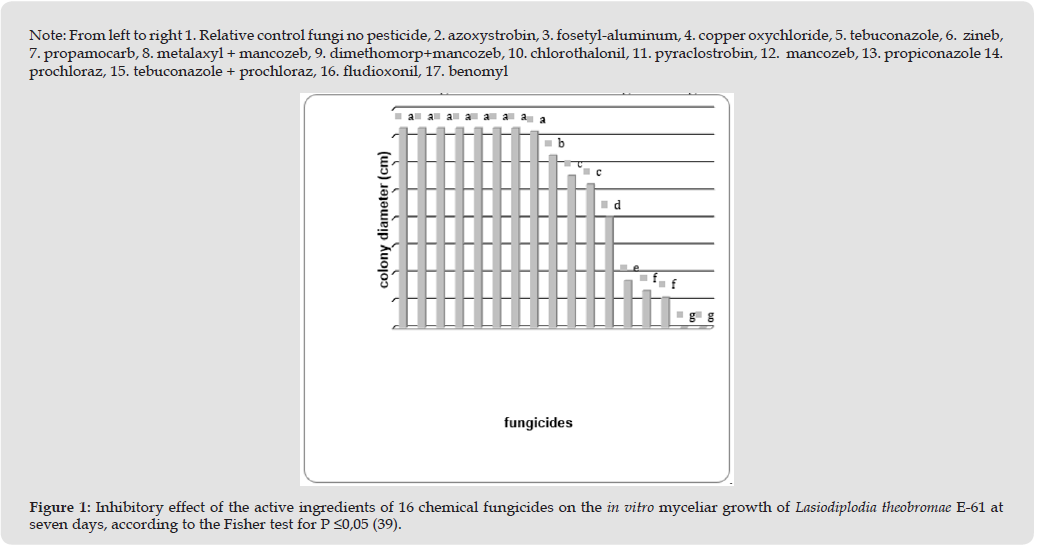
Figure 1 shows the effectiveness of the active ingredients of the 16 fungicides on the in vitro mycelial growth of the fungus L. theobromae. In this case benomyl and fludioxonil were the most effective, no statical differences between them for P ≤0.05, with a 100% inhibition of growth, followed by tebuconazole + prochloraz and prochloraz. The latter have no statistical differences between themselves but with the first two. On the contrary, the least effective active ingredients turned out to be: metalaxyl + mancozeb, propamocarb, azoxystrobin, tebuconazole, zineb, copper oxychloride and fosetyl - aluminum, all had no statistical differences between themselves compared to the control with the Petri dish with the phytopathogenic fungus without the fungicide. When analyzing how benomyl and fludioxonil, followed by tebuconazole + prochloraz and prochloraz, were the most effective active ingredients against L. theobromae as is shown on Figure 1 these results were similar to those reported by Ferrer, et al. [19] when they pointed out benomyl, prochloraz and tebuconazole + prochloraz as the most effective against this phytopathogenic fungi and it is taken into account that fludioxonil was not studied by these authors. The results of this study also coincide with those of Vargas [20] and Rondón, et al. [21] who stated that benomyl and prochloraz were effective in reducing the incidence of this fungi in mango cultivation.
Figure 1
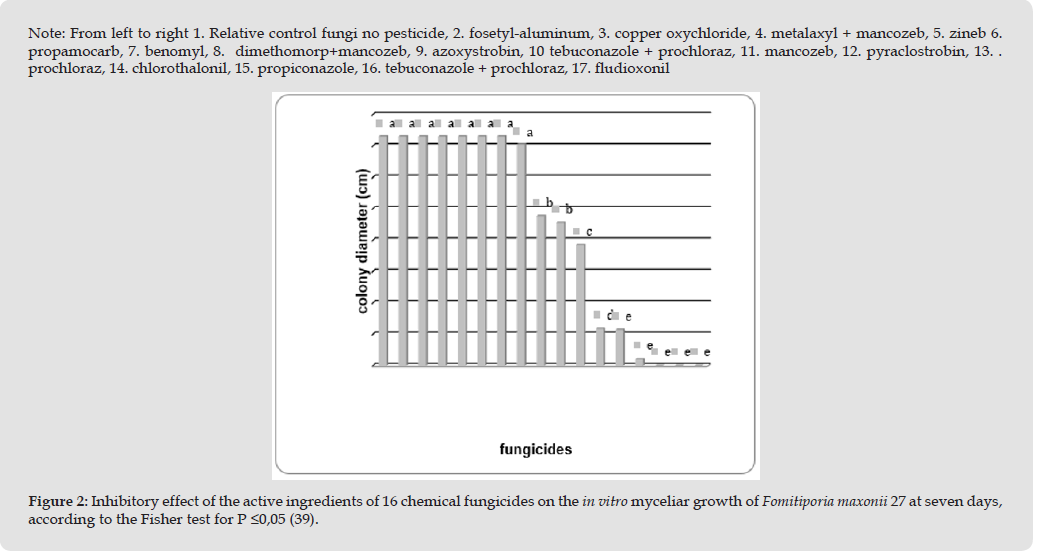
According to Torres, et al. [22], among the best active ingredients to inhibit both conidial germination and mycelial growth of Diplodia serieta De Not. and Diplodia mutila Fr., myclobutanil, prochloraz and prochloraz + epoxiconazole are found; they also reported out that a higher dose of these ingredients was needed to inhibit the conidial germination of these fungi than to reduce mycelial growth. The best active ingredients against in vitro mycelial growth of Fomitiporia maxonii at seven days were: fludioxonil, tebuconazole + prochloraz, propiconazole, chlorothalonil and prochloraz (Figure 2), no statical differences between them for P ≤0.05, and pyraclostrobin. that without differing from each other, in this sense did show statistical differences with the first four who managed to inhibit the mycelial growth of this fungi by 100%. The least effective active ingredients against this fungus were: dimethomorph + mancozeb; metalaxyl + mancozeb; propamocarb; benomyl; zineb; copper oxychloride and fosetyl-aluminum, all without significant differences between themselves and with the control. The results that were achieved against F. maxonii at seven days with tebuconazole + prochloraz; chlorothalonil; fludioxonil and propiconazole, followed by prochloraz and pyraclostrobin, coincide with those of Ferrer, et al. [19] when they pointed out that prochloraz and tebuconazole + prochloraz were the most effective against this fungus. Likewise, fosetyl-aluminum and copper oxychloride were again the least effective in reducing the mycelial growth of F. maxonii [19,21,22].
Figure 2
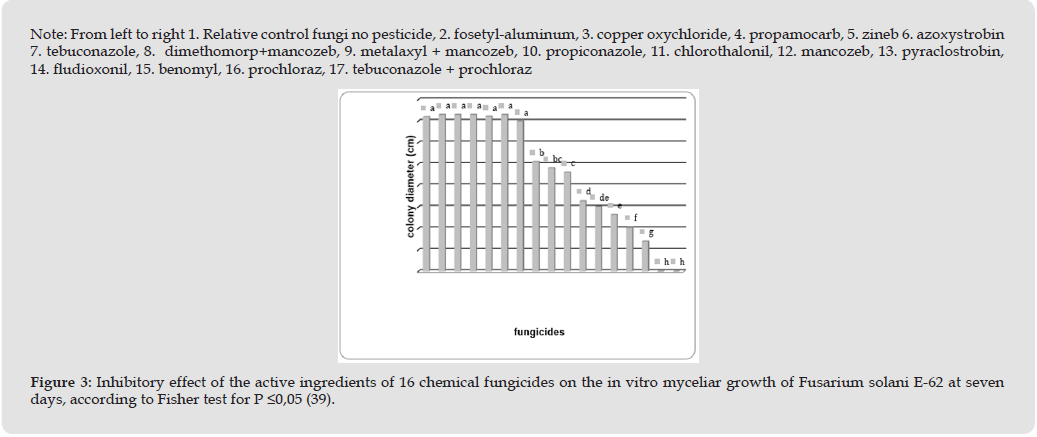
For F. solani, the most effective active ingredients to inhibit its mycelial growth in vitro at seven days were tebuconazole + prochloraz and prochloraz no statical differences between them for P ≤0.05, followed by benomyl and fludioxonil as is shown on Figure 3, these fungicides had statical differences s between these and with the first two, the only ingredients that inhibit the growth of the mycelium of these fungi by 100%. The least effective ingredients against F. solani were: azoxystrobin, fosetyl-aluminum, copper oxychloride, propamocarb, zineb and tebuconazole; not statical differences between themselves compared to the None had statistical differences between them only with the Petri dish control without pesticide only with the growth of the phytopathogenic fungi. The results achieved in the case of F. solani with tebuconazole + prochloraz and prochloraz, followed by benomyl and fludioxonil, coincide with those achieved by Ferrer, et al. [19] when they evaluated their action against Fusarium sp. The effectiveness of these active ingredients generally lies in its action at the level of tubulin in the cell, that prevents mitosis from taking place and thus the growth of the mycelium [23]. The least effective active ingredients against this fungi turned out to be: tebuconazole; zineb; copper oxychloride; azoxystrobin; fosetyl – aluminum and propamocarb, none had none had statistical differences between them only with the Petri dish control without fungicide with the growth of the phytopathogenic fungi tested [21,22,24].
Figure 3
For Neofusicoccum mangiferae, the most effective active ingredients to reduce the in vitro mycelial growth of this fungi, after seven days were: propiconazole; mancozeb; fludioxonil; tebuconazole + prochloraz; benomyl; metalaxyl + mancozeb and prochloraz, non-statical differences between them for P ≤0.05 (Figure 4), followed by tebuconazole and pyraclostrobin with statical differences between the latter and with the first seven, in this case only propiconazole; mancozeb, metalaxyl + mancozeb, tebuconazole + prochloraz and fludioxonil inhibited 100% of the mycelial growth of N. mangiferae [20]. In the opposite way the least effective active ingredients against this fungi were: fosetyl-aluminum; zineb; propamocarb and azoxystrobin, all non-statical differences between. The results achieved with prochloraz and tebuconazole coincide with those obtained by Torres, et al. [22], They pointed out, among other active ingredients, tebuconazole and prochloraz as the best to inhibit both conidial germination and mycelial growth of N. australe and N. parvum. Torres, et al. [22] also considered that a higher dose was required to inhibit the conidial germination of these fungi. Finally, in the case of the phytopathogenic fungi Phaeoacremonium sp., the best active ingredients with 100% inhibition of mycelial growth were: tebuconazole + prochloraz; fludioxonil and prochloraz as is shown on Figure 5), had not statistical differences between them for p ≤0.05.
Figure 4
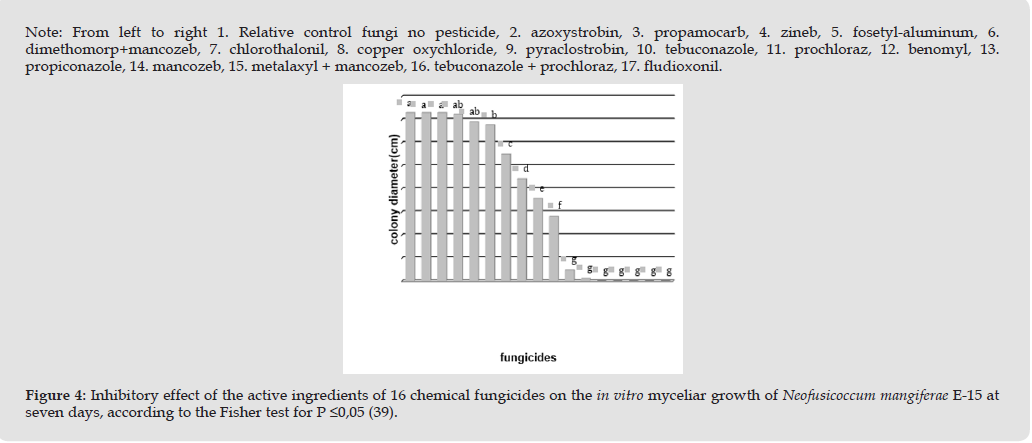
Figure 5

They were followed by benomyl and propiconazole, which did differ from each other and from the first three. The least effective active ingredients against this fungus were: fosetyl – aluminum; metalaxyl + mancozeb; zineb; propamocarb; azoxystrobin; tebuconazole and copper oxychloride, all without significant differences between themselves or with the control. According to Halleen, et al. [25], the active ingredients of the fungicides benomyl, imazalil, prochloraz and flusillasole, among others, were the most effective against fungal species belonging to the genus Cylindrocarpon, often associated with species of the genus Phaeoacremonium [18]. Although some active ingredients, such as fludioxonil, are registered on the Official List of Authorized Pesticides in Cuba [26] only for seed disinfection, there is evidence of their effectiveness primarily against the phytopathogenic fungi L. theobromae, F. maxonii, N. mangiferae [5,12], and Phaeoacremonium sp., [18] justifying their application in the chemical control of these fungal diseases in Cuban fruit trees [15,27-32]. However, it is necessary to validate the efficacy of each of these fungicides under field conditions in Cuban fruit production, in conjunction with environmental toxicological research [33-35], as well as their cost-benefit analysis. This provides solid support for the alternation of these fungicides with a wide variety of active ingredients to prevent the induction and selection of resistance in this range of phytopathogenic fungi associated with fruit production [36-38].
Based on in vitro results, the active ingredient with the greatest fungicidal efficacy in inhibiting mycelial growth of F. maxonii, F. solani, N. mangiferae, Phaeoacremonium sp, and to a lesser extent that of [39] L. theobromae, was prochloraz, that completely prevented the mycelial growth of these first four fungi [12-15]. In opposite way, propamocarb was the least effective in inhibiting the in vitro mycelial growth of the phytopathogenic fungi evaluated, a result similar to that reported by Ferrer, et al. [19], when they evaluated it against L. theobromae, F. maxonii, and Fusarium sp. Other active ingredients, such as tebuconazole, were not effective against the five phytopathogenic fungi evaluated [13,15]. However, it is recommended for field control of these fungi with other fungicides such as Supreme E W (13.3 + 26.7); has low antifungal effectiveness and should therefore be removed from the list for chemical control of diseases caused by these phytopathogenic fungi [25,27]. Based on the trials conducted in this research, it is proposed to avoid the application of fungicides with more than one active ingredient without first demonstrating the individual effectiveness of each against fruit tree diseases caused by these phytopathogenic fungi [32-34]. Generally, seven days after the in vitro trial, supported by statistical analysis of the genera and species of phytopathogens: L. theobromae, F. maxonii, F. solani, N. mangiferae, and Phaeoacremonium sp.
Among the different fungicides evaluated in vitro, the most effective active ingredients in inhibiting mycelial growth of the phytopathogens were tebuconazole + prochloraz, prochloraz, and fludioxonil, followed by propiconazole and benomyl [22,27,36,37]. However, the ineffective ones were propamocarb, zineb, copper oxychloride, azoxystrobin, fosetyl aluminum, tebuconazole, dimethomorph + mancozeb, and metalaxyl + mancozeb [33,35]. A global analysis of the in vitro effect of the active ingredients that were tested showed that practically around 50% of these have no or very little action on the development of their mycelia [26]. This makes it crucial to know the effectiveness of each fungicide, according to its chemical composition, before proceeding to its use as a way to avoid costly ecological, economic and social effects [25,27,37]. These results coincide with those obtained by Ferrer, et al. [19], this research showed that of the 16 active ingredients tested against L. theobromae, F. maxonii and Fusarium sp only about four or five which ones, of these showed marked effectiveness against these fungi [14,19,22]. The results obtained demonstrate the possibility of using the most efficient active ingredients against the main phytopathogenic fungi active in Cuban fruit growing as responsible for dead plants [20-24], provided that these are validated in the field among other studies and the use is approved by the National Registry of Pesticides from Cuban government [25,37], of those that require it. In this sense, it should be noted that all the fungicides tested, with the exception of Funchloraz, are authorized in the list of authorized fungicides.
Another issue to take into account is the way in that the fungi came into contact with the active ingredients of each fungicide [19,25]. The methodology tested in this work is one of those that most simulates what happens in practice, when a fungicide is applied and the product remains in a solid-gas interface, just as it happens on the surface of a leaf or a fruit [19,21,22,26]. This method the poisoned medium method, widely used for these tests [14,19,21,22,26]. There is no scientific publication that says that what the reviewers say is possible, regarding this there are negative criteria, since it is proposed that the agar can function as a chelate that masks the particles of the active ingredient and the fungus can grow without coming into contact with it [19-22]. There is no argument to say that the concentration varies and, in any case, if we talk about doses, it would be the same for each Petri dish, when removing the excess liquid [21,22]. It must be taken into account that in practice, the same thing happens on the leaf, the product also penetrates [24,25]. In any case, in vitro tests with fungicides allow obtaining an indirect estimate of the practical value of the product [26-31], ignoring the interferences inherent to field experiments [25,32]. While the major problems that exist in achieving good effectiveness when applying a fungicide [21,22], is the fact that there is not always a precise diagnosis of the phytophagic fungi agent or agents to be controlled, since the same active ingredient is not the more efficient in all cases [24-27]. This was demonstrated, for example, in the present study, where benomyl was effective against L. theobromae and not against F. maxonii [27] something also demonstrated by Ferrer, et al. [19]. For benomyl this is of interest since it has been described with some tendency to select races resistant to fungicides [26,27]. Resistance to fungicides is a first example of adaptation of a population to environmental changes, also known as evolutionary rescue [27]. Despite the demonstrated effectiveness of some active ingredients in inhibiting the mycelial growth of phytopathogenic fungi, several works [28-30] recommended efficient pruning and adequate cultural care to reduce the incidence of fungal diseases criterion that is shared by the authors [25,27,32].A product that is effective in vitro will not necessarily be effective in the field since factors such as degradability, persistence, etc [27,32] influence its performance, however, if a product is not useful in vitro, it will hardly be useful in the field.
• It was found that the most effective active ingredients in inhibiting mycelial growth in vitro were: L. theobromae, benomyl and fludioxonil; F. maxonii, chlorothalonil, propiconazole, fludioxonil and tebuconazole + prochloraz; F. solani, prochloraz and tebuconazole+ prochloraz; N. mangiferae, propiconazole, mancozeb, fludioxonil, tebuconazole + prochloraz, benimil, metalaxyl + mancozeb and prochloraz and for Phaeoacremonium sp, tebuconazole + prochloraz, fludioxonil and prochloraz.
• The most effective active ingredients in vitro against the main phytopathogenic fungi present in Cuban fruit growing were identified as: tebuconazole + prochloraz, prochloraz and fludioxonil, generally followed by propiconazole, benomyl, in opposite way, the least effective ones turned out to be: propamocarb, zineb, copper oxychloride, azoxystrobin, fosetyl-aluminum, tebuconazole, dimethomorph + mancozeb and metalaxyl + mancozeb.
Extend in vitro tests to conditions of experimental plots and fruit plantations.
This work was funded by the Fruit Business Group (GEF) through the project “Study of fungi diseases and new strategies for their management in fruit trees of greatest economic importance”, code 2001. The authors would like to thank the MSc. Eduardo Canales for the support in some documentation of interest. To the Coordinación de Investigación Científica de la UMSNH “Aislamiento y selección de microrganismos endófitos promotores de crecimiento vegetal para la agricultura y biorecuperacion de suelos” from the Research Project (2025), Universidad Michoacana de San Nicolas de Hidalgo, Morelia, Michoacán, México.
The authors declare that there is no type of conflict of interest in its planning, execution and writing with the institutions involved, as well as those that financially supported this research.

International Association of Landscape Archaeology, Czech Glass Society, Czech Republic

Department of Chemistry, Semenov Institute of Chemical Physics, USSR Academy of Sciences, Moscow, Russia

Neurology, LA BioMed Research Institute, USA

Associate Professor at Department of Breast and Thyorid Surgey, Chongqing General Hospital, China

Professor of Nuclear Medicine, Faculty of Medicine and Surgery, University of Milan, Milan, Italy





 Abstract
 PDF
PDF



























