info@biomedres.us
+1 (502) 904-2126
One Westbrook Corporate Center, Suite 300, Westchester, IL 60154, USA
Site Map
 ISSN: 2574 -1241
ISSN: 2574 -1241
ISSN: 2574 -1241
Received: April 21, 2025; Published: April 29, 2025
*Corresponding author: Abdol Ghaffar Ebadi, Department of Agriculture, Jo.C, Islamic Azad University, Jouybar, Iran
DOI: 10.26717/BJSTR.2025.61.009628
Neuroimmune interfacing is a paradigm-breaking concept for how the central nervous system (CNS) communicates with the immune system to deliver homeostasis and respond to pathologic stimulation. Once considered to be immunologically privileged, the CNS is presently known to be highly interactive with innate and adaptive immune systems. Neuroimmune communication involves molecular signaling by cytokines, chemokines, neurotransmitters, and cellular interactions that modulate inflammation and neuroprotection. Recent advances in imaging and omics technology have unraveled complex signaling pathways demonstrating bidirectional communication between microglia, astrocytes, neurons, and peripheral immune cells. These interactions are crucial in the regulation of neuroinflammatory responses, pathogen clearance, and repair processes, and are also implicated in chronic neurological diseases.
Keywords: Neuroimmune Crosstalk; CNS Inflammation; Microglia; Neurodegeneration; Immune Modulation
Abbreviations: CNS: The Central Nervous System; AD: Alzheimer’s Disease; PD: Parkinson’s Disease; MS: Multiple Sclerosis; BBB: Blood-Brain Barrier; NSAIDs: Non-Steroidal Anti-Inflammatory Drugs
The central nervous system (CNS) was once considered an immune- privileged compartment, distinct from the peripheral immune system. Recent research has, however, uncovered a dynamic and intricate dialogue between the nervous and immune systems, referred to as neuroimmune crosstalk. This two-way crosstalk involves a variety of cell types, including neurons, microglia, astrocytes, and peripheral immune cells, and is facilitated by cytokines, chemokines, neurotransmitters, and other mediators. Microglia, the resident immune cells of the CNS, are key to detecting and reacting to disease signals, while astrocytes assist in maintaining homeostasis and regulating immunity. These cells themselves can influence immune function via the secretion of neuropeptides and other regulators of glial cell activity. This precise balance enables the CNS to produce a proper response to infection and damage and also facilitate neural function. This homeostasis compromised might lead to recurrent inflammation and disease pathogenesis in a multitude of neurological disorders (Pierson, et al. [1])
Neuroimmune Mechanisms in Disease Pathogenesis
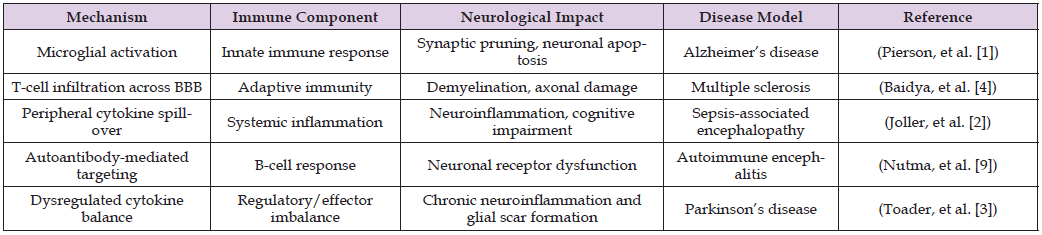
In disease states, the protective and destructive neuroimmune responses tend to be unbalanced. Activation of microglia and astrocytes on a chronic basis results in the excessive production of pro-inflammatory cytokines like IL-1β, TNF-α, and IFN-γ that amplify neuronal damage and lead to neurodegeneration. Alzheimer’s disease, Parkinson’s disease, and multiple sclerosis are examples of how immune dysregulation contributes to disease progression (Joller, et al. [2]). In Alzheimer’s, for instance, amyloid-β plaques trigger innate immune responses that propagate a cycle of inflammation and neuronal damage. Similarly, in multiple sclerosis, autoreactive T cells cross the blood-brain barrier and kill myelin, resulting in demyelination. Understanding such pathogenic processes is key to identifying new targets and biomarkers for therapy (Table 1).
Table 1: Neuroimmune Mechanisms and Their Implications in Major CNS Disorders.
Immune Cell Infiltration and CNS Autoimmunity
Peripheral immune cells, like T cells, B cells, and monocytes, can migrate into the CNS during certain pathological processes and result in autoimmune and inflammatory diseases. Destruction of the bloodbrain barrier is a prerequisite process to allow such invasions. Th17 and Th1 cells invade the CNS during multiple sclerosis and enact an inflammatory cascade leading to oligodendrocyte death and demyelination. Similarly, in neuromyelitis optica spectrum disorders, aquaporin- 4 antibodies induce complement-dependent astrocyte damage. Infiltrating macrophages augment the inflammatory microenvironment, often synergizing with resident microglia. Such mechanisms illustrate the complexity of immune cell behavior within the CNS and underscore the requirement for precise immune modulation (Joller, et al. [2]).
New Neuroimmune Therapeutics
Therapeutic measures targeting neuroimmune interactions are rapidly evolving. Monoclonal cytokine antibodies (such as anti-IL-6, anti-TNF-α) have proven to be promising in the modulation of neuroinflammation in preclinical and clinical models. Immune checkpoint inhibitors and tolerogenic vaccines are also being explored to restore immune tolerance in autoimmune CNS disorders. Stem cell therapies and gene editing technologies (such as CRISPR-Cas9) offer new opportunities to manipulate immune cell function and suppress neuroinflammatory responses. Small molecule microglial activational targets, such as P2X7 receptor antagonists, have also revealed potential in neurodegenerative disease animal models. These emerging therapies demonstrate therapeutic potential of neuroimmune modulation (Toader, et al. [3]).
Challenges and Future Prospects
While exciting progress has occurred, several issues remain in deriving clinical therapies from neuroimmune work. The lack of consistency across individuals and across stages of different diseases complicates therapeutic targeting. In addition, the CNS introduces unique drug delivery challenges due to the limited character of the blood-brain barrier. Biomarker identification for detecting early disease and monitoring of therapy response is only beginning. Individualized medicine approaches, integrating genomics, proteomics, and neuroimaging to tailor treatments, are in the forefront of future investigation. Moreover, ethical considerations and extended safety data on immune-modulating therapies need careful evaluation.
Neuroimmune Crosstalk in Neurodegenerative Diseases
Neurodegenerative diseases such as Alzheimer’s disease (AD) and Parkinson’s disease (PD) are characterized by gradual neuronal loss and cognitive impairments. Recent studies have highlighted the central role of neuroimmune interactions in the pathogenesis of these diseases. In AD, Aβ plaque deposition induces microglial activation, release of pro-inflammatory cytokines that enhance neuronal damage. Similarly, in PD, aggregates of α-synuclein stimulate microglial activation responsible for chronic inflammation and loss of dopaminergic neurons. Understanding such interactions provides insight into potential therapeutic targets acting on immune regulation to avert or attenuate disease progression (Baidya, et al. [4]).
Peripheral Immune Impact on CNS Function
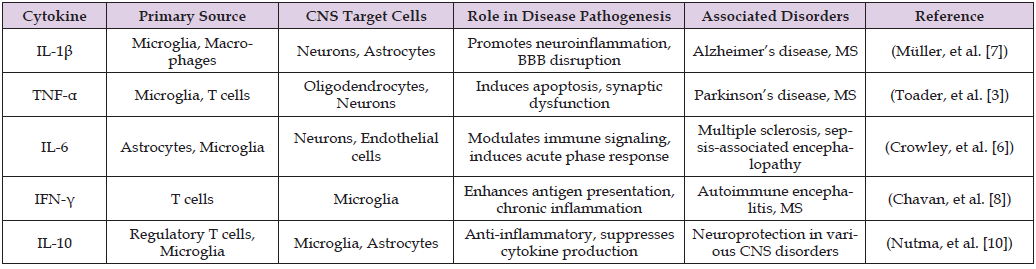
The central nervous system (CNS) is not free from the effects of peripheral immunity. Peripheral immune cells can infiltrate the CNS in pathological states to augment neuroinflammation. For instance, in multiple sclerosis (MS), autoreactive T cells cross the blood-brain barrier to cause demyelination and neuronal damage. Besides, systemic inflammation or infection impacts CNS function, such as in sepsis- associated encephalopathy where peripheral cytokines modulate brain function without direct infection. These observations underscore the importance of systemic immune status for CNS disease and health (Prinz, et al. [5]). The blood-brain barrier (BBB) is a critical CNS-peripheral circulation interface that regulates the entry of immune cells and molecules. BBB integrity is compromised in numerous neurological conditions, and this allows peripheral immune cells to invade the CNS. Disruption of this breach can lead to exacerbated neuroinflammation, for example, in MS and neuromyelitis optica. Therapeutic strategies to preserve or repair BBB function are being explored to prevent neuroimmune-mediated damage (Table 2).
Table 2: Key Cytokines Involved in Neuroimmune Crosstalk and Their Roles in CNS Pathologies.
Therapeutic Modulation of Neuroimmune Interactions
Targeting the neuroimmune interactions offers promising therapeutic avenues for CNS disorders. Anti-inflammatory therapies, such as non-steroidal anti-inflammatory drugs (NSAIDs), have been investigated for their ability to regulate neuroinflammation (Crowley, et al. [6]). Biologic therapies targeting a particular cytokine, such as TNF-α inhibitors, are under development in neurodegenerative disease (Müller, et al. [7]). Therapies targeting the modulation of microglia activation states to induce pro-inflammatory to anti-inflammatory phenotype switching are also being developed. These therapies aim to restore immune homeostasis within the CNS and minimize secondary neuronal damage (Chavan, et al. [8]).
Future Research Directions in Neuroimmune Science
Advances in neuroimaging and molecular biology techniques are refining our understanding of neuroimmune interactions. Single-cell RNA sequencing enables us to establish the heterogeneity of immune cell populations within the CNS and disclose their roles in health and disease (Nutma, et al. [9]). Furthermore, the development of in vitro models such as organoids offers systems to study neuroimmune dynamics in controlled settings. Next-generation research must elucidate the spatial and temporal dynamics of neuroimmune interactions, identify biomarkers for early onset diagnosis, and develop targeted therapies to modulate immune responses in CNS disease (MacKenzie, et al. [10]; Ebadi and Zelamoglu, [11]; Ebadi, et al. [12]; Ebadi and Selamoglu, [13]; Ebadi, [14]).
Neuroimmune crosstalk is at the core of maintaining central nervous system (CNS) homeostasis but also in enhancing the pathogenesis of most neurological and neurodegenerative diseases. The interdynamic interaction between neural and immune components regulates defense reactions against intruding pathogens and neuroinflammatory reactions which, if not well regulated, will result in conditions such as multiple sclerosis, Alzheimer’s disease, Parkinson’s disease, and chronic neuroinflammation. Appreciation of cellular and molecular mechanisms that orchestrate these interactions—particularly microglia, astrocyte, peripheral immune cell, cytokine signaling, and immune checkpoint interactions—has the promise to uncover new therapeutic avenues. Immunomodulatory methods that control finer than absolutely abolishing immune activity may prevent neurotoxicity without diminishing vital protective mechanisms. Furthermore, advances in neuroimaging, single-cell sequencing, and biomarker research are enhancing our ability to monitor immune responses within the CNS more accurately. The tools will be essential for developing personalized therapies and early intervention strategies. As increasingly more of the complexity of neuroimmune communication is revealed through investigation, transdisciplinary strategies integrating neurology, immunology, and biotechnology will be essential. Ultimately, this expanding knowledge base will probably transform clinical management strategies, improve patient outcomes, and open up new therapeutic possibilities for the treatment of otherwise intractable neuroimmune-mediated diseases.

International Association of Landscape Archaeology, Czech Glass Society, Czech Republic

Department of Chemistry, Semenov Institute of Chemical Physics, USSR Academy of Sciences, Moscow, Russia

Neurology, LA BioMed Research Institute, USA

Associate Professor at Department of Breast and Thyorid Surgey, Chongqing General Hospital, China

Professor of Nuclear Medicine, Faculty of Medicine and Surgery, University of Milan, Milan, Italy





 Abstract
 PDF
PDF



























