info@biomedres.us
+1 (502) 904-2126
One Westbrook Corporate Center, Suite 300, Westchester, IL 60154, USA
Site Map
 ISSN: 2574 -1241
ISSN: 2574 -1241
ISSN: 2574 -1241
Received: April 23, 2025; Published: April 29, 2025
*Corresponding author: Abdol Ghaffar Ebadi, Department of Agriculture, Jo.C, Islamic Azad University, Jouybar, Iran
DOI: 10.26717/BJSTR.2025.61.009627
Precision agriculture uses biotechnological innovations to enhance crop productivity and sustainability and can influence human health. Genetically modified crops, microbial biofertilizers, and controlled-environment agriculture reduce pesticide reliance and improve nutritional value. However, unintentional exposure to modified plant metabolites, recalcitrant agrochemicals, and destabilized soil microbiomes may impact food safety and public health. This mini-review covers the double-edged impacts of precision agriculture on human biology, focusing on micronutrient bioavailability, chronic disease risk modulation, and microbiota modulation through diet. Utilization of omics-based technologies for crop engineering is viewed for the development of nutritionally fortified and hypoallergenic foods. Risk assessment models and policy recommendations are also examined for adoption safety. In connecting agrifood biotechnology to biomedical outcomes, this review emphasizes the need for an interdisciplinary approach in food-health-environment interactions.
Keywords: Precision Agriculture; Biotechnology; Nutritional Health; Microbiome; GMOs
Abbreviations: PA: Precision Agriculture; GPS: Global Positioning Systems; GIS: Geographic Information Systems; VRT: Variable Rate Technology; UAVs: Unmanned Aerial Vehicles; GM: Genetically Modified; GMOs: Genetically Modified Organisms; EFSA: European Food Safety Authority; FDA: Food and Drug Administration
Precision agriculture (PA) refers to the application of advanced technological solutions to optimize field-level management of crop production. The core idea is the delivery of the right input, at the right time, in the right amount, and to the right location, thereby maximizing productivity, sustainability, and resource efficiency. Technologies such as global positioning systems (GPS), geographic information systems (GIS), variable rate technology (VRT), and unmanned aerial vehicles (UAVs) facilitate real-time monitoring and targeted interventions. Soil- and plant-based sensors detect moisture, nutrient levels, and crop health and transmit the information into AI-based algorithms that guide decision-making. These technologies reduce input waste, decrease environmental impact, and maximize yields. In addition, remote sensing and satellite imagery enable farmers to determine crop stress and disease outbreaks at an early stage, allowing responses in a timely manner. With PA maturing, it aligns more and more with the tenets of sustainable agriculture and food security (Ebadi, et al. [1-6])
Contemporary agricultural biotechnology goes beyond yield increase to encompass the enhancement of human health. Crop biofortification with essential micronutrients such as iron, zinc, and vitamin A by genetic modification is a milestone towards eliminating global malnutrition. Beta-carotene-enriched Golden Rice is a great example of the contribution PA and biotech technologies can make towards combating vitamin A deficiency. Furthermore, genetically modified (GM) crops with higher tolerance to pests and diseases reduce the application of chemical pesticides, thereby reducing the risk of exposure to hazardous agrochemicals to farmers and consumers. Transgenic crops can even be utilized in the production of edible vaccines, offering a new avenue for prophylactic medicine. In the broadest sense, agricultural biotechnology with a health focus is redrawing the intersection point of agriculture and medicine, highlighting the need for integrated policy and research strategies combining food production and public health factors (Zare, et al. [6-8]).
Agricultural use of biotechnology raises pertinent questions about its nutritional and toxicological effects. Even though the nutritional content of biofortified foods seems to have the potential to reduce micronutrient deficiency, there remain concerns regarding allergenicity and unintended effects of transgenic modification. Furthermore, reduced pesticide use by biotechnology interventions does not entirely eliminate residual toxicity risk due to other agrochemicals. Chronic exposure to such toxins has been implicated in a series of diseases like endocrine disruption, carcinogenicity, and neurotoxicity. In addition, genetic alteration of food content can impact gut microbiota and metabolism but with long-term studies required to confirm such impacts. Thus, an intensive toxicological assessment process, including short- and long-term health tests, is mandatory before large-scale production of biotech crops.
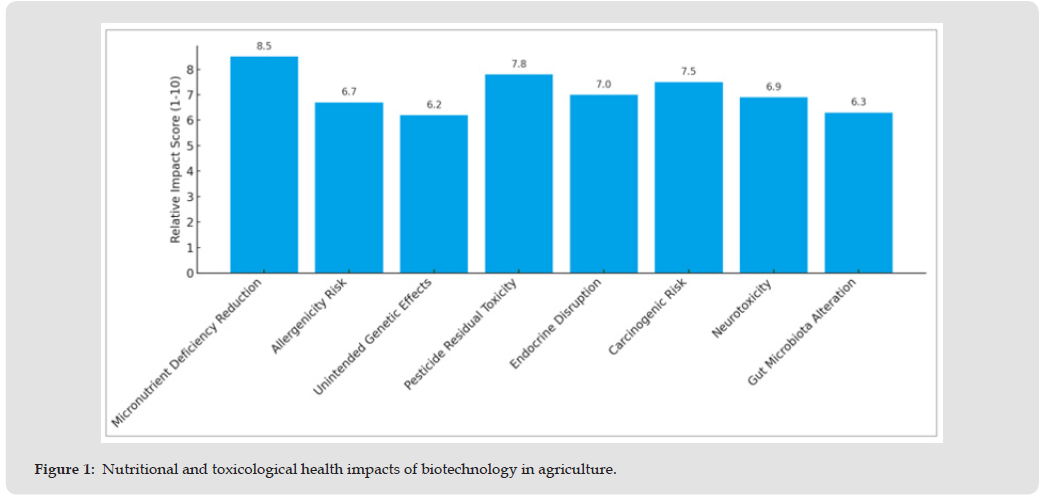
Perception and trust on the part of the public regarding genetically modified organisms (GMOs) are also essential and must be addressed through transparent communication and regulation (Xu, et al. [9,10]). The Figure 1 graphically portrays significant health-associated impacts—favorable and perhaps adverse—attributable to the agricultural use of biotechnology. It depicts the manner in which biofortified crops can reduce micronutrient deficiency (high score), alongside other issues such as allergenicity, genetic modification, and residual pesticide toxicity, each representing varying levels of health importance. This relative visualization is important for policymakers, academics, and the public to weigh the benefits against potential dangers and highlights the need for robust safety reviews and transparency.
Figure 1
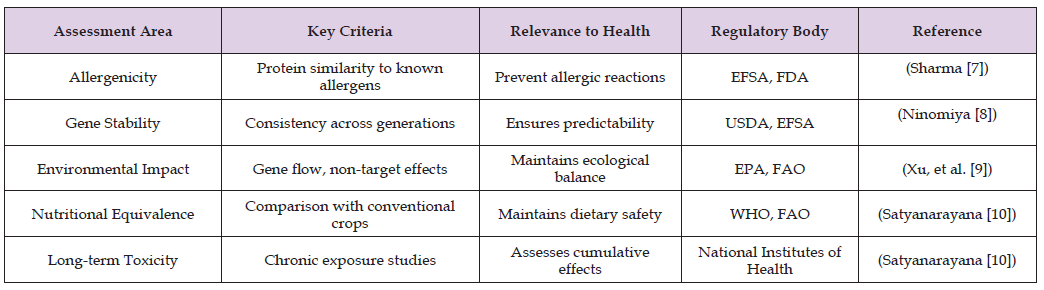
Robust risk assessment models must balance the benefits and potential risks of biotech-based precision farming. Regulators such as the European Food Safety Authority (EFSA) and the United States Food and Drug Administration (FDA) have set standards for evaluating the safety of transgenic plants. The standards include determination of gene stability, allergenicity, environmental risk, and nutritional value. Yet, regulatory landscapes vary very considerably across countries and tend to reflect cultural and political attitudes to biotechnology. A science-informed evidence-based global harmonization would facilitate worldwide trade and enhance safety assurance. There is poor technical capacity for application of biosafety measures among developing nations and additional challenges created thereby. Besides, intellectual property rights issues involved with patented biotechnologies lead to issues surrounding access and equity, particularly to smallholder farmers. Innovative models of collaborative governance in the public-private partnership mode can facilitate inclusive innovation and ensure regulatory systems that incorporate technological progress and the public good based on Table 1 (Cheng, et al. [11-13]).
Table 1: Risk assessment considerations for agricultural biotechnologies.
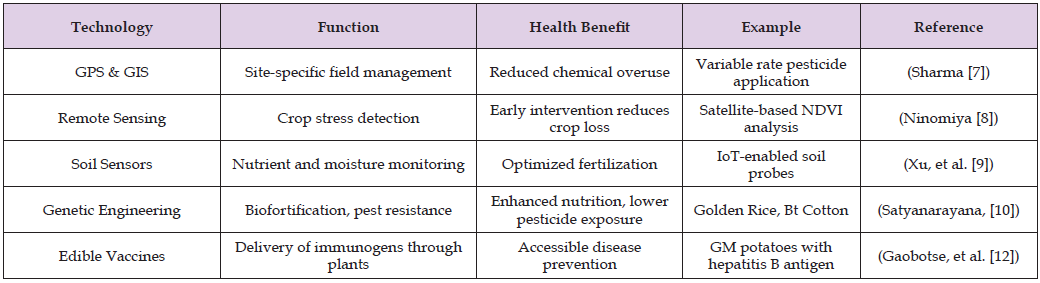
As agriculture, nutrition, and health are interlinked, integrative policies have become a growing necessity to bridge the gap between agronomic intervention and biomedical result. Agri-biomedical convergence envisions a policy space where agricultural innovation is evaluated not just for yield or financial gains, but also for the implications on human health and disease avoidance. Inter-sectoral partnership among ministries of agriculture, health, environment, and education can foster comprehensive approaches to policy-making. For example, promoting the development of nutrient-rich crops and reducing pesticide application aligns agricultural and health goals. Furthermore, data convergence from surveillance systems in agricultural monitoring systems and health can define patterns and inform interventions. Synergized with biomedicine, precision agriculture can potentially generate strong food systems that feed populations and reduce the disease burden (Table 2). Policy coherence, stakeholder involvement, and translational research will be drivers toward realizing the vision of sustainable, health-oriented agriculture in the future (Wang, et al. [14-16]).
Table 2: Technological tools in precision agriculture and their health implications.
Precision agriculture, driven by biotechnology, promises to improve not only crop yield but also human health. With biofortified foods to reduced pesticide exposure, its advantages are diverse; they are, however, accompanied by subtle challenges in the form of possible toxicological impacts, changes in the microbiome, and socio- regulatory issues. Equilibrium is vital to ensure that biotechnological progress in agriculture translates into secure, equitable, and health-directed food systems: it must rest on stringent risk assessment, cross-disciplinary synergies, and integrative policy.

International Association of Landscape Archaeology, Czech Glass Society, Czech Republic

Department of Chemistry, Semenov Institute of Chemical Physics, USSR Academy of Sciences, Moscow, Russia

Neurology, LA BioMed Research Institute, USA

Associate Professor at Department of Breast and Thyorid Surgey, Chongqing General Hospital, China

Professor of Nuclear Medicine, Faculty of Medicine and Surgery, University of Milan, Milan, Italy





 Abstract
 PDF
PDF



























