info@biomedres.us
+1 (502) 904-2126
One Westbrook Corporate Center, Suite 300, Westchester, IL 60154, USA
Site Map
 ISSN: 2574 -1241
ISSN: 2574 -1241
ISSN: 2574 -1241
Received: April 21, 2025; Published: April 29, 2025
*Corresponding author: Kiouah Abdelhak, Rhode dental clinic, Rhodes saint genese in Belgium, Belgium
DOI: 10.26717/BJSTR.2025.61.009626
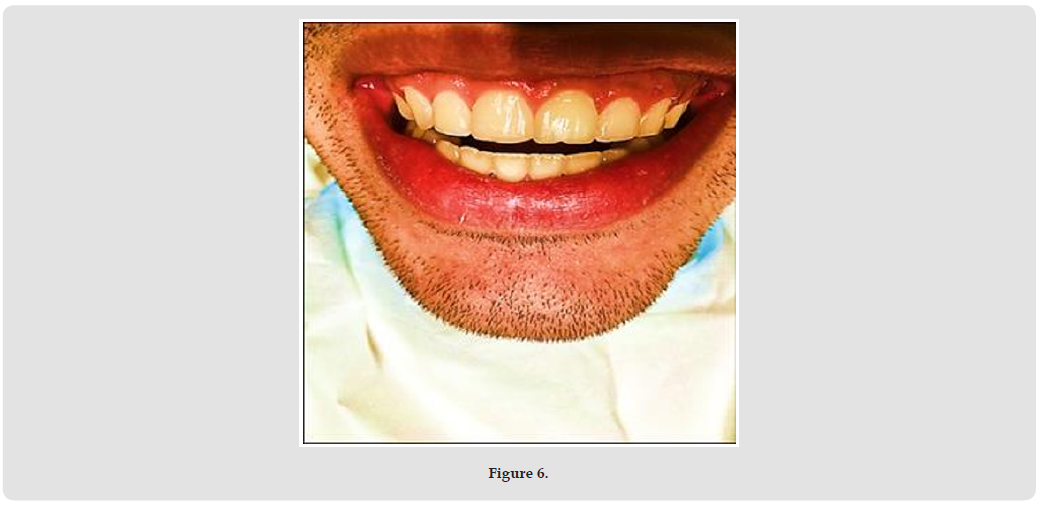
Tooth discoloration of endodontic origin can be a major aesthetic concern, especially among young patients. Internal bleaching provides a minimally invasive solution. This case report presents the successful management of a pink discoloration of a maxillary central incisor following dental trauma, using internal bleaching with sodium perborate. The treatment yielded excellent aesthetic results within three weeks and avoided more invasive restorative options.
Facial aesthetics have become an integral aspect of personal well-being, and the smile plays a crucial role in social interactions. Teeth, being central to a smile, significantly affect perceived beauty. Among the various aesthetic dental treatments, bleaching is the least invasive method to improve tooth shade [1-5]. Bleaching can be external— using hydrogen peroxide gels and custom trays—or internal, performed in non-vital teeth using sodium perborate introduced into the pulp chamber.
An 18-year-old male presented to the dental clinic with a concern about a pinkish-red discoloration of his left maxillary central incisor (tooth 21), which he noticed after orthodontic appliance removal. Upon questioning, the patient recalled a traumatic fall at the age of 12 resulting in a minor enamel fracture on the incisal edge of the same tooth.
Clinical examination and a periapical radiograph revealed:
- Negative response to vitality testing
- Negative percussion and palpation tests
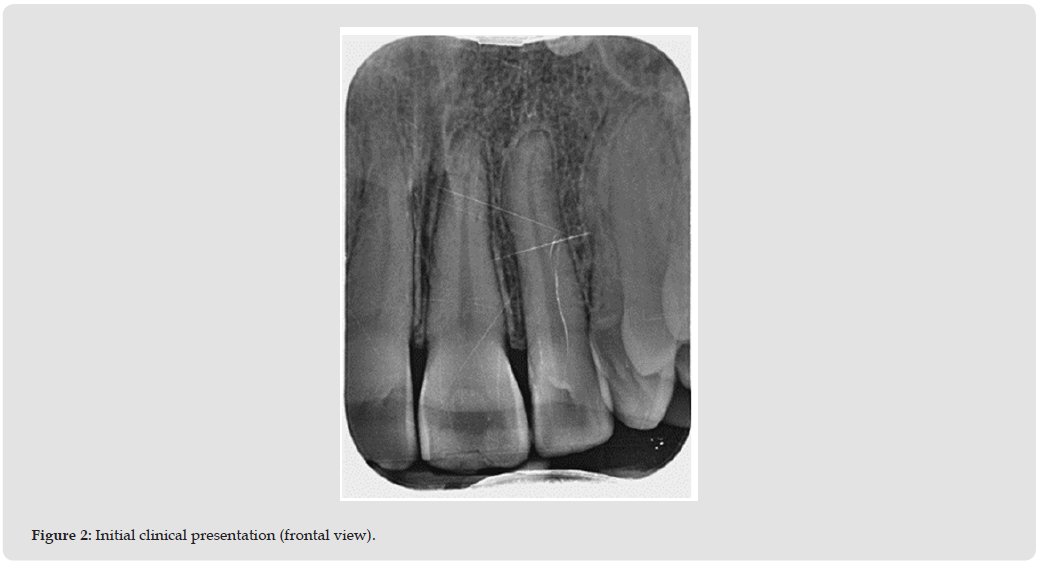
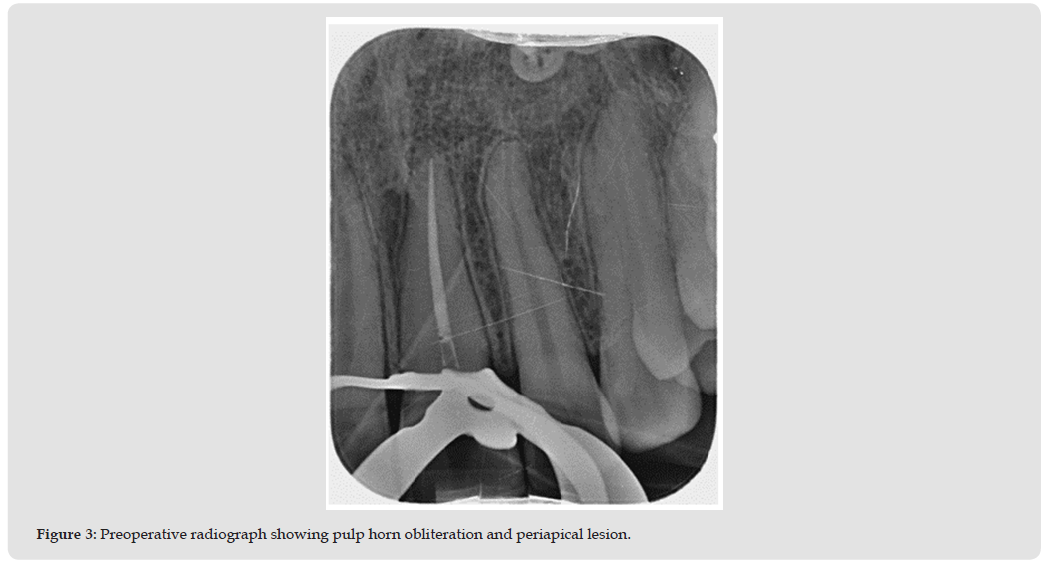
- Apical radiograph showed pulp horn obliteration and an incipient periapical lesion (Figures 1 & 2).
These findings confirmed pulp necrosis and suggested hemorrhagic degradation products (hemoglobin breakdown) as the origin of the pink discoloration [6-10].
Figure 1
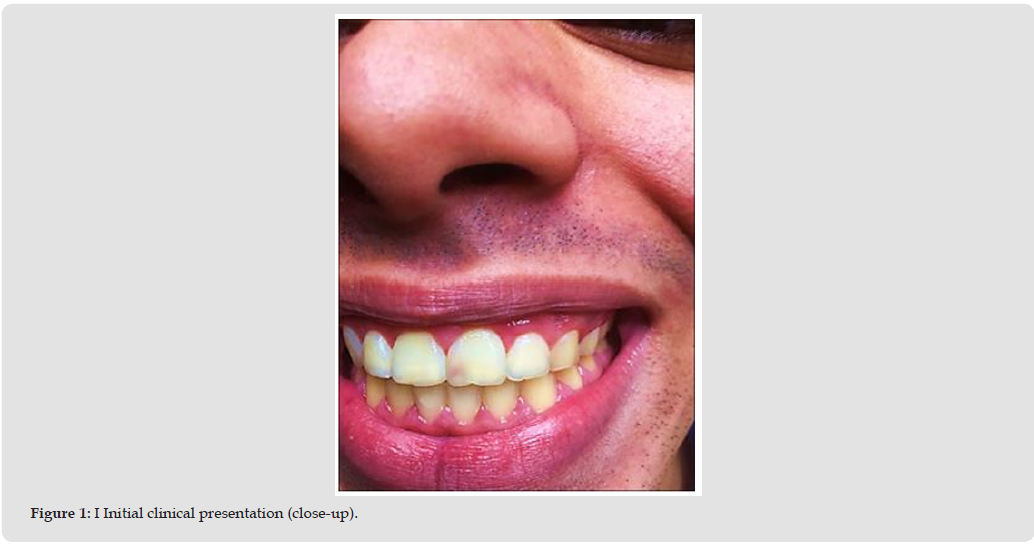
Figure 2
Diagnosis and Differential
The primary diagnosis was pulp necrosis with internal discoloration secondary to traumatic hemorrhage. External cervical resorption was ruled out based on the absence of cervical granulation tissue, lack of radiographic signs, and negative vitality testing (which would typically be positive in early-stage resorption). Moreover, the discoloration was localized rather than cervical.
Treatment Plan
Given the pulp necrosis and periapical lesion, root canal therapy was indicated. Simultaneously, internal bleaching was chosen as a conservative aesthetic treatment, preferred over veneers or external bleaching due to its targeted action and literature-supported efficacy.
Treatment Protocol
Session 1 – Endodontic Treatment:
- Local para-apical anesthesia and rubber dam isolation
- Access cavity preparation
- Canal instrumentation to the apical constriction using hand files (ISO 10-15) and Protaper Next™ (sizes 20 and 25)
- Irrigation sequence: 3% sodium hypochlorite, 17% EDTA, followed by 3% sodium hypochlorite
- Drying and obturation with gutta-percha and Top Seal™ using the lateral condensation technique (apical size 35)
- Temporary closure with cotton pellet and Cavit™ (Figure 3).
Figure 3
Sessions 2–4 – Internal Bleaching (1-week intervals):
- Removal of provisional material
- Application of sodium perborate mixed with saline into the pulp chamber
- Placement of a 2 mm thick flowable composite barrier over the canal orifice to prevent peroxide diffusion and reduce risk of external cervical resorption
- Temporary sealing with cotton pellet and Cavit™ (Figures 3-6).
Figure 1: Tooth appearance at Session 2.
Post-Bleaching Protocol
- Cavity cleaning under rubber dam
- Placement of calcium hydroxide dressing for 3 weeks to neutralize residual oxygen radicals and prevent external resorption by raising pH
- Final composite restoration scheduled after 3 weeks to ensure full degradation of oxygen residues and to allow stable shade match
Figure 4
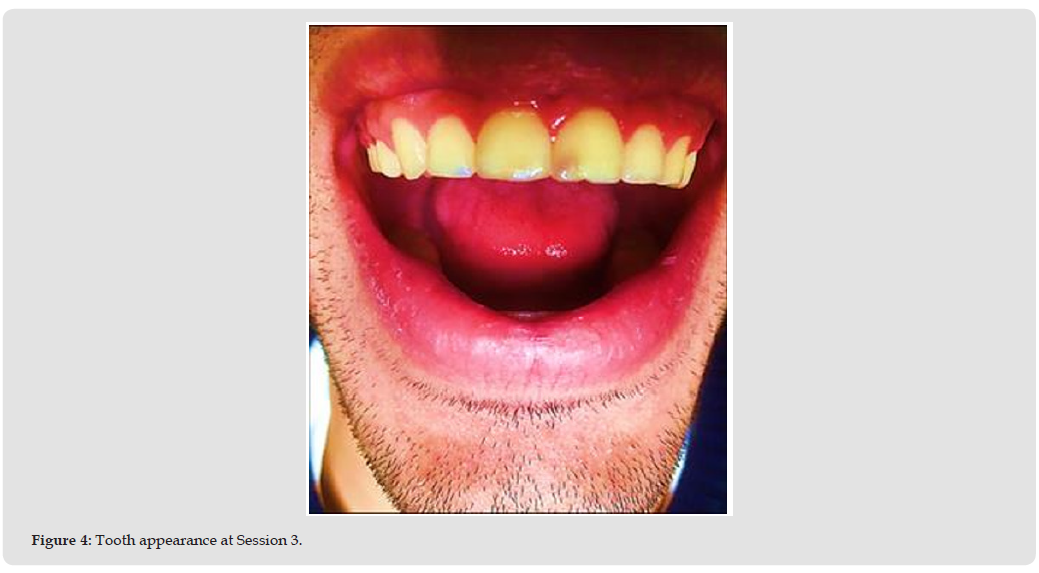
Figure 5
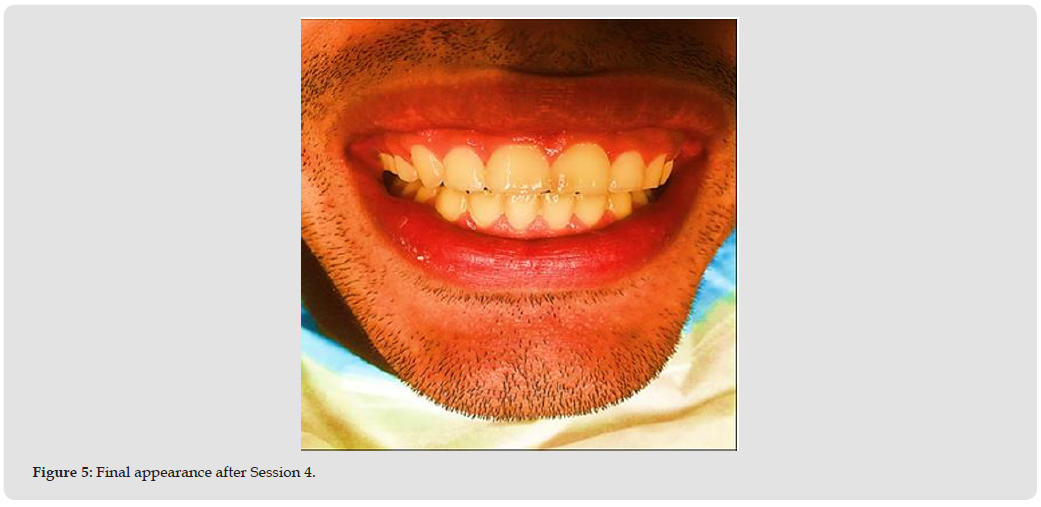
Figure 6
Outcome and Follow-Up
The discoloration resolved entirely without over-whitening the surrounding enamel. The patient experienced no post-operative pain and expressed high satisfaction [11-13]. A one-year follow-up was planned to monitor periapical healing and long-term success.
Internal bleaching is a reliable, conservative treatment for discolored non-vital teeth. Sodium perborate offers an effective whitening agent with fewer risks of cervical resorption compared to hydrogen peroxide. The use of a composite barrier and calcium hydroxide dressing is essential for safety. This case highlights the importance of differential diagnosis and careful planning to achieve optimal aesthetic and biological outcomes.

International Association of Landscape Archaeology, Czech Glass Society, Czech Republic

Department of Chemistry, Semenov Institute of Chemical Physics, USSR Academy of Sciences, Moscow, Russia

Neurology, LA BioMed Research Institute, USA

Associate Professor at Department of Breast and Thyorid Surgey, Chongqing General Hospital, China

Professor of Nuclear Medicine, Faculty of Medicine and Surgery, University of Milan, Milan, Italy





 Abstract
 PDF
PDF



























