info@biomedres.us
+1 (502) 904-2126
One Westbrook Corporate Center, Suite 300, Westchester, IL 60154, USA
Site Map
 ISSN: 2574 -1241
ISSN: 2574 -1241
ISSN: 2574 -1241
Received: April 07, 2025; Published: April 25, 2025
*Corresponding author: Paolo Ruggero Errante, Department of Pharmacology, Universidade Federal de São Paulo, Escola Paulista de Medicina, Laboratory of Autonomic and Cardiovascular Pharmacology, Rua Pedro de Toledo, 669. Vila Clementino, CEP: 04039-032, São Paulo, SP, Brazil
DOI: 10.26717/BJSTR.2025.61.009615
Infections caused by cutaneous mycobacteriosis are distributed worldwide and manifest in three forms: atypical mycobacteriosis, feline leprosy and cutaneous tuberculosis. Atypical cutaneous mycobacteriosis in cats is a rare disease commonly caused by rapidly growing mycobacteria belonging to group IV of Runyon classification. This case report describes a case of dermatitis resulting from infection by an atypical mycobacterium of Mycobacterium fortuitum complex in a five-year-old female, mixed breed feline. The cat presented ulcerated lesions, accompanied by exudative fistulas, with caseous-looking material. The presence of mycobacteria from the Mycobacterium fortuitum complex was identified after histopathology, bacterial culture and biochemical tests.
Keywords: Dermatitis; Dermatophaties; Atypical Bacteria; Feline Cutaneous Mycobacteriosis; Mycobacterium Fortuitum
Mycobacterial diseases have an infectious, granulomatous, chronic and progressive nature, and are caused by bacteria of the order Actinomycetale, family Mycobacteriaceae, genus Mycobacterium, which have a cell wall rich in complex lipids and mycolic acid, which promotes the characteristic of alcohol-acid resistance when subjected to Ziehl-Neelsen staining [1]. Mycobacteria isolated from domestic animals are divided into two large groups according to the culture growth time, being classified as slow or fast (group IV of the Runyon classification), and according to the type of infection triggered, such as leprosy, tuberculous or non-tuberculous [1,2]. All are non-chromogenic, fast-growing, Gram-positive, acid-alcohol resistant, aerobic and non-spore forming. They are ubiquitous in nature, being found in water and moist soil, and in the enteric tract of pigs and ruminants, and are not pathogenic for healthy and immunocompetent animals [3]. Cutaneous mycobacteriosis is uncommon in dogs and cats, and dermatopathies related to mycobacterial skin diseases include atypical cutaneous mycobacteriosis, canine leproid granuloma syndrome, feline leprosy, and cutaneous tuberculosis [4,5]. Cutaneous mycobacteriosis is uncommon in dogs and cats, and dermatopathies related to mycobacterial skin diseases include atypical cutaneous mycobacteriosis, canine leproid granuloma syndrome, feline leprosy, and cutaneous tuberculosis [6]. Feline mycobacteriosis associated with infections by atypical mycobacteria are uncommon and, in felines, include Mycobacterium fortuitum, found in soil and aquatic biofilms in different geographic regions. It is a fast-growing mycobacterium belonging to Runyon group IV, which has three biovariants (biovar peregrinum, biovar fortuitum and biovar inominata), in addition to the species M. phlei, M. smegmatis and M. chelonei [7-10].
Felines infected with mycobacteria may present a clinical picture characterized by weight loss, coughing and dyspnea, associated or not with lymphadenopathy [11,12]. The cutaneous form of disease is characterized by multifocal nodules with or without ulcerations, and regional lymphadenopathy may be the only clinical finding [13]. Cats are more susceptible to mycobacterial infections, since the entry point is through the presence of lacerations and traumatic skin breaks [14]. These lesions are normally observed in the ventral abdominal region (mesogastric and hypogastric), with the presence of macules, nodules and draining fistulas presenting a chronic and recurrent character [15]. On palpation, the panniculus is thickened, firm and nodular. These lesions must be differentiated from other diseases such as nodular panniculitis, pansteatitis, foreign body granulomas, nocardiosis, protothecosis, actinomycosis, cryptococcosis and sporotrichosis, pseudomycetoma, neoplasms, feline leprosy, tuberculosis and abscesses secondary to immunosuppressive infections (feline leukemia virus/FeLV and feline viral immunodeficiency/FIV) [16,17]. Diagnosis is based on direct examination of exudate or decals of injured tissue stained by the Ziehl-Neelsen technique, bacterial culture (Löwestein-Jensen, Petragnani or Stonebrink culture media), biochemical studies of isolated strains and histopathology [14,18]. Therapy involves the use of antibiotics associated with aggressive surgical debridement [19]. The objective of this study was to describe a case of atypical cutaneous mycobacteriosis in a feline resident in the city of São Paulo, state of São Paulo, Brazil.
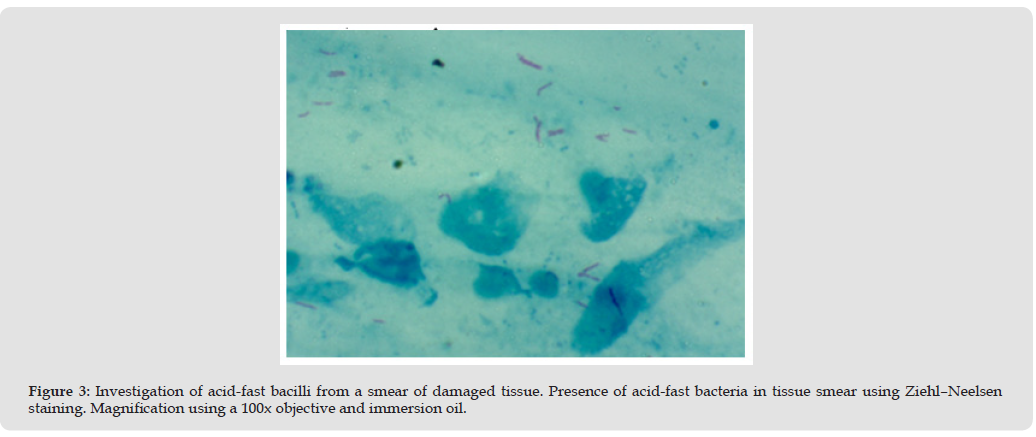
In 2025, a nulliparous, mixed breed, spayed, five-year-old female cat with yellow fur, who frequently goes outside, was seen by owners living in the outskirts of the city of São Paulo, São Paulo, Brazil. When consulted, the guardians reported the appearance a few months ago of multiple exuding wounds in the cat’s abdomen region. According to the owners, the cat did not present any changes in appetite, water intake, bowel or urination habits. The physical examination revealed normal temperature, normal sphygmomanometry, normal opnea, normal colored mucous membranes, no lymphadenopathy or changes in cardiopulmonary auscultation or abdominal palpation. On clinical examination, the skin lesions were characterized as ulcerated areas, with fistulous tracts containing caseous-looking material inside (Figure 1). Based on the appearance of the lesions, a presumptive diagnosis of bacterial panniculitis caused by atypical mycobacteria was established. The animal underwent hematological and biochemical tests, electrocardiogram, abdominal ultrasound and chest X-ray. From the ulcerative lesions, material was collected for histopathological examination, bacterioscopy using decals of injured tissues subjected to Ziehl-Neelsen staining, and bacteriological culture. No hematological, biochemical, radiographic or ultrasound alterations were evidenced by complementary examinations. Biopsy specimens were fixed in 10% formalin and routinely processed for histopathology, and histological sections stained with hematoxylin and eosin (H/E) were evaluated. Histopathological examination of a skin fragment demonstrated the presence of granulomas (Figure 2A) containing macrophages with the appearance of epithelioid cells and multinucleated giant cells (Figure 2B). For the investigation of acid-alcohol resistant bacteria, decals of damaged tissues subjected to Ziehl-Neelsen staining were used, where the presence of bacilli stained in red was verified (Figure 3). In the bacterial culture examination, there was growth of mycobacteria in Löwestein-Jensen medium over a period of five days at room temperature. Through biochemical tests (iron uptake, catalase activity, growth in sodium citrate, fruits and mannitol, and nitrate and urease tests) the presence of atypical mycobacteria, in this case M. fortuitum, was confirmed.
Figure 1

Figure 2
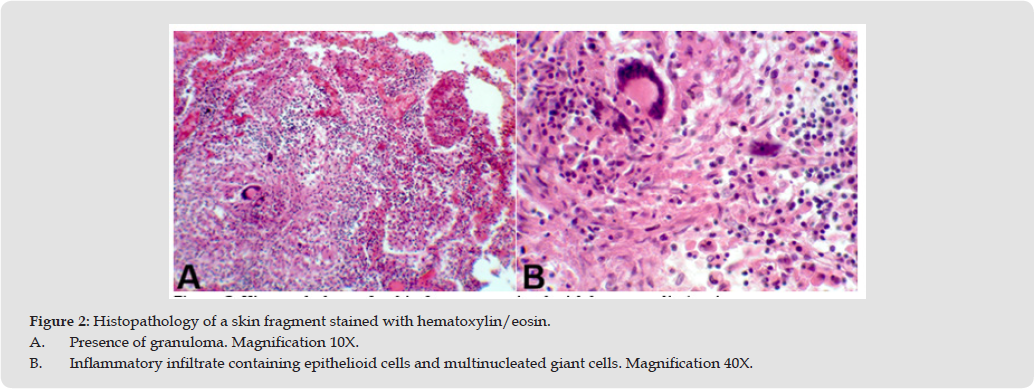
Figure 3
In Brazil, the occurrence of atypical mycobacteriosis is uncommon. Infections by atypical mycobacteria, also called opportunistic, are more commonly described in felines than dogs, and are associated with trauma, inoculation during fights, use of surgical material or contaminated needles. In felines, lesions are more common in the ventro- caudal (inguinal, umbilical) or lumbar abdominal region [15], our clinical findings are in agreement with the literature. These lesions are usually painless and unaccompanied by lymph node enlargement, pyrexia or dysorexia, as observed in the cat in this case report. In some immunosuppressed animals, lesions may spread or develop into sepsis [4,11]. In humans, deficits in T-lymphocyte-mediated immunity, compromising the functioning of interleukin-12/interferon-gamma axis, or secondarily the use of immunosuppressive drugs, neoplasms, malnutrition, advanced age and endocrinopathies can favor the emergence of infectious conditions caused by mycobacteria [20]. In the cat in this case report, hematologic, biochemical, hormonal, and serologic (FIV/FeLV) findings did not indicate the presence of immunosuppression. According to the literature, hematological and biochemical changes are not specific, usually suggesting a chronic inflammatory condition [19]. Atypical mycobacteriosis in cats mimics other dermatopathies that present nodules and tissue loss in the form of erosions, ulcers and fistulas [21], it is essential that they are differentiated from degenerative panniculitis (pansteatitis) or infectious panniculitis (nocardiosis, sporotrichosis, dermatophytosis, cryptococcosis, actinomycosis, tuberculosis and leprosy) [9,13,22-26]. The infection usually remains localized in the cutaneous and subcutaneous tissues in a healthy, immunocompetent host. Although adjacent structures such as the abdominal wall may be affected, spread of infection to internal organs and locally draining lymph nodes is uncommon [5].
In cases of cutaneous infection by atypical mycobacteria, pyogranulomatous inflammation of the subcutaneous adipose tissue, overlying dermis, abdominal fascia and underlying musculature is histologically observed [5,8,9]. Mycobacteria are usually difficult to observe in Ziehl–Neelsen-stained tissue sections, although acid-fast bacilli can be detected within macrophages or extracellular lipid vacuoles [5,19]. In this case report, the histopathological examination provided elements for establishing the diagnosis, prior to microbiological identification, through the presence of granulomas, although mycobacteria can be seen in 50% of cases, especially those in the fast-growing group [19]. Although it is not always possible to directly observe mycobacteria from exudate or fragments of damaged tissue stained by the Ziehl-Neelsen method, examination of damaged tissue decals allowed the observation of acid-resistant microorganisms. Fine needle aspirates or smears from skin lesions (ulcers, drainage tracts) or granulomatous lymph nodes should be stained for acid-fast bacteria using the Ziehl-Neelsen method [13,19]. The sensitivity of the test is variable, since the number of bacteria within the macrophages varies depending on the mycobacterial species and host’s immune response [1,5,8]. Even when mycobacteria are visualized in material stained by the Ziehl-Neelsen method, it is important to perform a bacterial culture to differentiate atypical mycobacterial infections from those originating from feline leprosy, nocardiosis or tuberculosis [4,19]. Culture of a fresh tissue sample is useful for confirming mycobacterial infection and identifying the species involved, and has implications for treatment, prognosis and assessment of zoonotic risk, and is usually performed in a specialized laboratory. As many mycobacterial species grow slowly or do not grow in culture media, it is advisable to send tissue samples for examination using polymerase chain reaction (PCR) [27].
In bacterial culture, strains identified as M. fortuitum are acid-resistant, grow in less than 7 days at 28 °C and 37 °C, produce non-pigmented colonies, have a positive three-day arylsulfatase reaction, are positive for iron uptake, and reduce nitrate [28], as observed in the culture obtained from material from the cat in this case report. Also, the characterization in the cultivation in Lowestein-Jensen medium, associated with rapid aerobic growth, presenting itself as an immobile, non-spore-forming, acid-alcohol resistant bacillus, provided the necessary elements for the identification of M. fortuitum, even without resorting to molecular biology techniques [27,28]. Despite the diagnosis being made, it was not possible to carry out treatment due to the loss of contact with tutor.
Cutaneous infection by atypical mycobacteria in felines is rarely diagnosed and little described in the veterinary literature in small animals in Brazil. This is due to its low frequency, lack of knowledge of the disease by clinical veterinarians and its form of diagnosis and treatment. However, the combination of histopathology, biochemical and culture tests allows for a highly sensitive diagnostic approach.

International Association of Landscape Archaeology, Czech Glass Society, Czech Republic

Department of Chemistry, Semenov Institute of Chemical Physics, USSR Academy of Sciences, Moscow, Russia

Neurology, LA BioMed Research Institute, USA

Associate Professor at Department of Breast and Thyorid Surgey, Chongqing General Hospital, China

Professor of Nuclear Medicine, Faculty of Medicine and Surgery, University of Milan, Milan, Italy





 Abstract
 PDF
PDF



























