info@biomedres.us
+1 (502) 904-2126
One Westbrook Corporate Center, Suite 300, Westchester, IL 60154, USA
Site Map
 ISSN: 2574 -1241
ISSN: 2574 -1241
ISSN: 2574 -1241
Received: April 14, 2025; Published: April 24, 2025
*Corresponding author: Peter C Dartsch, Dartsch Scientific GmbH, Institute for Cell Biological Test Systems, Oberer Anger 1, D - 86911 Dießen am Ammersee, Germany
DOI: 10.26717/BJSTR.2025.61.009611
Background: Recent findings indicate that hydrogen has a variety of pharmacological effects which have a positive
impact on various diseases. Among these is a reduced situation of intestinal health. In the present study, cell
biological test methods were used to investigate whether hydrogen-enriched water possesses beneficial effects
at the cellular level in direct comparison to the same initial tap water without treatment.
Experimental: Hydrogen-enriched water was produced by two different devices from misterwater GmbH, Germany,
from initial local tap water in accordance with the operating instructions. Investigations of the resulting
hydrogen-enriched water were performed immediately after hydrogen generation. The same tap water without
treatment by the hydrogen-producing devices was taken as corresponding control. For the experiments, a well
established intestinal epithelial cell line (IPEC-J2) was used.
Results: The use of freshly prepared hydrogen-enriched water resulted in a statistically significant reduction of
the unwanted consequences of exogenous reactive oxygen radicals on cultured intestinal epithelial cells and the
integrity of the intestinal barrier in vitro. Cell viability without exposure of the cells to reactive oxygen species
was increased significantly by hydrogen-enriched water by 14.3 ± 5,9% (mean value ± standard deviation) compared
to the initial tap water without treatment. The addition of hydrogen peroxide reduced intestinal epithelial
cell viability in a dose-dependent manner, but viabilty of cells with hydrogen-enriched water was improved by
19.1 ± 8.5% (mean value ± standard deviation) compared to cells only exposed to the initial tap water without
treatment. Microscopic examination of the regeneration process of intestinal epithelial cell cultures at exogenous
oxidative stress conditions resulted in a significant stimulation. The examination of the intestinal barrier
integrity after the addition of 1 mM of hydrogen superoxide with both water samples resulted in a reduction of
the transepithelial electrical resistance by 80.1 ± 4.6% for hydrogen-enriched tap water and by 96 ± 5.3% for
initial local tap water (mean values ± standard deviations). Moreover, there was also a significant difference in
the residual cell-covered area of 98.5 ± 1.6% for the intestinal epithelial barrier exposed to hydrogen-enriched
water and a cell-covered area of only 85.9 ± 4.2% for the intestinal epithelial barrier exposed to initial local tap
water (mean values ± standard deviations).
Conclusions: Regular drinking of freshly prepared hydrogen-enriched water produced by the devices of misterwater
GmbH might possess a beneficial impact on int6estinal health, and consequently, on human well-being
and the attitude to life.
Keywords: Intestinal Epithelial Cells; IPEC-J2; Hydrogen-Enriched Water; Cell Viability; Cell Regeneration; Oxidative Stress; Reactive Oxygen Species; Intestinal Barrier Integrity; Transepithelial Electrical Resistance; TEER; Cell Culture
The intestinal barrier has several important immunological and non-immunological functions. The epithelial cell layer is one of the most important non-immunological components as it provides a physical barrier between the contents of the intestinal lumen and the rest of the body, ensures efficient absorption of essential nutrients from the intestinal lumen and produces mucus and substances with regulatory properties [1]. Especially intestinal hyperpermeability has been shown to contribute to the pathogenesis of several gastrointestinal diseases, thus affecting not only intestinal health but also systemic health [2-4]. Ingested substances and microbial pathogens that disrupt normal cellular homeostasis in the gut can cause oxidative stress and gastrointestinal damage due to an excess of reactive oxygen species [5-8]. Recent findings demonstrate that hydrogen has a variety of pharmacological effects [9,10]. Among them are antioxidant, anti-inflammatory or anti-apoptotic properties [11-13]. Molecular hydrogen penetrates rapidly into tissues and cells and does not interfere with metabolic redox reactions or reactive oxygen species, which play an important role in cellular signaling in the body [14]. Therefore, the use of molecular hydrogen should have no adverse effects, as demonstrated in a study of mutagenicity, genotoxicity, and subchronic oral toxicity up to a daily intake of 20 ml of hydrogen-enriched water per kilogram of body weight [15]. There are several methods of ingesting hydrogen, such as inhaling hydrogen gas or drinking hydrogen-enriched water. Water has the advantage that it is very easy to prepare and hydrogen can be dissolved to a concentration of 1.6 ppm under normal atmospheric pressure at room temperature. By using cultured intestinal epithelial cells, cell biological test methods were performed to investigate whether hydrogen-enriched local tap water might have beneficial effects on intestinal health in direct comparison to the same initial local tap water without treatment. Due to the positive effects described by users, the investigations in this study were done exclusively with cultured intestinal epithelial cells and were focussed on the cellular action caused by unwanted exogenous oxidative stress.
Preparation and Use of Hydrogen-Enriched Water
Two different devices from misterwater GmbH, D-85540 Haar OT Salmdorf, Germany, were provided for the duration of the tests and used with local tap water in accordance with the operating instructions. Investigations of the resulting hydrogen-enriched water were performed immediately afterwards, as the generated and dissolved hydrogen is very short-lived. By sealing the cell culture dishes, precautions were also taken to allow the hydrogen to act on the cell cultures as long as possible. As a corresponding control, the same initial tap water without treatment with the hydrogen devices was used. To avoid osmotically induced cell alterations and cell volume regulations, the initial water and the hydrogen-enriched water were added to the culture medium or reaction mixture as a volume fraction of 25 vol%.
Cell culture
The investigations were performed with IPEC-J2 cells (ACC-701; Leibniz Institut, DSMZ, Braunschweig, Germany). The cells were routinely grown in a mixture (1:1) of Dulbecco’s Modification of Eagle’s Medium and Ham’s F12 supplemented with 10% growth mixture and 0.5% gentamycin and cultivated in an incubator at 37 °C in a humid atmosphere of 5% CO2 and 95% air. The cells were routinely cultivated as mass cultures and were regularly subcultured twice a week with fresh culture medium. For the experiments, cells were taken from 80- 90% confluent mass cultures.
Cell Viability After Exogenous Oxidative Stress
Our established hydrogen peroxide-induced oxidative stress test system (HP-IOS) was used for these studies. From a 3% hydrogen peroxide solution (= 880 mM), 10-fold concentrated hydrogen peroxide stock solutions of the finally used cell culture test concentrations were prepared by further dilution with phosphate buffered saline. Intestinal epithelial cells were seeded at a density of 100,000 cells/well in 96-well multiplates and were allowed to attach, spread and stabilize their metabolism for 48 hours until a confluency of about 90% was achieved. Then, cells were incubated with various concentrations of hydrogen peroxide (0 to 0.5 mM) and a volume fraction of 25 vol% of either hydrogen-enriched water or initial local tap water as control for another 24 hours. Finally, the activity of the surviving cells was measured by a redox color reaction after the addition of XTT (2,3-bis- (2-methoxy-4-nitro-5-sulfophenyl)-2H-tetrazolium-5-carboxanilide; Xenometrix, Allschwil, Switzerland) with an Elisareader (BioTek ELx 808 with software Gen 5 version 3.00) as a differential measurement at ΔOD = 450 – 690 nm at definite time points up to 120 min. Three independent test series were performed (n = 3).
Cell Regeneration and Oxidative Stress
In this model, the granulation phase, which is characterized by the occurrence of migration and proliferation of cells for closing a defect after injury, was simulated [16,17]. Cells were seeded at a density of 100,000 cells/ml into the individual compartments of a silicone 4 well-culture insert (ibidi, Gräfelfing, Germany). The single compartments of the inserts are separated by a 500 μm thick silicone bar with an outer silicone frame of 700 μm. Due to the special adhesion area, a silicone insert adheres firmly to the bottom of a culture dish and forms a distinct cell-free area, which the cells can colonize by migration and proliferation. Upon reaching confluency within 48 hours after cell seeding, the silicone inserts were removed with tweezers to achieve a sharp edge of the cell-free area between the compartments. A volume fraction of 25 vol% of hydrogen-enriched water or initial local tap water was added to the culture medium as well as 0.5 mM hydrogen peroxide as the source for exogenous reactive oxygen species. Intestinal epithelial cells were allowed to migrate and proliferate for 14 hours. Finally, cell cultures were fixed with 100% methanol, stained with Giemsa’s azur eosin methylene blue solution (Merck, Darmstadt, Germany) and air-dried. The colonized area was examined under the microscope at three different points of each cell culture and calculated by the wound healing assay v3.0.0 of a specialized software with artificial intelligence from KML Vision, Graz, Austria (IKOSA AI software). Three independent experimental series were performed (n = 3).
Transepithelial Electrical Resistance (TEER) and Oxidative Stress
Intestinal epithelial cells were cultured for a total of 7 days on the surface of 0.4 μm porous membranes (Corning transwell plates, Sigma- Aldrich, Deisenhofen, Germany), which resulted in two separate compartments within the cell culture dish. The layer of cells covering the surface of the membrane (= apical compartment = intestinal lumen) represents a physical barrier to the lower compartment (= basolateral compartment = blood). TEER was measured by placing an electrode in the culture medium in the apical compartment and an electrode in the culture medium in the basolateral compartment [18]. TEER was measured directly with a portable voltmeter (Millicell ERS-2 voltmeter, Millipore/Merck, Darmstadt; Germany). Only intestinal epithelial cell layers with an electrical resistance of at least 2,000 Ω/cm2 were used for the experiments, which represents an intact physical barrier with very good integrity [19-21]. TEER of the porous membrane without any epithelial cell barrier was measured with values between 160 and 180 Ω/cm2. After the TEER measurements, a volume fraction of 25 vol% of hydrogen-enriched water or untreated initial tap water as well as 1 mM hydrogen peroxide and was added to the culture medium. After 12 hours of continuous incubation with this mixture, TEER of the intestinal epithelial cell barrier was measured again. Moreover, the cell-covered areas of the samples were examined and calculated with the confluence assay v2.1.0 of the IKOSA AI software (KML Vision, Graz, Austria). Three independent experiments were performed (n = 3).
Statistical Analysis
Statistical analysis was done using the parameter-free two-tailed Wilcoxon-Mann-Whitney rank-sum test.
Measurement of cell viability without exposure of the cells to reactive oxygen species was increased significantly by hydrogen-enriched water by 14.3 ± 5,9% (mean value ± standard deviation; p ≤ 0.01) compared to the initial tap water without treatment. The addition of 0.05 to 0.5 mM hydrogen peroxide reduced intestinal cell viability in a dose-dependent manner. However, cell viabilty of cells exposed to reactive oxygen species and hydrogen-enriched water at the same time was improved by 19.1 ± 8.5% (mean value ± standard deviation; p ≤ 0.01) compared to cells exposed to the initial tap water without treatment.
Figure 1

The microscopic examination of the regeneration process of intestinal epithelial cell cultures at exogenous oxidative stress conditions showed a significant stimulation of the colonization of the cellfree area by exposure to the hydrogen-enriched water compared to the initial tap water (Figure 1). The stimulating effect became also obvious when the single values of three independent experiments each are presented in graphical form (Figure 2). When the residual cell-free area of the cell cultures was directly calculated as depicted in Figure 2, this area was 693,400 ± 53,000 square pixels for the initial tap water and only 375,600 ± 52,200 square pixels for the hydrogen- enriched water (mean values ± standard deviations; p ≤ 0.01).
Figure 2
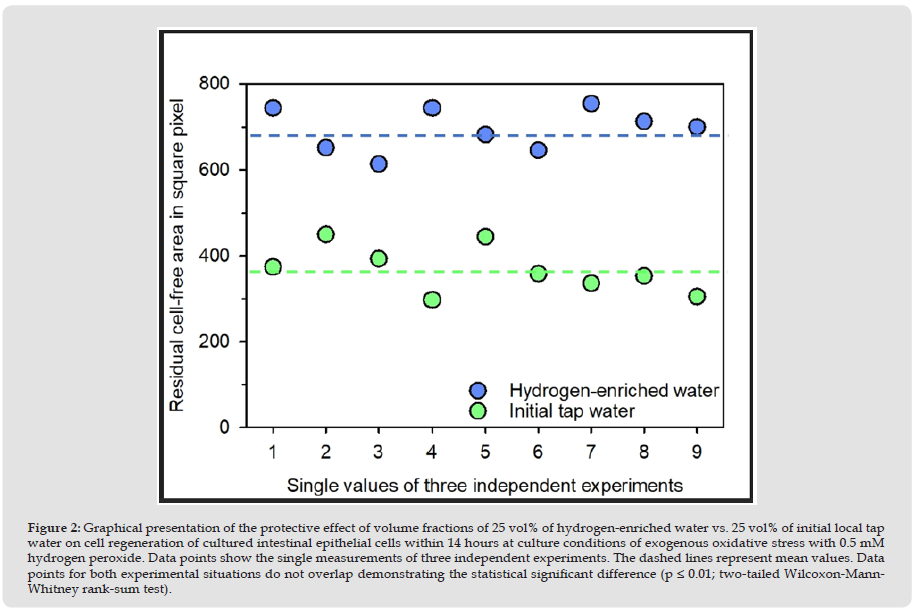
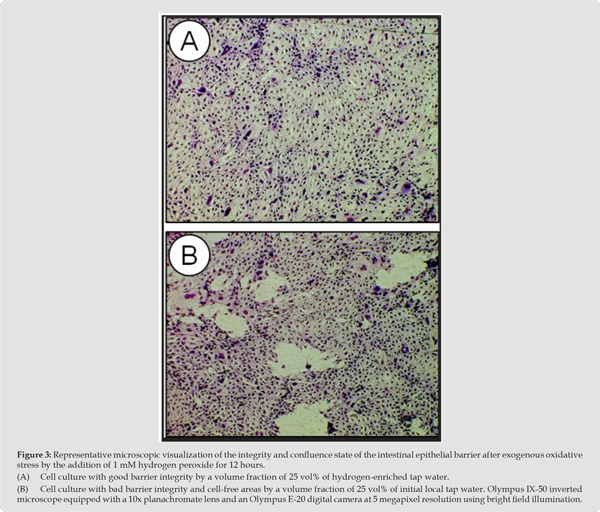
This means that the residual cell-free area was 46% smaller for the cultures with hydrogen-enriched water compared with cultures containing initial tap water. The examination of the intestinal epithelial barrier integrity after 7 days of cultivation resuloted in values of 4,700 ± 120 Ω/cm2 (mean value ± standard deviation) demonstrating the high integrity of the barrier. The addition of fresh culture medium containing a volume fraction of 25 vol% of hydrogen-enriched water or 25 vol% of initial tap water as well as 1 mM of hydrogen superoxide in both water samples resulted in a reduction of TEER by 80.1 ± 4.6% for hydrogen-enriched tap water and by 96 ± 5.3% for initial local tap water (mean values ± standard deviations). The difference between both exogenous oxidative stress conditions with both water samples was statistically significant (p ≤ 0.01), i.e. the hydrogen-enriched water showed a better protection and preservation of intestinal epithelial barrier integrity than the initial local tap water. This difference could also be demonstrated in representative micrographs of the intestinal epithelial barrier after 12 hours of exogenous oxidative stress (Figure 3). According to the TEER measurements after oxidative stress, we found a significant difference (p ≤ 0.01) in the cell-covered area of 98.5 ± 1.6% for the intestinal epithelial barrier exposed to hydrogen-enriched water and the cell-covered area of only 85.9 ± 4.2% for the intestinal epithelial barrier exposed to initial local tap water.
Figure 3
The IPEC-J2 cell line was chosen for this study, because “the IPEC- J2 cell line is unique as it is derived from the small intestine and is neither transformed nor tumorigenic in nature. IPEC-J2 cells mimic the human physiology more closely than any other cell line of non-human origin” [22]. The cells were originally isolated in 1989 by Helen Berschneider at the University of North Carolina [23]. The advantage of the IPEC-J2 cell line as an in vitro model originates from its morphological and functional similarities with intestinal epithelial cells in vivo [24]. The epithelial cells of the intestinal barrier have a high turnover rate, because they are quite sensitive against alterations of their endogenous environmental conditions involving a deficiency of the epithelium and immune/inflammation mediating cells [8]. The application of freshly produced hydrogen-enriched local tap water produced by the devices of misterwater GmbH, resulted in beneficial biological effects of cultured intestinal epithelial cells and on the integrity of the intestinal epithelial barrier when compared with the initial local tap water. The main target of the hydrogen-enriched water in the study was its reactive oxygen radical scavenging (= antioxidative) effect on the cellular level. This resulted in a better cell viability in mass cultures as well as in a significantly stimulating effect on the regeneration process of intestinal epithelial cells at culture conditions of exogenous oxidative stress. Moreover, the resistance of the intestinal barrier against oxidative changes in the cellular environment was also increased by hydrogen-enriched water.
The results are in accordance with findings of other scientists who have shown that molecular hydrogen or hydrogen-enriched water has serious medical applications and health benefits [25-27]. Especially the regeneration process plays an essential role after intestinal injury due to food intolerances, food additives and many other factors that might cause oxidative stress and, subsequently, a reduced intestinal permeability and function. Defects in intestinal barrier function play a pathogenic role in intestinal dysfunction and disease. As reviewed by Farhadi et al. [28], a role for reactive oxygen species “in gastrointestinal- related abnormalities has been established for several gastrointestinal disorders. These include ischemic injury of the gastrointestinal mucosa, inflammatory bowel disease, peptic ulcer disease…” and others. It is not surprising that oxidative stress can damage the intestinal barrier, alter its functions and increase intestinal permeability. In the case the intestinal epithelial barrier is improved and maintained by hydrogen-enriched local tap water it can resist more easily oxidative stress from exogenous factors and their unwanted injuries. Therefore, regular drinking of freshly prepared hydrogen-enriched water produced by the devices of misterwater GmbH might possess a beneficial impact on human well-being and the attitude to life.

International Association of Landscape Archaeology, Czech Glass Society, Czech Republic

Department of Chemistry, Semenov Institute of Chemical Physics, USSR Academy of Sciences, Moscow, Russia

Neurology, LA BioMed Research Institute, USA

Associate Professor at Department of Breast and Thyorid Surgey, Chongqing General Hospital, China
Professor of Nuclear Medicine, Faculty of Medicine and Surgery, University of Milan, Milan, Italy





 Abstract
 PDF
PDF



























