info@biomedres.us
+1 (502) 904-2126
One Westbrook Corporate Center, Suite 300, Westchester, IL 60154, USA
Site Map
 ISSN: 2574 -1241
ISSN: 2574 -1241
ISSN: 2574 -1241
Received: April 11, 2025; Published: April 23, 2025
*Corresponding author: Jinhua Gu, Rheumatology and Immunology Department, Yibin Second People’s Hospital, Yibin, Sichuan 644000, China
DOI: 10.26717/BJSTR.2025.61.009607
Objective: To determine the solubility limit of uric acid in adult serum.
Methods: Five healthy adult males and five females were recruited. Five milliliters of blood were drawn from
their elbow veins, allowed to coagulate naturally, and then centrifuged. Two milliliters of serum were transferred
to a centrifuge tube. A small amount of uric acid powder was added to the serum multiple times, while shaking
until visible powder sedimentation was observed at the bottom of the tube (supersaturated serum uric acid
solution). The solution was equilibrated in a water bath at 37 °C for 24 hours, centrifuged at 3500 rpm for 12
minutes, and the supernatant was the solubility limit solution (or saturated solution) of uric acid. The concentration
of uric acid in the supernatant was measured using an automatic biochemical analyzer with uricase method.
Results: The solubility limit of serum uric acid in adult males was 336.24 ± 24.83 mg/dl (n = 5), and in adult
females was 298.96 ± 12.21 mg/dl (n = 5), with a P value of 0.0975 between the two groups. The solubility limit
of serum uric acid in adults was 317.60 ± 27.27 mg/dl (n = 10).
Conclusion: The solubility limit of uric acid in adult serum is 317.60 ± 27.27 mg/dl; the conclusion that the
solubility limit of human serum uric acid is 6.8 mg/dl in “Kelley’s Textbook of Rheumatology” and “Gout” is incorrect;
the solubility limit of uric acid varies among different individuals and within the same individual under
different physiological or pathological conditions, and there is no constant or absolute solubility limit of uric
acid in human serum.
Keywords: Serum; Uric Acid; Solubility Limit; Uricase Method
“Kelley’s Textbook of Rheumatology” and “Gout” describe that hyperuricemia is defined as a serum uric acid level higher than 6.8 mg/ dl, which is the solubility limit of uric acid in serum. Upon searching databases such as Pubmed, MEDline, and CNKI, no research reports on the solubility limit of uric acid in serum in adults were found. This experiment prepared a solution with the solubility limit of serum uric acid in adults and measured the uric acid concentration when it reached the solubility limit in serum. The measured results greatly differed from those described in “Kelley’s Textbook of Rheumatology” and “Gout”. The relevant reports are as follows.
General Information
Instruments, reagents, and serum; fully automated biochemical analyzer (Hitachi 7100 model); uric acid assay kit (uricase method); uric acid powder (Shanghai Enzyme-Linked Biological Co., Ltd.); reagents are of analytical grade; 0.01mol PBS buffer diluent (Shanghai Enzyme-Linked Biological Co., Ltd.); 5 adult males and 5 adult females, with 2ml of serum each.
Method
Preparation of the Serum Uric Acid Solubility Limit Solution for Adults: In our hospital’s physical examination center, 5 healthy adult males and 5 females were randomly selected. After obtaining informed consent, 5ml of blood was drawn from their elbow veins, allowed to coagulate naturally, and then centrifuged. 2ml of serum was collected and placed in a centrifuge tube. A small amount of uric acid powder was added multiple times and mixed thoroughly by shaking until visible powder sedimentation was observed at the bottom of the centrifuge tube. The mixture was in a 37 °C water bath for 24 minutes, centrifuged at 3.5×10^3 r·min^-1 for 12 minutes, and the supernatant served as the serum uric acid solubility limit solution. 1.5ml of this supernatant was taken as the sample for subsequent testing. Determination of Uric Acid Concentration in Samples: The uric acid concentration in samples is detected using a uricase reagent kit and an automatic biochemical analyzer. If the uric acid concentration in the sample exceeds the quantitative linear detection range, it is diluted n times with 0.01 mol PBS buffer diluent, and the measured value is multiplied by the dilution factor n to obtain the uric acid concentration in the sample.
Statistical Analysis: The mean uric acid concentrations of adult males and females (n=5) were calculated using SPSS statistical software. A comparison of the means yielded a statistically significant difference (P<0.05). If there was no statistical difference between the male and female groups, the limiting concentration of uric acid solubility for adults (males and females) was calculated (n=10).
The serum uric acid solubility limit concentration value for adult males is 336.24±24.83mg/dl (n=5), while for adult females it is 298.96±12.21mg/dl (n=5), with a mean comparison P < 0.05. The serum uric acid solubility limit concentration value for adults is 317.60±27.27mg/dl (n=10). There is no significant difference between the sample values (Table 1).
Table 1: Limiting concentration of serum uric acid solubility in adults.
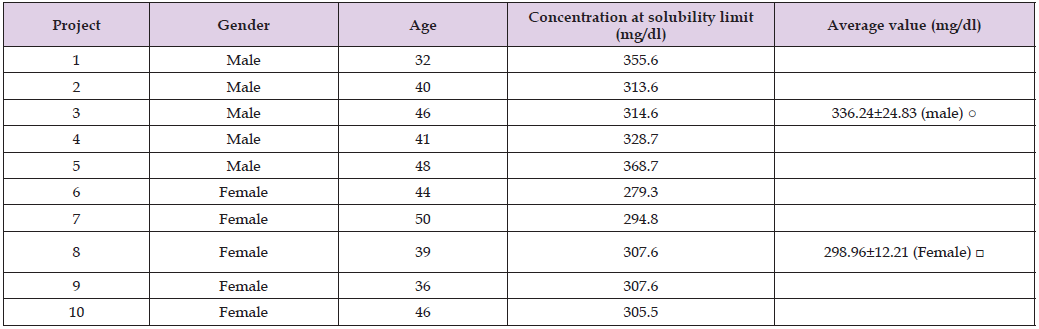
Note: P=0.0975
Uric acid is the metabolic end product of purine and is slightly soluble in water. According to Chapter 94 of the 10th edition of “Kelley’s Textbook of Rheumatology” and Fenando A, et al. [1], at pH 7.4 and 37 °C, the definition of hyperuricemia is a serum uric acid level above 6.8 mg/dL, which is the solubility limit of uric acid in serum. However, in the real world, hyperuricemia with levels above the solubility limit of 6.8 mg/dL is prevalent and cannot be explained by the supersaturation theory. This is because the serum in the human body is constantly influenced by various physicochemical factors such as flow rate, temperature, pH, and electrolytes. If uric acid becomes supersaturated in serum, it becomes unstable and can precipitate out to form crystals within blood vessels. The solubility of uric acid in water is 6.23 mg/dL [2], and rat body fluids have relatively good solubility for uric acid [3]. Upon searching databases such as Pubmed, MEDline, and CNKI, there are no experimental reports on the determination of serum uric acid concentration at the solubility limit in adults. “6.8 mg/dL is the solubility limit of uric acid in serum” stated in “Kelley’s Textbook of Rheumatology” is not supported by literature. The data cited in “Gout” is derived from the solubility of uric acid in physiological saline. The solubility of the same solute (uric acid) in different solvents (physiological saline, human serum) is obviously different.
It is completely erroneous to equate the solubility of uric acid in physiological saline with its solubility limit in human serum, as physiological saline and human serum are two solvents with completely different properties. Hepatocytes convert purine into uric acid and secrete it into the serum. 98% of uric acid is converted into uric acid sodium. Uric acid and uric acid sodium transform into each other in the serum and maintain a dynamic balance. The premise for uric acid to reach its solubility limit in the serum is that uric acid sodium also reaches its solubility limit simultaneously. Uric acid sodium is soluble in the serum. The uricase method (or other methods) is used to detect the concentration of uric acid in human serum. The detection substrate is the sum of the concentrations of uric acid and uric acid sodium in the serum, essentially representing the concentration of uric acid radicals. This experiment measures the solubility limit concentration of serum uric acid in adult males as 336.24±24.83mg/dl and in adult females as 298.96±12.21mg/dl, with P>0.05. The solubility limit concentration of serum uric acid in adults is 317.60±27.27mg/ dl. Theoretically, the solubility limit of uric acid in serum in the body is higher than 317.60±27.27mg/dl, as the serum in the body is in a state of high flow. Therefore, the conclusion in “Kelley’s Textbook of Rheumatology” that the solubility limit of serum uric acid is “6.8mg/ dL” is incorrect. In the real world, hyperuricemia above the “solubility limit of 6.8mg/dL” can exist in large quantities and for long periods, without monosodium urate crystal deposition in human tissues.
Due to physiological or pathological changes in different individuals or the same individual, the physicochemical properties of blood change accordingly, and the solubility limit of uric acid also fluctuates, without a constant absolute value. The theory of gout pathogenesis based on the “solubility limit of 6.8mg/dL” in serum is incorrect. Whether urate crystals precipitate in tissues mainly depends on the saturation of urate in tissue fluid, not serum, and is influenced by various factors. It is also incorrect to use 6.8mg/dL as the cutoff point for hyperuricemia in all people worldwide. More epidemiological studies are needed to define hyperuricemia in different regions and ethnic groups, as lifestyles, dietary habits, and genetic backgrounds vary.

International Association of Landscape Archaeology, Czech Glass Society, Czech Republic

Department of Chemistry, Semenov Institute of Chemical Physics, USSR Academy of Sciences, Moscow, Russia

Neurology, LA BioMed Research Institute, USA

Associate Professor at Department of Breast and Thyorid Surgey, Chongqing General Hospital, China

Professor of Nuclear Medicine, Faculty of Medicine and Surgery, University of Milan, Milan, Italy





 Abstract
 PDF
PDF



























