info@biomedres.us
+1 (502) 904-2126
One Westbrook Corporate Center, Suite 300, Westchester, IL 60154, USA
Site Map
 ISSN: 2574 -1241
ISSN: 2574 -1241
ISSN: 2574 -1241
Received: April 04, 2025; Published: April 14, 2025
*Corresponding author: Ana Doyle Sánchez, Medical Department, ITF Research Pharma, S.L.U., Alcobendas, Madrid, Spain
DOI: 10.26717/BJSTR.2025.61.009593
Oniria Plus® is a nutraceutical formulated as prolonged release caplets (film-coated tablets designed specifically with a capsule shape for easy swallowing), containing 1.98 mg of melatonin and 4 mg of valerenic acid, intended to support physiological sleep. In vitro tests show its controlled dual dissolution profile: an initial release of both actives of about 40% in the first 30 minutes, followed by a sustained release of the remaining 60% over 300 minutes, indicating its potential effectiveness for promoting and maintaining sleep.
Keywords: Melatonin; Valerenic Acid; Prolonged Release; Dual Action; Physiological Sleep
Insomnia is defined according to the DSM-5 (Diagnostic and Statistical Manual of Mental Disorders, version 5) as a “predominant dissatisfaction with quantity or quality of sleep” [1], being a highly prevalent and disabling condition in Europe [2]; in fact, the Spanish Society of Neurology has recently estimated that 22-30% of Spanish population could suffer from sleep disorders, mostly insomnia [3]. Oniria Plus® is a nutraceutical intended to assist physiological sleep. It contains 1.98 mg of melatonin and 4 mg of valerenic acid. It is formulated as prolonged-release caplets, which are film-coated tablets shaped like capsules to facilitate oral administration, thereby improving patient compliance and adherence (see Figure 1).
Figure 1

Melatonin regulates sleep-wake cycles, while valerenic acid reduces anxiety and promotes relaxation, aiding both the onset and continuity of sleep [4,5]. Valerenic acid combined with melatonin formulated in prolonged-release caplets is intended to improve sleep quality. The prolonged-release formulation would ensure a steady supply throughout the night, supporting uninterrupted sleep. The challenge and novelty of this study consist in the development and achievement of a formulation capable of controlling the gradual release of both actives simultaneously. This combination of the two actives is expected to deliver a synergistic effect and, with the unique controlled-release mechanism, is intended to facilitate not only the sleep onset but, overall, to naturally support a deeper and more consistent sleep throughout the night. To ascertain the capacity to release the active ingredients (melatonin and valerenic acid) from the caplets over time in physiological conditions, we have performed an in vitro dissolution profile of Oniria Plus®.
Caplets of Oniria Plus® containing melatonin and valerenic acid as active components were manufactured according to standard GMP manufacturing practice and quality. The release rate of the actives was tested and proven by a dissolution profile study. A single unit was defined as one single caplet. The assay was performed in six replicates. The dissolution media used in the assays is a buffered media in pH (phosphate buffer pH 6.8) mimicking the intestinal environment where melatonin, and likely valerenic acid, are absorbed [6,7]. Also, in line with intestinal digestion time, the dissolution was monitored for 5 hours. All tests were performed in an Agilent 708-DS apparatus, according to the following conditions (Table 1). Samples from the dissolution media were automatically extracted 10-20-30-45-60-90- 120-180-240-300 minutes after the start of the assay. The melatonin and valerenic acid content released was measured by a validated method based on RP-HPLC/DAD (Reverse Phase High-Performance Liquid Chromatography-Photodiode Array Detector) technique. The percentage of dissolved active substances was calculated from the concentration of the samples at each time point over the theoretical content of actives per formulation. Summary statistics are presented as mean and standard deviation (SD).
Table 1: Demographic distribution of patients with rib fractures.
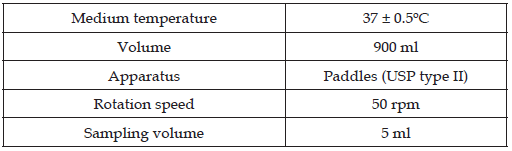
The Oniria Plus® novel formulation efficiently releases the total content of melatonin and valerenic acid at the physiological pH conditions. The dissolution profile of Oniria Plus® caplets shows a controlled release with a dual pattern, featuring an initial rapid release followed by a sustained release of the active ingredients. Importantly, a similar pattern is achieved with both active ingredients. In the first 30 minutes, approximately 40% of the melatonin and valerenic acid is released. The remaining 60% is gradually released over the next 300 minutes (see Figure 2 and Table 1).
Figure 2
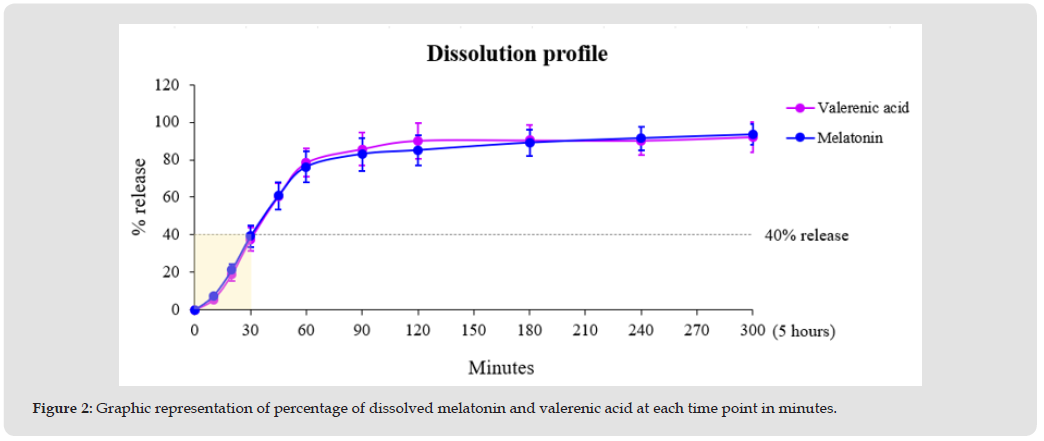
The novel formulation of Oniria Plus® prolonged-release caplets, containing 1.98 mg of melatonin and 4 mg of valerenic acid, exhibits a controlled dual-release profile for both actives. This profile features an initial burst release, followed by a sustained release, designed to support both the onset and maintenance of physiological sleep. Additionally, the easy-to-swallow film-coated tablet format as caplets is specifically designed to enhance patient compliance, providing a more convenient and comfortable administration and ensuring the target therapeutic efficacy (Table 2).
Table 2: Percentage of dissolved melatonin and valerenic acid at each time point in minutes.

Patricia García Rodríguez, Sara Serrano, Javier González García and Ana Doyle Sánchez are employees of ITF Research Pharma, S.L.U., Alcobendas, Madrid, Spain.

International Association of Landscape Archaeology, Czech Glass Society, Czech Republic

Department of Chemistry, Semenov Institute of Chemical Physics, USSR Academy of Sciences, Moscow, Russia

Neurology, LA BioMed Research Institute, USA

Associate Professor at Department of Breast and Thyorid Surgey, Chongqing General Hospital, China

Professor of Nuclear Medicine, Faculty of Medicine and Surgery, University of Milan, Milan, Italy





 Abstract
 PDF
PDF



























