info@biomedres.us
+1 (502) 904-2126
One Westbrook Corporate Center, Suite 300, Westchester, IL 60154, USA
Site Map
 ISSN: 2574 -1241
ISSN: 2574 -1241
ISSN: 2574 -1241
Received: April 02, 2025; Published: April 11, 2025
*Corresponding author: Muharrem Cakmak, Fırat University Faculty of Medicine, Department of Thoracic Surgery, Elazig, Turkey
DOI: 10.26717/BJSTR.2025.61.009591
Introduction: Many studies have been conducted on rib fractures, and factors affecting mortality and morbidity
have been reported. However, no specific studies regarding fractures of floating ribs have been reported. In our
study, we aimed to share the results of patients with fractures of floating ribs after trauma.
Material and Methods: 66 patients who were followed up and treated for isolated floating rib fractures were
evaluated. Patients’ age, gender, symptoms, fracture localization, radiological findings, diagnosis and treatment
methods, complications, concomitant injuries, mean number of fractures, trauma scores values were recorded.
Results: The number of surviving patients was 55 while the number of patients who died was 11. All patients
were male. Concomitant pathologies were contusion in 9 patients, pneumothorax in 5, hemothorax in 7, and
pneumomediastinum in 5 patients. Concomitant injuries were pelvic fracture in 5, multiple extremity fractures
in 5, intracranial hemorrhages in 4, sternum in 4, clavicle in 4, scapula in 3, vertebra in 3, vertebra+scapula
in 4, liver in 8, spleen+kidney in 2, and liver+kidney+spleen injury in 2. The mean number of fractures were
1.01±0.80, RFS; 2,11±0,18, CWIS; 1,01±0,1, CTS; 4,1±0,25, TTSS; 3,22±1,41, and ISS; 15,23±4,63. In the treatment,
7 patients underwent tube thoracostomy, and all patients with pneumomediastinum underwent fiberoptic
bronchoscopy + esophageal passage graph, and endoscopy. 6 of the patients with intraabdominal injury, 3
of those with intracranial bleeding, and 8 of those with pelvis and extremity fractures were operated. 4 of the
patients with intra-abdominal bleeding, 3 of those with intracranial bleeding, and 4 of those with pelvis and
multiple extremity fractures died. The most common morbidities in the patients were pneumonia (n: 4) and
atelectasis (n: 2). The mean length of hospital stay was 7±4 days.
Conclusion: In patients with isolated floating rib fractures, concomitant pathologies and organ injuries are the
most effective factors in mortality and morbidity. Although trauma scoring scales do not yield high scores, ISS
values can be used to evaluate for such fractures. Intra-abdominal injuries, especially those that may occur in
the early period and during follow-up, should not be ignored in patients with floating rib fractures. In treatment,
patients should be monitored; oxygen saturation, arterial blood pressure, cardiac rhythm, and arterial blood gas
should be followed.
Keywords: Floating Rib; Fractures; Trauma
The first 7 ribs are called true ribs, the 8-9-10th ribs are false ribs, and the 11th and 12th ribs are called vertebral or floating ribs. Rib fractures due to trauma are most commonly seen between the 4th- 9th ribs [1-3]. Many studies have been conducted on rib fractures, and factors affecting mortality and morbidity have been reported. However, no specific studies regarding fractures of floating ribs have been reported. In our study, we aimed to share the results of patients with fractures of floating ribs after trauma.
Patients
In the study, 66 patients who were followed up and treated for isolated floating rib fractures after trauma between 2015-2021 were included.
Procedures
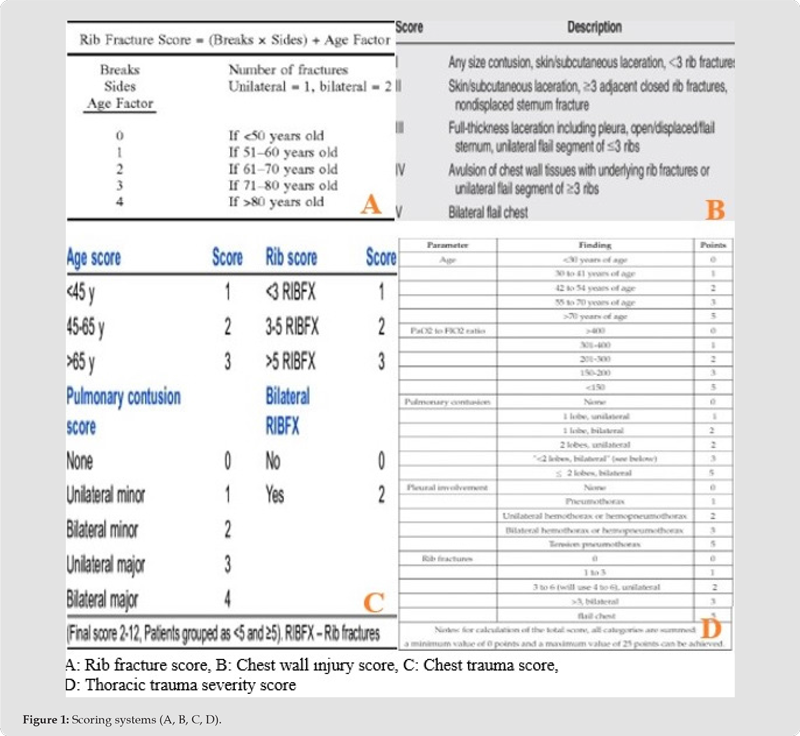
Patients’ age, gender, symptoms, fracture localization, radiological findings, diagnosis and treatment methods, complications, concomitant injuries, mean number of fractures, Rib fracture score (RFS), Chest wall injury score (CWIS), Chest trauma score (CTS), Thoracic Trauma severity score (TTSS), Injury severity score (ISS) (Figure 1), and mortality and morbidity rates were recorded. While continuous variables were expressed as mean ± standard deviation, categorical variables were explained as number-ratio.
Figure 1
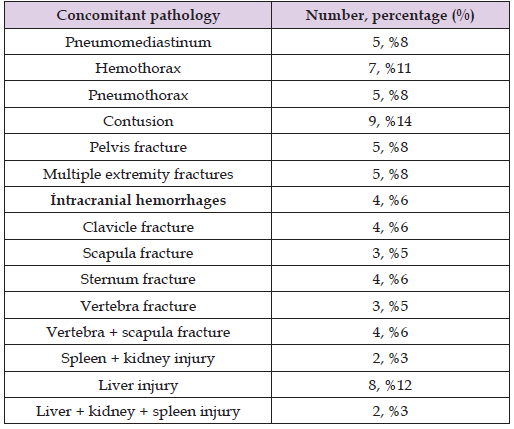
The total number of patients who were followed up and treated for rib fractures was 482, and the number of patients with isolated floating rib fractures was 66 (14%). The mean age of these patients was 57.12 ± 15.88 years. Etiological causes were traffic accidents in 47 (71%) and falling from a height in 19 (29%). The number of surviving patients was 55 (83%) while the number of patients who died was 11 (17%). All patients (92%) were male. Fractures had right localization in 37 (56%), left in 27 (41%), and bilateral in 2 (3%) (Table 1). The most common complaints of the patients were chest pain, shortness of breath, and abdominal pain. The main diagnostic methods were physical examination findings, chest X-ray, and mostly computed tomography of the thorax (Figure 2). Concomitant pathologies were contusion in 9 (14%) patients, pneumothorax in 5 (8%), hemothorax in 7 (11%), and pneumomediastinum in 5 (8%) patients. Concomitant injuries were pelvic fracture in 5 (8%), multiple extremity fractures in 5 (8%), intracranial hemorrhages (subdural or subarachnoid) in 4 (6%), sternum in 4 (6%), clavicle in 4 (6%), scapula in 3 (5%), vertebra in 3 (5%), vertebra + scapula in 4 (6%), liver in 8 (12%), spleen + kidney in 2 (3%), and liver + kidney + spleen injury in 2 (3%) (Table 2). The mean number of fractures were 1.01 ± 0.80, RFS; 2,11 ± 0,18, CWIS; 1,01 ± 0,1, CTS; 4,1 ± 0,25, TTSS; 3,22 ± 1,41, and ISS; 15,23 ± 4,63.
Table 1: Demographic distribution of patients with rib fractures.
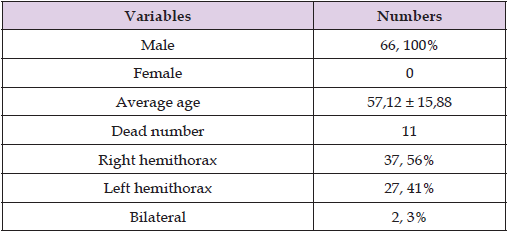
Note: %; Percentage
Figure 2
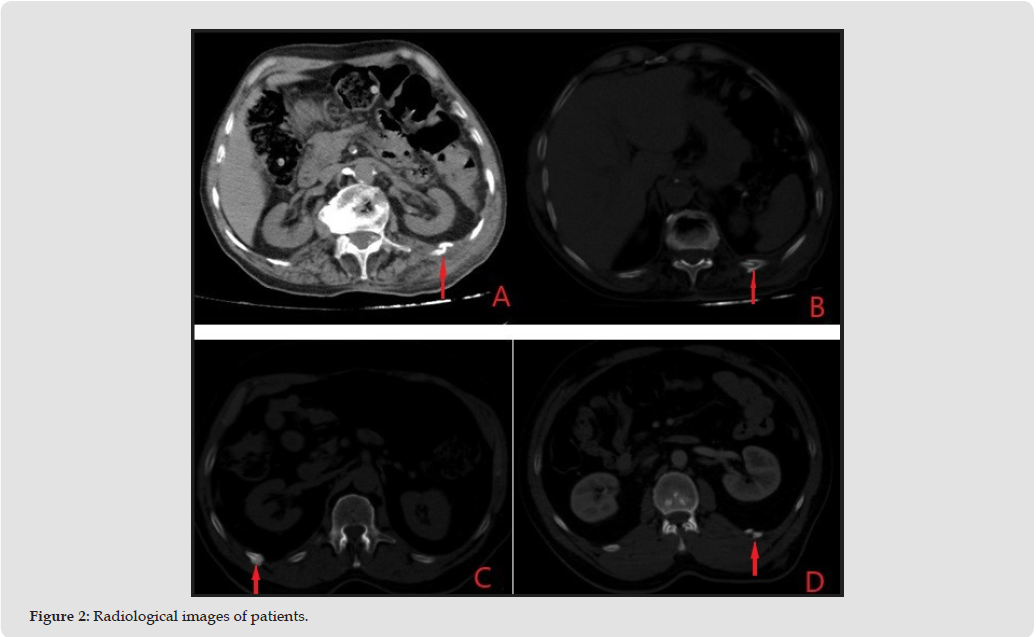
Table 2: Concomitant pathologies and injuries accompanying rib fractures.
In the treatment, 7(%11) patients underwent tube thoracostomy, and all patients with pneumomediastinum underwent fiberoptic bronchoscopy + esophageal passage graph, and endoscopy. 6 (9%) of the patients with intraabdominal injury, 3 (5%) of those with intracranial bleeding, and 8 (12%) of those with pelvis and extremity fractures were operated. 4 (6%) of the patients with intra-abdominal bleeding, 3 (5%) of those with intracranial bleeding, and 4 (6%) of those with pelvis and multiple extremity fractures died. The most common morbidities in the patients were pneumonia (n: 4, 6%) and atelectasis (n: 2, 3%). The mean length of hospital stay was 7 ± 4 days.
The incidence of rib fractures due to trauma has been reported to be 7-9%, and the mortality rate to be 10-12% [4-6]. Since only patients with isolated floating rib fractures were studied in our study, the rate of floating rib fractures due to trauma was 14%, and the mortality rate was 17% (Table 3). The prognosis for rib fractures depends on the age of the patient, the number of broken ribs, and the condition of concomitant injuries. In frontal traumas, the rib is fractured from the outer surface due to compression, and mediastinal injury is usually seen. In lateral trauma, the rib is broken internally and pleuropulmonary injury is common. The most common fractures are between the 4-9th ribs. In these fractures, lung, pleura, bronchial, and cardiac injuries can be seen. First and second rib fractures are observed in high-energy traumas. Since the upper ribs are surrounded by the calvicula, scapula and shoulder, great force is required to break especially the 1st and 2nd ribs. Subclavian vascular injuries are common in these fractures. There may be minor aorta and innominate artery injuries and tracheobronchial injuries. Fractures between the 9th and 12th ribs should suggest abdominal organs and spinal injuries. Liver and spleen injuries may be observed, especially in fractures of the 10th and 11th ribs [5-7].
Table 3: Comparison of the mean score values of the groups.

Note: RF; Rib fracture, RFS; Rib Fracture Score, CWIS; Chest Wall Injury Score, CTS; Chest Trauma Score, TTSS; Thoracic Trauma Severity Score, ISS; Injury Severity Score
The diagnosis of rib fractures is mainly made by physical examination. The presence of pleuritic chest pain and tenderness on physical examination guide the diagnosis. The pain increases with coughing and breathing. Due to severe pain, patients cannot remove secretions. Atelectasis occurs and patients face the danger of hypoxia and metabolic acidosis due to pulmonary shunts. Rib fractures may not be seen up to 50% in chest X-ray, and lateral rib fractures may be hidden by rib lines when there is no obvious separation. Lower rib fractures can be observed on thoracolumbar radiographs. Intra-abdominal hemorrhage should be evaluated in lower rib fractures [1-4]. In our study, the most common complaints were chest pain, shortness of breath, and abdominal pain, and the main diagnostic methods were physical examination findings, chest X-ray, and mostly computed tomography of the thorax. Early complications in rib fractures are contusion, pneumothorax, and hemothorax, whereas late complications are atelectasis and pneumonia. Broken ends can puncture the lung, diaphragm, and abdominal organs [2]. Concomitant pathologies were contusion in 9 (14%) patients, pneumothorax in 5 (8%), hemothorax in 7 (11%), pneumomediastinum in 5 (8%) patients. Concomitant injuries, on the other hand, were pelvic fracture in 5 (8%) patients, multiple extremity fractures in 5 (8%), intracranial hemorrhages (subdural or subarachnoid) in 4 (6%), sternum in 4 (6%), clavicle in 4 (6%), scapula in 3 (5%), vertebra in 3 (5%), vertebra + scapula in 4 (6%), liver in 8 (12%), spleen + kidney in 2 (3%), and liver + kidney + spleen injury in 2 (3%) patients.
RFS is a scoring method used to determine the risk ratio of complications that may develop due to rib fractures in adult patients [8]. It has been reported that patients with RFS above 7 points need strong analgesic therapy [9]. In our study, RFS was 2.11 ± 0.18. Except for routine analgesic treatment, the patients did not need analgesic treatment. Because floating ribs are free-ended, their fractures are less painful than other rib fractures, and bilateral fractures are very rare. CWIS is a scoring method that is between 1-5. It has been reported that there is an increase in mortality and morbidity with the increase in scoring [10]. In our study, CWIS values were found to be 1.01 ± 0.1 since these patients were cases with mild skin abrasion and contusion, mostly accompanied by sternum fractures rarely and without flail segment. CTS is a scoring method based on patient age, number of broken ribs, fracture location, and lung contusion. Chen et al. reported that the probability of poor outcomes such as complications and mortality can be predicted in patients with thoracic trauma with a CTS above 5 [11,12]. In our study, the CTS values were found to be 4.1 ± 0.25. Because in this scoring, injuries to the accompanying organs or other systems were not taken into account. TTSS is a scoring system closely related to mortality and morbidity [13]. Elbaih et al. reported that TTSS is a very significant scoring system for mortality and morbidity [14]. In our study, the TTSS value was found to be 3.22 ± 1.41. In this scoring system, similar to CTS, injuries to the accompanying organs or other systems were not taken into account.
With ISS, injuries that are not life-threatening alone have been shown to significantly affect mortality when combined with injuries to other organs. If the ISS is greater than 16, major trauma is present. The mortality rate does not increase directly with higher ISS scores, and different injury combinations may yield the same ISS values even though they have different mortality rates. All injuries must be identified when performing the calculation, which is possible only when the patient is discharged. Similar to ISS, it is a calculation method made after the patient is discharged [15]. In our study, ISS values were 15.23 ± 4.63. In our study, a high value was found because injuries related to the accompanying organs or other systems were also taken into account. The main approach in the treatment of rib fractures is pain control and breathing exercise. Hypoventilation due to pain predisposes to secretion retention, atelectasis, and infection. For this reason, pain should be prevented and respiratory physiotherapy should be performed. [16]. In our study, 7 (%) patients underwent tube thoracostomy. In addition, we found that 6 (9%) patients with intra-abdominal injury, 3 (5%) patients with intracranial hemorrhage, and 8 (12%) patients with pelvis and extremity fractures were operated.
In patients with isolated floating rib fractures, concomitant pathologies and organ injuries are the most effective factors in mortality and morbidity. Although trauma scoring scales do not yield high scores, ISS values can be used to evaluate for such fractures. Intra-abdominal injuries, especially those that may occur in the early period and during follow-up, should not be ignored in patients with floating rib fractures. In treatment, patients should be monitored; oxygen saturation, arterial blood pressure, cardiac rhythm, and arterial blood gas should be followed. Pain control and respiratory physiotherapy should be provided. While the primary treatment method in patients with intrathoracic complications is simple tube thoracostomy, more comprehensive surgical interventions should be performed in necessary cases despite high mortality.
The authors received no financial support for the research, authorship, and/or publication of this article.
The authors declared no potential conflicts of interest with respect to the research, authorship, and/or publication of this article.
All patients provided written informed consent and the study was approved by ethical committee.

International Association of Landscape Archaeology, Czech Glass Society, Czech Republic

Department of Chemistry, Semenov Institute of Chemical Physics, USSR Academy of Sciences, Moscow, Russia

Neurology, LA BioMed Research Institute, USA

Associate Professor at Department of Breast and Thyorid Surgey, Chongqing General Hospital, China

Professor of Nuclear Medicine, Faculty of Medicine and Surgery, University of Milan, Milan, Italy





 Abstract
 PDF
PDF



























