info@biomedres.us
+1 (502) 904-2126
One Westbrook Corporate Center, Suite 300, Westchester, IL 60154, USA
Site Map
 ISSN: 2574 -1241
ISSN: 2574 -1241
ISSN: 2574 -1241
Received: March 24, 2025; Published: April 09, 2025
*Corresponding author: VM Poznyakovsky, Kemerovo State Medical University of the Ministry of Health of the Russian Federation, Kemerovo, Russia
DOI: 10.26717/BJSTR.2025.61.009583
Alzheimer’s disease is a disease caused by the atrophy of brain tissue. It is accompanied by progressive senile dementia. Current methods of prevention and treatment are poorly studied and require further research. Of no small importance is the use of natural biologically active complexes with a directed neurotropic effect in the correction of metabolic disorders in the disease in question. The aim of the work was to study the neuroprotective and neurotropic efficacy of a biocomplex in the form of a dietary supplement based on maral antlers in the conditions of modeling Alzheimer’s disease.
Tasks
• To study the efficacy of pantohematogen preparations in the amount of 20 and 45mg/kg on impaired cognitive functions of rats by introducing a fragment of betaamyloid 25-35 into the basal nucleus of Meinert, the main source of cholinergic projections in the cortex of the cerebral hemispheres (translational model of Alzheimer’s disease).
• To determine the effect of dietary supplements on the activity of the enzyme for the synthesis of acetylcholine – choline acetyltransferase as a marker of the density of cholinergic projections into the cerebral cortex.
• To assess the effect of the tested drugs on the level of testosterone and dehydroepiandrosterone in the blood serum.
Objects and Materials
The studies were carried out on male rats of the Wistar line, obtained from the Stolbovaya kennel of the Russian Academy of Medical Sciences. The animals of the experimental and control groups were kept on a standard diet under the same conditions in accordance with the Russian rules of laboratory practice [1]. 8 groups of 10 rats each were formed:
• 1st – falsely operated animals.
• 2nd (control) – animals with a model of Alzheimer’s disease, which were injected with water for injections.
• 3rd – animals, animals with a model of Alzheimer’s disease, which were injected with Pantobiol-4-1 at a dose of 45 mg/ kg.
• 4th – animals with a model of Alzheimer’s disease, which were injected with Pantobiol-4-1 at a dose of 20 mg/kg.
• 5th – animals with a model of Alzheimer’s disease, which were injected with Pantobiol-4-2 at a dose of 45 mg/kg.
• 6th – animals with a model of Alzheimer’s disease, which were injected with Pantobiol-4-2 at a dose of 20 mg/kg.
• 7th – animals with a model of Alzheimer’s disease, which were injected with Pantobiol-4-3 at a dose of 45 mg/kg.
• 8th – animals with a model of Alzheimer’s disease, which were injected with Pantobiol-4-3 at a dose of 20 mg/kg.
Panbiol preparations were administered Per os through probes in the form of aqueous solutions of 1 ml/kg of water, animals of the first and second groups – 1 ml/kg of water after 3 hours, as well as on the second, fourth and sixth days after the modeling operation. Testing of cognitive functions was carried out on days 16-18 after modeling the disease by the indicator of recognition of a new object, on days 20-21 - testing on a model of passive avoidance. Panbiol preparations are deer antler powder, obtained using a special patented technology. They contain tissue growth factors: insulin-like growth factors (IGF- 1, IGF-2), nervous tissue growth factor (NGF), cartilage growth factor, bone growth factor, transforming growth factors (TGF-α, TGF-β); short-chain peptides, amino acids, lipids, phospholipids, glucosamine sulfate, chondroitin, collagen, hormones (testosterone, DHEA, erythropoietin), periostal stem cells, vitamins (A, B1, B2, B5, B6, B9, B12, D, E, F, P), minerals (calcium, phosphorus, potassium, magnesium, sodium, zinc, etc.).
Modeling Alzheimer’s disease. It was obtained by injecting a fragment of 25-35 beta-amyloid into the basal giant cell nucleus of Meinert, which provokes a change in cognitive dysfunctions, expressed in a negative change in cholinergic afferentation of the cerebral cortex. Beta-amyloid injections were carried out on a stereotactic unit using a Hamilton microsyringe manufactured by TSE, Germany, at the coordinates AP-1.5, DL ±2.7, H 8.1 [2]. Rats of groups 2-5 received betaamyloid fragment (25-35) bilaterally - 2μg in 1μl of saline. The first group with a false operation is 1 μl of saline. In total, 80 animals are involved in the operation, the mortality rate is 0%. New object recognition model. The recognition test consists of three 5-minute sessions with an interval of 24 hours: 1 session included adaptation to the installation without the objects of study, 2 - using metal cylinders with a diameter of 6 cm and a height of 8 cm, with the presence of two identical objects for familiarization, 3 - a testing session, including the replacement of one of the cylinders with a plastic cube with a rib length of 6 cm EthoVision XT - Noldus. The recognition index was determined using the formula: (Tn – Tz/Tn+Tz)* 100%, where Tn is the time of the “new” object, and Tz is the time of the study of the “familiar” object during the third session [3,4]. Passive avoidance model. An experimental chamber from Columbus Instruments (USA) was used, consisting of two identical compartments measuring 25x40x25 cm.
Animals were placed in the illuminated compartment to develop passive avoidance and the time of their transition to another, darkened compartment for the mink reflex was noted. After the animals were placed in a dark chamber, electrocutaneous stimulation was applied to them through metal floor rods at a dose of 0.6 mA, 3 s, and transferred from the chamber to the home cage. After 48 hours of the experiment, the rats were tested for the acquired skill again with the recording of the time of transition to the dark half [2,5]. Determination of Choline Acetyltransferase (CAT) activity. On the 22nd day of the experiment, after the end of testing, the animals were decapitated, the cerebral cortex was isolated and 5% homogenate in 10 mM phosphate buffer (pH 7.4), containing 10 mM EDTA, and 0.5% Triton X-100 were prepared. All procedures were carried out at 4°C, the obtained samples were stored at -80°C. The activity of CAT was determined by the F. Fonnum radiometric method [6]. The method is based on the properties of sodium tetraphenylborate (Calignost) to selectively bind ACh and dissolve only in organic solvents. Initial solutions of reagents ([1-14C]CoASA in H2Obidist, Triton X-100, NaCl and EDTA-Na2 in Na-phosphate buffer, pH = 7.4-7.5, as well as choline chloride, physostigmine, albumin, MgCl2, NaCl in H2Obidist) stored tO=-26°C. The reaction medium was prepared estempore before the experiment, the enzymatic reaction was carried out under conditions of mixing the homogenate with a final protein concentration in the sample of 3.5 mg with the reaction medium.
Composition of the reaction mixture and final concentrations: [1- 14C] CoASA, 0.2 mM (SRA - 5 mCi/mmol); choline chloride, 10 mM; physostigmine salicylate, 0.2 mM; NaCl, 300 mM; MgCl2, 3 mM; Triton X-100, 0.5% (m/V), albumin, 0.5 mg/ml; EDTA-Na2, 1 mM; Na-phosphate buffer, 10 mM, 5% homogenate - 70 mg protein/ml; pH=7.4-7.5. The reaction took place in a total volume of 50 μl in a water bath with a shaker at +37°C, t incubus = 15 min. The reaction was stopped by adding 2 ml of ice solution of 0.2 mM ACh in 10 mM Na-phosphate buffer, pH = 7.4-7.5, and cooling in an ice bath. Then 1 ml of Calignost solution in butyl acetate (15 mg/ml) was added and the samples were vigorously shaken on a rocking chair (500 rpm, 4 min). During this time, the synthesized ACh was extracted into the organic phase, which was separated from the inorganic phase by centrifugation on a refrigerated ultracentrifuge K-23 (Germany) in a bucket rotor ― cross‖, 1000g x 15 min, tO = +2 - +4°C. The organic phase (0.3 mL) was transferred to vials of scintillator liquid. The concentration of the accumulated [1-14C]AC was measured by DPM on a liquid scintillator counter ―RackBeta‖ (version 1211) of the company ―LKB/Wallac‖. ―Blind‖ samples were determined for each concentration of the substrate in parallel with the experimental samples and according to the same scheme, using ‖the isolation medium instead of the subfraction (0.32 M sucrose, 1 mM EDTA-Na2, 3 mM TrisHCL buffer, pH = 7.4-7.5). The determination was carried out selectively in animals of 4 groups:
• pseudooperated rats (group 1),
• control animals (group 2).
• animals treated with pantobiol 4-2 at a dose of 20 mg/kg (group 6), - animals treated with pantobiol 4-3 at a dose of 20 mg/kg (group 8). Determination of the hormones testosterone and Dihydroepiandrosterone (DHEA) in the blood serum. On the 7th day after surgery (24 hours after the last administration of drugs), blood was taken from the subclavian vein in animals of all groups and serum samples were obtained. In the obtained samples, the level of testosterone and DHEA was determined by enzyme-linked immunosorbent assay using sets from DRG Diagnostics GmbH (Germany) and an automatic reader Model 680 Microplate Reader Accessories (Bio-Rad, UK). The determination was carried out in accordance with the manufacturer’s protocols. Statistical processing of results. The results were statistically processed using the ANOVA analysis of variance. The significance of the differences between the groups was assessed using the Tukey test (HSD) to reduce the effect of multiple comparisons. Results of the study. Table 1 presents the results of the study on the effect of the tested drugs on the behavior of animals in the object recognition model. The effect of the Group factor (F7, 72) = 2.62, p=0.018) in the training session in relation to the total time spent examining objects in the training session was revealed.
Table 1: The Influence of Dietary Supplements on the Indicators of Orientative-Research Activity and Long-Term Memory in the Object Recognition Model.

Note: * - the level of significance of differences from falsely operated animals (Tukey HSD test),
#The level of significance of differences from the control (Tukey HSD test)
A posteriori analysis showed that the animals receiving Pantobiol 4-1 at a dose of 45 mg/mg examined the objects in the training session for significantly less time than the falsely operated animals (Table 1) and did not differ in this parameter from the control group (p=0.327), and the decrease relative to the other experimental groups (groups 4-8) was a trend ( 0.05≦p ≦ 0.08). The influence of the Group factor on the total time of studying objects in the testing session was observed at the trend level (F(7, 72)=1.74, p=0.092). Tukey’s HSD test revealed a decrease in this indicator in animals treated with Pantobiol 4-1 at a dose of 45 mg/mg, only relative to the group of falsely operated animals, and the differences from the other groups did not even reach the trend level (p > 0.1). The main indicator of long-term memory in the object recognition model is the discrimination index. Given the significant intergroup differences in research activity in the training session, this indicator was used as a covariate in the analysis of the discrimination index. The analysis of variance revealed a significant effect of the Group F(7, 72) = 6.08, p=0.00001, and the Tukey HSD test showed a significant decrease in the discrimination index in the control group relative to falsely operated animals, indicating a violation of long-term declarative memory, which confirms the validity of the model. In groups 3-8, the values of the discrimination index were statistically significantly higher than in the control group, mainly due to a reduction in the time of examination of the “old”, familiar object.
At the same time, in groups 4 (Pantobiol 4-1, 20 mg/kg) and 5 (Pantobiol 4-2, 45 mg/kg), the values of the discrimination index were significantly lower than in group 1 (false operation); That is, the cognitive deficit in these groups was not completely eliminated. Groups 3 and 6-8 did not show significant differences from pseudooperated rats. Thus, the most pronounced and stable effect in this model was demonstrated by the Pantobiol 4-3 sample.
Passive Avoidance Test
When analyzing the behavior of animals in the passive avoidance model, several parameters were evaluated (Table 2). The indicator of the time of transition to the dark compartment in the training session (before electroshock) characterizes the combination of motor activity, orientative-exploratory behavior and the level of photophobia. The analysis of variance did not reveal a significant effect of the Group’s factor on this indicator (F (7.72) = 0.46, p = 0.86. The time of transition to the dark compartment in the testing session characterizes the long-term memory of the painful irritation received in the dark compartment. The analysis of variance revealed significant differences in this indicator between the groups F(7, 72) = 6.6035, p<0.001. The Tukey HSD test showed that in the control (group 2) and in animals receiving Pantobiol 4-1 at a dose of 45 mg/kg (group 3), the value of this indicator was significantly lower than in falsely operated animals. In groups 4-8, the differences with false-operated animals are insignificant, and there is a significant increase in transition time compared to controls. Another indicator of long-term memory in the passive avoidance model is the increase in transition time in the testing session compared to the training session. The effect of group F(7, 72) = 5.72 p<0.001 was established. A comparison by the Tukey HSD test showed that in groups 4-8 there was a recovery in the ability to learn, while Pantobiol 4-1 at a dose of 45 mg/kg had no effect. Activity of choline acetyltransferase in the cortex of the cerebral hemispheres.
Table 2: Effect of Dietary Supplement Subjects on Learning Indicators in a Rat Model of Passive Avoidance with Amyloid Beta Administration.

Note: * - the level of significance of differences from falsely operated animals (Tukey HSD test) # the level of significance of differences from the control (Tukey HSD test).
The activity of CAT in the control group was statistically significantly reduced relative to the similar indicator in the sham group (Table 3). The revealed decrease indicates a decrease in the activity of cholinergic projections into the cortex, the main source of which is the basal nucleus of Meinert. The results obtained are consistent with the data of the literature [7]. The administration of Pantobiol 4-2 at a dose of 20 mg/kg and Pantobiol 4-3 at a dose of 20 mg/kg restored the activity of CAT to the level of falsely operated group. The content of testosterone and DHEA in the blood serum was determined. Administration of beta-amyloid had no effect on serum testosterone levels. Administration of Pantobiol 4-2 and 4-3 in both doses used caused an increase in testosterone levels, while the effect of Pantobiol 4-1 was significant only at a dose of 45 mg/kg, but not at 20 mg/kg (Table 4). It should be noted that the testosterone level in group 5 receiving 45 mg/kg of Pantobiol-2 was significantly higher (p<0.05) than in the groups receiving dietary supplements. Administration of beta-amyloid led to an increase in serum DHEA levels. The biocomplex in the amount of 45 mg/kg reduced the level of the hormone to the level observed in falsely operated animals. None of the drugs at a dose of 20 mg/kg had an effect on DHEA levels.
Table 3: Choline acetyltransferase (CAT) activity in the cerebral cortex of rats.

Note: * - p<0.01 level of significance of differences from falsely operated animals (Tukey HSD test), ^^ p<0.01 level of significance of differences from control (Tukey HSD test).
Table 4:Plasma levels of testosterone and DHEA in animals of various groups.
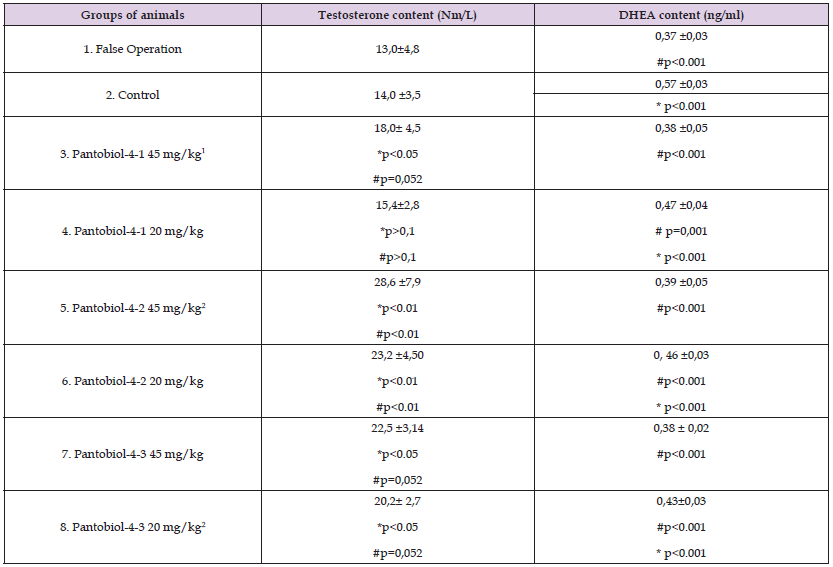
Note: * - the significance of the differences from the sham operation
# - significance of differences from the control group
The results of the experiments showed the effectiveness of Pantobiol- 4 drugs for restoring the functions of the central nervous system disturbed as a result of the toxic effect of a fragment of beta-amyloid (25-35) on the basal giant cell nucleus. The data obtained indicate a wide range of biological activity of the tested bio complexes and the presence of a specific pattern of effects in relation to cognitive functions. In terms of behavior testing, Pantobiol 4-3 is the most optimal in terms of the totality of the observed effects. Thus, the object recognition model revealed that the stimulating effect of Pantobiol-4-1 at a dose of 20 mg/kg and Pantobiol 4-2 at a dose of 45 mg/kg on long-term declarative memory was less than that of the corresponding doses of Pantobiol 4-3. It was found that Pantobiol 4-1 is characterized by a direct, and Pantobiol 4-2 is characterized by an inverted dose-dependent effect. The effects of Pantobiol 4-3 at doses of 20 and 45 mg/kg did not differ significantly. In the passive avoidance model, neuroprotective activity was not detected in the Pantobiol 4-1 sample at a dose of 45 mg/kg but was observed at 20 mg/kg of the drug, i.e., an inverse dose-response was observed. All other samples effectively restored long-term memory in the passive-defensive behavior model. At the same time, the assessment of the activity of CAT (preservation of cholinergic projections in the cortex) showed that Pantobiol 4-2 and Pantobiol 4-3 at a dose of 20 mg/kg have equally pronounced neuroprotective effects.
When examining hormone levels, it was found that Pantobiol 4-2 increases testosterone levels to the greatest extent. The effects of testosterone on cognitive functions are ambiguous: high doses of the hormone can cause a decrease in the effectiveness of tests [8-10]. Thus, it is possible that the inverse dose-dependent effect of Pantobiol 4-2 in the object recognition test is due to its effect on the hormonal background, leading to a change in orientation and exploratory behavior. It can be assumed that the features of the dose-effect dependence identified for Pantobiol 4-1 are also due to the ratio of neuroprotective and generalized activation effects of this sample, but in general, its cognitive activity is significantly inferior to drugs 4-2 and 4-3. The introduction of beta-amyloid increases the level of DHEA, which is explained by oxidative mechanisms of activation of alternative pathways of its biosynthesis. Such a reaction of exchange and activation has been confirmed by a number of authors [11,12]. In our case, these mechanisms can be realized in conditions of dislocation when beta-amyloid enters the capillary bed of brain tissue and further transit into the general circulation. It can be induced by specific signals from the central nervous system. In rats, the contribution of this alternative DHEA synthesis to total DHEA levels may be particularly significant, since the amount of the hormone produced by the adrenal glands in them, unlike in primates, is negligible.
The normalization of serum DHEA in animals treated with Pantobiol- 4, which we observed, indicates that their complex protective effect may include antioxidant effects. Analysis of the totality of the obtained behavioural and biochemical data allows us to conclude that Pantobiol 4-2 and 4-3 have a high level of neuroprotective efficacy in a translational model of Alzheimer’s disease.

International Association of Landscape Archaeology, Czech Glass Society, Czech Republic

Department of Chemistry, Semenov Institute of Chemical Physics, USSR Academy of Sciences, Moscow, Russia

Neurology, LA BioMed Research Institute, USA

Associate Professor at Department of Breast and Thyorid Surgey, Chongqing General Hospital, China

Professor of Nuclear Medicine, Faculty of Medicine and Surgery, University of Milan, Milan, Italy





 Abstract
 PDF
PDF