info@biomedres.us
+1 (502) 904-2126
One Westbrook Corporate Center, Suite 300, Westchester, IL 60154, USA
Site Map
 ISSN: 2574 -1241
ISSN: 2574 -1241
ISSN: 2574 -1241
Received: February 28, 2025; Published: April 08, 2025
*Corresponding author: Lawrence O Flowers, Associate Professor of Biology Department of Biological and Physical Sciences Saint Augustine’s University, USA
DOI: 10.26717/BJSTR.2025.61.009576
The phytomicrobiome refers to all the symbiotic microorganisms and microbial genes that interact independently or synergistically with plant tissue and genome. Considerable research is devoted to plant abiotic and biotic stress factors. However, very little is known about the phytomicrobiome as it relates to plant stress and tolerance systems. Microbial tolerance mechanisms are synchronized events involving distinct microbial populations that often result in the suppression of microbial species or propagation of key species that possess genomes responsible for protective anti-stress proteins and pro-tolerance mechanisms that mediate plant health. Filling this research gap is essential to elucidating new knowledge about plant growth and development. Insights into phytomicrobiome and plant health may provide an impetus for new technologies and economic opportunities.
Keywords: Phytomicrobiome; Abiotic; Biotic; Plant Stress; Plant Tolerance
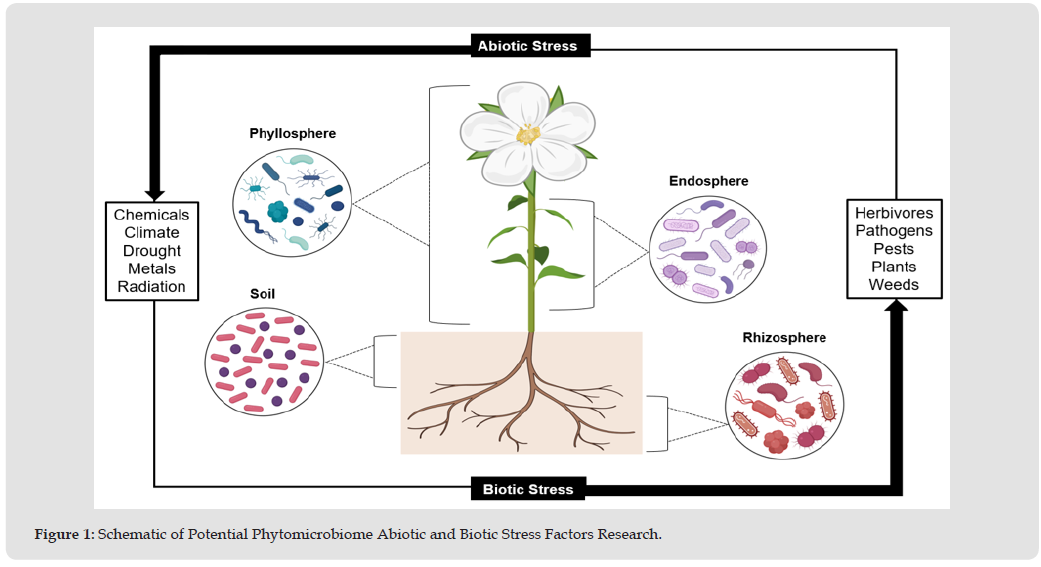
The phytomicrobiome or plant microbiome refers to the intricate relationship between microorganisms, plant structures, and soil adjacent to plant roots [1]. The phytomicrobiome contributes to crop production, plant growth, health, and disease. A better understanding of the phytomicrobiome and the microbial response to adverse plant changes from physical, chemical, and biological factors may lead to a more robust understanding of host-microbe interactions and microbial ecology. Moreover, plant stress response factors may hold essential clues to formulate sustainable agricultural practices for mitigating the effects of abiotic and biotic plant stress on plant health [2,3]. More investigation is needed to comprehend the complex relationship between plants and plant-associated microorganisms. Future experimental techniques will ascertain how the phytomicrobiome facilitates plant tolerance to abiotic and biotic stress that threatens plant health and fecundity. A firm understanding of the numerous microbial biochemical pathways mediating plant resistance to unfavorable chemical and physical pressures may lead to the next generation of synthetic products and therapeutics that can produce immeasurable societal benefits [4]. Plant tolerance refers to modifications a plant undergoes in response to biological or non-biological stress types. Researchers have explored plant transcription factors and enzymes, scavenger molecules, and hormones that play a role in plant tolerance mechanisms as a strategy to produce better crops and promote plant health [5]. Examining the effects of abiotic and biotic stress factors on the phytomicrobiome involves four primary experimental approaches. The four methods are 16S rRNA gene sequencing, metagenomic shotgun sequencing, microbial culture methods, and biochemical testing. In addition to conducting experiments on soil, investigations on the phyllosphere, endosphere, and rhizosphere are sufficient to glean a comprehensive picture of the relationship between plants and the phytomicrobiome. While many relevant research questions exist, two primary research questions represent fertile areas of exploration: How do plant-associated microbes sense plant stress? How do phytomicrobiome communities mobilize to protect plants?
Phytomicrobiome and Abiotic Stress Factors
Abiotic stress factors refer to non-living elements in the biosphere that interact with plants and plant structures that negatively alter plant growth. Abiotic stress factors are environmental or physical components and include, but are not limited to, drought, extreme temperatures, salinity, nutrient deficiencies, radiation, heavy metals, wind, and soil pH imbalances [6]. The primary focus of this commentary is to strongly encourage students and experienced researchers to consider exploring the phytomicrobiome and abiotic stress factors from an experimental perspective. The relative ease of conducting controlled phytomicrobiome experiments in the lab or field adds to the amenability and advantages of performing this type of research. Suppose you require additional information about how to set up abiotic stress conditions in the laboratory. In that case, the literature contains many studies that provide specific information regarding the materials and methods needed to simulate drought, extreme temperatures, and soil pH irregularities in the laboratory. Climate change and drought, among many other abiotic stress factors, have led to profound decreases in the world’s food supply. Identifying specific microbes or groups of microbes susceptible to genetic engineering will aid in designing comprehensive and sustainable biodegradable agriculture practices to combat climate change, drought, and nutrient deficiency to improve crop production, which is desirable to society [7].
Phytomicrobiome and Biotic Stress Factors
Biotic stress factors refer to biological organisms associated with plant tissue or soil that produce undesirable observable or latent physiological or underlying biochemical and cellular alterations deleterious to plant health. Biotic stress factors include but are not limited to bacteria, fungi, insects, weeds, helminths, and other plants. Viruses are biotic stress factors, although viruses are not living organisms. Specifically, biotic stress factors interrupt plant metabolism, reproduction, and nutrient transport, leading to disease or reduced growth rates. Examining the phytomicrobiome may reveal microbial plant resistance agents that counteract biotic stress factors and mediate plant stress tolerance. In 2025, researchers performed a painstaking meta-analysis study to demonstrate that rhizosphere microbiome inoculants contributed to plant tolerance from herbivorous insects [8]. Endophytes typically perform life-sustaining processes such as producing growth metabolites and have been utilized as biocontrol instruments [9]. While phytomicrobiome-based tolerance mechanisms have demonstrated similar actions and abundance of specific microbial species, more coverage in this area will undoubtedly produce the discovery of new species enriched for stress resistance in plants in response to biotic stress factors.
While we know a great deal about plant stress response systems, we know very little about the contributions of the phytomicrobiome in response to abiotic and biotic stress variables. In general, evidence indicates that plants impact phytomicrobiome communities, and phytomicrobiome communities impact plants in ways that are not fully understood. The phytomicrobiome has evolved over millions of years, and thus, unlike biotic stress agents, it does not cause disease or negatively impact plant growth. A better understanding of the microbial populations mediating plant tolerance mechanisms will lead to identifying genes, transcription factors, biochemical pathways, bacterial crosstalk systems, and proteins that may improve plant growth during unfavorable conditions [10]. Future review articles will explore the different strategies specific microbes employ to enhance plant growth. Genetic engineering and biotechnological applications may revolutionize how botanists and farmers protect valuable crops from environmental, physical, and pathogenic threats. The research exploration recommendations in this article are best suited for research and educational purposes. From culture-based studies to complex sequencing studies, phytomicrobiome research holds great promise for engaging many students in original undergraduate research programs. Undergraduate research is vital in adequately preparing students for graduate school, research careers, or STEM-based jobs (Figure 1).
Figure 1
Phytomicrobiome research is cost-effective and, given the nature of the experimental procedures, such as microbial species identification and differential abundance analysis, does not require expensive equipment to establish basic phytomicrobiome research laboratories, which are essential for institutions that lack significant resources. Furthermore, students gain knowledge about biological defense mechanisms that protect plants from abiotic and predatory biotic entities (e.g., insects, worms, fungi) and may uncover novel information about how microbes mount tolerance resistance mechanisms to either target biological plant pathogens or modify plant tissue to withstand chemical or physical threats posed by microscopic and macroscopic plant pathogens and abiotic forces. The design of online STEM labs and virtual reality labs may improve student understanding of understudied abiotic and biotic plant defense systems targeted by symbiotic microbes in the endosphere, phyllosphere, rhizosphere, and soil. Even more intriguing about this fertile research area is that researchers, teachers, or college professors can develop research questions and projects from many scientific disciplines depending on curriculum goals, expertise, funding, available equipment, and supplies. The studies advocated in this article address many fields, including microbiology, biochemistry, genetics, molecular biology, bioinformatics, plant immunity, ecology, evolution, and statistics. Further, these studies are excellent for course-based undergraduate research experiences (CUREs) designed to teach scientific methods, lab safety, protocol planning, hypothesis development, and career self-efficacy [11].
This work was supported by grants from the National Science Foundation (EES - 2205612, EES - 2232563, EES - 2306512).

International Association of Landscape Archaeology, Czech Glass Society, Czech Republic

Department of Chemistry, Semenov Institute of Chemical Physics, USSR Academy of Sciences, Moscow, Russia

Neurology, LA BioMed Research Institute, USA

Associate Professor at Department of Breast and Thyorid Surgey, Chongqing General Hospital, China

Professor of Nuclear Medicine, Faculty of Medicine and Surgery, University of Milan, Milan, Italy





 Abstract
 PDF
PDF