info@biomedres.us
+1 (502) 904-2126
One Westbrook Corporate Center, Suite 300, Westchester, IL 60154, USA
Site Map
 ISSN: 2574 -1241
ISSN: 2574 -1241
ISSN: 2574 -1241
Received: March 28, 2025; Published: April 04, 2025
*Corresponding author: Qian-ye ZHAO, Department of Pediatrics, Lianyungang Maternal and Child Health Care Hospital, Lianyungang, Jiangsu, China
DOI: 10.26717/BJSTR.2025.61.009572
Kikuchi-Fujimoto disease (KFD) is a rare, benign, and self-limiting disease characterized by regional lymphadenopathy accompanied with fever. Diagnosis is established through histopathological examination of excisional biopsy specimens. Infection often acts as the primary trigger for KFD. Although most cases of KFD resolve spontaneously, children with KFD who are associated with systemic lupus erythematosus (SLE) may experience recurrent symptomatic episodes of KFD, which may subsequently result in retinal involvement. We present a clinical case involving a 12-year-old female adolescent who developed retinal lesions associated with Kikuchi- Fujimoto and lupus overlap syndrome over a two-week duration.
Keywords: Kikuchi-Fujimoto Disease; Systemic Lupus Erythematosus; Retinopathy
Abbreviations: KFD: Kikuchi-Fujimoto Disease; SLE: Systemic Lupus Erythematosus; ANA: Antinuclear Antibodies; ESR: Erythrocyte Sedimentation Rate; KD: Kawasaki Disease; MIS: Multisystem Inflammatory Syndrome; IVIG: Intravenous Immunoglobulin; SLE-KFD: SLE Coexisting with KFD
Kikuchi-Fujimoto disease (KFD) in pediatric patients is primarily observed in individuals over the age of 10 years. Fever, lymphadenopathy accompanied by tenderness, and skin rashes has been reported with increased frequency in pediatric cases [1]. Additionally, some patients experienced myalgia, arthralgia, weight loss, and aseptic meningitis [2]. Low levels of C4, positive antinuclear antibodies (ANA) [3], and an elevated erythrocyte sedimentation rate (ESR) (> 30 mm/h) [4] were associated with KFD recurrence. Recurrent cases are more likely to progress to systemic lupus erythematosus (SLE) [5], Sjogren’s syndrome (SS) [6] and multiple autoimmune syndrome [7].
The adolescent and her parents provided written informed consent to participate in this study, adhering to the principles outlined in the Declaration of Helsinki. This research was approved by the Institutional Review Board at Lianyungang Maternal and Child Health Hospital (Project No. 2024-XM-016). We present a clinical case of a 12-year-old Chinese girl admitted to the hospital with complaints of a two-week history of febrile, right unilateral cervical lymphadenopathy. Her clinical manifestations included initial lymphadenopathy, multiple facial rashes, bilateral upper limb pain, fatigue, and progressive weight loss throughout the course of her illness. She had no significant past medical history and there was no documented family history of hereditary or rheumatic diseases. Echocardiography revealed no evidence of coronary artery dilation or involvement of its branches at local hospital. Despite receiving empirical antibiotic therapy, she continued to exhibit persistent fever, prompting to her referral to our hospital for further diagnostic assessment and comprehensive therapeutic management. Upon admission, the patient presented with a clear mental state; however, their overall mental status was suboptimal. Multiple patchy, dark red rashes were observed on the forehead and both cheeks. These lesions were slightly elevated above the skin surface, non-pruritic, and non-tender. Cervical rotation to the right was limited, accompanied by localized hyperthermia without evidence of erythema or swelling.
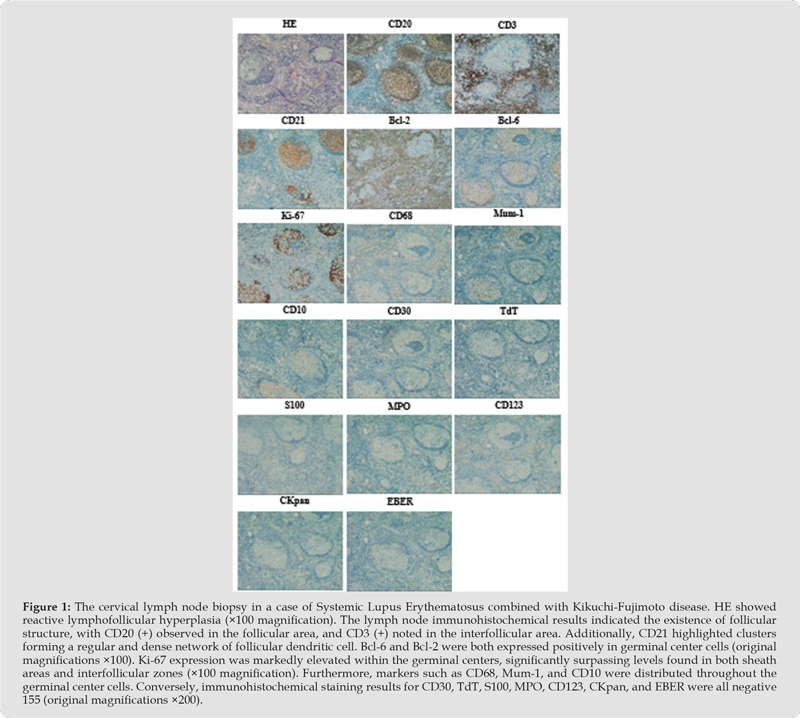
Bilateral palpable cervical lymphadenopathy was observed, with the largest node measuring approximately 3 cm in diameter. No clinical signs of alopecia, eyelid edema, conjunctival congestion or mulberry tongue were observed. The patient also reported the recent onset of blurred vision, her best-corrected visual acuities were 0.8 and 0.6 in the right and left eyes, respectively. A cervical lymph node biopsy was performed, along with comprehensive evaluations of cerebrospinal fluid and bone marrow smears. Pathological findings from the lymph node biopsy revealed chronic lymphadenitis with lymphoid hyperplasia (Figure 1). Bone marrow cytology results were unremarkable. Subsequent peripheral blood tests showed normal leukocyte, lymphocyte, and platelet counts. Pathogen detection via metagenomic next-generation sequencing of cerebrospinal fluid and blood samples yielded negative results, as did the T-SPOT test, streptococcal antibody test, M. pneumoniae antibody test, Epstein-Barr virus PCR, G test, and GM test. Imaging studies demonstrated no significant abnormalities in the bilateral sacroiliac joints or lower extremity bone marrow. MRI scans of the cervical and hip joints revealed multiple enlarged lymph nodes in the neck, submandibular, supraclavicular, infraclavicular, anterior mediastinum, and bilateral axillary regions, with evidence suggestive of possible necrosis. Chest X-ray findings were unremarkable.
Figure 1
Additional laboratory findings included an elevated ferritin level of 486.40 ng/mL and ESR of 40 mm/h, along with reduced complement C3 levels at 0.65 g/L and complement C4 levels at 0.10 g/L. α-interferon levels were markedly increased to 124.4 pg/mL. Although the patient’s fever subsided following the lymph node biopsy, the rash persisted alongside muscle pain and poor appetite. This prompted the initiation of oral prednisone therapy at a dose of 1 mg/kg.d (15 mg twice daily). On the sixth day following admission, autoantibody tests returned positive results for ANA at a titer of 1:640, as well as for antibodies against U1RNP, SSA, histones, ribosomal P protein, nucleosomes, and SS-A 52-kDa (Table 1). Funduscopic examination revealed extensive cotton wool spots bilaterally, and macular edema in the left fundus. Subsequent 24-hour urinary protein quantification was normal, β2-microglobulin assay was negative, and Coombs’ test yielded a positive result. The patient’s rash improved following a regimen of oral prednisone, in conjunction with hydroxychloroquine (150 mg once daily), vitamin D, and calcium supplements, which also provided significant relief from neck pain. Following an eight-day hospitalization, the patient reported a marked reduction in both back and abdominal pain, and visual acuity demonstrated a gradual improvement. Following discharge, during a six-month period of outpatient follow-up, visual acuity returned to baseline levels, and no evidence of SLE-related renal involvement was observed.
Table 1: The results of autoantibodies.
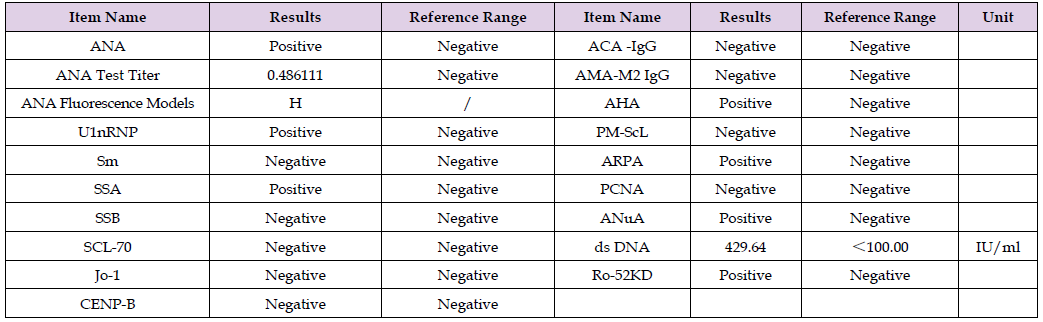
Note: ANA, anti-nuclear antibody; H, Homogeneous; U1nRNP, anti-nuclear ribonucleoprotein U1 small nuclear ribonucleoprotein antibody; Sm, anti- Smith antibody; SCL-70, anti-scleroderma 70 antibody; Jo-1, anti-Jo-1 antibody; CENP-B, anti-centromere protein-B antibody; ACA, anti-cardiolipin antibody; AMA-M2, Anti-mitochondrial antibody M2 subtype; AHA, anti-histone antibody; PM-ScL, anti-PM-Scl antibody; ARPA, anti-ribosomal P protein antibody; PCNA, anti-proliferating cell nuclear antigen antibody; ANuA, anti-nucleosome antibody; ds DNA, anti-double-stranded DNA antibody; Ro-52KD, anti-ribonucleoprotein antigen 52 kDa antibody.
Fever accompanied by cervical lymphadenopathy and impaired neck mobility is uncommon in childhood. These symptoms may be observed in infectious lymphadenitis, Kawasaki disease (KD), multisystem inflammatory syndrome (MIS), and Kikuchi-Fujimoto disease (KFD). Infectious lymphadenitis typically occurs at a younger age and responds effectively to anti-infective therapy [8]. Atypical Kawasaki disease presenting initially with cervical painful lymphadenopathy is more likely to be associated with symptoms such as odynophagia, drooling, and neck stiffness. Additionally, radiographic imaging may reveal a lesion resembling a retropharyngeal abscess. High fever is generally resolved following high-dose intravenous immunoglobulin (IVIG) therapy [9]. In this case, The lack of response to broad-spectrum antibiotics administered at the local hospital further indicated a low probability of acute lymphadenitis. Additionally, given the administration of a single 2 g/kg dose of IVIG without achieving defervescence, and the absence of mucocutaneous lesions throughout the disease course, KD was excluded from the differential diagnosis. Moreover, the patient exhibited no clinical signs indicative of COVID-19 infection; thus, MIS was also ruled out. The pediatric patient presented with generalized lymphadenopathy, predominantly characterized by cervical lymph node enlargement. Defervescence was achieved following cervical lymph node biopsy without antibiotic therapy. Lymph node biopsy demonstrated proliferative type [10], whereas MRI of the cervical lymph nodes suggested the potential presence of necrosis.
Based on these findings, a definitive diagnosis of KFD was established. Upon confirmation of the diagnosis of KFD, further investigation into its potential etiology is warranted. The patient’s onset of illness coincided with the global COVID-19 pandemic; however, the patient had no history COVID-19 vaccination [11], and negative screening results for multiple pathogens. Therefore, various infections and the possibility of COVID-19 vaccine-induced KFD were provisionally excluded. The child tested positive for ANA, and based on diagnostic criteria of SLE, achieved a cumulative score of 20 points [12]. Consequently, the final revised diagnosis was established as Kikuchi- Fujimoto and lupus overlap syndrome (SLE-KFD). Throughout the progression of the disease, the patient had retinal involvement characterized by presentations of cotton wool spots in the bilateral fundi, and exhibited a gradual decline in vision. However, these findings were not initially recognized as being related to fundus involvement associated with SLE prior to the confirmation of positive autoantibody results. SLE-KFD patients exhibit involvement of ocular fundus [13,14], which is significantly associated with visual deterioration and well-known negative prognostic factor for survival. The management of patients with SLE-KFD necessitates a multidisciplinary approach involving rheumatologists, nephrologists, and ophthalmologists, all of whom play a pivotal role in controlling disease progression and enhancing the quality of life for these patients during outpatient follow-up.
The authors wish to thank all medical staff involved in the treatment of the disease.
The authors declare no competing interests.

International Association of Landscape Archaeology, Czech Glass Society, Czech Republic

Department of Chemistry, Semenov Institute of Chemical Physics, USSR Academy of Sciences, Moscow, Russia

Neurology, LA BioMed Research Institute, USA

Associate Professor at Department of Breast and Thyorid Surgey, Chongqing General Hospital, China

Professor of Nuclear Medicine, Faculty of Medicine and Surgery, University of Milan, Milan, Italy





 Abstract
 PDF
PDF



























