info@biomedres.us
+1 (502) 904-2126
One Westbrook Corporate Center, Suite 300, Westchester, IL 60154, USA
Site Map
 ISSN: 2574 -1241
ISSN: 2574 -1241
ISSN: 2574 -1241
Received: March 24, 2025; Published: March 26, 2025
*Corresponding author: Ebrahim Fatahinejad, Departments of soil sciences.Be.C.,islamic azad univercity.Behbahan.iran
DOI: 10.26717/BJSTR.2025.61.009554
Application of plant growth simulating bacteria as bio-fertilizers play an important role in sustainable management ecosystem in farming system, which increases soil fertility and production of any of these systems. Bacteria present in the biological Nitroxin fertilizers cause not only stability in air nitrogen and cause balancing in the absorption of high consumption elements which are tiny but nutritious for the plant, but also discharge Amino acids and variation of antibiotics and cyanide hydrogen, cydrophor Etc. and cause growth and development in the aerial parts of the plant and protect plants root from the soil diseases and therefore the fertility and productivity will increase and in the environmental tension conditions such as salinity and dryness, cause the plants to have more stamina and resilience. To analyze the effect of Nitrogen and Nitroxin bio-fertilizer, on the amount of current photosynthesis and wheat further distribution, a factorial test in complete block type has been conducted randomized with 9 treatments in 4 replications in year 2022 in the city of Behbahan. First factor consisted of 50, 100 and 150 k.g.nitrogen in hectar and second factor conducted with application of bio-fertilizer Nitrox in with 3 different levels of non-inoculation, inoculation and 3 and 6 litres inoculation in a hectar of seeds. The results show that test treatments have significant effect on the further distribution and current photosynthesis and regarding the share of each one we understood that the most amount of further distribution is in 50 k.g Nitrogen treatment together with 3 litres of Nitroxin in each hectar, while the least amount is3 obtained in the treatment of 150 k.g of Nitrogen together with 6 liters of Nitrox in.
Keywords: Organic Fertilizers; Nitrogen; Existing Photosynthesis; Redistribution; Wheat
Biological mechanisms are considered as natural solutions for the use of a safe and inexpensive method for reducing danger for it, since it has been considered as the most important stable agricultural method in wheat cultivation. Takada [1] reported that photosynthesis in the rice plants is related to (3) the increase in the amount of nitrogen fertilizer which increases the speed of photosynthesis in the unit and thereby decreases the redistribution amount. Application of Azotobacterial and Az spirillum cause increase in nutritious properties whereby causing (5) an increase in the dried materials and increase in the dried material distribution within the seed produced (Hamidi, et al. [2]). Existing photosynthesis is a process in which the photo synthases produced from the green leaves specially the bunting leaf of the plant from the time of pollination to the time of grain handling ( maturation), moves towards the seed and has a direct effect in the filling and growth of the seed (Naderi, et al. [3,4]) reported that increase in the use of nitrogen causes delaying in aging of leaves whereby causes increase in the photo synthesis present and decrease in the re transferring contribution. Panvaroo, et al. [5] reported that density of chlorophyll in wheat inoculated with Microsporidium bacteria in relation to witness have increased and this increase in the amount of chlorophyll caused increase in the photosynthesis activity and absorption of nitrogen by bacteria. Considering excessive use of chemical fertilizers and difficulties created by them and also with regard to the importance of wheat as a strategic plant suitable to the country’s area and nonavailability of well documented and comprehensive information regarding the growth reaction and performance of the plant to nonchemical fertilizers, this study was conducted with the aim of evaluating the effects of organic and chemical fertilizers and their a combination on wheat, reduction of their use and to increasing the efficiency of chemical fertilizers.
This experiment was conducted using the factorial block design with 4 replications. The first factor consisted of nitrogen fertilizer in 3 levels 50, 100 and 150 k.g.in hectare and the second factor consisted of biological nitrox in in 3 levels 0 as control, 3 and 6 litres per hectare which was mixed with the seed. This method of mixing was done by first spreading the seeds on plastic sheets kept in the shade and then sprinkling the nitrox in liquid on the seeds. The seeds were allowed to dry out completely (for about 2 hours). The amount of fertilizers used was 2-4 litres for every 200 kilograms of wheat seeds (recommended by Fanaveri zist mehr Asia Technological Company). Nitrogen fertilizer treatments were in 3 levels of 50, 100 and 150 k.g. supplied though urea(46 %N) amounting to 109, 218 and 327 k.g.in hectare. . Dimensions of the plot was 1.2 X 5 m with 6 rows each ( spacing of 20 cm between each row ).Recommended sowing depth of 3 cm was adopted. For measuring redistributions, 3 bushes from each plot were chosen and their components which consisted of barb at the constituency stage and before pollination which consisted of internodes, leaves and spike were separated and dried75 0c for 48 hours and weighed using a digital weighing scale. The amount of redistribution and its parameters
(1) were calculated using the Van Sen Ford and Mc Quin relation (1987).
Amount of redistribution = dried weight of growing organs seven days after pollination – dried weight of growing organ at the maturation stage.
Share of redistribution = Amount of redistribution *100
Amount of current photosynthesis = seed’s operation – amount of redistribution
Share of current redistribution = 100- amount of redistribution Data (1) analysis was conducted using the SAS software while drawings and pictures with Excel software and comparison of their averages used the LSD test having a probability of 1%.
Biological Performance
Results obtained from the variance analysis table show that the effect of nitrogen, nitrox in and mixture of nitrogen nitroxin are at the probable level of 1% on the biological operation level of wheat is very significant (Table 1). Nitrogen fertilizer causes
Table 1: Variant analysis of redistribution and photo synthesis of wheat with the effect of different amounts of Nitrogen fertilizer and Nitroxin biological fertilizer.
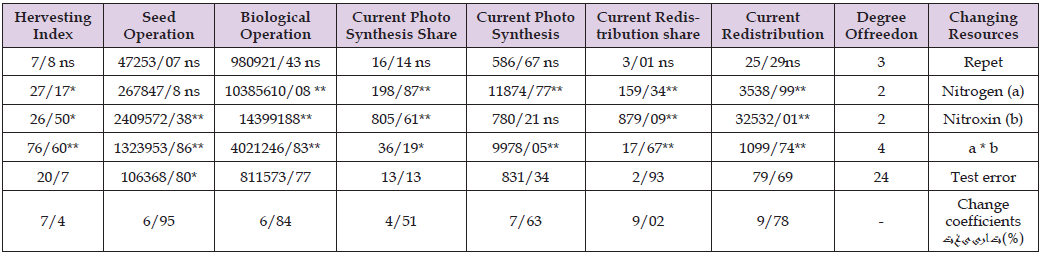
1. A significant increase in the biological operation. Use of 100 and 150 k.g. of nitrogen in relation to 50 k.g. use, cause an increase of 12635.4 k.g. and 14231.5kg. in hectare respectively at the biological operation. With increased amounts of nitrogen the growing parts will be stimulated and also cause increase in the strew operation and therefore biological operation increases. In addition enough nitrogen will be provided to the nitrogen at this time, and need for other nutritious elements such as phosphorus and potassium increases. nitrogen helps speedy growth of the plant (increase in the height and number of sub shrubs), increase in the size of the leaves, number of seeds in each cluster. It can be seen that nitrogen affects all the biological performance characteristics. These results
2. Match the research conducted by McDonald [6] in the year 2015. inoculation using Nitroxin biological fertilizer causes significant increase in the biological performance. Azospiriluim and Azotobacter in addition to providing more dry substances to the bush causes increase in the growth of growing components and therefore there is a better chance of using the sun light to create more photosynthesis and finally increase in the growth. Gilik, et al. [7] reported that presence of bacteria is effective
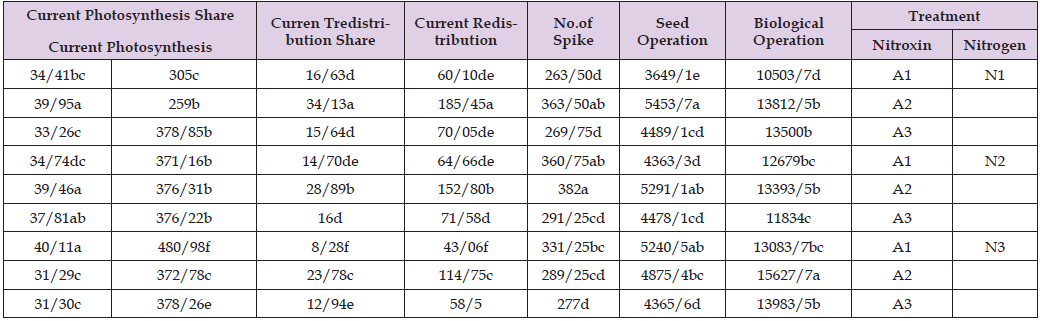
3. On the growth of shoots. Considering the comparisons, mutual average effects of nitrogen and nitroxin on the biological operation have been meaningful and the most biological operation of wheat (15627.7 kilograms per hectare) which is about the treatment of 150 kilograms use of nitrogen along with 3 liters of nitroxin per hectare. This result shows that even though Nitrogen fertilizer has a good 4. Effect on the growth of the shoots, in addition organic fertilizer has been able to increase the plant shoots growth due to nitrogen absorption; thereby substantiating the results obtained by Nanda [8] in the field tests conducted by them. They identified that inoculation of maize seeds with Aztobacteria and Azospiriluim bacteria cause increase in the green fodder performance under treatment with Nitrogen fertilizer.
Also, a least amount of 10503.7 kilograms per Hectare iws due to the use of 50 kilograms Nitrogen and no application of Nitroxin, and increase in the amount of Nitroxin more than what is recommended which means use of 6 liters per hectare, the biological performance amount have been noticed. It seems that this quantity causes poisoning to the plant and plant prefers to stay at the normal level which means use of 3 liters per hectare and considering the high percentage of organic material in this area the results seems logical and matches with the Russell results in the year 2014.
Seed’s Performance
Results obtained from variance table analysis Table 1 shows that the effect of nitroxin and mutual effects of nitrogen nitrox in at a probable level of 1% on the performance of the seed is vital. Since nitroxin consists of bacteria in order to stabilize nitrogen (Azespriilium and Azotobacter), therefore by inoculating the seeds, there are possibilities of using seedling from nitrogen and other nutritious elements and therefore the plant can grow in better conditions and will have better nutritious properties. Azespriilium and Azotobacter having biological Nitrogen stabilizing power, helps in the extension of roots for better absorption of water and other nutrition available and in addition production of growth hormones(2) and some of the vitamins; qualitative and quantitative growth of plants are in turn invigorated, resulting in increase in its performance, thereby co-coordinating the results obtained by Pereira, et al. [9], and in which he also reported increase in the performance of plants inoculated with Azespriilium in relation to biological fertilizers. (Table 2) Considering comparisons of Nitrogen and Nitroxin mutual effects on the seed performance, most of the wheat performance (5453.7 kilograms per Hectare which were treated with 50 kilograms Nitrogen together with application of 3 liters of Nitroxin per Hectare and the least amount of (3649.1 kilograms / Hectare) for the treatment of nonapplication Nitroxin and use of 50 kilograms Nitrogen / hectare. Bashan, et al. [10] in 2013 reported that with reduction in the chemical fertilizers, Azospiriluim play a big role in the nutrition of the plant and reduces need for chemical fertilizer and, Azospiriluim acts as a supplement for Nitrogen fertilizer and therefore (6) use of chemical fertilizer could be reduced. Hassan Abadi, et al. [11] reported that application of Azospiriluim together with Nitrogen causes increase in the seed operation and reduces the use of fertilizer by 50%.
Table 2: Mutual effects of Nitroxin and Nitrogen on the wheat qualitative traist.
Harvesting Index
Considering table of variance analysis for Nitrogen and Nitroxin factors traits at the probable level of 5% and the mutual effects of Nitrogen and Nitroxin at the likely level of 1% are significant. (Table 1) Nitrogen creates meaningful differences in the harvesting index where (1) with the use of 50 kilograms per Hectare of Nitrogen, the harvesting index will be 35.98% and then with the use of 100 kg Nitrogen per hectare it reached 37.2%, but with the 150 kilograms per hectare the harvesting index reduced to 34.23% which was due to increase in the biological performance. Even though it is a fact that increase in the Nitrogen causes an increase in the seed operation, but still causes increase in the plant constructive tissues production. So, therefore increase in the Nitrogen use causes (6) a decrease in the ratio of seed to total biomass (2) On the other hand, Nitroxin causes significant increase in the harvesting index which means that the growth increasing bacteria cause increase in the harvesting index while effecting the dried material and allocating more dry substance to the seed. Results obtained coordinates the results of Goyal, et al. [12] in the year 2014 and as he has reported the reaction of seed, oil and harvesting index of the Rape plant in relation to Azotobactial compared to witness’s treatment without insemination contains increase respectively among the performance components and the number of seeds in the shears (pods) showed the least reaction to the Azotobacterisl treatment. Taking into consideration, the average comparison of average Nitrogen and Nitroxin mutual effects in the treatments without insemination, Nitrogen causes (1)an increase in the harvesting index. In Nitrogen fertilizer treatment used and insemination with Nitroxin the most harvesting index (39.95%) belonged to treatment of 50 kilograms Nitrogen together with insemination of 3 liters per hectare of Nitroxin which caused an increase in the seed performance treatment and (2)on the other hand the least harvesting index belonged to treatment of 150 kilograms of Nitrogen and insemination of 3 liters per hectare (31.29) and this treatment had the most biological performance, since the harvesting index has a direct relation with seed operations. These results seem logical. Harvesting index is a ratio of biological performance which consist of economical operations and increases with increment in the amount of dried substance for Economical purposes. Results show that the harvesting index is most(1) probably due to the influence of environmental and experimenting executive management conditions, and the suitability of environment and proper management of field is effective in harvesting index increment. And this increase in the consolidating chemical and biological fertilizer system is very noticeable. And(3) the increase in the dried substance contribution to the bushes, leaves, stems and seed cause an increase in the harvesting index which matches with the results obtained by Goyal, et al. [12] in the year 2014. They have also reported that with increase in Nitrogen fertilizer, dried matters of the plant also increases and the least amount of dried weight is obtained from 0 kilogram of Nitrogen.
Redistribution
Results obtained from variance analysis table show that the effect of Nitrogen, Nitroxin and mutual effects of Nitrogen Nitroxin on the level of redistribution of wheat seed with a probable of 1% is meaningful. Considering the comparison of the simple effect of Nitrogen fertilizer application causes most of the redistribution in the wheat, the most amount of redistribution regarding the use of 50 kilograms Nitrogen per Hectare (105.20 grams per square meter) and the least is regarding a treatment of 150 kilograms Nitrogen (72.03). Application of Nitrogen fertilizer causes increase in the speedy growing of seed and fuller (plumper) kernels affecting its weight. The reason for this can be due to faster absorption of materails by the growing parts and in turn their transfer to the seed under study. These results are in accordance to those reported by Takada [1]. He also mentions that the amount of photosynthesis in rice plant is linked with the amount of Nitrogen available and with(2) the increase in the amount of Nitrogen fertilizer, the speed of photosynthesis per unit increases and therefore the amount of redistribution also decreases. Inoculation with Nitroxin biological fertilizer causes (1)significant increase in the amount of redistribution with most of it belonging to the 3 liters of Nitroxin / hectare (151grams in square meter) and the least belonged to no insemination (55.9 grams on square meter). Application of Nitrogen bacteria ( Azotobacteria) and Azospirillum cause increase in the nutritious elements which help increase accumulation of dry substance contributing to fuller (plumper) ears of wheat. These(3) results were obtained by Hamidi, et al. [4]. Also considering the mutual effects of Nitrogen and Nitroxin, the major amount of redistribution was due to treatment by the use of 50 kilograms Nitrogen and application of 3 liters of Nitroxin per hectare (185.4 grams per square meter) and the least was due to treatment with the use of 150(4) kilograms of Nitrogen per Hectare and non inoculation (43.05 grams per square meter).
Redistribution Share
Results obtained from the variance analysis show that the effect of Nitrogen and Nitrox in and the mutual effect of Nitrox in on the probable level of 1% on the redistribution share of wheat seed are meaningful.Comparison of simple effects of Nitrogen fertilizer application cause increase in redistribution share in wheat and the most redistribution share belongs to the use of 50 kilograms Nitrogen per hectare (22.3%) and the least belongs to treatment of 150 kilograms Nitrogen (15%). At higher levels lesser transferring condition exists due to production of more leaves with higher durability and therefore more existing photosynthesis redistribution share in production and performance reduces. In addition with increase in the amount of Nitrogen, more biomass is produced and while there is increase in seed performance, the share of current photosynthesis increases and also the photosynthesis matters decrease resulting in growing parts of the plant such as branches which operation as a physiological matter and retain the photosynthesis matters as Pear Dashti [13] mentioned in his research result.Inoculation with Nitroxin biological fertilizer causes meaningful increase in the redistribution share which is mainly due to the use of 3 liters of Nitroxin per hectare (28.94%) and the least belongs to noninsemination (13.20%). Azotobacterial and Azospirillum cause increase in the nutritious elements and thereby dry matter accumulation and an increase in dry matters contribution in each seed, as per the result of Hamidi, et al. obtained in 2015.Also, considering the mutual effects of Nitrogen and Nitroxin the major share of redistribution is related to treatment (1)with the use of 50 kilograms Nitrogen and application of 3 liters of Nitroxin per hectare (34.13) and the least is related to the treatment of 150(4) kilograms of Nitrogen per hectare and non-inoculation (.28%).
Current Photosynthesis
Results obtained from the variance analysis show that the effect of Nitrogen and mutual effect of Nitrogen Nitroxin at the probable level of 1% on the amount of current photosynthesis of wheat kernel is substantial.
Current photosynthesis is a process where photosynthesis is produced from the green parts of the plant specially the stamen from the pollination stage to the final maturation of the seeds. And this has (1) a direct effect on the fullness and growth of seed Naderi [3]. Considering the comparison on the effects of the straightforward application of Nitrogen fertilizer caused increase in the current photosynthesis in the wheat kernels. The large amount amount of current photosynthesis is related to the use of 150 (4) kilograms of Nitrogen per Hectare (410.6 grams per square meter). and the least belongs to treatment with the use of 50 kilograms Nitrogen (348 grams in sq.m).Nitrogen increases photosynthesis which is due to increase in the leaf area Zaker Nejad [14] and its durability due to delay in aging of leaves Yang, et al. [4]. Also, Nitrogen brings about (1) an increase in the fertile tillers and increase in the amount of spikes and therefore it produces a stronger reservoir for receiving more assimilates produced by photosynthesis. Simply put till the time the plant does not have a strong reservoir, and as there is no need for photosynthesis, it does not increase, similarly photosynthesisation also does not increase. Naderi [3]. Also, considering the mutual effects of Nitrogen and Nitroxin, the greater amount of current photosynthesis belongs to treatment of 150 kilograms Nitrogen and application of non-inoculation in one hectare of Nitroxin (480.98 g.sm) and the least belongs to treatmen using 50 kilograms Nitrogen and non-inoculation (305gm/sq.m). Of course the use of 3 liters Nitroxin with other amounts of Nitrogen does not create much differences in the application of this amount of Nitroxin (2) and the use of 150 k.g per hectare as they are from the same group. Considering Azotobacteria and Azospirillum bacteria being used as stabilizer for Nitrogen, and [13,14] Nitrogen is an important element in the production of chlorophyll and chloroplast which have a direct role in the production of photosynthesis in the leaves and become for fullness of the seeds, the application and use of this bacteria together with Nitrogen fertilizer cause increase in the amount of photosynthesis.
In general, as the results show that test treatments (nitrogen and biological nitrogen fertilizers) have significant effect on the further distribution and current photosynthesis and regarding the share of each one we understood that the most amount of further distribution is in 50 k.g. Nitrogen treatment together with 3 liters of Nitroxin in each hector, while the least amount is3 obtained in the treatment of 150 k.g. of Nitrogen together with 6 liters of Nitroxin.
We thank the Research and Technology Department of the Islamic Azad University of Behbahan Branch in Iran for its facilities and cooperation.
All authors declare that there is no conflict of interest in this work.
There is no funding source.

International Association of Landscape Archaeology, Czech Glass Society, Czech Republic

Department of Chemistry, Semenov Institute of Chemical Physics, USSR Academy of Sciences, Moscow, Russia

Neurology, LA BioMed Research Institute, USA

Associate Professor at Department of Breast and Thyorid Surgey, Chongqing General Hospital, China

Professor of Nuclear Medicine, Faculty of Medicine and Surgery, University of Milan, Milan, Italy





 Abstract
 PDF
PDF



























