info@biomedres.us
+1 (502) 904-2126
One Westbrook Corporate Center, Suite 300, Westchester, IL 60154, USA
Site Map
 ISSN: 2574 -1241
ISSN: 2574 -1241
ISSN: 2574 -1241
Received: March 14, 2025; Published: March 25, 2025
*Corresponding author: Anastasios Tzenalis, Associate Professor at the Nursing Department of the University of Patras, Patras City, Greece
DOI: 10.26717/BJSTR.2025.61.009548
This study explores the relationship between experience, education, and nurses’ knowledge levels in dysphagia management. The findings indicate that nurses with more years of professional experience, particularly those working in Intensive Care Units, demonstrate higher specialization. Additionally, the majority of participants expressed a need for further education, highlighting the importance of continuous professional development. The study underscores the positive impact of educational programs in enhancing nurses’ knowledge and clinical practice, ultimately improving the quality of care for patients with dysphagia.
Keywords: Dysphagia; Nurses; Patients; Ingestion; Treatment
Swallowing disorders constitute a common clinical complication that can occur in patients with various pathological conditions, and their diagnosis relies on different diagnostic techniques [1]. Dysphagia is a pathological condition observed across all age groups, from infancy to old age, with severity ranging from mild swallowing difficulty to complete inability to swallow. It is estimated that a significant proportion of the general population will experience temporary episodes of dysphagia at some point in their lifetime, while approximately 10% of individuals, particularly older adults, live with chronic dysphagia [2-4]. The diagnosis of dysphagia requires a correlation between symptoms and the ingestion of liquids or solid foods. When discomfort in the upper esophagus is not linked to swallowing, it may indicate a pharyngeal globus, which differs from dysphagia and may result from either a functional disorder or a muscular abnormality of the pharynx or upper esophagus [4].
Unlike other symptoms, such as chest pain or gastrointestinal bleeding, which may be associated with esophageal disease, dysphagia specifically indicates an esophageal disorder. The causes of dysphagia are generally classified into two main groups: obstructive lesions and motility disorders. A more specific classification categorizes dysphagia based on its anatomical location: pre-esophageal (or oropharyngeal) dysphagia, esophageal dysphagia, post-esophageal (or esophagogastric) dysphagia, and paraesophageal (or extrinsic) dysphagia. Although these classifications are useful, overlap between categories is common [4,5]. Nurses play a central role in the interdisciplinary team responsible for managing dysphagia in patients, acting as key healthcare providers who ensure the safety and well-being of individuals affected by swallowing disorders. Their role extends beyond treatment to encompass the early detection and systematic assessment of dysphagia, which are crucial for preventing complications such as malnutrition, dehydration, and aspiration pneumonia. As frontline caregivers, nurses are often the first to identify signs of dysphagia, facilitating timely interventions and appropriate referrals to specialists.
Despite the critical nature of their involvement, the specific responsibilities of nurses in dysphagia management remain inadequately defined, and there is a notable lack of standardized protocols guiding their practice. Furthermore, specialized training programs on dysphagia care for nurses are limited, resulting in variability in knowledge and clinical competency across different healthcare settings [6- 8]. Addressing this gap is essential to enhancing the effectiveness of dysphagia management, as well-trained nurses can play a pivotal role in implementing evidence-based feeding strategies, monitoring patients for changes in swallowing function, and providing education to both patients and caregivers on safe swallowing techniques.Studies have increasingly highlighted the multifaceted contributions of nurses in dysphagia management. Their responsibilities include conducting initial screenings to identify at-risk patients, assisting with bedside swallowing assessments, and collaborating closely with speech and language therapists to reinforce therapeutic recommendations. In addition, nurses are instrumental in adapting dietary modifications, supervising mealtime strategies, and advocating for patient-centered interventions that align with individual needs [9]. By enhancing their training and clarifying their role within the healthcare team, nurses can further optimize dysphagia care and improve patient outcomes. The purpose of this study is to investigate nurses’ knowledge regarding dysphagia, with particular emphasis on comparing the knowledge levels between nurses working in Intensive Care Units (ICUs) and those working in other clinical units. The research aims to assess the level of knowledge concerning the symptoms, complications, and management strategies of dysphagia, focusing on the effective care of affected patients.
This study adopts a descriptive design with a quantitative approach, aiming to collect data from 100 nurses working either in ICUs or in other hospital departments across the country. The sample was selected using convenience sampling, as participants were identified through nursing networks and groups on social media.The study included nurses from various age groups, educational backgrounds (secondary and tertiary education levels), and with different years of professional experience (new entrants, nurses with moderate or extensive experience). Data collection took place between March 3, 2023, and April 24, 2023, and was conducted using online closed-ended questionnaires sent via personal emails.
Data Collection Instrument
The data collection tool used in this study was a closed-ended questionnaire designed to assess nurses’ knowledge and experience regarding the management of dysphagia. A pilot test was conducted on nurses who were not included in the final sample, demonstrating an Intra-Class Correlation (ICC) of approximately 0.7. The questionnaire consisted of five distinct sections:
Demographic and Social Characteristics: The first section included questions regarding the participants’ demographic information, such as age, gender, professional experience, educational level, and the department in which they work.
Knowledge on Dysphagia Symptoms and Signs: The second section aimed to evaluate the nurses’ knowledge of the indications, signs, and symptoms of dysphagia.
Complications of Dysphagia: In the third section, participants were asked questions regarding the complications of dysphagia to assess their awareness of the potential negative consequences of this disorder.
Feeding Management in Dysphagia: The fourth section focused on nurses’ knowledge about feeding management for dysphagia patients, covering topics such as appropriate interventions to prevent complications, safe feeding practices, and the implementation of therapeutic protocols.
Experience and Education on Dysphagia: The fifth section assessed the nurses’ experience in caring for dysphagia patients, including their prior education on the subject, with particular emphasis on the management of dysphagia in stroke patients.
Data Analysis
Data analysis was conducted using SPSS software, version 25, with the aim of drawing reliable conclusions regarding nurses’ knowledge and experience with dysphagia. Descriptive statistics were first applied to analyze the socio-demographic and clinical variables, in order to calculate measures of central tendency and dispersion. Specifically, for quantitative variables, the mean and standard deviation (SD) were calculated, while for categorical variables, frequencies (n) and percentages (%) were reported.To investigate potential differences between the two groups of nurses (ICU and non-ICU), an independent samples t-test was applied to compare the mean values of the quantitative variables between the groups and determine the presence of statistically significant differences.Furthermore, a Chi-square (χ²) test was performed to examine correlations between categorical variables such as professional experience, prior education, and knowledge of dysphagia complications. This test was used to assess whether the distribution of responses for one variable is influenced by another categorical variable, thereby identifying potential statistically significant relationships between different factors.Additionally, to examine the correlation between quantitative variables, such as professional experience (years of employment) and knowledge level, Pearson’s correlation coefficient (Pearson’s r) was calculated.Statistical significance was set at p<0.05, meaning that results with p-values below 0.05 were considered statistically significant. These tests allowed the identification of key factors influencing nurses’ knowledge regarding dysphagia, as well as the exploration of relationships between education, experience, and knowledge.
Ethical Considerations
The study was approved by the Ethics and Deontology Committee of the University of … and received approval number 04/25-10-2021. Participants were provided with detailed information regarding the anonymous nature of their participation, the confidentiality of the data, and its use solely for research purposes. Additionally, participation in the questionnaire was voluntary, and the responses were used exclusively for drawing conclusions related to the study’s research questions.
Demographic Data
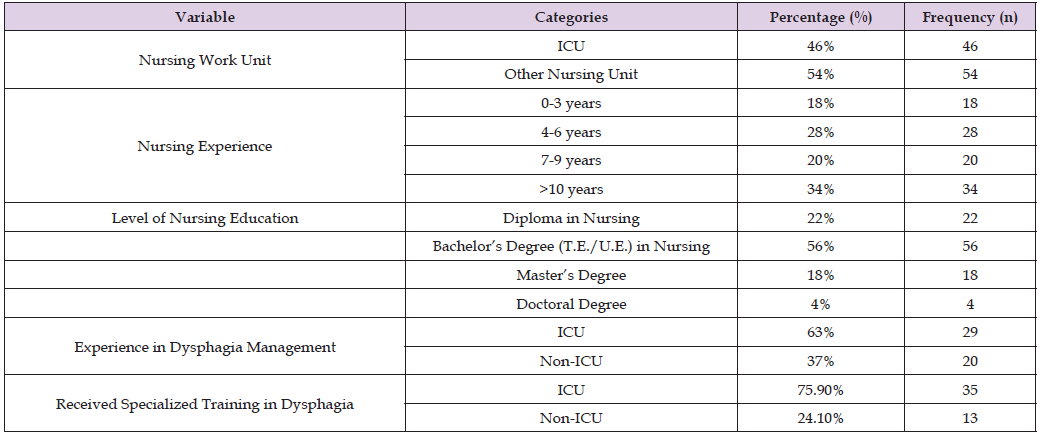
A total of 100 participants took part in the study, with 46 working in ICUs and 54 in other hospital departments. The mean age of the participants was 39.2 years, with an age range from 20 to over 60 years. Based on professional experience, the majority had over 10 years of experience, with the lowest percentage being in the 0-3 years experience category. Regarding educational level, most participants were university graduates, while smaller numbers came from other educational backgrounds. A detailed breakdown of the socio-demographic characteristics of the sample is presented in Table 1.
Table 1: Socio-demographic Characteristics of the Sample.
Descriptive Analysis of Questions on Symptoms, Complications, Management of Dysphagia, and Experience
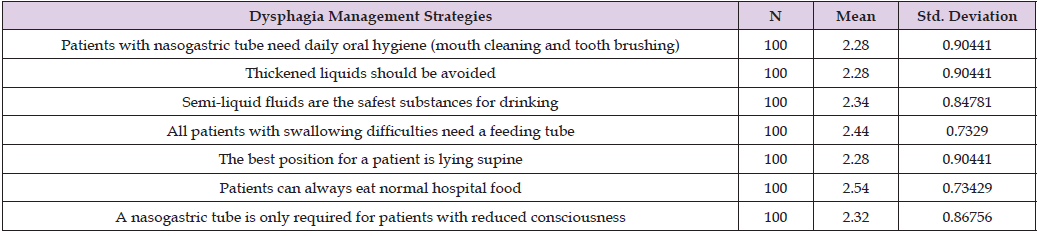
Regarding the assessment of nurses’ knowledge on the symptoms and signs of dysphagia, data analysis revealed generally high levels of knowledge. The evaluation was conducted using a Likert scale (1- 3), where 1 corresponded to an incorrect answer, 2 to indecisiveness, and 3 to a correct answer. The overall mean score of the responses was 2.44, indicating that most participants selected the correct answer or leaned towards it. The mean scores ranged from 2.18 to 2.78, with higher scores observed in questions regarding the clear symptoms of dysphagia. However, on certain questions, nurses exhibited increased indecisiveness, as evidenced by responses to questions on difficulty chewing (M = 2.32), weight loss (M = 2.28), food residues in the mouth (M = 2.18), and chest pain (M = 2.28). Detailed results regarding the knowledge levels of participants on dysphagia symptoms are shown in Table 2. Additionally, data analysis highlighted that nurses had a satisfactory level of knowledge regarding the complications of dysphagia. The overall mean score of the responses was 2.36, suggesting a generally positive trend towards correct answers. However, increased uncertainty was observed in questions relating to anaphylactic shock (M = 2.12), generalized weakness (M = 2.28), and sudden myocardial infarction (M = 2.28). Detailed knowledge levels concerning the complications of dysphagia are presented in Table 3. Finally, in the evaluation of nurses’ knowledge regarding the management of feeding in dysphagic patients, a positive trend towards correct answers was again observed, although some indecisiveness was noted in certain responses. Specifically, the average knowledge score was 2.35, indicating generally sufficient knowledge. However, on questions relating to the avoidance of thickened/half-thick liquids and the preference for a supine position, some participants again indicated indecisiveness. Detailed results are shown in Table 4.
Table 2: Descriptive Statistics of Dysphagia Symptoms.
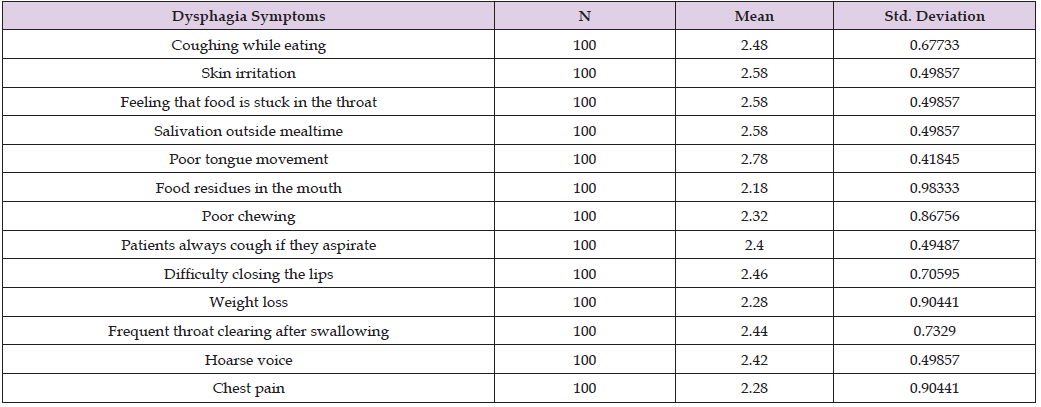
Table 3: Descriptive Statistics of Dysphagia Complications.
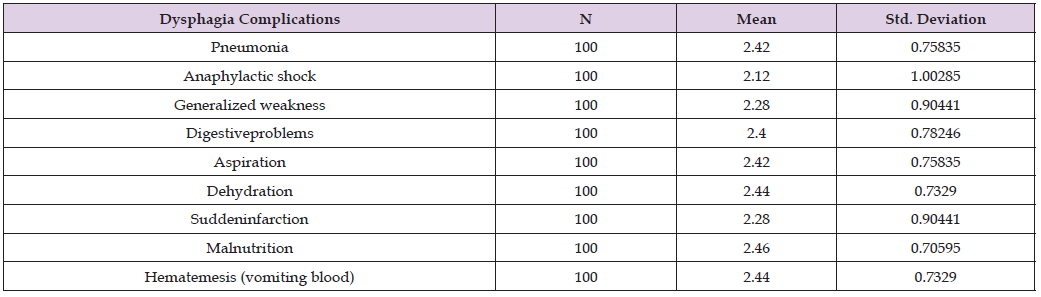
Table 4: Descriptive Statistics of Dysphagia Management Strategies.
Experience and Training on Dysphagia
Data analysis showed that 63% of nurses working in ICUs had experience in managing dysphagic patients, while 75.9% had received some form of specialized training. In contrast, among nurses working outside of ICUs, only 37% had experience managing dysphagia cases, and 24.1% had received additional training in this clinical condition (Table 1). The level of knowledge among nurses regarding the symptoms and signs of dysphagia was found to be directly correlated with their experience. Specifically, for both ICU and non-ICU nurses, analysis showed p = 0.00, indicating strong statistical significance (Tables 5-6). Similarly, the correlation between the level of knowledge of nurses regarding the complications of dysphagia and their experience revealed p = 0.00 for ICU nurses and p = 0.01 for non-ICU nurses, indicating statistically significant relationships (Table 7). However, statistical analysis showed that differences in knowledge levels between ICU nurses and non-ICU nurses were not statistically significant (t = -0.734, p = 0.464, Cohen’s d = 0.145), suggesting that the impact of the work environment on knowledge levels is minimal (Table 8). Additionally, the correlation between experience (years of work) and knowledge levels exhibited a strong positive correlation (r = 0.89), indicating that the more experience a nurse has, the higher their knowledge level. However, the p-value of 0.11 suggests that this relationship is not statistically significant at the p < 0.05 level (Table 9).
Table 5: Statistical Analysis of Knowledge Differences Regarding Dysphagia Symptoms and Indications Among ICU Nurses Based on Experience.

Table 6: Statistical Analysis of Knowledge Differences Regarding Dysphagia Symptoms and Indications Among Non-ICU Nurses Based on Experience.

Table 7: Statistical Analysis of Knowledge Differences Regarding Dysphagia Complications Among Non-ICU Nurses Based on Experience.

Table 8: Descriptive Statistics of Knowledge Levels Regarding Dysphagia Symptoms and Indications.

Table 9: Summary of Statistical Analyses.

Desire for Further Training in Dysphagia Management among ICU and Non-ICU Nurses
The results indicated that both ICU nurses and those working in other departments felt the need for further training to effectively perform their duties.Specifically, 93.5% of ICU nurses and 79.6% of non- ICU nurses reported a desire for further training in dysphagia management. Statistical analysis showed that training significantly affects nurses’ knowledge levels (Chi² = 19.45, p < 0.001, Table 9), indicating that those who have received training exhibit higher knowledge in managing dysphagia. While all participants expressed the need for enhanced knowledge, ICU nurses displayed a higher percentage of positive attitudes, which may be related to the clinical nature of the department in which they work.
The findings of the present study highlight the importance of professional experience and specialized training in the management of dysphagia incidents by nurses. Specifically, nurses working in ICUs demonstrated a higher level of knowledge and expertise, as confirmed by statistical analysis. However, the strong correlation between knowledge and clinical experience was observed in both ICU nurses and those working in general hospital wards, indicating a satisfactory overall level of training. Similar findings were reported in a 2019 study conducted in Nepal, which identified a statistically significant association between knowledge levels and experience in the care of stroke patients [10]. Additionally, Harper (2007) found that nurses with extensive clinical experience exhibited significantly higher levels of knowledge compared to those with limited experience [11]. One of the most notable findings of this study is the pronounced need for additional training, as expressed by the participants. This need was particularly evident among ICU nurses, which can be attributed to the complexity of dysphagia cases they encounter. Similar results were reported in a 2013 study in Brazil, where, despite nurses possessing satisfactory theoretical and practical knowledge, continuous education was deemed essential [12]. The present study also confirms the correlation between training and knowledge levels, as previously documented in other research. According to Farpour, et al. [13], 96.82% of healthcare professionals were familiar with the definition of dysphagia, a percentage significantly higher than the 63.2% reported in the study by Sánchez-Sánchez, et al. [13,14]. This finding aligns with the current study, as nurses with prior training demonstrated higher levels of knowledge. Additionally, various studies across different healthcare systems have confirmed that education significantly improves knowledge and the management of dysphagia [15-17]. Furthermore, the study by Knight, et al. [18] supports the necessity of interdisciplinary collaboration between nurses and speech-language pathologists to optimize dysphagia symptom management [18].
The implementation of specialized educational protocols appears to play a crucial role in the recognition and management of dysphagia. For example, a study conducted in the United States in 2020 demonstrated that the use of the Yale Swallow Protocol (YSP) led to a statistically significant improvement in nurses’ knowledge (pre-test: 86.3% → post-test: 94.9%, p=0.000) [19]. Similarly, the study by Palupi, et al. [20] indicated that training nurses with the Nursing Dysphagia Screening Tool (NDST) significantly enhanced their ability to assess and document dysphagia cases (p=0.000, p<0.05) [20].Beyond the improvement of theoretical knowledge, training also appears to enhance nurses’ confidence in managing dysphagia. A study conducted in the United States in 2020 found that nurses who participated in a specialized training program reported increased confidence in identifying and addressing dysphagia, a finding consistent with the results of the present study [19].
The present study underscores the critical role of both clinical experience and specialized education in enhancing nurses’ ability to manage dysphagia effectively. The findings indicate that while ICU nurses demonstrated higher levels of expertise, knowledge acquisition was significantly correlated with years of professional experience across all nursing departments. This reinforces the notion that continuous exposure to dysphagia cases contributes to greater competency in recognizing and managing the condition.Moreover, the study highlights the pressing need for further training, as expressed by a substantial proportion of the participants. The strong association between education and knowledge levels aligns with previous research, emphasizing that structured training programs are instrumental in improving clinical practice. Evidence from various studies supports the implementation of specialized educational protocols, such as the Yale Swallow Protocol and the Nursing Dysphagia Screening Tool, which have been shown to enhance both knowledge and confidence in dysphagia management.Given these findings, it is essential for healthcare institutions to prioritize ongoing professional development and interdisciplinary collaboration to optimize patient outcomes. Future research should focus on evaluating the long-term impact of training interventions and exploring innovative educational strategies to further improve dysphagia care in clinical settings.
The researcher is grateful to all parties involved in this study, including the university that granted the research permit and especially the respondents who participated in the study.
The authors declare that they have no competing interests.
By submitting this document, the authors declare their consent for the final accepted version of the manuscript to be considered for publication.

International Association of Landscape Archaeology, Czech Glass Society, Czech Republic

Department of Chemistry, Semenov Institute of Chemical Physics, USSR Academy of Sciences, Moscow, Russia

Neurology, LA BioMed Research Institute, USA

Associate Professor at Department of Breast and Thyorid Surgey, Chongqing General Hospital, China

Professor of Nuclear Medicine, Faculty of Medicine and Surgery, University of Milan, Milan, Italy





 Abstract
 PDF
PDF



























