info@biomedres.us
+1 (502) 904-2126
One Westbrook Corporate Center, Suite 300, Westchester, IL 60154, USA
Site Map
 ISSN: 2574 -1241
ISSN: 2574 -1241
ISSN: 2574 -1241
Received: March 05, 2025; Published: March 12, 2025
*Corresponding author: Shobha Ahi, Drug Control Centre, King’s College London, UK
DOI: 10.26717/BJSTR.2025.60.009524
Androgens, both naturally occurring and synthetic, are among the most effective and widely abused performance- enhancing drugs in sports. The detection of exogenous (synthetic or externally administered) steroids primarily relies on advanced analytical techniques such as gas chromatography-mass spectrometry (GC-MS) and liquid chromatography-mass spectrometry (LC-MS). However, detecting the exogenous administration of endogenous steroids—those naturally produced by the body—requires more sophisticated methodologies. These include longitudinal monitoring of an individual’s urinary steroid concentration ratios and isotope ratio mass spectrometry (IRMS), which can distinguish synthetic steroids from naturally occurring ones. Traditionally, urine has been the preferred biological matrix for detecting androgens in sports. However, blood analysis is emerging as a complementary approach due to its potential to enhance detection capabilities. One of the most recent advancements in anti-doping science is the use of dried blood spot (DBS) analysis, a novel and increasingly valuable tool in sports drug testing. DBS testing offers several advantages over traditional urine and blood sample collection methods. The technique simplifies sample collection, transportation, and storage. Unlike conventional blood draws, DBS requires only a small sample, which can be obtained with minimal invasion using micro-lancet or micro-needle devices. The World Anti-Doping Agency (WADA) recently introduced DBS testing as part of routine doping control during the Tokyo and Beijing Olympic and Paralympic Games, highlighting its growing importance in anti-doping strategies. One of the key benefits of DBS analysis is its stability— most androgens remain stable at room temperature, eliminating the need for stringent storage conditions during transport. Additionally, due to its small size and weight, DBS testing is more cost-effective than urine or conventional blood sampling. However, because DBS samples are microscale, they require highly sensitive and precise analytical methods to ensure accuracy and reliability. The Drug Control Centre at King’s College London, a WADA-accredited laboratory, is currently investigating the integration of DBS testing into its systematic routine analysis. This research aims to further enhance doping detection methodologies and solidify DBS as a standard tool in anti-doping science.
Abbreviations: LC-MS: Liquid Chromatography-Mass Spectrometry; DBS: Dried Blood Spot; WADA: The World Anti-Doping Agency; DBS: Detection Methodologies and Solidify; IOC: International Olympic Committee; NADOs: National Anti-Doping Organizations; AAS: Anabolic-Androgenic Steroids
The goal of sports is to provide all athletes with equal opportunities to achieve victory and recognition. To uphold fairness, protect athletes’ health, and preserve the integrity of competition, the use of performance-enhancing substances and methods has been strictly prohibited. “Doping” refers to the use of banned substances in competitive sports to gain an unfair advantage. According to the International Olympic Committee (IOC), doping involves the administration or use of any foreign substance, or a physiological substance in abnormal quantities or by an unconventional route, with the sole intent of artificially enhancing performance [1]. Doping regulations are rigorously enforced by organizations such as the World Anti-Doping Agency (WADA) and national anti-doping organizations (NADOs). Anti-doping laboratories play a critical role in ensuring fair competition by providing scientific evidence of the presence of prohibited substances, detecting sample manipulation, and identifying the use of banned performance-enhancing methods. The primary approach to doping detection involves the analysis of biological fluids (such as urine and blood) and tissues for the presence of drugs, their metabolites, or markers of prohibited methods. The analytical processes in doping control laboratories differ significantly from those in conventional testing facilities. These laboratories must detect and quantify over 400 different substances, including both parent drugs and their metabolites, within complex biological matrices. The concentrations of these analytes can vary widely between samples, adding to the complexity of the analysis. To ensure fairness and accuracy, doping tests must be both valid and reliable, as their results can have serious consequences for an athlete’s career. A false positive could lead to wrongful sanctions, damaging an athlete’s reputation and livelihood, while a false negative could allow doping violations to go undetected, undermining the integrity of sports. As a result, anti-doping laboratories adhere to stringent testing protocols, utilizing advanced analytical techniques such as mass spectrometry and chromatography to achieve precise and legally defensible results [2].
Androgens and Their Role in Sports Doping
Androgens are naturally occurring or synthetic hormones that play a key role in increasing lean body mass and reducing fat mass. Due to their potent anabolic effects, they are among the most effective and widely abused performance-enhancing drugs in sports. Athletes seeking a competitive edge often misuse these substances to enhance muscle growth, strength, and overall physical performance. The principal androgens include testosterone and its potent metabolite dihydrotestosterone (DHT). In addition to naturally occurring androgens, anabolic-androgenic steroids (AAS) are synthetic derivatives of testosterone, specifically designed to promote muscle growth (anabolic effects) and develop male characteristics (androgenic effects). These compounds enhance protein synthesis and muscle hypertrophy, making them highly desirable in strength-based and endurance sports. Among the most commonly abused AAS in sports are: Testosterone – the primary male sex hormone, often used in synthetic or exogenous form to enhance performance, Stanozolol – a synthetic AAS known for increasing strength and lean muscle mass while reducing fat, Nandrolone – a long-acting AAS that promotes muscle recovery and endurance, frequently detected in doping cases [3]. The widespread abuse of these substances presents a significant challenge for anti-doping authorities. Consequently, advanced analytical techniques have been developed to detect both exogenous AAS and the manipulation of endogenous androgens. The detection methodologies for the exogenous steroids is mostly based on the gas/liquid chromatography and mass spectrometry, while detection of the exogenous administration of endogenous steroids requires more complex methodologies including the longitudinal monitoring of individual urinary steroid concentrations/ ratios and isotope ratio mass spectrometry [4]. Although, urine has always been the first choice of sample matrix to detect androgens in sports. However, blood matrix is also now paving its way towards a complementary matrix for detection of androgens in sports.
Dried Blood Spots in Anti-Doping
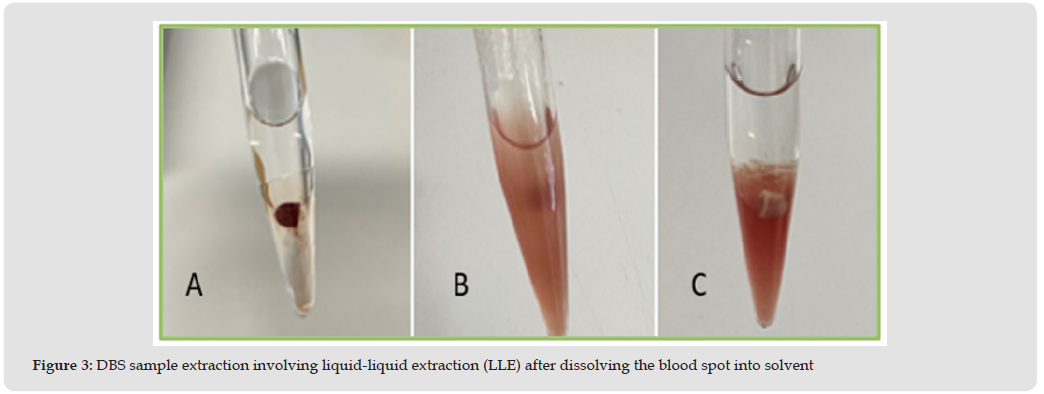
Dried blood spot (DBS) analysis is an emerging and highly promising tool in sports drug testing. As an alternative to traditional urine and blood sample collection, DBS offers several advantages, including cost-effectiveness, ease of collection, and simplified transportation and storage (see Table 1). These benefits make DBS a valuable addition to anti-doping methodologies. DBS testing involves the collection of a small volume of whole blood, typically ranging from 5 to 100μL (equivalent to a finger-prick or approximately one-fifth of a teaspoon). Compared to conventional blood draws or urine collection, DBS sampling is minimally invasive and requires less technical expertise for proper administration. A key advantage of DBS testing is its efficiency in collection, shipment, and storage. Unlike liquid blood samples, DBS samples are stable at room temperature, reducing the need for specialized refrigeration or complex handling procedures (Figures 1-3). This stability simplifies logistics, particularly in remote or large-scale sporting events where sample integrity is crucial. Given these advantages, DBS has gained recognition as an innovative anti- doping tool. The World Anti-Doping Agency (WADA) has recently integrated DBS testing into routine doping control, including its use during the Tokyo and Beijing Olympic and Paralympic Games. This implementation underscores the growing role of DBS in enhancing doping detection strategies [5].
Table 1: Comparison of DBS with Urine, Serum, and Whole Blood Collection.
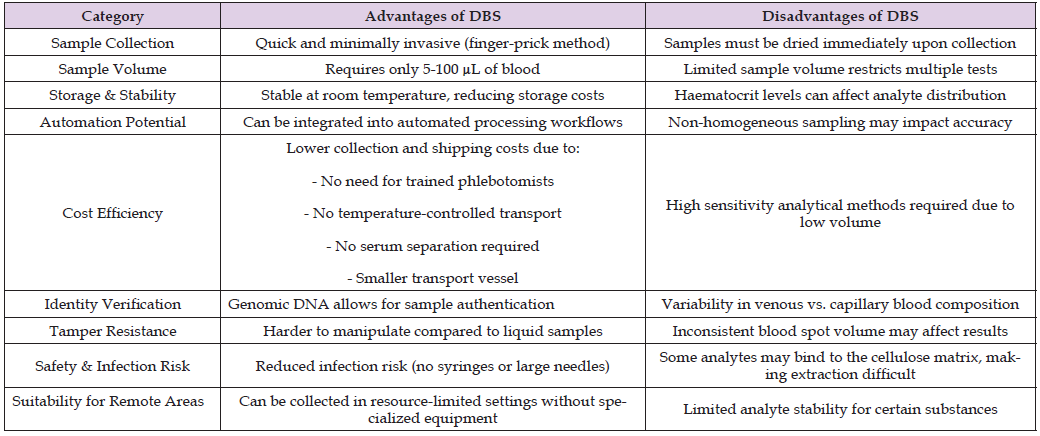
Figure 1
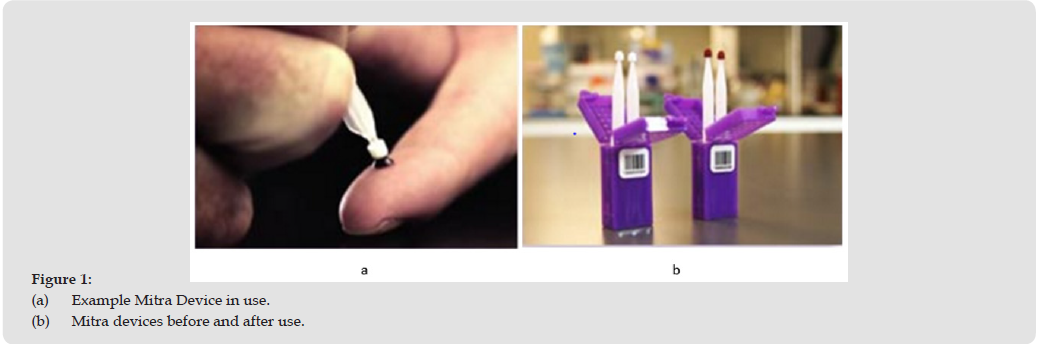
Figure 2
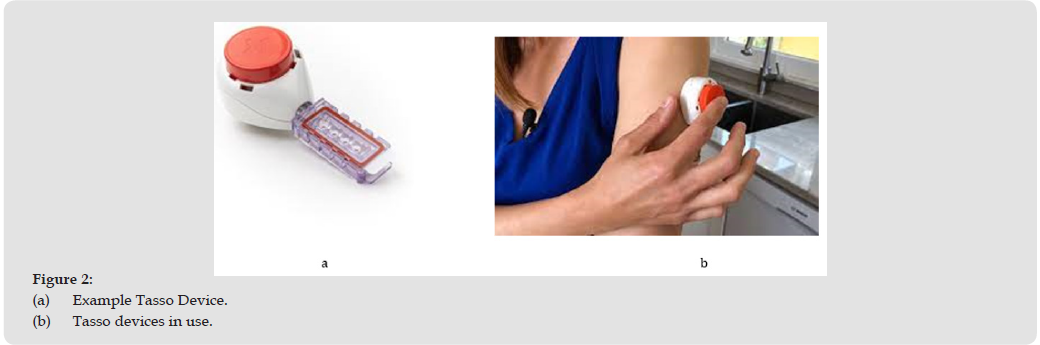
Figure 3
The World Anti-Doping Agency (WADA) has recently incorporated dried blood spot (DBS) testing into routine doping analysis, including its use during the Tokyo and Beijing Olympic and Paralympic Games. This implementation marks a significant advancement in anti-doping strategies, offering a more convenient and cost-effective alternative to traditional urine and blood sampling. DBS samples can be collected with minimal training and require only a small volume of blood, obtained through a micro-lancet or micro-needle device. This makes DBS collection less invasive and more accessible, particularly in remote or resource-limited settings. A key advantage of DBS is its stability at room temperature, particularly for androgens, eliminating the need for specialized temperature-controlled transport. Additionally, the small size and lightweight nature of DBS samples significantly reduce storage and shipping costs compared to urine or liquid blood samples. However, due to the microscale nature of DBS samples, highly sensitive and precise analytical methods are required for accurate detection of prohibited substances. This necessitates the development and refinement of advanced mass spectrometry techniques to ensure reliable results in anti-doping analysis.
The Drug Control Centre at King’s College London, a WADA-accredited laboratory, is at the forefront of research into dried blood spot (DBS) testing as a new methodology for anti-doping analysis. As part of its ongoing efforts to enhance doping detection, the laboratory is actively investigating the integration of DBS testing into its systematic and routine analytical processes. To advance this initiative, the Drug Control Centre has successfully developed and validated analytical methods for detecting exogenous steroids and steroid esters in DBS samples. These methods have demonstrated high sensitivity, specificity, and reliability, reinforcing DBS as a promising tool for the detection of androgens and other performance-enhancing substances in sports doping. One of the key findings of this research is that DBS testing provides a viable alternative to traditional urine and blood analysis, with the added benefits of simplified sample collection, reduced transportation costs, and improved sample stability. By optimizing mass spectrometry-based techniques, the laboratory has enhanced the detection of anabolic-androgenic steroids (AAS), their metabolites, and steroid esters, ensuring compliance with WADA regulations and anti-doping standards. Moving forward, the Drug Control Centre aims to further refine and expand DBS methodologies, exploring its potential for broader anti-doping applications. This includes assessing its effectiveness in longitudinal athlete monitoring, where repeated sample collection over time can help detect patterns of steroid use and doping violations.
The successful implementation of DBS testing in doping control could revolutionize the way anti-doping laboratories conduct analyses, offering a cost-effective, less invasive, and logistically efficient approach to ensuring fair play in sports.
The rapid and minimally invasive collection process, combined with lower shipment and storage costs, makes dried blood spot (DBS) testing a highly effective addition to current anti-doping strategies. Compared to traditional urine and venous blood sampling, DBS enables more frequent, cost-efficient, and large-scale testing, thereby enhancing both detection capabilities and deterrence measures in sports. As an innovative and complementary tool, DBS sampling has the potential to significantly strengthen existing urine and blood testing programs. By integrating DBS into routine anti-doping analysis, authorities can expand testing efforts to a greater number of athletes, particularly in remote or resource-limited settings, while maintaining high analytical standards. Moving forward, further research, validation, and regulatory integration will be key to maximizing the potential of DBS in anti-doping. Its successful implementation could mark a major advancement in the fight against doping, ensuring a fairer and cleaner competitive landscape in sports.

International Association of Landscape Archaeology, Czech Glass Society, Czech Republic

Department of Chemistry, Semenov Institute of Chemical Physics, USSR Academy of Sciences, Moscow, Russia

Department of Educational Sciences, Research Centre Qualities of Teachers, School of Education – HAN, Nijmegen, Netherlands

Associate Professor at Department of Breast and Thyorid Surgey, Chongqing General Hospital, China

Neurology, LA BioMed Research Institute, USA





 Abstract
 PDF
PDF



























