info@biomedres.us
+1 (502) 904-2126
One Westbrook Corporate Center, Suite 300, Westchester, IL 60154, USA
Site Map
 ISSN: 2574 -1241
ISSN: 2574 -1241
ISSN: 2574 -1241
Received: March 03, 2025; Published: March 11, 2025
*Corresponding author: Simona Laura, Mag Medica Imperia, Italy
DOI: 10.26717/BJSTR.2025.60.009520
Background: Dupuytren’s disease is a pathology that usually occurs in male patients over 40 years of age, which
results in a motor deficit on some fingers, leading to reduced functionality of the hand. The cause of the pathology
is still not clear even if hereditary traits are found, as well as there is a high incidence in patients who have
long performed manual work that exposed them to vibrations. At present, several surgical and non-surgical
therapies are suggested although they do not guarantee a full recovery.
Objectives: Evaluate the effectiveness and safety of the therapy based on electromagnetic fields and vacuum
(VEMF therapy) in the treatment of Duputreyn’s contracture.
Methods: In this retrospective study we documented seven subjects burdened with Duputreyn’s contracture,
all of them had previously undergone surgery on the palm of their hand. The subjects underwent between three
and seven treatment sessions. The results were evaluated with echography, infrared photographs, VAS and DASH
score.
Results: The patients have shown a significant improvement in every measurement, which remained stable six
months later. No side effects were found.
Conclusion: Although only a small number of patients was documented, it is believed that VEMF therapy can be
considered as a potential treatment for Dupuytren’s contracture for its proven effectiveness and safety.
Keywords: Dupuytren’s Disease; VEMF Therapy; Biodermogenesi; Electromagnetic Field; Negative Pressure; Vacuum; Regenerative Medicine
Dupuytren’s disease is a fibroproliferative pathology of the palmar and digital fascia, caused by overproduction of collagen that limits the grip and strength of the fingers 01. It usually occurs in male patients over the age of 40 as a fibrotic nodule on the palm fascia. When this happens, a large amount of type III collagen replaces the type I collagen normally present in the tissues of the hands and promotes the formation of reticular fibers [1,2]. The evolution is very similar to the repair phase of wounds, which results in an inflammatory reaction [1-3]. Over time the nodule increases in size and can promote the formation of longitudinal fibrous septa along the palm of hand [4] which tend to extend at a rate of one centimeter per month during the acute phase [5]. These fibroses cause retractions that lead to a contracture of the fingers resulting in hook closure. The prevalence of bilateral disease is 43% in women and 59% in men [6,7]. Among the main risk factors are age, male gender, excessive alcohol consumption, smoking, diabetes, heavy manual work, trauma to the hands and post-surgical after-effects on hands [2,8-11]. Two studies carried out in total on more than 4,600 men employed in manual work with vibrating instruments have associated this work with the development of Dupuytren’s pathology [12,13]. Many authors hold the belief that there are significant genetic aspects, which are highlighted by the higher incidence in the presence of family history and faster progression [2,14-17], frequently accompanied by early onset and greater severity [4].
This pathology has a different incidence in the main parts of the world; the most affected are men from northern Europe while it is rare in Asian populations and those of high phototype (IV, V, VI) [14]. Interestingly, there are certain regions in Taiwan and Japan where there is a high incidence [6,18]. The asymptomatic form that affects soft tissues without limiting finger and hand functions is defined as Dupuytren’s disease. The most severe form with major disease and contracture, known as Dupuytren’s contracture, identifies only patients with motor and functional deficits in fingers and hand [19]. For reasons still unknown, in patients with Dupuytren’s contracture, pathological myofibroblasts do not undergo apoptosis and continue to proliferate even after the cause that originally stimulated them has ceased [20]. It is believed that this is the main cause why Dupuytren’s contracture is currently hardly considered curable.
When treating the Dupuytren’s disease, the primary goal is the recovery of the extension of the fingers and the recovery of the best functions of the hand [21]. It is therefore preferable to intervene before the contractures of the fingers and the functions of the hand are seriously compromised also because it is known that undergoing surgery close to the onset of the pathology increases the chance of success [14]. The therapies up to now are divided into conservative, for the milder forms, and surgical for the severe forms.
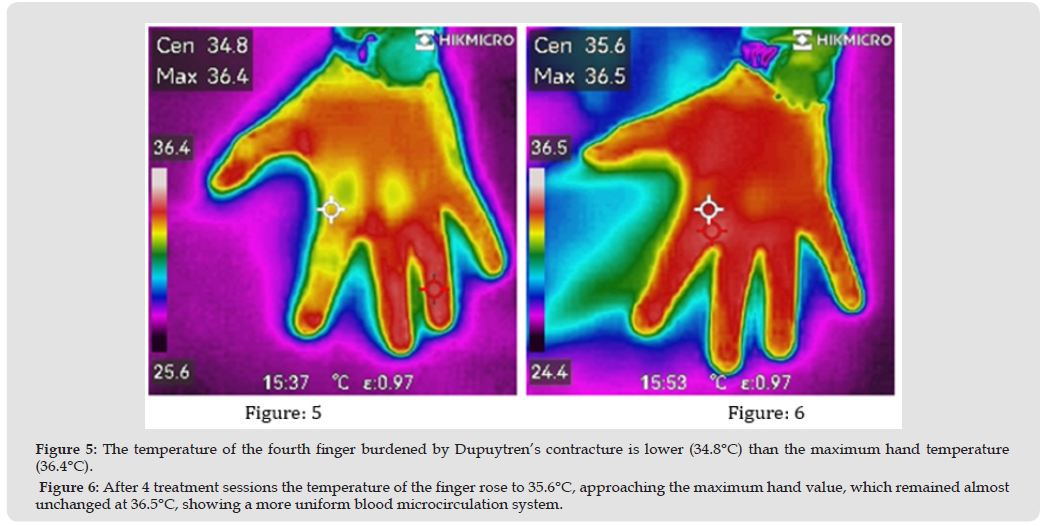
The surgeries for Dupuytren’s retraction are called “fasciectomy”. The first technique, born in the 60s, involves the total removal of the pathological tissue, up to the subcutaneous fat resulting in skin grafting. Recommended in severe cases and in young patients, it is certainly the most radical type of intervention, which reduces the risk of relapse [14,22]. Side effects are loss of sensitivity on transplanted tissue, scar formation and long recovery times.Currently a limited fasciectomy, the surgical removal of only 1-cm segments of the pathological cords, is the most common solution for the treatment of Dupuytren’s disease [23]. This intervention allows to reduce contractures up to about 80%, provides a short healing but longer recovery time. The risk of recurrence is significant [14,24]. A recent development involves the limited fasciectomy combined with autologous adipose tissue grafting; this seems to offer better therapeutic prospects [25,26], although it will have to be verified over time. Another minimally invasive procedure, called Needle fasciotomy, involves the separation of fascial bands using a hypodermic needle [27]. The main advantage of this technique is that it is performed under local anesthesia and in outpatient care [27], while the lack of effectiveness in severe cases and the high risk of recurrence are the main limitations [28,29]. Due to the nature of the intervention, the neurovascular bundles in the treated area are subject to the risk of injury, most often with temporary effects [24] (Figures 1-5).
Figure 1
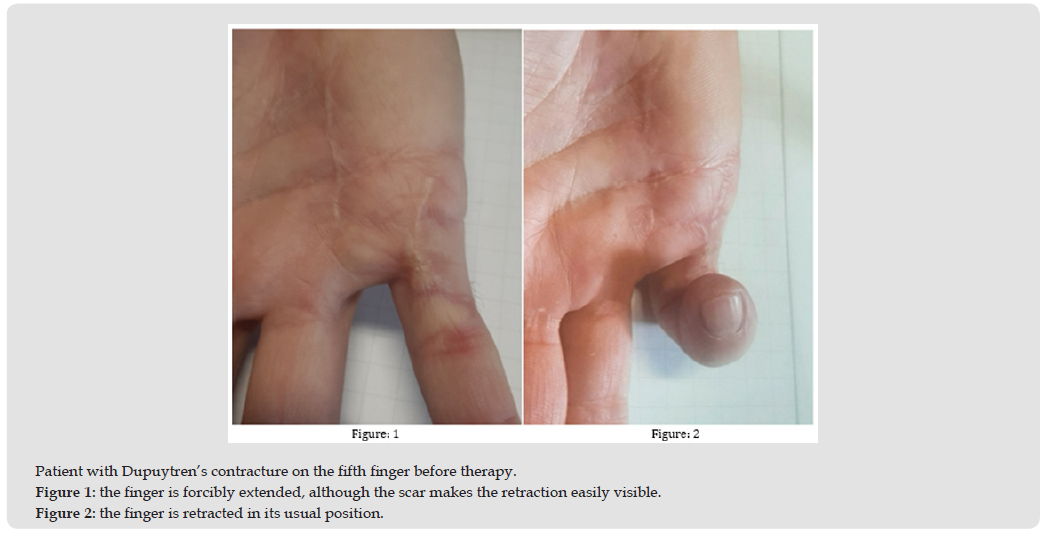
Figure 3
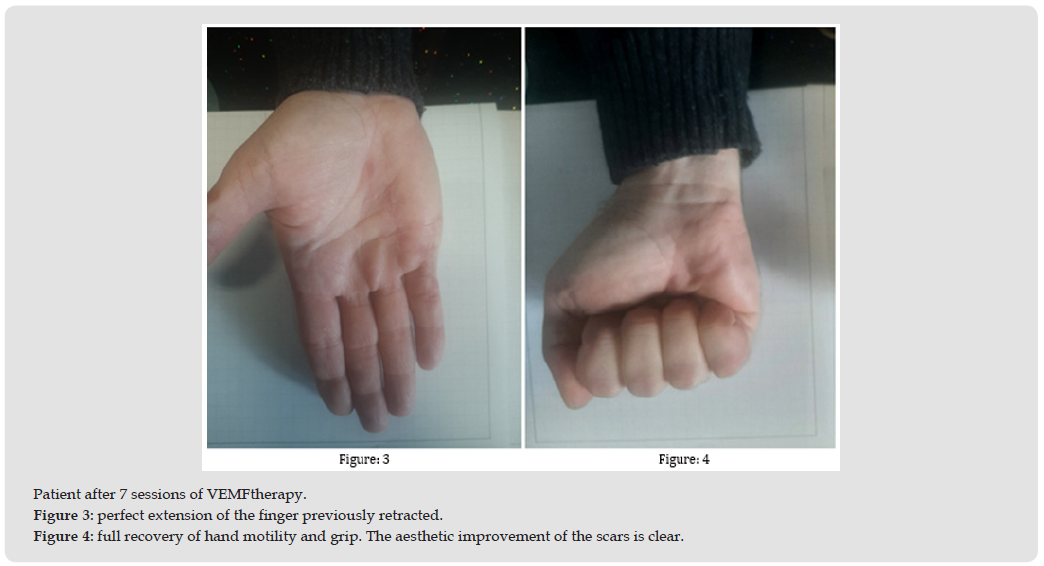
Figure 5
Physiotherapy
In less severe cases, an improvement was observed in 80% of the cases who adopted extensor braces during sleeping [30]. Similarly, an improvement was seen, again on mild cases, with the forced mobilization of tissues showing increased movement of fingers [31].
Radiotherapy
A review study has shown objective improvements on a group of 698 patients [32]. Radiotherapy is believed to inhibit fibroblast proliferation and have an anti-inflammatory effect useful in attenuating Dupuytren’s disease [33]. Radiotherapy has exposed the patients to frequent relapses and presented temporary side effects (erythema 20% to 40% of cases), chronic (skin atrophy in just under 10%) and a low incidence of malignant tumors (0.02%) [32].
Collagenase
Collagenase is activated by a bacterium called Clostridium histolyticum, which causes lysis of pathological type-III collagen present in fibrous cords [34]. This therapy is particularly appreciated by patients for its minimal invasiveness and extremely short recovery times, although it has a high risk of recurrence (47%) [35].
The purpose of this retrospective study is to evaluate the effectiveness and safety of Biodermogenesi®, also called VEMF therapy, in treating Dupuytren’s contracture in a preliminary manner. Therefore, we have documented the therapeutic path of seven subjects, five men and two women, aged between 45 and 69 years old, burdened by Dupuytren’s contracture on one hand. All the patients had previously undergone surgery to the treated hand and had a fibrotic and retractive scar. The pathology has been present for a period ranging from 7 to 25 years and has been causing the retraction of the fourth or fifth finger, resulting in reduced grip and strength and consequent motor deficit. The subjects do not fall within the limitations provided for the application of Biodermogenesi® treatments, meaning they are not epileptics, pacemaker bearers, subjects with open wounds, subjects who have undergone oncological therapy in the last 5 years and subjects who have suffered from anorexia or bulimia in the past 2 years; they were healthy individuals.
Patients have signed informed consent and have undergone a cycle of three to seven weekly sessions of Biodermogenesi® with Bi-one® LifeTouchTherapy (Expo Italia Srl, Firenze, Italy), a Class IIB medical device that combines electromagnetic fields with vacuum and electrostimulation.
Biodermogenesi®, otherwise called VEMF therapy, is based on the simultaneous delivery of electromagnetic fields with frequency ranging from 0.5 to 2 MHz, power between 0.4 and 0.6 W, negative pressure with a value between -10 and -15 cents of BAR and square-wave electrostimulation at 5 Hz with intensity of 3.5 VPP. In the specific application, it is recalled how electromagnetic fields have shown particular effectiveness in treating fibrosis [36-38], and in particular how VEMFtherapy has restored motility limited by significantly extended and thick fibrosis [39].The outcomes of the study are documented by echographies, performed with different instruments at patient’s trusted ultrasound technician’s and with a PocketE_Hikmicro infrared camera (Hangzhou Microimage Software Co., Ltd., Hangzhou, Zhejiang, China) intended to detect the temperature of the hand in question. These instrumental tests were combined with the evaluation of hand functions by adopting The Disability of the Arm, Shoulder, and Hand (DASH) questionnaire [40,41]; with the assessment of the level of comfort of patients verified on a scale from 0 (no comfort) to 10 (maximum comfort); and with the Visual Analog Scale (VAS) pain scale [42]. VAS and DASH evaluations were also performed 6 months after the end of the treatment cycle. This study was conducted in full compliance with the standards in the Declaration of Helsinki and MEDDEV 2.7.1 revision 4 on clinical research. The study was not submitted for prior approval by the Ethics Committee as patients underwent therapy of their post-surgical scars in order to reduce the aesthetic impact and fibrosis. These procedures are already widely documented by the technology under discussion [39,43-46]. The improvement of Dupuytren’s contracture was appreciated, especially by the patients, but it was not expected. The sharing of information between the authors led to the discovery of the uniformity of the results and thus to write this article.
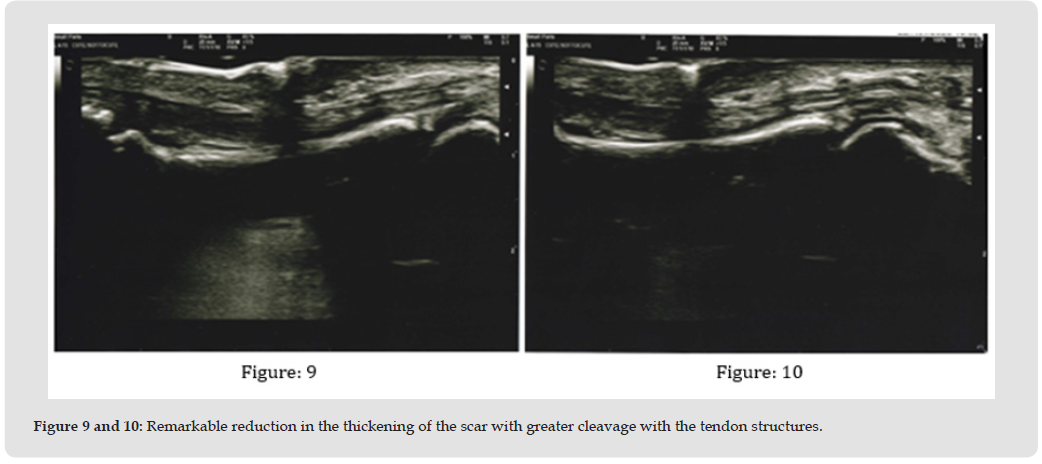
All patients responded positively to the therapy, showing an increased extension of the treated fingers and a softer and more elastic tissue from the very first treatment application. The echographies showed a reduction in the thickening of the scar and its fibrosis combined with an increased cleaving of the tendon structures. The infrared camera detected a significant difference between the maximum temperature of the fingers (36.4 °C) and the retracted finger, which average temperature was 34.8 °C before therapy. After the treatment cycle, the maximum temperature of the hand was stable (36.5 °C) while that of the suffering finger increased to 35.6 °C, demonstrating a more uniform vascularization of tissues. DASH assessment score provided crucial information on functional recovery of the fingers/hands, as before the treatment the average level was 37.33 (from 32.50 to 42.75) while after the cycle of sessions it reduced to an average value of 11.66 (from 6.50 to 16.75), with a significant average improvement of 25.67 (equal to 68.77%).The average comfort level was 7.71 (from 7 to 9), showing that the patients considered the treatment pleasant and relaxing. VAS scale before the treatment cycle showed an average level of pain of 3.01 (from 2.1 to 3.5), after therapy it lowered to an average value of 1.07 (from 0 to 1.8) showing a significant average improvement (-1.94 equal to -64.5%). The follow-ups performed six months later showed a slight improvement of the VAS scale (average value 0.88, minimum 0, maximum 1.5) and stabilization of the DASH score. No subject experienced side effects, not even minor ones, during the treatments and all of them could immediately resume their normal lifestyles without any restrictions.
This study was developed by combining retrospective experiences of the various authors who casually found to have had similar outcomes on patients treated for scars on the palm of the hands, also burdened by Dupuytren’s contracture, and who then retrieve all the documentation provided in this study. The fortuitousness of this discovery hindered the preparation of a study plan with certain parameters for patient enrollment, such as patient splitting into homogeneous groups in order to compare results with greater precision; however, the authors have decided to stick to those parameters in order to recruit a significant number of patients to see if the results obtained will be confirmed on a large scale. The analysis of the collected data is positive and potentially preferable to existing state-of-the-art therapies, at least for the first six months. If on the one hand more sessions are required (in our case we have provided between 3 and 7), on the other the immediate recovery of full activity by the patients, absence of pain, downtime or restrictions to regular lifestyles as well as greater relaxation of the fingers were appreciated already from the first session. A clear improvement of the pathology with total stabilization over six months was proven by all the assessment scales adopted; this makes us optimistic in view of a larger clinical study. The total absence of side effects, already demonstrated by VEMFtherapy in scars treatment [39,43-46] was also appreciated. Analysis of the existing literature suggests that the combined action between electromagnetic fields and negative pressure has an important effect on the remission of fibrosis [39,43] as has also been shown by the separate use of electromagnetic fields, although in different fields [36-38] and negative pressure, which mechanical action promotes a series of reactions in terms of mechanotransduction [21,22,44,45] by converting mechanical stimuli into biochemical signals that activate a series of cascade reactions, reducing the compactness and strength of the fibrous component. In our opinion, the anti-inflammatory action of the electromagnetic fields is particularly relevant, as these lead to an increase in the production of IL-10 anti-inflammatory cytokines 46, analogously to what has been documented with negative pressure [28] (Figures 6-10).
Figure 7
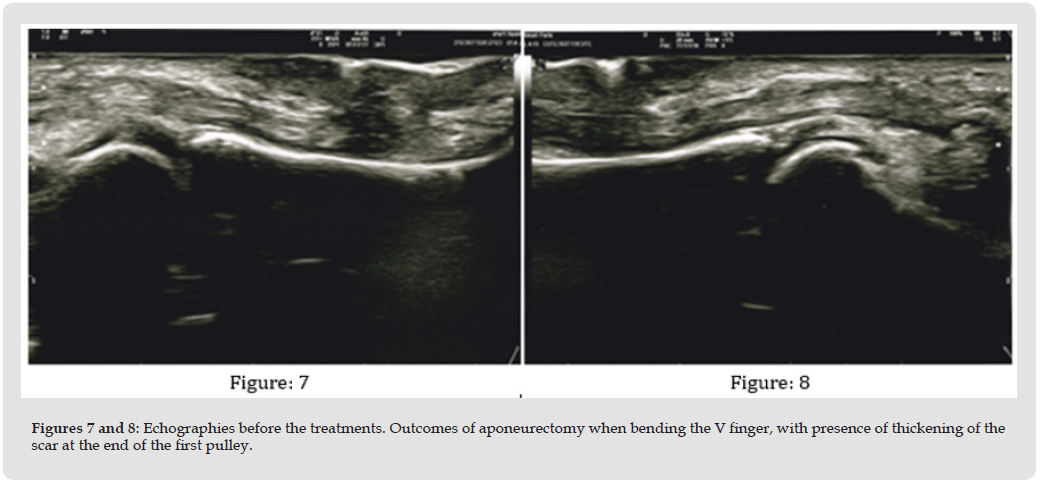
Figure 9
The evident improvement observed on the patients, its comfort and the total absence of side effects make VEMF therapy to be considered a new effective and safe therapy for treating Dupuytren’s contracture and disease. We recognize the need for a wider clinical investigation on a larger number of subjects divided into homogeneous groups to assess the outcomes more accurately, specifying whether the pathology of each patient is mild or severe. To gain a comprehensive perspective on the use of VEMF therapy in treating Dupuytren’s disease and contracture, it is important to evaluate multi-annual follow- ups and any recurrence [47-50].
Conceptualization, M.B. and S.L.; methodology, M.B.; validation, S.L.; formal analysis, S.L.; investigation, S.L., C.G., F.L. and C.Z.; data curation, S.L.; writing—original draft preparation, S.L.; writing—review and editing, S.L., C.G., F.L and C.Z.; supervision, M.B.; project administration, M.B. and C.G. All authors have read and agreed to the published version of the manuscript.
This research received no external funding.
All the data used for this study are present in the text.
Maurizio Busoni is part of the Board of Directors of Expo Italia Srl, the company that produces Bi-one® Life Touch Therapy; the other authors have no conflict of interest.

International Association of Landscape Archaeology, Czech Glass Society, Czech Republic

Department of Chemistry, Semenov Institute of Chemical Physics, USSR Academy of Sciences, Moscow, Russia

Neurology, LA BioMed Research Institute, USA

Associate Professor at Department of Breast and Thyorid Surgey, Chongqing General Hospital, China

Professor of Nuclear Medicine, Faculty of Medicine and Surgery, University of Milan, Milan, Italy





 Abstract
 PDF
PDF



























