info@biomedres.us
+1 (502) 904-2126
One Westbrook Corporate Center, Suite 300, Westchester, IL 60154, USA
Site Map
 ISSN: 2574 -1241
ISSN: 2574 -1241
ISSN: 2574 -1241
Received: Marh 01, 2025; Published: March 06, 2025
*Corresponding author: Yasin Tire, Department of Anesthesiology and Reanimation, Konya City Hospital, University of Health Science, Konya Turkey and OUTCOMES RESEARCH Consortium®, Houston, Texas, USA
DOI: 10.26717/BJSTR.2025.60.009519
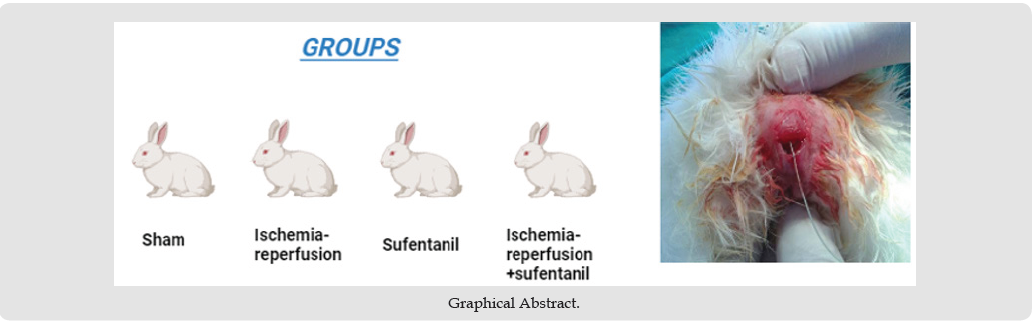
Epidural Sufentanil and Less Cardiac Ischemia-Reperfusion Injury: Thirty-two Newland-type rabbits, which
were anaesthetized with ketamine and xylazine, were divided into four equal groups sham, ischemia-reperfusion,
sufentanil and ischemia-reperfusion+sufentanil. In the ischemia groups,ischemia of 30 minutes followed
by reperfusion of 120 minutes was performed with occlusion of the left anterior descending coronary artery. An
epidural dose of 5 μg sufentanil was administered before ischemia (Graphical Abstract).
Conclusion: Epidural sufentanil appears to have a cardioprotective effect against myocardial ischemia-reperfusion
injury in the experimental rabbit model.
Graphical Abstract
Ischemia triggers a series of cellular events, mild at the beginning, and increases during the course of ischemia. This condition is known as ischemic injury. Ischemia is terminated by reperfusion, which is necessary for cellular survival and normal cell function, but contrastingly, leads to cellular injury known as reperfusion injury [1]. Preconditioning is an intrinsic response of the body that produces an adaptive resistance against more severe trauma through the production of sub-lethal metabolic stress [2]. Ischemic preconditioning, remote ischemic preconditioning, and ischemic post-conditioning are the mechanisms aimed at reducing ischemia-reperfusion (IR) injury. Pharmacologic agents have cardioprotective effects through the activation of various cardiomyocyte receptors, especially adenosine, bradykinin, and opioid receptors, intracellular signal transduction pathways, and mitochondria [3]. Opioid receptor agonists increase myocardial tolerance during IR injury. Their infarct-reducing effect is observed both during prophylaxis and also during acute treatment before reperfusion. Opioids have also been shown to be effective in the prevention of ischemia-induced arrhythmia [4]. The role of sufentanil (selective mu-opioid receptor agonist) against IR injury has been investigated and the cardioprotective effect of intravenously-administered sufentanil in clinical and experimental models was shown [5- 8]. Despite recent studies on sufentanil, no clinical and experimental studies associated with its central nervous system application have been reported to date. Therefore, in the present study, we aimed to investigate the cardioprotective effect and hemodynamic response of epidural administration sufentanil on myocardial IR injury.
This study was conducted at the Experimental Medicine Research and Application Center after obtaining approval from the local Experimental Animals Ethics Committee (Decision date: 31.10.2011,No: 2011-109).
Thirty-two three-month-old New Zealand-type rabbits weighing between 1900 and 2360 grams were used in the study. Before the study, the rabbits were subjected to a 12-hour cycle of light and darkness with no restriction on food and water.
Surgical Preparation
The rabbits were weighed prior to the procedure and an anesthetic mixture of ketamine hydrochloride (30 mg/kg) and xylazine hydrochloride (10 mg/kg) was administered intramuscularly. Maintenance anesthesia was provided intramuscularly every 45 minutes and when necessary. The sedated rabbits were fixed on a wooden block with the surgical area shaved and cleaned with povidone iodine solution. An intravenous route was opened through the lateral vein of the ear using a 22-gauge cannula. A continuous infusion of 20 mL/ kg/h Ringer’s lactate solution was provided. A three-lead electrode with metal clamps was placed on the chest wall. Monitoring of DII and V5 leads was initiated. The body temperature was monitored using a rectal temperature probe and maintained at 37-38 ºC using an external heating device. Following non-invasive monitoring, access to the trachea was performed through a superficial cut at the midline of the neck into the subcutaneous tissues. A 22-gauge cannula was placed in the right carotid artery lateral to the trachea and connected to the transducer, which was filled with heparinized fluid; invasive arterial blood pressure monitoring was then initiated. A tracheal cut was then made and a no:3 endotracheal tube was inserted, followed by the formation of a neuromuscular non-depolarizing agent (rocuronium bromide) and connection to a ventilator (100% oxygen, tidal volume: 10 mL/kg; respiratory rate: 20 to 30/min).
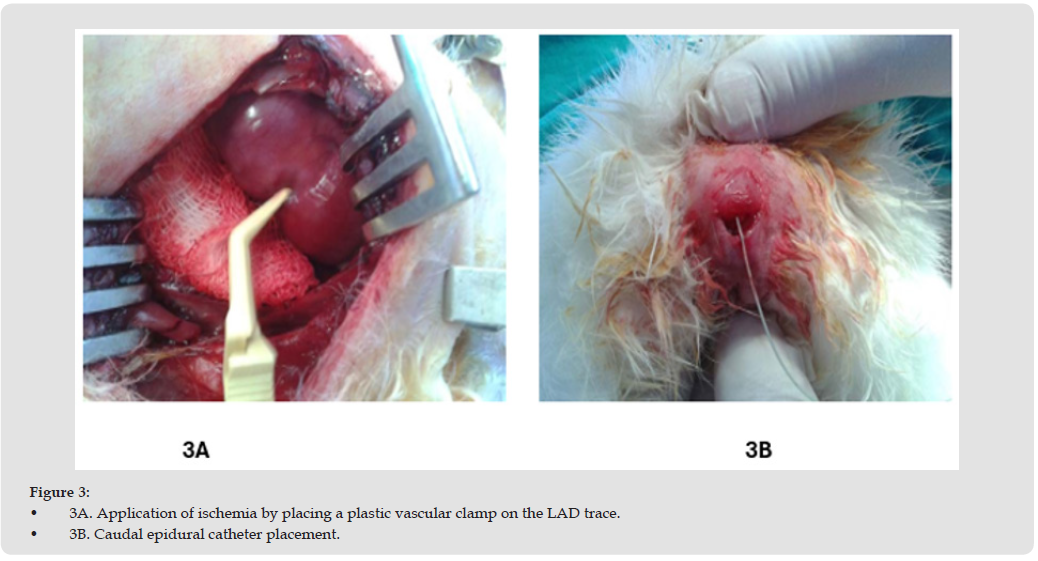
The heart was accessed through a left thoracotomy via the fourth and fifth intercostal space. The pericardium was opened and the left coronary artery was reached immediately below the left atrial appendage. After surgery preparation, the heart rate was left for 15 minutes to stabilize. This was followed by an injection of heparin (250 IU) via the ear vein. In the ischemic group, IR was provided by a clamp to the left anterior descending (LAD) artery. The presence of ischemia was confirmed by ST segment elevation on electrocardiography, and observation of cyanosis and hypokinetic areas on the LAD artery trace. A fall of the mean arterial pressure to below 50 mmHg was considered as the presence of hypotension, and 5 mg intravenous ephedrine was administered. The rabbits were divided into four groups: sham group (n=9), IR group (n=10). epidural sufentanil group (n=10), and the IR+sufentanil group (n=10).Sham= Left thoracotomy was performed and the rabbits were monitored for 150 min without ischemia-reperfusion.IR= Left thoracotomy was performed, then the LAD was subjected to 30 min of ischemia followed by 120 min of reperfusion.
Sufentanil= After epidural administration of 2.5 μg/0.5 mL sufentanil, left thoracotomy was performed and the rabbits were monitored for 150 min without ischemia-reperfusion. IR+sufentanil= After intrathecal administration of 2.5 μg/0.5 mL sufentanil, a left thoracotomy was performed, then the LAD was subjected to 30 min of ischemia followed by 120 min of reperfusion. Baseline hemodynamic parameters (mean arterial pressure and heart rate) were recorded 15 min after all surgical procedures were completed.In the ischemia groups, measurements were made at the 10th and 30th min of ischemia and at the 60th and 120th min of reperfusion; measurements were made at the 10th, 30th, 60th, and 120th minin the non-ischemic groups.
A 27-gauge needle was inserted from the L4-5 space into the interspinous space at the level of the posterior superior iliac crest; 2.5 μg/0.5 mL of sufentanil (5 μg/mL) was then injected after obtaining caudal and plantar reflexes. The LAD artery was occluded for a short period after reperfusion and 2%/1 mL Evans Blue was administered intravenously through the ear vein. After staining body fluids blue by perfusion for a short period, all rabbits were sacrificed with 1 mL intravenous ketamine.
Histopathologic Analysis
The heart was removed after the animals were sacrificed. The tissues were wrapped in stretch film to prevent dying of the tissues and to facilitate better penetration of the stain into tissues. After storage for 30 min at -55 °C, they were separated into five parts. Intubation at 37 °C for 20 min was performed using a buffer (pH 7.4) containing a 1% 2,3,5-triphenyl tetrazolium chloride (TTC) stain. The tissue parts were then put into 10% formaldehyde solution. Areas that maintained tissue viability were stained dark red with TTC. Necrotic areas, on the other hand, were observed as pale, yellowish brown. Parts of the heart were placed between two glass plates that were 2 mm apart and pressed together using two clamps placed on the sides. Images of each of the two cross-sections were taken. The borders of the necrotic regions (TTC-negative tissue) and risk areas (areas that contained no fluorescent particles under ultraviolet light) were marked on transparent acetate that was placed on the glass. The ratio of ischemic regions to risk areas was calculated. This ratio was used to compare the differences between the groups.
Statistical Analysis
Data were analyzed using the Mann-Whitney U test to evaluate variables between two groups; comparisons between more than two groups without normal distribution were made using the Bonferroni- corrected Kruskal-Wallis H test. A p value of <0.05 was considered statistically significant.
The four experimental subjects that were lost for various reasons were replaced by others and the study was terminated with a total of 32 rabbits. The weights of the experimental animals were similar (minimum 1750 g, maximum 2450 g) (p>0.05).
Hemodynamic Variables
The mean arterial blood pressure was found to be similar between the groups for measurements performed at baseline, at the 10th and 30th min of ischemia, and at the 60th and 120th min of reperfusion (p>0.05). There was a difference in the baseline heart rate between the IR and sufentanil groups; however, it was significant between the IR and IR+sufentanil groups in the 120th min values (p<0.05). The measurements of ischemia at the 10th and 30th min and those of reperfusion at the 60th min were found to be similar between the groups (p>0.05) (Tables 1-2).
Table 1: Comparison of mean arterial pressure values (MAP) (Mean±SD).

Table 2: Comparison of heart beat (BPM) values (Mean±SD).

Note: *p<0.05 significant difference between group 1 and group 4. With control value at 120th minute.
Myocardial Infarct Size
In the IR group, severe hydropic degeneration, vacuolization, and disorganization were observed in myocardial muscles in images obtained from the light microscopy evaluation of cell morphology with hematoxylin-eosin staining. In the IR+sufentanil group, a significant decrease in hydrops and vacuolization was observed (Figure 1). The histopathologic examination demonstrated an infarct size of 47.5% ±7.0% (minimum=39.2, maximum=58.2) in the IR group and 34.2%±4.7% (minimum=28.3, maximum=42.2) in the IR+sufentanil group. The infarct size was found to be statistically significantly smaller in the IR+sufentanil group (p=0.002) (Figures 2 & 3).
Figure 1
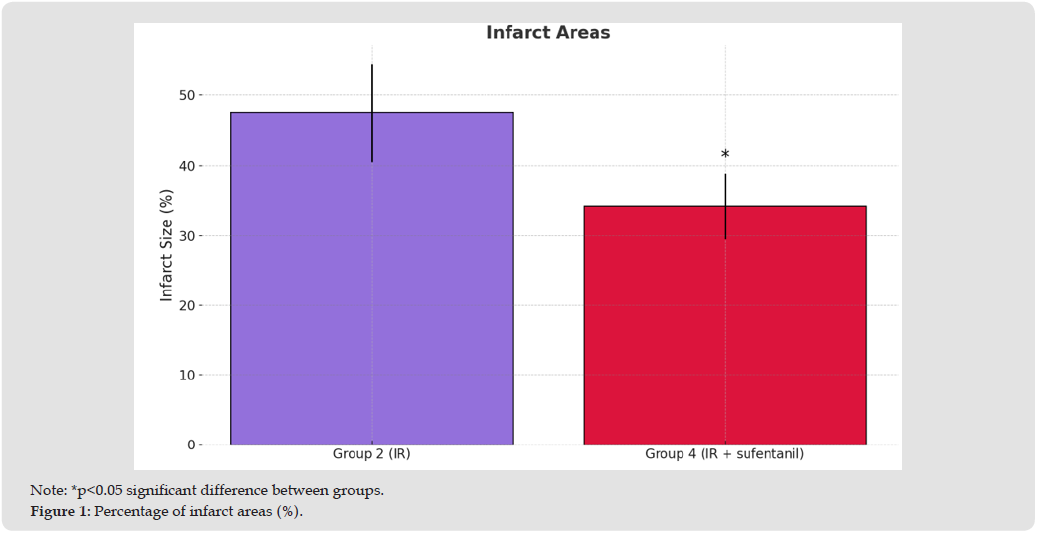
Figure 2
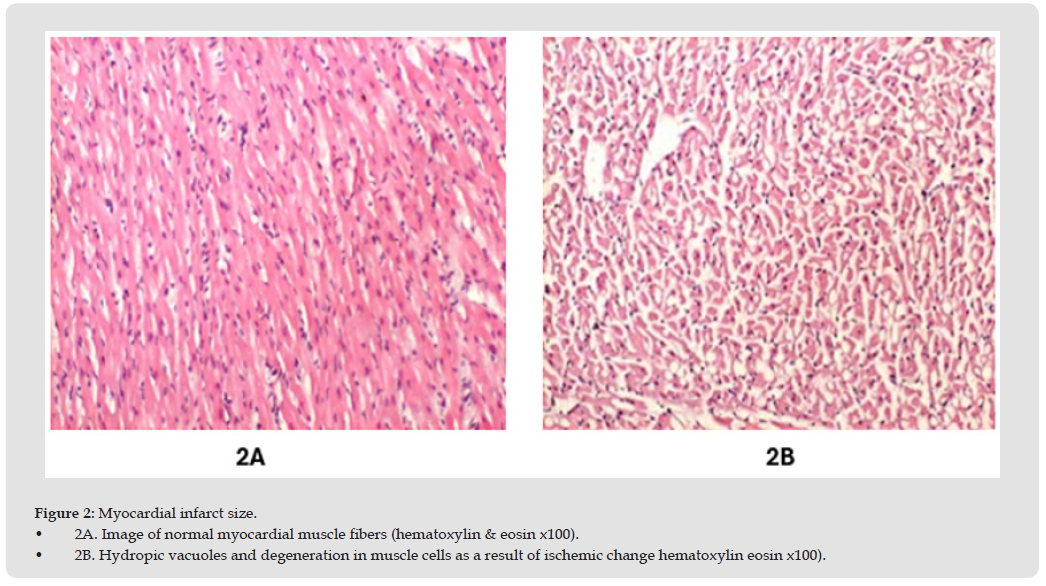
Figure 3
In our rabbit model of myocardial ischemia-reperfusion injury, epidural sufentanil reduced myocardial infarct size. Hemodynamic parameters did not change significantly. This is the first study to demonstrate a decrease of myocardial IR injury by epidural sufentanil. Opioid receptor systems are known to be activated under stress. A crosstalk has been described in the heart involving the interaction and modulation of both opioid receptors and the other receptors. This often occurs directly or indirectly. Furthermore, several peptides such as endorphins and encephalin are known to modify cellular functions in different cell types, independent of opioid receptors. Pharmacologic protection with opioid agents include pre- and post-conditioning, centrally-mediated opioidergic conditioning, and prolonged opioid receptor-mediated cardioprotection. Pathologic processes such aging, comorbidities, and drugs, may also significantly alter cardiovascular responses to exogenous opioids [2]. Groban, et al. [9] administered IT morphine (0.3 or 3 μg/kg) and intravenous morphine (0.3 mg/kg) to Wistar-type rats. For the first time, they demonstrated that IT morphine was as effective at protecting the heart as intravenous morphine. However, the mechanism of this cardioprotective effect has not been studied. Subsequently, the role of opioid receptors in IT morphine preconditioning was investigated by Li, et al. [10] IT morphine preconditioning was similar to ischemic and intravenous morphine preconditioning. The IT morphine preconditioning effect was abolished by intrathecal administration of any of the opioid receptor antagonists (mu, delta, and kappa). Thus, the role of delta, kappa, and mu-opioid receptors in IT morphine preconditioning has been demonstrated.
In another study investigating the effect of opioid receptors, three consecutive infusions of 1 μg/kg IT morphine for 5 min were administered before ischemia. In addition, the effects of intrathecal and intravenous naloxone methiodide, a peripheral non-selective opioid receptor antagonist, were also evaluated. A comparison of the infarct size to risk zone ratio with that of the control group (48±9%) demonstrated that there was a significant difference between ischemic (22±3%) and IT morphine (26±5%) preconditioning. The effect of morphine preconditioning (45±4%) was reported to decrease with the administration of IT naloxone methiodide. However, IT morphine preconditioning (28±9%) was not reversed by intravenous naloxone methiodide administration. The role of central opioid receptors in myocardial protection has been demonstrated in IT morphine preconditioning [11]. Similarly, central opioid receptors have also been demonstrated to play a role during IT morphine postconditioning [12]. Furthermore, IT morphine activates a neural pathway in which spinal opioid receptors use non-opioid neurotransmitters for cardioprotection [13]. The central endorphinergic system plays a role in intracerebroventricular morphine preconditioning signals. This cardioprotective effect is mainly due to an increase in levels of central beta endorphin in the serum, pituitary gland, ventrolateral periaqueductal gray and rostral ventrolateral medulla [14].
Intracerebroventricular morphine administration results in an increase of the expression of calcitonin in the hippocampus, which causes calcitonin gene-related peptide release, which then plays a role in remote preconditioning. In addition to the three opioid receptors, this route is suggested as the mechanism associated with the cardioprotective effect of intracerebroventricular morphine [15]. Both central and peripheral adenosine receptors may participate in epidural morphine preconditioning signals. Central receptors play an important role at the beginning of the procedure, and peripheral receptors have a role in the continuation of this effect [16]. A recent study also emphasized that spinal mu-opioid receptors and the activation of nitric oxide synthase (NOS) signaling are involved in the cardioprotective effects of epidural morphine [17]. In an experimental rat model by Adam, et al. [18] the analgesic effects of intravenous and intrathecal sufentanil were investigated, and ED50s were found to be similar in both routes of administration. This is explained by the high lipid solubility of sufentanil. In a recently conducted study, it was shown that a total1 μg/kg intravenous dose of sufentanil had cardioprotective effects on rabbits [8]. In our study, the IT sufentanil dose was determined as 2.5 μg. This dose used in our study is close to the intravenousdose used previously (approximately 1 μg/kg).
The epidural sufentanil dose used in our study was observed to reduce the area of infarct on rabbit myocardium subjected to IR.Low mean arterial pressure and high heart rate may increase infarct size. This property is particularly important for experimental models with high collateral blood flow. However, collateral circulation is limited (2%) in rabbits and decreased arterial pressure is unimportant in myocardial infarct size. Therefore, hemodynamic changes may negligiblein rabbit models [19]. The mean arterial pressure showed a similar course between the groups. In the IR group, the heart rate was lower at baseline and at 120 min of reperfusion than in the sufentanil and I/R+sufentanil groups, respectively, but this is not important clinically.
In conclusion, epidural sufentanil appears to have a cardioprotective effect in an experimental rabbit model of myocardial IR injury. However, there is a need for further clinical and experimental studies in which various routes of administration and doses of sufentanil and the underlying mechanisms are investigated.

International Association of Landscape Archaeology, Czech Glass Society, Czech Republic

Department of Chemistry, Semenov Institute of Chemical Physics, USSR Academy of Sciences, Moscow, Russia

Department of Educational Sciences, Research Centre Qualities of Teachers, School of Education – HAN, Nijmegen, Netherlands

Associate Professor at Department of Breast and Thyorid Surgey, Chongqing General Hospital, China

Neurology, LA BioMed Research Institute, USA





 Abstract
 PDF
PDF