info@biomedres.us
+1 (502) 904-2126
One Westbrook Corporate Center, Suite 300, Westchester, IL 60154, USA
Site Map
 ISSN: 2574 -1241
ISSN: 2574 -1241
ISSN: 2574 -1241
Received: January 24, 2025; Published: March 04, 2025
*Corresponding author: Töysa T, Licentiate of Medicine, Specialty General Practice, Retired, Student of Eastern Finland, Kuopio, Finland
DOI: 10.26717/BJSTR.2025.60.009512
The North Karelia Project (NKaP) began in April 1972 and was associated with CHD mortality reduction. It was
noted as a success, with low critical notes. This article shows statistical and visual assessments of Finnish (FI)
age-adjusted CHDFI and total mortality (TOTFI) development of middle-aged Finnish males and females, usually
by 3-year means, from 1952 to 2000, or shorter range. Assessed are CHD development in urban (URB) and rural
(RUR) and in the Province of North Karelia (NKa). Evaluations have been made even by exponent (power) of e,
given by Exel for exponential trendlines. Results have been evaluated by their percentages of their values in 1972
[CHD (i/1972)]).
Results: Periodical mean of female and male CHDFI decline in 1967-71 was 8.6 and in 1973-77 4.5 %, ca 1/3
slower. Male (CHDNKa/ CHDFI) ratio was varying, but CHDNKa was 31 % higher to CHD.FI at the begin and at the
end of the period 1972-2000. In 1972-2000 the exponents (power) of e for the exponential trendlines of male
CHD were about equal in NKa (-0.046) and in FI (-0.047). CHD reduction was accelerated in the 1980’s in FI and
NKa. In 1972-82 CHDFI declined slower than TOTFI and cardiovascular diseases (CVDFI) total. CHDRUR was lower
than CHDURB before 1972, after that they varied ca similarly.
Conclusion: Not female, nor male CHD reduction seemed to be accelerated after 1972. CHD reduction was slower
to total mortality in 1972-78. Male CHD was higher in NKa to FI and their annual total relative changes were
similar during 1972-2000. CHD reduction accelerated in 1984–86 and was more rapid in the 1986–2000 than
in 1972-85.
Keywords: CHD; Male; Female; 1972; North Karelian Project
Abbreviations: 3YM: Three-Year Mean; CHD: (Mortality from) Coronary Heart Disease; CVD: (Mortality from) Cardiovascular diseases (excl. alcohol-related); F: Female; FI: Finnish (or Finland); M: Male; Mortality (numbers): Age Adjusted Mortality Amongst People a) Aged 35–64 (or 15–64) (1/100,000); e: Euler’s Number: ca 2.718; etl: Exponential Trendline; NKaP: The North Karelia Project; NKa: The Provice of North Karelia (Differently Defined than in NKaP); TOT = Total Mortality: Mortality from all Causes; CHD(i/1952): CHD.i/CHD1952: percentages of CHD values (in year i, of CHD 1972).. (N.B. in Figures Post-Suffixes can be Shortened for Visual Reasons); RUR: Rural; URB: Urban; Δ: Difference
The North Karelia Project (NKaP) began in April 1972 and was associated with CHD mortality reduction [1]. It included data from the North Karelia and Kuopio (Northern Savo) provinces. Label “North Karelia” seems to be used for the collected data and Figures from these two provinces. Although NKaP was obviously most actively functioning in the North Karelia it was working in the whole Finland via press, TV-programs and practices of Health Centers. The statistical results of NKaP have been discussed sparsely [2], where part of the critique is between the lines. The role of CHD inside cardiovascular diseases (CVD, excl. alcohol-related) is one aim of this paper. The aim of this study is to evaluate development of CHDFI, CHDRUR, CHDURB before and after 1972 and to assess development of CHDFI and CHDNKa in 1972-2000, as well as CHDFI, CVDFI and TOTFI in 1972-90.
Annual age-adjusted CHD and TOT (mortality) (1/100,000) of males and females, aged 35–64, between 1969 and 2001 from the whole Finland and the province of North Karelia (N.B. difference with NKaP) are from Statistics Finland, only male data from North Karelia is presented [3]. Respective annual Finnish CHD and TOT (mortality) of males and females from 1951-68 are attained by measuring and computation from graphics [2] (on p. 274). These data is changed to 3-year means (3YM) of TOT FI and CHD FI for 1952-2000 (Table.1, Fig.1 & Fig.2). CHD URB & CHD RUR attained from [2] (on p. 278) for 1952-86 are represented in Fig.6 (was given) by 3 year means. Annual data of male CHD NKa are from [3] is represented by 3-year means. Free-of-charge statistical databases of the whole population, aged 15-64, [4] (Fig.5), have been used for comparing TOT and CHD development with the respective values and their associations with CVD and CVD less.CHD. Exponents of e of the exponential trendlines (etl) of M.CHD .NKa and M.CHD .FI , produced by Exel have been used for evaluation of the steepnesses in CHD reduction (Table 2, Figures 3-4).
Table 1: Age-adjusted CHD and Total Mortality of Finnish Males and Females, aged 35-64 yrs, 1/100,000 by 3-yr means and by percentages of 1952 values (decimals given by need).
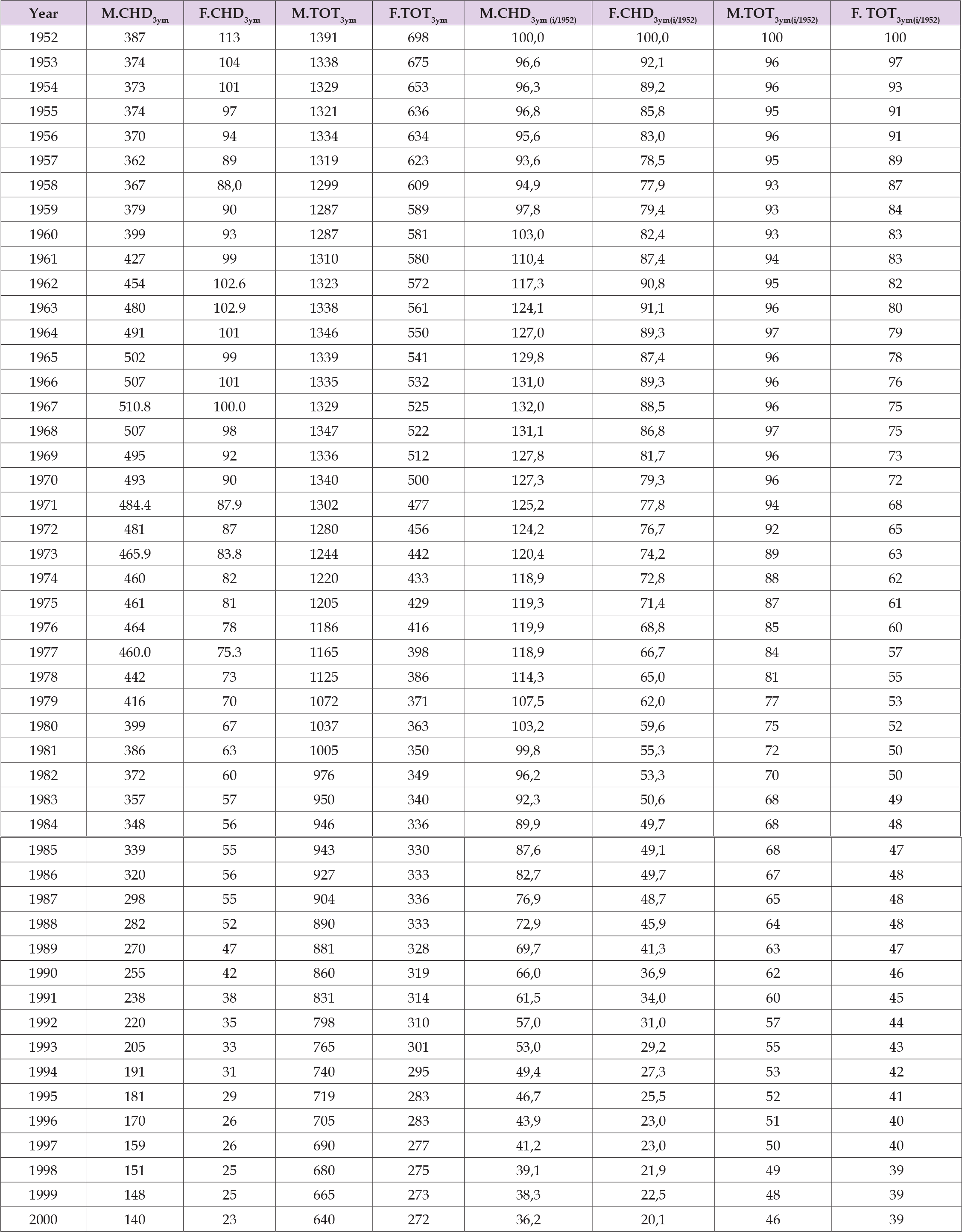
Figure 1
General presentation of the Development of Finnish CHD and TOT Mortality Changes
Figures 2 & 3 serve a general survey of Finnish female and male CHD and TOT development in 1952-2000 (by 3ym). The start point of CHD (and Tot) epidemic can be defined:
a) By their values in 1952
b) By the year just before they exceeded this
c) By their lowest values in (1952-60)
d) By the year before CHD exceeded TOT. The end point can be
defined by the year, when CHD is equal or lower to the value of the
start point.
Figure 2

Figure 3

(In order not to need fractionate the years of the beginning neither the ends, because passings do not occur exactly at the beginning or at the end of the year). We can say that the epidemic occurred somewhat between the (as above defined) start and the end points (years), inter alia because the by ruler measured (“Kuvio 1,” on p, 274 in [2]) and estimated data for 1952-69 are not accurate. Relative values and labels for periods with selected start points have been used: For period with start in 1952: [CHD.i/CHD.1952 = CHD. (i/1952)] (e.g. Figures 2 & 3) and for periods with start in 1972 respectively [CHD. (i/1972)], e.g. for comparing of different parameters. Figure 2 shows male CHD and TOT (mortality) percentages of 1952 with vertical lines showing limits of 1967-71, year 1972 and 1973-77. Other vertical lines show start and end points of differently defined CHD epidemics, as earlier presented. Stagnation in CHD decrease is shown between 1973 and 1977. Figure 3 shows female CHD and TOT (mortality) percentages of 1952 with vertical lines showing limits of study periods 1967-71 and 1973-77, as well as the year 1972. There are even presented in the text earlier defined, start and end points for the CHD epidemics. Female CHD never again exceeded the its start value (CHD1952). F. CHD1972 was lower to its lowest value in 1952-60 before 1972 (the beginning of NKaP). Even the exponents of e of the exponential trendlines (etl) of M.CHD.NKa and M.CHD.FI, produced by Exel have been used for easy evaluation of the steepness in CHD reduction (Table 2 & Figures 4 & 5).
Figure 4
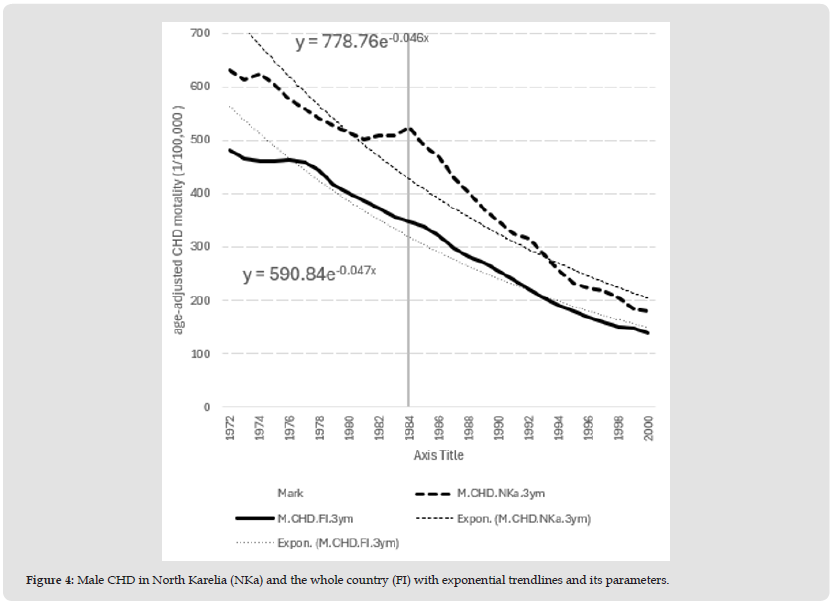
Figure 5
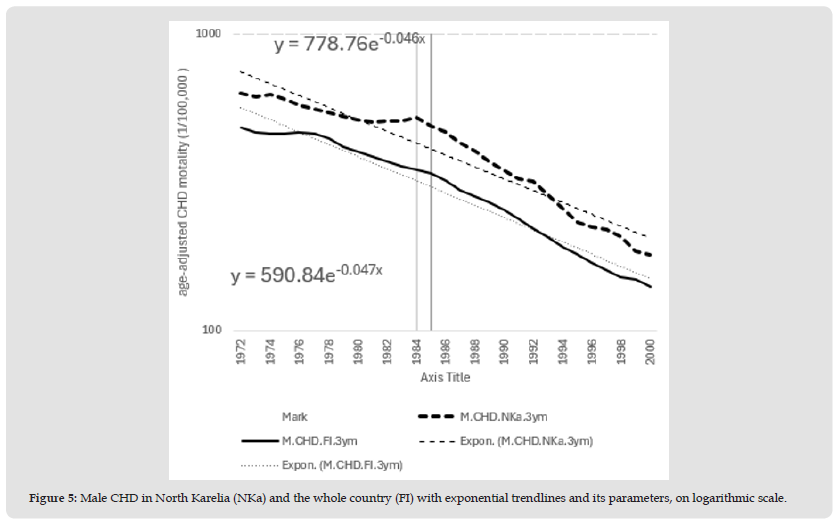
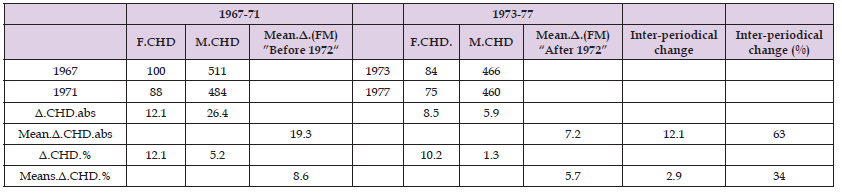
Table 2: Shows Female and Male CHD mortality in 1967, 1971, 1973 and 1977, as well as differences Δ(CHD1971 - CHD1967) (“ Before 1972”) and Δ(CHD1977 - CHD1974) (“ After 1972”), by absolute (1/100,000) values and in percents, means of female and male (FM) periodical values, their (inter-periodical) differences as such and in percents.
CHD Reduction in 1967-71 Compared with Reduction in 1973-77
Because NKaP started in April 1972, the year 1972 is excluded and comparison is made by female and male CHD changes (Δ) in 1967-71 (‘Before 1972’) to respective changes in 1973-77 (‘After 1972’). Data from Tables 1 & 2. shows absolute values of CHD (1/100,000) at the beginning and at the end of the test periods: “Before 1972” values for 1967 and 1971, “After 1972 values for 1973 and 1977, their (F & M) differences and Mean. Δ. (FM) and comparing periodical values as such and in percents. Mean (FM). CHD reduction “Before 1972”, 19.3 (1/100,000) was 12.1 cases (63 %) higher to “After 1972” (7.2). Mean (FM). CHD reduction “Before 1972” was 8.6 % and “After 1972” 5.7 %, which is 34 % lower than the change “Before 1972”.
Development of Male CHD in Finland and the Province of North Karelia during 1972-2000
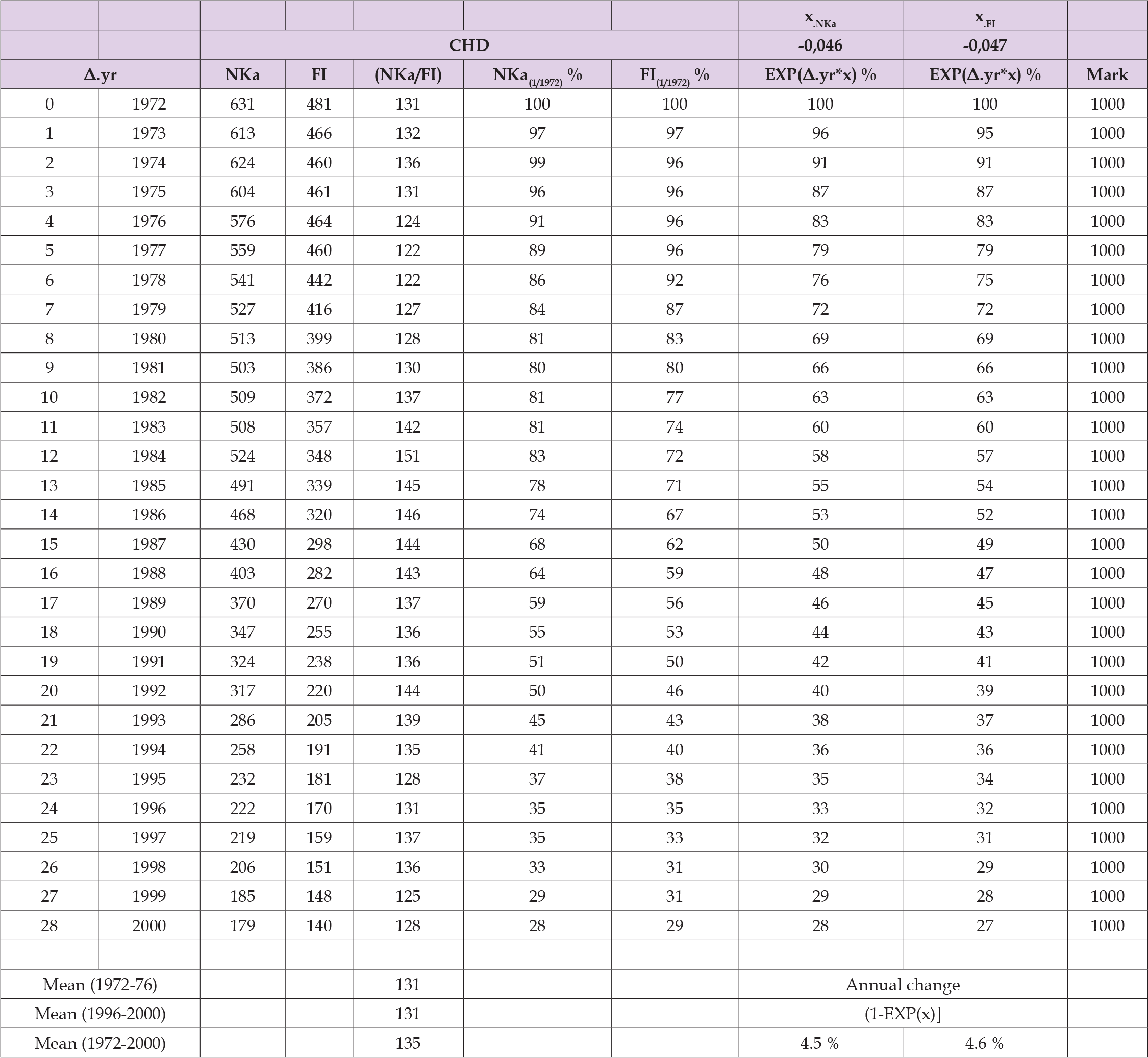
Annual data on age-adjusted CHD mortality of males, (1/100,000), aged 35-64, in the Province of Northern Karelia and Finland are from [2]. Table 2 & Figures 4 & 5 show age adjusted CHD mortality of males, aged 35-64, of Finland (FI) and the Province of North Karelia (NKa) by 3-year means (3ym) in 1972-2000 and their ratios (CHDNKa/CHDFI), additionally their percentages of 1972 and exponent of e, of their exponential trendlines, produced by Exel. (Computed means of (CHDNKa /CHDFI) for 1972-77, 1996-2000 and 1972-2000 at the ready). Although variation in M.CHD was higher in NKa than in FI, (Figures 4 & 5) their mean ratios during the first (1972-76) and the last 5 years (1996-2000) were the same: 1.31, i.e. male CHD was 31 % higher in NKa to FI, but a little lower to the average (CHDNKa/CHDFI) ratio: 1.35. Between 1972–2000 CHDNKa was reduced ad 28 % from its start value in 1972 and CHDFI respectively ad 29 %, highly similarly. Figure 4 shows male CHDNKa and CHDFI with their exponential trendlines. The measures for steepnesses (the exponents of e) of the exponential trendlines are produced by Exel, without efforts of the author. (N.B. CHD.NKa excludes the data from Northern Savo (Kuopio) province, which are included in NKaP ([1], Figure 2, p. 153). Figure 5 shows male CHD from NKa and FI on logarithmic scale. Although there was abundant variation, the relative difference between NKa and FI was the same at the beginning and at the end, in the middle third the (relative) difference was higher. Similar deviations upwards from the exponential trendlines (which are linear on logarithmic scale) are seen in FI and NKa curves at 1984-85, which suggest on new factor(s) (e.g. surgery [5] or changes in our biosphere, selenium supplementation in fertilizers [6]?).
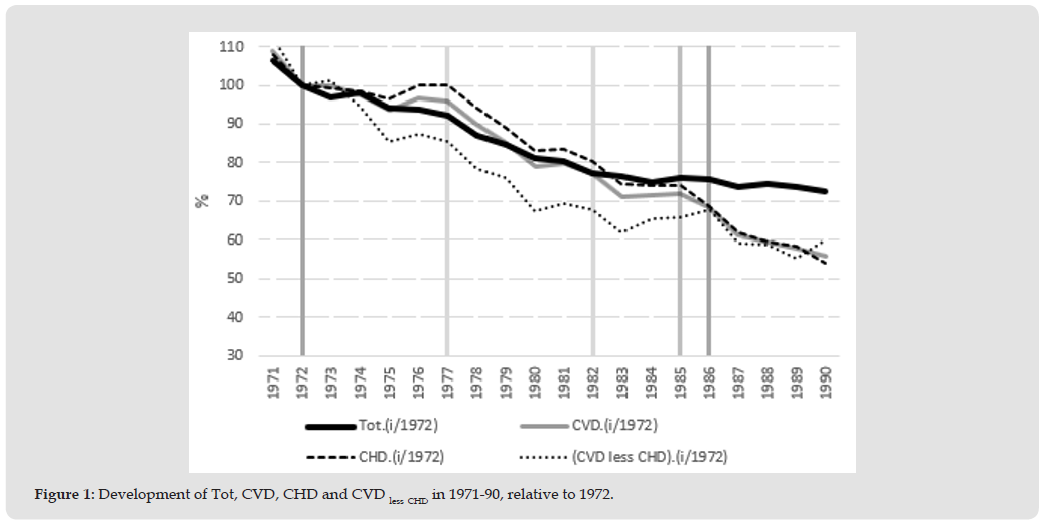
The development of TOT and CHD (Fig.1 & Fig.2) show remarkable co-variation during 1966-79, by males remarkable stagnation in 1974-77, which suggest on the common risk and protective factors. An abrupt change in CHD of North Karelia (Figure 2 in [1], p. 153) during the 1980’s and similar deviation from the exponential trendlines on logarithmic scale (Figure 5) suggest on effects of new factor(s) at about 1984-85, including coronary surgery [6] and changes in our biosphere, e.g. selenium [7].
Comparing New Mortality Data with above Presented
Table 3. Age-standardised death rate, aged 15-64 (1/100 000) are from Statistics Finland [4] in order to check the CHD stagnation in 1972-77 (Tables 3 & 4). CHD and CVD show stagnation in 1972–77. During 1973-77 mean CHD was 1.2 % lower than CHD 1972 (c.f mean exponential annual CHD reduction was 4.6 %, Table 2). In 1972-82 CHD declined slower than TOT. CVD was associated moderately with TOT from 1971 until 1982. Rapid decrease in CHD and CVD began in 1985 and the next year in CVD less.CHD . The rapid CHD change at 1985-86 suggest on new “anti-risk-factors(s)”, other than [5] (e.g. selenium [6] and/or coronary surgery [7]).
Table 3: Age-standardised death rate, aged 15-64 (1/100 000) Figures given as percentages of 1972 values.
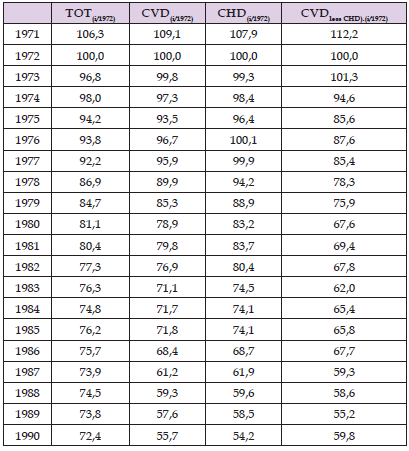
Table 4: Causes of Death, mean distribution in 1972-86 (%).

Table 5: Male CHD (3ym) in the whole country (FI) and North Karelia (NKa.), with percentages of 1972 and the exponent x of e of their exponential trendlines produced by Exel and values of Exponential trendlines relative to start values, EXP (Δ.yr * x) in percents and Mark for labeling years.
Rural and Urban Male CHD
Age-standardized CHD mortality (1/100,000) of males aged 35- 64, from rural (RUR) and urban (URB) regions in 1952-86, by 3-year means from [2] is represented in Figure 6. The data are attained by measuring from (“Kuvio 5”, i.e. Figure 1) in [2], where it was on logarithmic scale, and computed to linear scale. The data are earlier represented on linear scale e.g. in [8]. Fig.6 shows that in 1952-58 the average CHD URB (455/100,000) was 31 %, higher than the respective CHD RUR (348/100,000)]) and in 1966 higher by 17 %. Higher CHD URB associated with 30 % lower butter consumption (14.4 and 18.9 g/d) in 1966 [9]. Higher rapidity in decline of butter consumption in urban regions [g/d, urban/rural] from [8.7/15.1] in 1971 to [7.9/13.7 g/d] in 1976) was associated with faster CHD URB reduction [9], but about to the same level with CHD RUR in 1973–86. These changes do not suggest cardio-protective effects of butter fat reduction. No regional data on milk fat consumption before 1966 is available. Another Question is possible: Is it fair to compare fat consumption of people, whose daily diets are 2000 kcal, with people who consume 4200 kcal daily, as supposed by Finnish farmers in the 1970’s [10]. Open question: which were the protective factors in countryside in 1953-58 (with supposedly higher milk fat consumption [2]) having the same power as by “the avoided main risk factors” (with new medicines and social insurance, supported by coronary surgery) in 13 years (1972- 85)? Maybe the secret of the good results og the unsatyrated fatty acids [11] was not based on the primary quality of fats, but on the method to protect the unsaturated fatty acids and possible some other protective substances against excess temperature and oxygenation and becoming rancid? The calculated higher magnitude of stagnation in CHD reduction (Fig.1, Fig.2, Table 2) by males in 1973-77 could be associated nicotine abstinence [8]. The silence in discussion could have been caused by the fact that the CHD data concerning 1951-68 is not calculated in free access.
Figure 6

Not female, nor male CHD reduction seemed to be accelerated after 1972. CHD reduction was not faster than TOT in 1972-78. Male CHD was higher in NKa to FI and their annual total relative changes were similar during 1972-2000. CHD reduction accelerated in 1984– 86 and was more rapid in the 1986–2000 than in 1972-85.
I am grateful to Osmo Hanninen and Seppo Haaranen for co-working and co-thinking for many years.

International Association of Landscape Archaeology, Czech Glass Society, Czech Republic

Department of Chemistry, Semenov Institute of Chemical Physics, USSR Academy of Sciences, Moscow, Russia

Neurology, LA BioMed Research Institute, USA

Associate Professor at Department of Breast and Thyorid Surgey, Chongqing General Hospital, China

Professor of Nuclear Medicine, Faculty of Medicine and Surgery, University of Milan, Milan, Italy





 Abstract
 PDF
PDF



























